

It’s 7:52 on a Thursday, the bus is four minutes out, and you’re standing at the stop with your weight on one foot because the other shoe has started to slip at the heel. Eight degrees, wind coming off the corner, and a decision to make: keep walking and clench your toes, or stop and adjust in front of everyone.
Slip-on shoes for women with heels are the most convenient thing in a winter wardrobe and the easiest to get wrong. There’s no strap, no lace, nothing to tighten, so everything depends on how the shoe was built and how you sized it. Get those two right and you can walk a cold mile without thinking about your feet. Get them wrong and you’ll be doing that half-shuffle all the way to the office.
Here’s what actually changes when the temperature drops, and what to check before you spend money.
Cold weather changes the fit by about half a size
Your feet shrink in the cold. Not dramatically, but enough to matter in a shoe with no fastening. Blood vessels in the extremities constrict to keep heat in your core, and the soft tissue in your foot loses a little volume. Add tights and the friction changes too: nylon slides against leather in a way bare skin never does.
The practical result is that a slip-on heel which fits perfectly in July can feel loose in December, and the heel starts lifting with every step. Then your toes curl to hold the shoe on, and by the time you sit down at your desk your arch is aching for a reason that has nothing to do with the arch.
What changes, specifically:
- Heel hold: looser by 2mm to 3mm in cold, tighter if you add thick tights.
- Toe box: your toes curl slightly when cold, so a shoe that was snug gets oppressive.
- Upper: leather stiffens below about 10°C and takes longer to soften each morning.
None of this means slip-ons are a bad winter choice. It means you should be fitted in the conditions you’ll actually wear them in.
There’s also a version of this problem that has nothing to do with temperature: the shoe that fit in the shop at 11am, after you’d been walking for an hour. Feet are at their largest then. Buy at that moment and the same shoe will feel generous at 7am the next day, which is exactly when you need it to stay on.
Size them with the tights you’ll really wear
Try slip-on shoes for women with heels on in the afternoon, wearing the exact tights you plan to pair them with. Not a similar pair. The same denier. A 40-denier opaque and a 15-denier sheer change how the shoe grips by a noticeable amount, and the difference between them is roughly the difference between a shoe that stays on and one that doesn’t.
If you’re between sizes, take the larger one and add a heel grip. It’s much easier to make a slightly big slip-on fit than to stretch a small one, especially in leather that’s already stiff from the cold.
Three things to check while you’re standing there:
- Walk ten steps on a hard floor. If you can hear a flap at the heel, it’s too big.
- Stand still and lift your heels 10mm. The shoe should come with you.
- Press the upper across the widest part of your foot. It should give a little, not a lot.
One caveat that surprises people: a slip-on with a very soft, unstructured upper will feel comfortable in the shop and collapse sideways after a month. The shoe needs some body around the heel, or it will roll off your foot when you turn a corner.
The 3mm of heel grip that decides your whole morning
If your heel lifts more than about 3mm when you walk, you’ll clench. Clenching for a 15-minute walk is fine. Clenching for a 12-minute walk, twice a day, five days a week, is how you end up with a sore arch and a pair of shoes you stop wearing by February.
Two fixes, in order of preference. First, a suede or foam heel grip stuck inside the back of the shoe, which adds about 2mm and a lot of friction. Second, a thin insole under the whole foot, which lifts your heel into the shoe’s curve and can solve the problem in one move. What doesn’t work is a thicker sock, because it pushes your foot forward into the toe box and trades one problem for a worse one.
If neither works, the shoe is too long. A half size down is the answer, not another accessory.
The mule question: backless in a cold city
A mule is the purest slip-on and the worst winter choice, which is worth saying plainly because they’re everywhere right now. No back means nothing holds your heel except friction, and friction drops when your foot is cold and your tights are smooth. You’ll walk fine on carpet and fight the shoe on pavement.
That doesn’t make mules unwearable. It makes them an indoor-to-taxi shoe: office, restaurant, a wedding where you’re mostly sitting. If your day involves 6,000 steps and a train, a closed back is not optional.
The middle ground is a slingback or a d’Orsay with a thin strap across the heel. You still get the throw-on convenience, and the strap does the work your heel counter isn’t there to do. Try one on and walk toward a window: if the strap slides down every fourth step, it’s adjusted wrong or the shoe is too long, and no amount of tightening will fix the second problem.
What actually holds a slip-on on your foot, in order of reliability:
- Closed back with a firm counter: the only version that works without thinking about it.
- Slingback with an adjustable buckle: nearly as good, and more forgiving across sizes.
- Mule or d’Orsay with no back: fine for sitting, a gamble for walking, hopeless in the rain.
I own all three and I wear them in exactly that order between November and March. The mules come out for dinners and nothing else, which is a small admission that the most convenient-looking option is the least practical one when there’s ice on the pavement.
Grip on wet pavement is a sole problem, not a heel problem
Nobody thinks about the sole until the first wet morning, and then it’s the only thing they think about. A smooth leather sole on a damp station floor has roughly the grip of a tyre on ice. A rubber sole with 3mm to 4mm of tread is fine. The heel height gets blamed for slips, but the sole material is what actually decides it.
Two things worth knowing before you buy. Leather soles can be roughened with sandpaper, which helps for a week and then wears smooth again. Rubber top pieces on the heel are cheap to replace and worth doing every second winter if you walk a lot.
What the common options do in the wet:
- Rubber with tread: best grip, slightly heavier, the only sensible choice for a commute.
- Smooth leather: dangerous on tile and metal, fine on dry carpet and pavement.
- PU or TPR: decent grip when new, goes slick once the pattern wears, usually within a year.
There’s a cheap test in the shop. Turn the shoe over and run a thumbnail across the sole. If it slides without resistance, it’ll slide on a wet floor too.
Worth knowing: the grip problem doubles on a heel. A 50mm slip-on puts more of your weight on a smaller patch of sole than a flat does, so the same rubber compound behaves differently. If you’re comparing two pairs and both have rubber soles, pick the one with the deeper tread pattern, then check the heel tip separately. A worn tip on the back edge is what actually sends people over, and it’s a 10 euro fix at any cobbler.
Warmth without turning the shoe into a boot
You don’t need a winter boot to be warm in slip-on heels. You need the right layer underneath, and a footbed that isn’t a sheet of foam. The combination does more than any shoe design feature.
Eighty-denier opaque tights plus a leather-lined shoe handle 8°C comfortably for a commute. Below 5°C, add a thin wool insole or switch to a 120-denier tight. Above 12°C, sheer tights are fine and the shoe will feel looser, which is why the same pair can feel different in October and January.
What doesn’t work, from experience: thick socks inside a slip-on. Your foot slides forward, your toes hit the end, and the shoe looks a size too small. If you want sock-like warmth, buy a slip-on a half size up and accept that you’ll need a heel grip.
One more detail: a leather-lined shoe gets warm faster and stays warm longer than an unlined PU one, but it also holds moisture. If your feet sweat on the walk and then you sit for four hours, the shoe stays damp until lunch. Rotating two pairs is the only fix that really works.
For anyone who runs cold, a 3mm felt insole is the cheapest upgrade you can make. It insulates from the pavement, which is where most of the cold actually comes from, and it costs less than a coffee. Just check there’s room: adding 3mm under your heel changes the fit more than most people expect, and in a slip-on that’s already close, it can push your toes into the front.
Test it at home first. Wear the shoes with the insole for 20 minutes on a hard floor before you commit, because a slip-on that fits without one can become unwearable with one.
What 8°C does to suede, patent, and PU
Temperature changes what each upper material does, and winter is where the differences show. Suede stiffens and marks in rain. Patent stays waterproof and goes slippery underfoot, and it squeaks against tights in a way that’s audible in a quiet office. PU cracks at the flex point above the toe after about two cold seasons, and once it cracks it’s finished.
Ranking them for a cold, damp commute:
- Smooth leather: the most predictable. Stiff at first, softens over two weeks, repairable.
- Suede: warmest feel, worst in rain, needs a protector spray before the first wear.
- Patent: weatherproof, squeaky, and it shows every scuff as a dull patch.
- PU: cheap, light, and the shortest life by a wide margin.
Salt is the quiet destroyer here. Road salt dries into white lines along the sole edge and, on suede, into permanent stiff patches. Wipe the shoe with a cloth dampened in plain water the same evening and most of it comes off. Leave it until the weekend and it won’t.
If the upper is suede and the forecast is wet, don’t. That’s the one honest limitation of a slip-on in winter. There’s no boot shaft to keep the rain out and no way to dry the toe quickly once it’s soaked.
This is also where cheap slip-on shoes for women with heels give themselves away. The PU upper looks identical to leather in a photo, costs a third as much, and starts cracking at the toe flex point after two cold seasons. Leather creases. PU splits, and once it splits there’s nothing to repair. If you’re only wearing the pair six times a year, PU is a reasonable gamble. If it’s your weekday shoe, it isn’t.
The doorway test that saves you a walk of regret
Before you leave the house, do this: put the shoes on, walk to the front door and back on a hard floor, then turn sharply. If the heel moves, if you hear a flap, if your toes curl to hold the shoe in place, change shoes now rather than at the bus stop.
It takes 20 seconds and it’s the difference between a normal morning and a shuffling one. I’ve ignored it twice this winter. Both times I ended up carrying the shoes home.
There’s a reason this test works better than any fitting advice: it shows you the shoe under a turning load, which is what actually happens on a pavement. Standing still tells you almost nothing. Turning at the door tells you whether the counter holds, whether the sole grips, and whether your toes have room to stay flat while the shoe twists. Do it on tile if you have it, not carpet, because carpet hides every slip a slip-on will ever make.
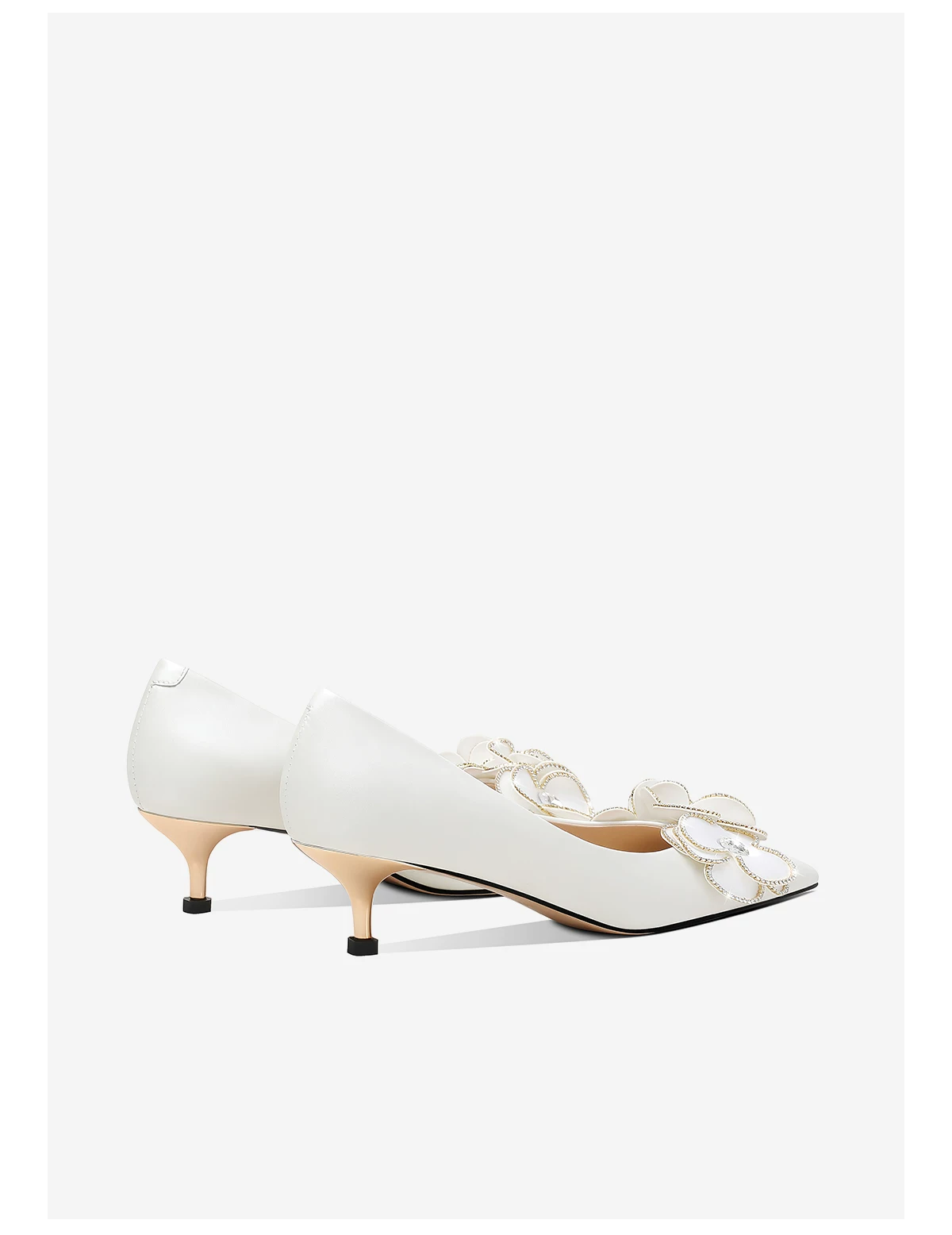
If you’re shopping for a pair that survives this routine, look at the heel counter first and the colour second. A kitten heel slip-on with a closed back holds the foot better than a mule in cold weather, and a pointed pair with a firm counter is the version that doesn’t need a heel grip by week two. For the fit side of the equation, this note on the 2cm that ruins the fit covers the measurement problem in more detail than a shop assistant will.
And if you want the short version of everything above: slip-on shoes for women with heels work in winter if the heel stays put, the sole grips, and the upper can take a wet morning. Three things. Check them in the shop, in that order, with your tights on. The pair that passes all three will be the pair you reach for every morning until March, and the pair that fails one of them will sit by the door looking expensive.
One last argument for spending more than you planned: the difference between a 60 euro slip-on and a 150 euro one is rarely the leather. It’s the counter, the shank, and the sole unit, all of which are invisible until month four. A cheap pair that slips and gets retired in January costs more per wear than an expensive pair you wear for three winters, and that maths only gets worse if you buy a replacement every year.
Mine are the black leather ones with the 55mm heel, and the only reason they’ve survived two winters is that I finally learned to test the heel hold before buying instead of after. That’s a small habit. It just happens to be the one that matters. Most slip-on shoes for women with heels aren’t harder to wear than anything else; they just give you less margin when the fit is wrong, and winter takes away the margin you had. If you’re still deciding between heel heights for a cold-weather pair, the slingback kitten notes go through the same trade-offs from a different angle, and the standard court shoe construction explains why the closed-back version grips better than a mule. If you want the sizing side in more depth, how heel height changes the load on the forefoot is worth five minutes before you order a 70mm pair online.
