

It’s 5:40 on a Thursday. You’re still at your desk with a client call that ran long, and there’s a dinner at 7:30 across town. You have one bag, no time to go home, and whatever is on your feet now has to work in both rooms.
That’s the case for a pair of open-toe heels. Not because they’re dressy, but because they’re the only heel that reads differently depending on what’s above them. With trousers and a blazer, they’re a work shoe. Swap the blazer for a slip dress and they’re evening. Nothing about the shoe changed.
The trick is picking a pair that can carry all three versions, and knowing which one combination will make you look like you got dressed in the dark. Here’s how that works, starting with what open toes actually fix.
What an open toe actually solves
Two things, and neither is about looking summery.
The first is room. A closed pointed toe compresses your toes at the widest part of your foot, and that’s where the ache comes from after four hours. An open toe removes the front wall entirely, so your toes have somewhere to go. If you’ve ever taken a pump off under a restaurant table, this is the fix.
The second is heat. Your foot swells during the day, and in a closed shoe that swell has nowhere to expand. An open toe gives about 4mm of extra space across the ball by the time you’ve been standing since morning. On a 32°C day that’s the difference between tolerable and unbearable.
What open toes don’t fix: heel height, arch support, or a strap that cuts into your instep. Those are separate decisions. If you’re choosing between an open-toe 90mm and a closed 60mm for a day that includes a walk, take the 60mm. The toe opening is worth less than the heel angle.
The load question stays the same in any heel. Walking in them shifts pressure forward onto the ball of your foot, which is the part clinical writing on high heels keeps returning to. An open toe doesn’t move that load anywhere. It just stops the shoe pressing on the same spot from above, so what you feel is pressure from below rather than a pinch from the leather. That’s still an improvement, but it’s a different fix.
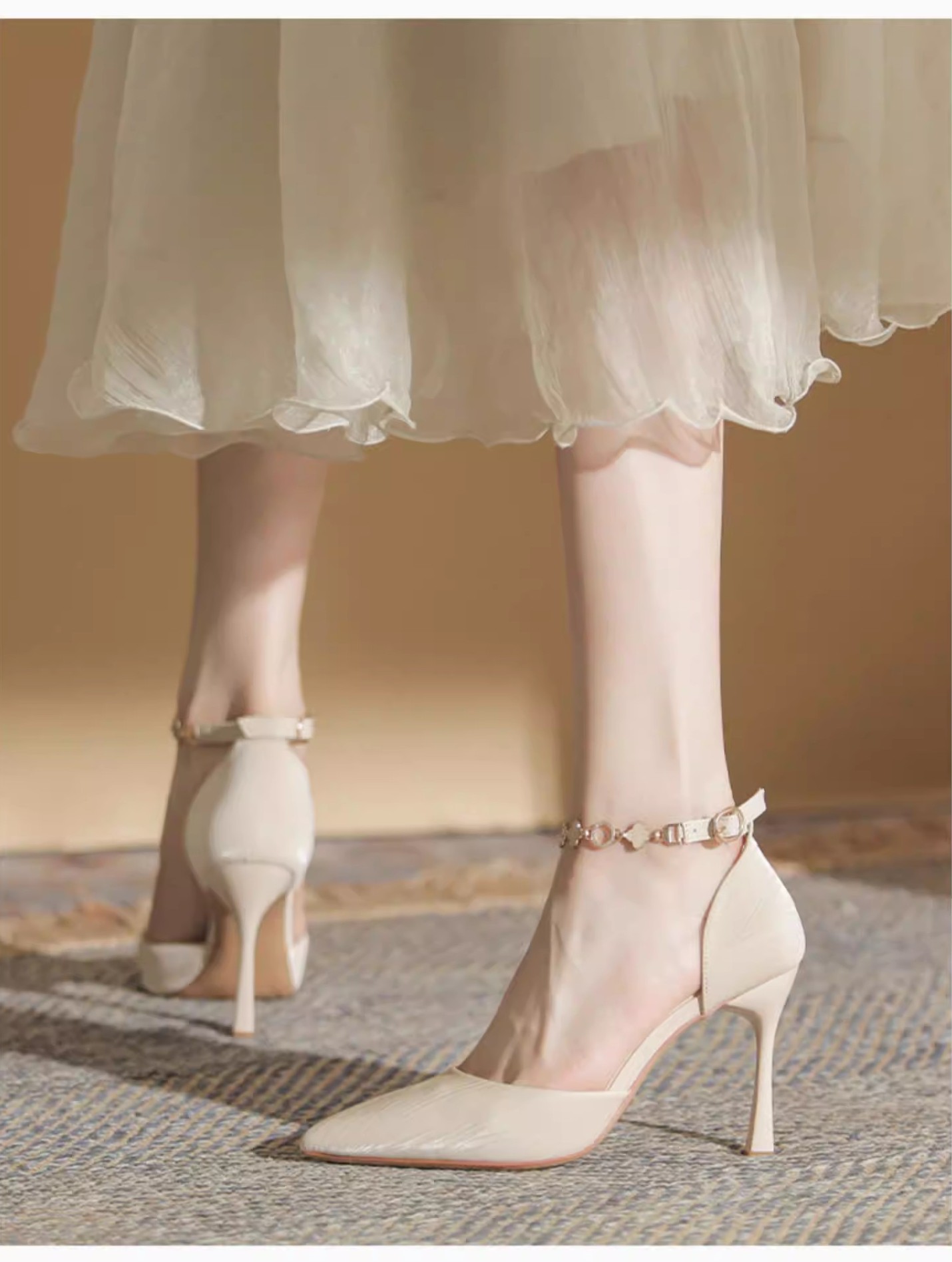
Outfit one: office, with trousers
The work version is the one people get wrong, because they assume open toes are automatically casual. They’re not. A pointed open-toe heel in black or nude leather under a wide-leg trouser reads as formal, especially if the toe opening is narrow.
Three details make or break it:
- Toe opening width. A narrow opening, just the tips of two toes visible, stays formal. A wide opening that shows four toes reads as a sandal and belongs at the weekend.
- Hem length. The trouser should skim the top of the shoe, not stop above the ankle. If you can see the whole shoe and a gap of leg, the proportion drops.
- Nail upkeep. Two toes visible is still two toes visible. This is not a moral point, it’s a practical one for anyone sitting in a meeting room with a glass table.
Keep the rest plain. A patent leather open toe with a 60mm heel does the job with a navy trouser and an untucked shirt. Anything with a bow, a buckle at the toe or a contrasting platform pushes the shoe into evening and it stops working at 10am.
A good version of this, if you want the shape to copy, is a thin-heel sandal with a single ankle strap. It’s the same silhouette as a court shoe with the front taken off.
Check one thing before you buy for the office: the inside edge of the toe opening. On cheaper pairs it’s cut and left raw, and that edge rubs the top of your toes raw within a week. A folded or stitched edge costs more to make and it’s the difference between a shoe you wear twice a week and one you wear twice.
Outfit two: dinner, same day, one swap
Six o’clock, client call done, twenty minutes in a bathroom. The only thing that changes is the top half and the jewellery.
Blazer off. Blouse swapped for a knit camisole or a slip top. Earrings in. Trousers stay, because they’re the thing that makes the whole day work, and the shoe still reads correctly under them.
If you’d rather change the bottom half, a bias-cut midi skirt in the same colour family works, and the open toe carries it because it looks lighter than a closed pump would. That’s the actual mechanical advantage: an open toe makes a midi skirt look less heavy at the ankle.
One swap that fails: capri trousers or anything cropped at the calf. The open toe plus a cropped hem creates a horizontal band right at the widest part of your calf, and the shoe stops looking deliberate. Full-length or midi, nothing in between.
There’s a practical side to this too. If you’re going from a heated office to a cold street and back, an open toe is the coldest shoe in the wardrobe. Tights under an open toe look wrong to most people, and no tights at all means your feet are the one part of you that isn’t dressed for the weather. On a 6°C evening, that twenty-minute walk to the restaurant is the part you’ll remember.
The workaround: keep a thin pair of ankle socks in your bag and put them on for the walk, then take them off at the door. It sounds fussy. It’s also the only way this shoe works in November.
Outfit three: weekend, and where it stops working
Saturday, jeans, a market, lunch that runs to three hours. An open-toe block heel survives this. A stiletto doesn’t, and that’s a heel question rather than a toe question.
The weekend pairing that works is straight-leg denim, hemmed to just touch the top of the shoe, with a block heel of 50 to 60mm. The open toe keeps it from looking like you’re wearing your work shoes on a Saturday, which is a real risk with black leather.
If you’d rather stay in a heel you can walk in, a shoe that passes the three-hour test on your feet is the right reference point rather than a style photo. Wear the pair for three hours at home first, on a hard floor, and see what your arches say before you take them outside.
What doesn’t work: open-toe heels with shorts, or with a maxi dress that already has a lot going on. Both make the shoe look like an afterthought. And if the day involves grass, gravel or a park, none of this applies. Thin heels and soft ground are a bad combination regardless of the toe.
Sizing: the half-size problem open toes create
Open-toe shoes fit differently from closed ones, and the size chart doesn’t know it.
In a closed shoe, your toes stop at the end of the leather and that’s your limit. In an open toe, your toes can slide forward until they reach the edge of the opening, and then they hang there. So a pair that’s technically your size can still let your foot slide forward with every step, until your heel is off the back and your toes are over the front edge.
Two things cause it: a sole that’s too smooth inside, and a heel that’s slightly too high for the shoe’s last. The fix is usually a thin insole pad under the ball of your foot, which stops the slide without changing the size. It costs a couple of dollars and solves a problem people usually try to fix by buying a smaller size.
Don’t buy smaller. A tighter open toe presses the edge of the opening into your toes, which is worse than the slide.
There’s also a width issue that only shows up in this style. If the ball of your foot is wider than the shoe, your foot spreads over the edge of the sole and you can see it from the side. Closed shoes hide this. Open toes don’t. Measure across the widest part of your foot with a tape, then compare it to the sole width if the listing gives one. If it doesn’t, assume the standard width and size up if you’re between.
The general sizing logic for women’s shoes is worth a read if you’ve been guessing for years, since a lot of it comes down to how the sizing systems were built rather than how your foot happens to be shaped.
Toe shape: peep, almond, square, and what each one does
Open toe isn’t one shape. It’s four, and they flatter different feet.
Peep toe shows the tips of two toes and is the most formal of the group. It also runs the risk of pinching the big toe if the opening is cut too far back, which is common on cheaper pairs. Check that the edge of the opening doesn’t sit right on the knuckle.
Almond open toe shows two or three toes and has a slightly wider opening. It’s the most forgiving shape for wide feet, and the easiest to wear with both trousers and skirts.
Square open toe shows three or four toes and is the most modern of the four. It’s also the least formal, so keep it away from anything you’d wear to an interview.
Fully open, essentially a sandal with a heel, is its own category. It’s fine, it just isn’t the shoe that does three jobs. If you want one pair for the office and dinner, stick to peep or almond.
One more variable: the height of the opening’s edge. A low-cut opening, where just the tips of your toes show, keeps the shoe formal. A high-cut opening that exposes the base of your toes drops it two notches instantly. Two shoes that look identical in a product photo can sit at completely different formality levels because of 5mm of leather.
If you can only see the shoe from the top in the listing photo, that’s the thing you can’t judge. Ask for a side view, or buy somewhere with returns you trust.
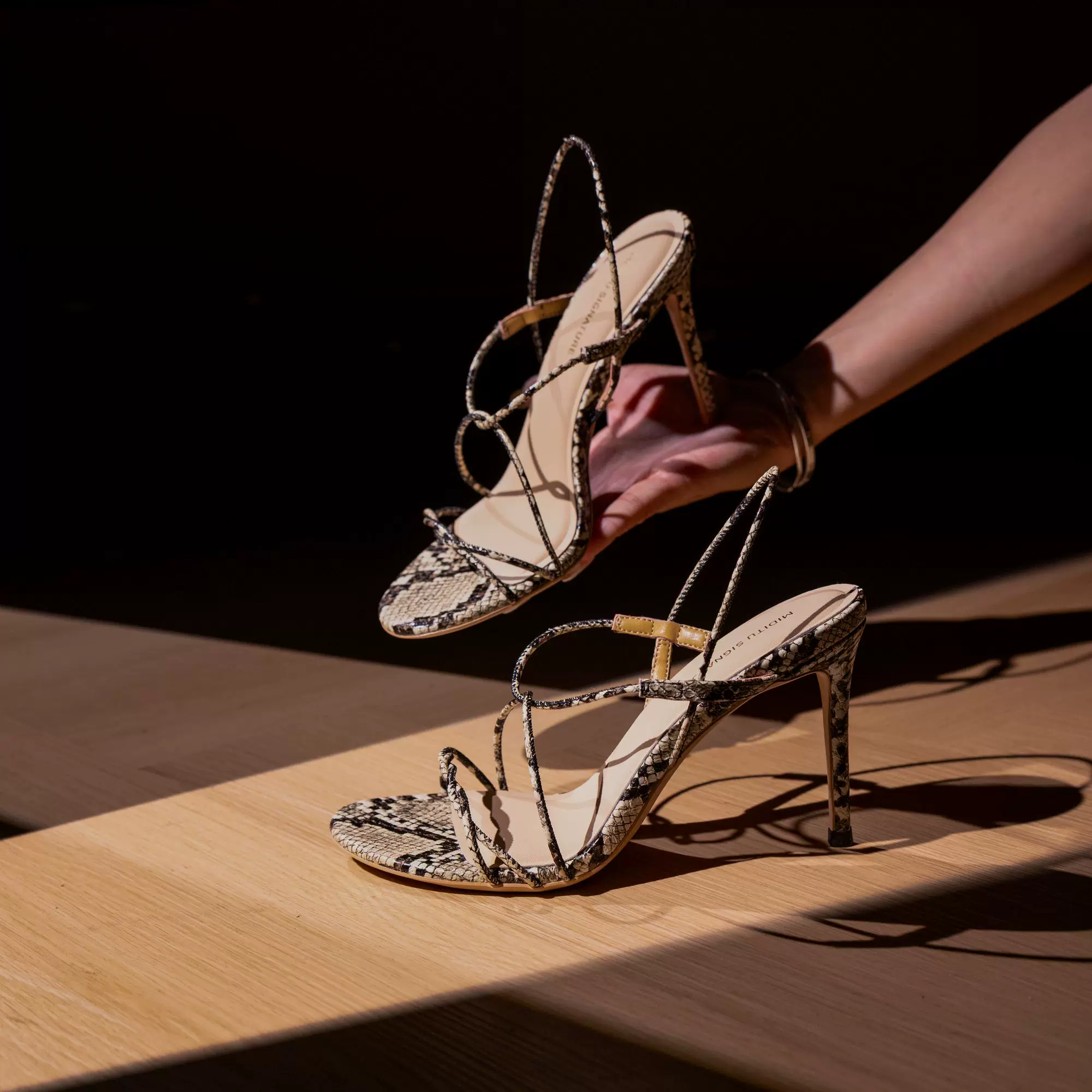
The strap question, and where it sits
Most open-toe heels come with a strap. Where it sits changes how your leg looks and how the shoe feels after two hours.
An ankle strap cuts your leg at the narrowest point, which is flattering, and it keeps the shoe on your foot, which matters more than people admit with an open toe. A slingback strap behind the heel does less visually and holds the shoe just as well.
What to avoid: a strap that crosses the instep right where your foot flexes. Every step pulls it tighter, and by the end of a long day you’ll have a red line and a sore spot. Try the shoe on, walk ten steps, and check whether the strap has moved at all.
There’s a fit note here too. Straps are usually cut for a sample size, so on a 41 they can land in the wrong place entirely. If the strap digs into your ankle bone, that pair isn’t going to work in your size, no matter how good the leather is.
Heat, swelling and the 34°C problem
Open toes are sold as a summer shoe and they do help in heat, but not as much as people expect.
Your feet swell by up to 5% over a long day, and the open toe gives that swell somewhere to go. What it doesn’t do is stop the sole from getting hot. A leather sole under a thin footbed on hot pavement transmits heat straight up, and by mid-afternoon your soles feel cooked. A rubber or foam sole is cooler to walk on, uglier to look at.
The other thing nobody warns you about: dust. An open toe collects grit between your toes on any city street, and there’s no sock to absorb it. If you’re walking more than a kilometer, expect to want a wipe before you sit down at a table.
Sweat is the other cost, and it’s why the strap material matters. A leather strap absorbs a little and stays comfortable. A coated or patent strap doesn’t absorb anything, so the foot slides inside the shoe, and by the end of a warm day you’re gripping with your toes to keep it on. That grip is what makes your shins ache the next morning, not the heel.
If you know you run warm, look at a strappy sandal with a thin heel and open sides for the hottest weeks, and keep the closed-back open toe for the days with air conditioning.
And the honest downside of the whole category: an open toe is a bad choice in rain, in an office with aggressive air conditioning, and on any day you’ll be on your feet for ten hours on hard floors. None of those are rare. It’s a shoe for a specific kind of day, not an everyday shoe, and pretending otherwise means you’ll be the person with cold toes at a conference.
Buying the pair that does all three jobs
If you want one pair to cover the office, dinner and a Saturday, here’s the spec: 60 to 70mm heel, almond or narrow peep opening, plain leather in black or a deep nude, strap at the ankle rather than across the instep, and a sole with enough rubber to survive a pavement.
Skip the platform, the contrast trim and the bow. Those are the details that lock a shoe to one occasion. The same goes for heavy hardware at the toe: a metal ring or a chunky buckle reads evening only, and you’ll be back at your desk in them at eleven the next morning.
Then test it properly. Put them on at the end of the day, not the morning, when your feet are at their largest. Walk the length of the shop four times. Sit down and cross your legs, because that’s when an open toe either holds your foot or lets it slide forward until your toes hang over the edge.
You’ll know within two minutes. If the edge of the opening presses on your toe knuckles, put them back. That pressure doesn’t soften with wear, and by the third evening out you’ll be the person who brings a second pair of shoes to a party, which is a fine habit but an expensive way to learn it.
One last thing. Before you commit to a colour, look at the pair you already own and wear most. If it’s black, buy black again. An open-toe shoe in a colour you love but never reach for will sit in the box while the plain pair goes to work, dinner and the market. Browse the full range of women’s shoe styles with that in mind, and you’ll probably find the one pair you needed was the one you almost didn’t try.
