

Your feet are flat on a concrete floor by 9 a.m. and still there at 5 p.m., with a 40-minute commute on either side. That’s the situation most people are actually buying for, and it’s not the situation most shoes are designed for. Shop lighting, a carpeted fitting room and a two-minute walk tell you almost nothing. Finding the most comfortable shoes for women at work starts with ignoring all three.
So before you pick anything, check three things in this order: the floor you stand on, the number of hours you’re upright, and whether you walk or stay put. Get those three right and the search for the most comfortable shoes for women gets much smaller. Get them wrong and even a good shoe will feel wrong by Wednesday.
Check the floor before you check the price
Concrete is the hardest surface most people stand on all day, and it doesn’t give anything back. A shoe with a thin sole on concrete transfers every step straight up through your heel. Carpet is forgiving. Wood is somewhere in between. Hospital corridors, warehouse floors and school halls are almost always the worst case.
If your day is concrete, you want three things: a sole at least 20mm thick at the heel, a heel counter that holds the back of your foot steady, and a removable insole so you can swap in something with actual arch support. If your day is carpet and you sit for most of it, you can get away with much less shoe.
The mistake I see most often is people buying one pair for both lives: the concrete-floor job and the carpeted office. Those are two different shoes, and trying to make one do both is how you end up with a pair that’s mediocre at everything.
Weight matters here too. A pair over about 400g per shoe starts to feel heavy around hour five, and you’ll notice it in your hip before you notice it in your foot. Light isn’t automatically better, because very light shoes usually skip the structure that keeps your arch from collapsing. The sweet spot for a full day is somewhere around 280 to 350g.
The three-hour test, and how to run it at home
You can’t judge a work shoe in a shop. You can judge it in three hours on your own floor, which is the closest thing to a controlled test you’ll get without buying it.
- Wear them for three hours at home on a hard floor. Not carpet, not a rug. Kitchen tile or hallway wood.
- Stand for 20 minutes of that time. Set a timer. Standing is where the pressure shows up, not walking.
- Check four places when you take them off: the ball of the foot, the outer edge of the little toe, the Achilles, and the top of the instep. Red marks in any of those four mean the shoe is fighting your foot.
- Do it at the end of the day, not the morning. Your feet are widest at 6 p.m. A shoe that fits at 8 a.m. can be tight by dinner.
If all four spots are clean after three hours, the shoe will probably survive a working week. If one spot is hot, it won’t get better on its own. Shoes break in at the upper, not at the sole or the toe cap, so any pressure that comes from the shape of the shoe stays.
That last point is the one people ignore. “They’ll stretch” is true for the width across the middle of the foot and almost nowhere else. A tight toe box does not stretch. A short shoe does not get longer.
Where comfort claims fall apart
Every brand now says cushioned. Very few say where the cushioning is, and that’s the part that matters. Foam under the heel helps with impact. Foam under the ball of the foot helps with standing. Foam in the arch does almost nothing unless it’s shaped and firm enough to hold the foot up, and soft foam in the arch is worse than no foam at all because it lets the foot roll inward.
Press your thumb into the insole at the arch. If it sinks easily, it’s decoration. If it resists a little, it’s doing a job.
Two more things worth knowing. First, a rocker sole, the kind that curves up at the toe, reduces the work your toes do when you walk. That’s genuinely useful if you’re on your feet for eight hours. It’s less useful if you’re mostly standing still, where a flat stable base beats a curve. Second, arch height varies enormously between people, and the shape of the forefoot decides whether a pointed toe will work for you at all.
A shoe that’s comfortable for your colleague with a high arch can be painful for you with a flat one. That’s why recommendations from friends are only worth so much. Their foot is not your foot.
Break-in is the other half of this. Leather uppers soften over two to three weeks and will give you maybe half a size across the middle of the foot. Mesh and knit soften almost immediately but don’t stretch at all, so the fit you get on day one is the fit you keep. Synthetic uppers mostly just crease. If a shoe is pinching at the little toe in the shop, none of these materials will rescue it, and the sensible move is to walk away rather than hope.
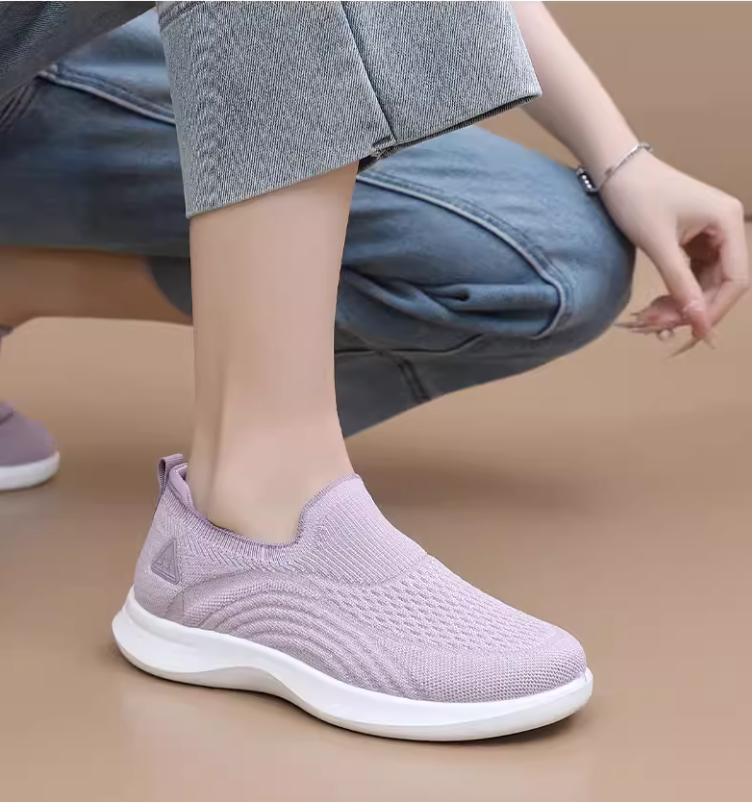
There’s a cheaper shortcut worth knowing about. A soft-soled mesh pair at around £46, like this mesh pair with a flexible sole, can handle a standing shift if you add an insole, and it weighs almost nothing. It’s not a dress shoe and it won’t pass a strict dress code, but as the second pair in a rotation it earns its keep.
Match the shoe to the job, not to the outfit
There are roughly three working days, and each wants a different shoe.
Standing all day, little walking. Think retail, reception, a lab bench, a kitchen pass. You want a flat or low sole, a wide base, and a shoe that doesn’t rock. A closed flat with a firm insole is the classic answer. A mesh walking shoe at 49 is the cheaper answer, and it works fine as long as the sole isn’t too soft.
Walking between places all day. Think hospital rounds, a campus, a sales floor with three buildings. You want cushioning at the ball of the foot and a rocker at the toe. Weight matters more here than anywhere else. The breathable mesh walking shoe is built for exactly this pattern, and the mesh matters more than people think when you’re doing 8,000 steps indoors.
On your feet but visible. Think front desk, showroom, teaching. This is where most people compromise badly, because they buy a dress shoe with no structure. There’s a middle ground: a low block heel with a padded insole, or a smart loafer with a rubber sole. The lightweight shock-absorbing pair works for the days nobody’s looking, and a proper low heel covers the days they are.
Whichever pattern you land in, buy for the worst hour, not the best. The shoe has to work at 6 p.m., when your feet have swollen and your patience hasn’t.
It’s also worth reading how a pair behaves over a full week rather than a single day. The piece on black sneakers that survive a five-day office week tracks exactly that, and the ending isn’t the one most people expect.
Insoles, socks, and the small fixes that change everything
Two people can wear the same shoe and have completely different days, and the difference is usually the insole. The one that ships in the box is a spacer, not support. A 4mm leather insole with a shaped arch costs about £12 and turns a flat shoe into something you can stand in for six hours.
Three fixes worth trying, in order of how much they help:
- A shaped insole at the arch. Firm, not squishy. If it compresses under your thumb, it isn’t doing anything.
- A heel cup or a suede grip. Stops the back of the foot sliding, which is what causes most blisters on work shoes.
- Thinner socks in summer. This sounds obvious and it’s the one people forget. A cotton sock at 2mm changes the fit of a shoe far more than a 2mm difference would suggest.
What doesn’t help: gel pads under the ball of the foot for a whole day. They feel lovely for an hour and then end up sliding forward, which crowds your toes. Gel is good for a specific event, not for a job.
If your feet swell during the day, which almost everyone’s do, buy the shoe with the insole in mind. Take the original out, put your own in, and check the fit again. If it’s tight with the insole in, it’s tight. You’ll be taking it out by lunchtime and then the shoe has no cushioning at all.
Cheap versus cheap-looking, and what I’d actually spend
There’s a real gap between a £40 shoe and an £80 shoe, and almost none between an £80 shoe and a £140 shoe. That’s the least popular thing I say, and I’ve checked it enough times to believe it.
What the extra £40 buys you at the bottom of the range: a sole that doesn’t wear through in four months, a lining that doesn’t go shiny, and a heel counter that holds its shape. Those three things are what separate a shoe that survives a year of work from one that doesn’t. Past about £90, you’re paying for leather grade and brand, and neither one changes how your feet feel at 5 p.m. That’s why the most comfortable shoes for women are rarely the most expensive ones in the shop.
So my rule is: spend the middle amount, and replace on wear rather than on boredom. A £75 pair that gets re-soled twice will outlast two £40 pairs and cost less overall. The maths is boring and it works.
The one exception is a pair you’ll wear four days a week for years. There, going up to £130 for better leather is worth it, because the upper is the part that fails last and looks worst when it does.
If one pair has to do everything
Some people genuinely need one pair. Maybe it’s the budget, maybe it’s the locker, maybe it’s a job that moves between a desk and a warehouse floor without warning. In that case, here’s the ranking I’d give, in order of how much it matters.
- Sole thickness and firmness over everything else. A thin soft sole is the single biggest cause of end-of-day foot pain.
- A removable insole. This turns one shoe into three, because you can swap in an arch support, a cushioning pad, or nothing at all.
- Enough width at the toe. Wiggle room, not just length.
- Under 350g per shoe. Heavy shoes get left at home.
- A colour you can wear four days out of five. Practical beats beautiful when you only own one pair.
The wider women’s shoe range has enough shapes in it that you don’t have to settle for the first black flat you find. Browse by sole shape rather than by trend, and you’ll cut the list down fast. Most comfortable shoes for women are not the ones with the softest foam. They’re the ones whose sole matches the floor you spend your day on.
One honest caveat. No shoe fixes a foot problem on its own. If you have persistent heel pain in the morning, the kind that’s sharp for the first twenty steps, that’s worth a conversation with a physio rather than another pair of shoes. The plantar fascia is usually involved, and shoes help but they don’t treat it.
If you take nothing else from this, take the three-hour test. It costs you an evening and it saves you from a year of shoes you resent. Put them on after dinner, stand in the kitchen for twenty minutes, and see what your feet say.
And when you do find the pair that works, buy the same model again when it wears out. The most comfortable shoes for women are usually the second pair of something, not the first.
