At 7:40 on a Tuesday, nobody is really choosing shoes. You’re choosing between being late and being uncomfortable, and whatever sits by the door gets the job.
That’s how casual work shoes actually get picked. Bad hallway light, one hand on a coffee, a bag already sliding off your shoulder. No lookbook involved.
Spend any time near a shoe floor or a returns desk and the pattern gets boring fast. Most women don’t bring a pair back because the style was wrong. They bring it back because the last was wrong, or because they bought for the outfit they wore once instead of the day they actually live.
So here’s the order I’d give a friend: three checks, five minutes, out the door. Everything below hangs off those three, and none of them starts with a colour.
Check one: count your steps before you count your outfits
Open the health app on your phone and look at yesterday. Not your best day. Not the day you went to that thing after work. Yesterday, with the commute and the stairs and the walk to the place that sells decent soup.
If the number sits under 4,000 steps, you can wear almost anything flat and soft and your feet won’t complain until evening. Between 5,000 and 8,000 is where most office jobs land once you stop guessing. That range is where a sole with some substance starts earning its price. Past 9,000, especially if a chunk of it is standing still rather than walking, you want a shoe built like a walking shoe that happens to look like a casual one.
The rough bands, if you want them short:
- Under 4,000 steps: flat, flexible, light. Under 280 g per shoe is a good target.
- 5,000 to 8,000: 20 to 25 mm of sole under the heel, a firm heel counter, an insole you can pull out.
- 9,000 plus, or long standing shifts: walking-shoe midsole, wider toe box, no hard seam crossing the toes.
The common mistake runs in both directions. Plenty of people buy for the 9,000-step day when they live at 3,500, and end up in something so padded it feels vague underfoot and reads like a gym shoe under a blazer. The reverse is worse. A thin-soled flat on a 9,000-step day will find your arch around the third hour, and by the time you get home the ache has moved along the outside of the foot.
None of that is dramatic. It’s just arithmetic, and it’s why the same pair can feel fine to your colleague and awful to you.
Check two: the half size that decides hour four
Feet swell. Not a little, either. Most people gain close to half a size between 8 am and 6 pm, and the difference lands right where a casual shoe is tightest, across the widest part of the forefoot.
That’s why trying shoes at 10 am on a Saturday is a bad test. Try them at the end of a working day, or at least after a walk, and try them with the socks you’d really wear. Then do the thumb check: with the shoe unlaced and your heel against the back, you should fit roughly a thumb’s width, around 10 mm, between your longest toe and the front.
Half sizes disappear above EU 41 in a lot of casual ranges, which is where the real trouble starts. If you’re between sizes and the shoe runs narrow, size up and add a thin insole. If it runs wide, size down only when the upper is leather. Knit and mesh stretch, leather mostly doesn’t, and a snug leather pair stays snug in a way that stops being charming by week two.
Here’s the detail almost nobody checks: take the insole out and stand on it. If your foot hangs over the edge by more than a couple of millimetres, the shoe is too narrow no matter what the size label says. Width isn’t listed on most boxes, so this is the fastest honest test you have.
One more. If the pair pinches across the top of your foot where the laces start, that’s a high instep problem, and no amount of breaking in fixes it. Change the lacing instead. Skip the bottom two eyelets and lace straight up from the third. It buys you 4 or 5 mm of room for free.
Check three: what the sole is actually made of
Sole height gets all the attention. Sole material is what decides whether you still like the shoe in March.
EVA foam is the light option. It’s springy for the first few months and then compresses, usually in the heel first, which is exactly where you load it. If the label says EVA and nothing else, expect a firm, flat ride by month six. Rubber is heavier but barely changes shape. A thin rubber outsole glued under an EVA midsole is the usual compromise, and for office shoes it works.
Do the twist test in the shop. Hold the toe and the heel and twist. A casual shoe should bend across the ball of the foot and resist twisting through the middle. If it folds like a wrap, there’s no shank in it and your foot is doing the work. If it won’t bend at all at the front, you’ll walk on your heels all day and feel it in your lower back.
Also press the heel counter, the stiff bit at the back. It should hold its shape under your thumb. Soft, floppy counters are why people’s heels slide out of a shoe with every step, which turns into a blister by lunch and a ruined sock by three.
If you want the clinical version of why any of this matters, the plantar fascia takes the load when a shoe gives too little under the arch. It’s a thick band of tissue, not a muscle, and it complains for weeks once it’s annoyed.
The one thing worth spending on
If you can only upgrade one part, upgrade the insole. A removable footbed that you can swap for a 4 mm gel or cork layer changes the feel of a cheap pair more than an extra €40 on the upper ever will. Pull the original out first, though. Some are glued, and glued insoles are a warning sign about how the rest of the shoe was built.
Materials that hold up past 200 wears
Full-grain leather creases where your foot bends, and that’s fine. Creases are how leather shows it’s leather. It also moulds to your foot after about two weeks, which is why a leather pair that feels slightly firm on day one often ends up the most comfortable thing you own.
Knit uppers feel amazing out of the box and go soft in a way leather never does. The catch is that they stretch permanently. A knit shoe that’s snug in the shop will be a size bigger by autumn, and the heel will start to slip. If you like knit, buy it on the tighter side and accept that it’s a two-season shoe.
Suede is the one people get wrong most. It’s beautiful for about three weeks and then it depends entirely on the weather where you live. Light rain is survivable if you spray it before the first wear. Slush is not. If your commute involves a wet walk, suede is a bad idea and you already know it.
Linings get ignored and matter more than the outside. A leather lining breathes and lasts. A synthetic lining feels cool for two hours and then turns into a small greenhouse. Turn the shoe over and look inside before you buy. If it’s shiny and plasticky, your feet will be damp by mid-afternoon, and damp feet plus friction is how blisters start.
Weight is the last easy check. Anything above 400 g per shoe will feel fine for the first hour and then like a small commitment. Take both shoes out of the box and hold them, one in each hand. If you can feel the difference between left and right, the pair is badly made.
Three outfits, one pair, five minutes
This is where the five-minute part comes in. If the shoe works with three outfits you already own, you’ll wear it four days out of five and stop thinking about it. If it works with one, you’ll spend every morning solving the same problem.
The combinations that actually hold up, in order of how often they get worn:
- Straight-leg trousers, cuffed once above the ankle. Any low-profile casual shoe with a 20 to 25 mm sole. The cuff is doing the work here, because it shows the shoe instead of burying it.
- Dark jeans, full length. Needs a slightly chunkier sole so the hem doesn’t pool on top of a flat shoe. This is the case where a 30 mm platform looks intentional rather than heavy.
- A midi skirt or dress, opaque tights, same shoe. The one that surprises people. A clean casual shoe under a midi reads modern and gives you a 9,000-step day in something that isn’t a sneaker.
What doesn’t work: a very pale shoe with black tights. Not a rule anyone wrote down, it just looks like a mistake, and you’ll notice it in every photo. Same story with an all-white sole in a rainy city by week three.
Colour-wise, the safest order is black, then tan, then off-white. Black hides scuffs and goes with everything you own after 6 pm. Tan is friendlier with denim and looks more expensive than it costs. Off-white is the most photographed and the most annoying to keep clean, which is a real cost even if the price tag says otherwise.
One honest caveat: the outfit logic above assumes you’re not standing for eight hours. If you are, drop the trousers pairing and wear the chunkier sole. Comfort beats the cuff every single time.
Where a cheap pair fails (and where it doesn’t)
A €45 pair and a €130 pair are often made in the same factories from the same machines. The difference usually sits in four places, and only two of them show up before you’ve worn them for a month.
First, the insole foam. Cheap foam packs down in six to eight weeks. Good foam holds for a year. Second, the lining. That’s the one that decides whether your feet sweat through August.
Then the parts you can’t see: how the upper is attached, and how much glue is holding the sole. Glued soles with a thin layer fail at the toe first, usually in a small peel you can ignore for two weeks and then can’t. Stitched construction costs more because someone has to do it.
Here’s the part that annoys people who spent a lot: price is a weak predictor of comfort. I’ve worn €60 pairs for two years and had €180 pairs that never stopped rubbing the same spot on the left heel. Fit and last shape beat price every time. What money does buy is consistency, so two pairs of the same expensive model feel identical and two pairs of a cheap one might not.
Practical version: spend on the pair you’ll wear four days a week, save on the one you wear to dinner. The maths is cost per wear, and a €130 pair worn 200 times costs less per outing than a €45 pair worn twelve.
Socks, laces, and the ten seconds everyone skips
Most “uncomfortable shoe” complaints I hear trace back to a sock that slid down inside the shoe by 10 am. No-show socks with a silicone heel grip stay put. The thin cotton ones don’t, and you’ll spend the day feeling a wadded lump under your arch.
In warm weather, a merino or bamboo blend beats cotton because it moves moisture instead of holding it. In cold weather, one pair of thin wool socks is warmer than two pairs of cotton and takes up less room, which matters if the shoe is already snug.
Laces: double-knot them, or swap to flat elastic laces and stop thinking about it. And if the heel slips, don’t tighten everything. Lace the top two eyelets tighter and leave the middle loose. That locks the ankle without squeezing the middle of your foot.
One last thing worth 30 seconds. Wear new shoes for two hours at home on carpet before you commit to a full day. Not to break them in, but to find the spot that rubs while you can still return them. Every pair that ever hurt me announced itself in that first two hours and I ignored it because the shoes looked good.
The return window is the most useful tool you have
Most people treat returns as an admission of failure. Treat it as a free trial instead, because that’s what it is. A 30-day window is 30 days of real information, and the only thing you have to do is keep the box and the receipt somewhere you’ll find them.
The trick is to test in stages rather than one long day. Wear them indoors for two hours on day one. If nothing bites, do a half commute on day three, maybe 3,000 steps. Day five, a full working day. If you get through that with no hot spot on either heel, the pair is yours and you’ll probably keep it two years.
What you’re looking for at each stage is specific. Day one is for pressure, meaning any point where the upper pushes on bone. Day three is for slipping, which shows up as a heel that rises more than 5 mm with each step. Day five is for fatigue. If your calves are sore the morning after a normal day, the heel drop is wrong for you, not the shoe.
Three things void the test and you should know them before you scuff anything. Wearing them outside on a wet day. Wearing them to an event. Wearing them without socks if the lining is suede. Any of those and you’ve turned a trial into a purchase, which is fine if you’re sure, expensive if you’re not.
There’s also a maths argument for buying two pairs of the same model when you find one that fits. Rotating them gives each pair a full day to dry out, and moisture is what kills linings. Two pairs worn alternately usually last longer than three pairs worn one at a time, which sounds wrong until you’ve watched a favourite pair die at the heel from being worn damp five days a week.
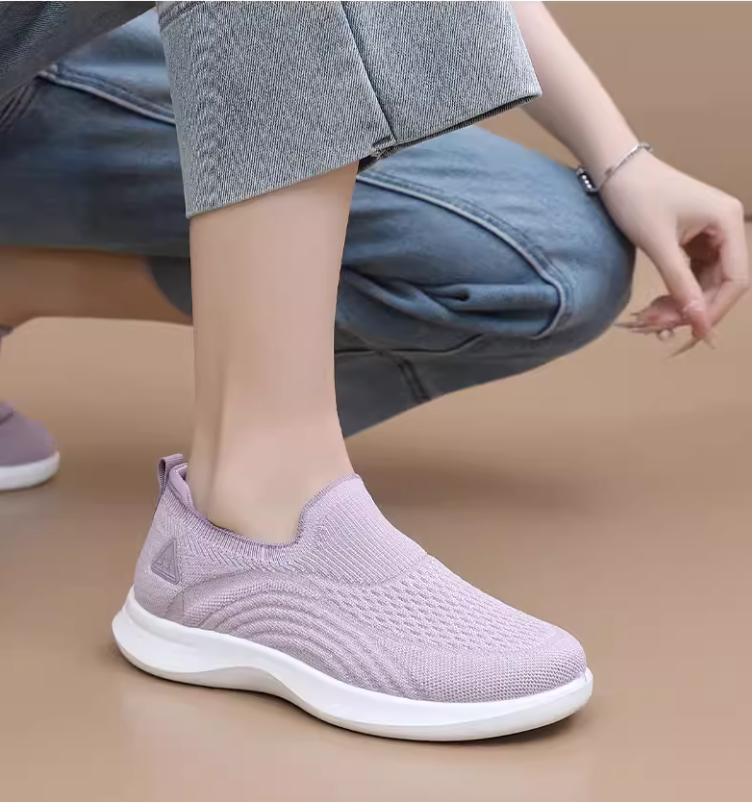
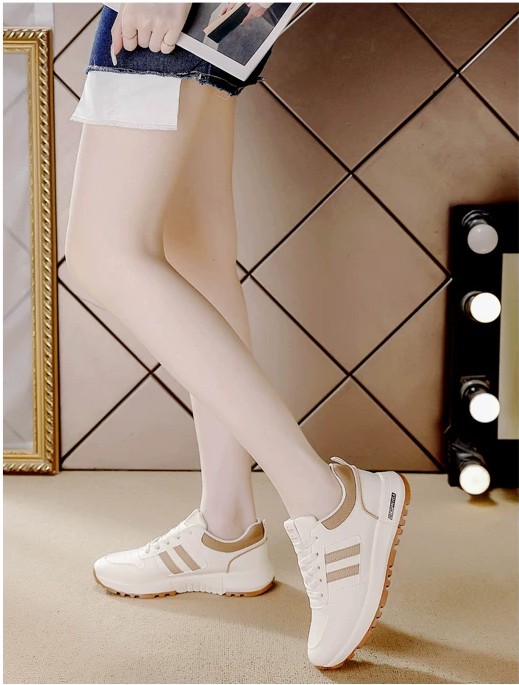
If you want somewhere to start, this pair of breathable mesh walking shoes with a low sole sits in the middle of the range above, and the soft-soled mesh sports shoes work if your day runs past 8,000 steps. For something a bit more structured under trousers, the spring and summer leisure shoes hold their shape better than the knit options.
Browse the full women’s shoes collection if none of those match, and if you’re the sort who wears one pair into the ground, this piece on 40 days in one pair of black sneakers covers what actually wears out first. The colour question gets its own treatment in which blues read cheap and which don’t.
Tomorrow morning, before you reach for anything, check yesterday’s step count. Then pick the pair that matches the number instead of the outfit. It takes five minutes the first time, and after that you stop thinking about shoes in the hallway altogether.