

At 8:35 on a Tuesday I was standing in the hallway with one shoe on, one shoe in my hand, and about ninety seconds to spare. The left pair pinched across the top of my foot. The right pair had a heel that made my calf complain before I’d reached the front door. I left in the scuffed pair, because at least I knew how they’d behave by six in the evening.
That is the whole problem with professional comfortable shoes for women. A pair can feel fine on a carpet square at eleven in the morning and turn on you by the third meeting. You can’t test a nine-hour day in three minutes, and nobody in the shop will tell you which part of the shoe is going to give out first.
So I did the boring thing. I wore three pairs through real work weeks, sat in them for two hours at a stretch, and wrote down what my feet did. Here’s what actually matters when you’re buying.
What “arch support” means inside a work shoe
Most of the support in a dress shoe doesn’t come from the bit you can see. The thin foam layer under your foot is the least important part. What holds your arch up is the shank, a stiff strip of steel or fiberboard running through the middle of the sole, plus the shape of the last the shoe was built on.
If the shank is flimsy, the whole shoe bends in the middle like a paperback. Your arch then does the work the shoe should be doing, and by mid-afternoon you feel it along the inside of your foot. According to the clinical overview of arch support, the point of support is to spread load across the whole foot rather than let one band of tissue take it all. That’s a decent way to judge a shoe in your hand: hold the toe and the heel and try to fold it. A good pair resists.
You can also hear it. Tap the middle of the sole against a table edge. A hollow, dead sound usually means fiberboard that’s already separating. A short, hard knock means there’s something structural in there. It’s not a laboratory test, but it’s caught two bad pairs for me in changing rooms.
The heel counter is the other half nobody mentions. That’s the stiff cup at the back that holds your heel in place. Pinch it between thumb and finger. If it folds flat, the shoe will let your heel roll inward with every step, and your arch pays for that all day. Good counters flex a little at the top and stay firm at the base.
The other half is the insole. In cheaper pairs it’s glued in and about 3mm thick, which is decoration. In better ones it’s removable, has a slight rise under the arch, and can be swapped for your own insert without the shoe getting tight across the top. That single difference separates most professional comfortable shoes for women from the pairs that only look the part.
Worth saying plainly: no dress shoe treats foot pain. If you already have sharp heel pain in the morning, that’s a conversation with a clinician, not a shopping trip. The Mayo Clinic’s summary of plantar fasciitis is a sensible starting point. What a well-built shoe can do is stop making things worse for eight hours a day.
The two-hour sit test
Here’s the test I now run on every pair, and it takes half a day. Wear them to work. Sit at your desk for two hours without getting up. Then stand.
At 2:10pm on the Wednesday I tested the first pair, my arch felt like it had slid forward inside the shoe. That’s not imagination. When you sit, your foot spreads slightly and the shoe holds it in a compressed position. Stand up fast and the insole has to take the load again in a fraction of a second. A soft, unsupported insole loses that fight by lunchtime.
There’s a shorter version if you’re testing in a shop. Sit on the bench for ten minutes with the shoes on, then stand and walk twenty steps on a hard floor, not carpet. Carpet hides everything. Tile and concrete tell you the truth about how the sole behaves.
If you already own a pair that fails this and you don’t want to replace them yet, a thin leather insert with a raised arch can buy you a few months. It won’t fix a bent shank, and it will make the shoe feel tighter across the top, so take the original insole out first if it lifts.
Three things to watch when you stand:
- Does the ball of your foot land on the widest part of the shoe, or is it jammed forward?
- Can you feel the edge of the insole under your arch?
- Does the heel counter hold your heel, or does it slide up a few millimetres?
Any of those going wrong on day one gets worse by Friday, not better. The pair that passed had a firm heel counter and a 4mm arch rise. Not a dramatic number. Just enough that my foot stopped hunting for a position.
Three pairs I wore through a full work week
I rotate three pairs now, which sounds extravagant until you do the maths on how fast one pair wears out when you wear it five days straight. Here’s what each one did.
First up: the block heel. A padded block-heel commuting pair at $167. The 55mm heel is wide enough that my weight lands over the whole heel rather than a point, and the insole has a real arch curve. I wore these for three consecutive office days, about 6,500 steps each, and had no hot spot. The drawback: the leather is stiff for the first week and the toebox creases right where your big toe bends.
Second: the suede flat-ish heel. A soft-soled suede heel built for office floors at $80. These are the ones I reach for on days with a lot of standing at a printer or a whiteboard. The suede upper gives across the top of the foot, which matters if your instep is high. Less structure than pair one, so I wouldn’t wear them for a 10,000-step day, but for a normal desk day with two hours of standing they’re fine.
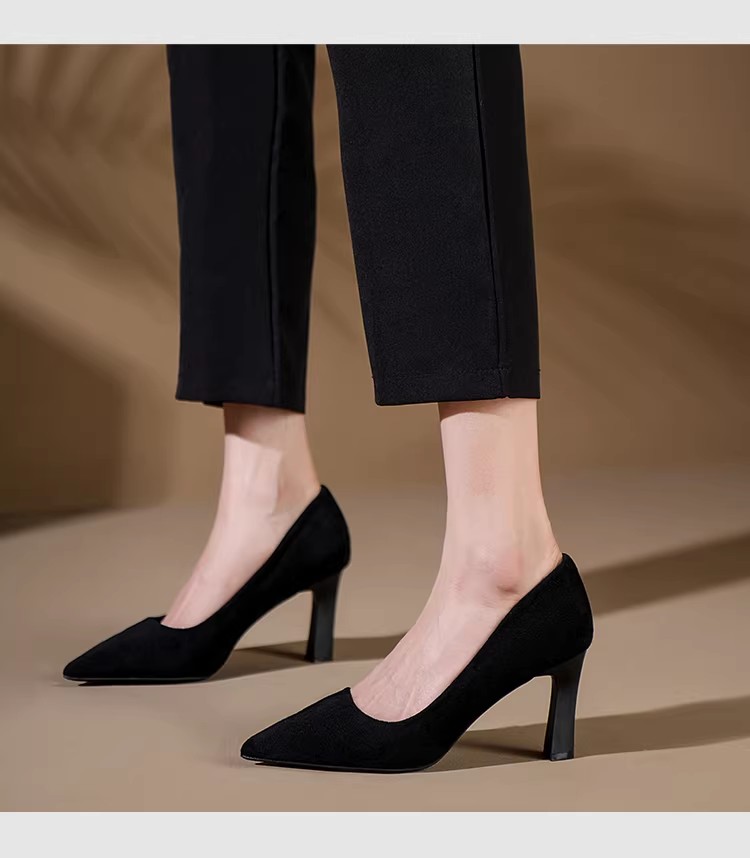
Third: the pointed court shoe. A shallow-cut pair with a slightly wider toe at $169. Prettiest of the three, honestly, and the one that needed the most breaking in. The toe box is tapered, so my little toe had opinions for four days. After that it settled.
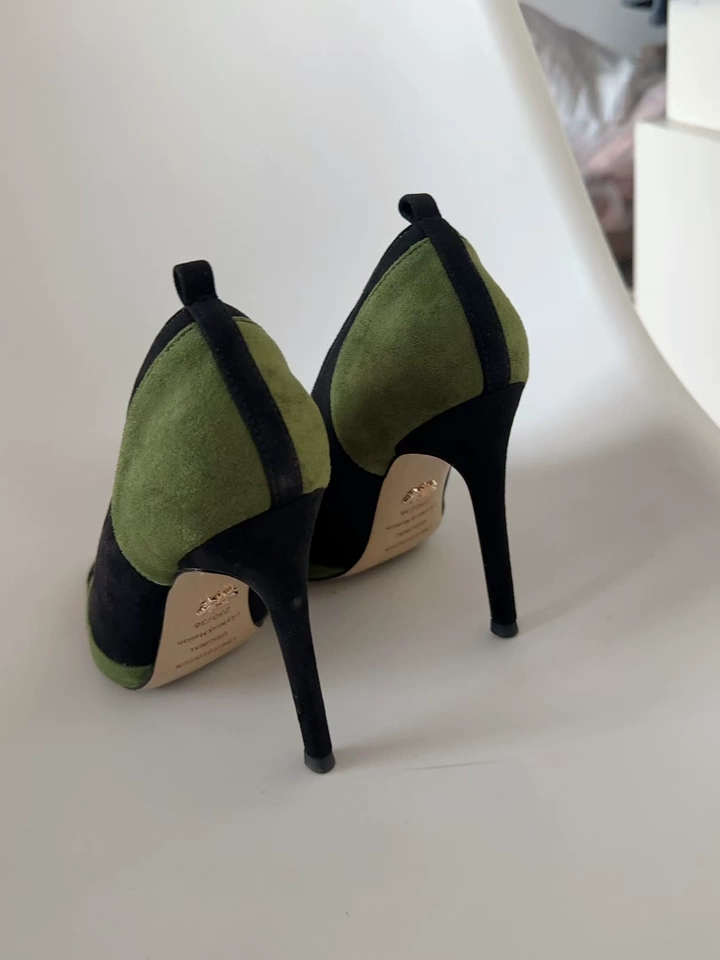
If you want a single recommendation from the three: pair one for long days, pair two for standing-heavy days, pair three for the days that start with a client meeting.
Cost per wear is the number that settles arguments. Pair one at $167, worn forty times, is about $4 a wear. A $60 pair that hurts after two hours gets worn four times and then lives under the bed, which is $15 a wear and a small daily grudge. Buy the pair you’ll actually reach for.
I also ordered a fourth pair that never made it into the rotation. Pointed toe, no cushioning under the ball, very handsome. I wore them for one afternoon, took them off in the car park at 5:40, and sent them back the next morning. The return cost me $9 in postage. That’s the cheapest foot advice I’ve ever bought.
Heel height changes everything above 60mm
Below 50mm, a dress shoe can carry your arch reasonably well because your foot isn’t tilted much. Between 50 and 60mm, most people are still comfortable if the heel is wide and the insole is shaped. Above 70mm, the geometry starts working against you: your weight shifts onto the ball of your foot, the arch lifts away from the insole, and the shoe’s support has less contact with your foot to work with. Any honest shortlist of professional comfortable shoes for women has to start around that 60mm line.
I’m not saying skip the high ones. I’m saying the higher you go, the less the shoe can help and the more the fit has to be right. A 75mm pair that fits properly beats a 45mm pair that’s half a size small.
Platform soles change the maths a bit. A 70mm heel with a 20mm platform only tilts your foot as much as a 50mm heel would, and the thicker sole usually hides a better shank. The trade-off is weight. My platform pair comes in around 380g per shoe, which you notice on stairs by the end of the day.
Ground surface matters too. A pair that’s fine on an office carpet can feel unstable on wet pavement, because the heel tip is small and the sole is smooth. If your commute includes twenty minutes of walking, judge the shoe on the street, not in the corridor outside the fitting room.
One useful trick: try the pair at the end of the day, not the morning. Feet swell by up to half a size over a workday. If the shoe is snug at 6pm, it’ll be fine at 8am. If it’s snug at 8am, you’ll be limping by 4pm. The same logic applies to how collar height changes the fit on low-profile shoes, which is a shorter read if you’re shopping casual pairs too.
Sizing, wide feet, and the high instep problem
Most dress shoes are built on a narrow last. If your foot is wide across the ball, sizing up half a size usually makes things worse, because the shoe gets longer while staying just as narrow. You end up with a gap at the heel and the same pinch at the side. That’s why the professional comfortable shoes for women that actually work tend to be cut a little wider than the pretty ones.
What works better, in my experience:
- Look for a brand that lists width, not just length. EU sizing alone tells you nothing about width.
- Check whether the insole is removable. Pull it out and stand on it. If your foot spills over the edge, the shoe is too narrow no matter what the size says.
- For a high instep, choose a lace-up, a slingback with an adjustable strap, or a soft suede upper. A stiff slip-on will press on the top of your foot all day.
My own feet are a 37 with a high instep and a slightly wide ball, which is roughly the worst combination for pointed courts. The pairs that worked had either suede uppers or a toebox cut a few millimetres wider than average. If you’re in the same boat, start with the women’s dress shoes collection and read the size notes on each listing before you commit.
One more thing people forget: what you wear inside the shoe changes the fit. A 40-denier tight takes up maybe 2mm; a cotton sock takes up more like 4mm, and it changes where your arch sits against the insole. If you’ll wear these with tights from October to March, try them on with tights. Sounds obvious. Almost nobody does it.
Ignore the US number on the box and work from the EU size plus the length in centimetres, which most listings now include. A US 7 is a EU 38 in some brands and a EU 37.5 in others. Centimetres don’t lie.
Where cheap pairs give out first
I’ve bought the $35 pair. It looked fine in the box and lasted about six weeks of regular wear. Two things failed, and they always fail in the same order.
First the insole flattens. The foam compresses to about half its thickness, and the arch support you thought you had disappears. Second, the heel tip wears through, which changes your gait slightly and makes the whole shoe feel unstable. Neither is visible from the outside, which is why cheap pairs seem like a bargain right up until they aren’t.
Lining is the other place budgets show. Leather lining breathes and softens against the skin, and it usually lasts the life of the shoe. Synthetic lining feels smooth for a month, then starts to hold odour and peel at the heel. If you’re choosing between two pairs at the same price, take the one with the leather lining and the simpler upper. You’ll feel the difference in August.
What I would skip: any pair where the sole bends in half when you twist it, and any pair where the insole is glued in so firmly you can feel the edge of the glue line under your arch. Also skip the trend pair that’s a full size too narrow. You will not break it in. You’ll break your patience.
Repair is worth pricing before you bin a pair. A new heel tip costs about $12 at my local cobbler and takes ten minutes. A full resole runs $45 to $60, which only makes sense on a pair that already fits well. If the insole has collapsed and can’t be replaced, that’s usually the end of the road, because replacing the whole footbed costs more than the shoe is worth.
The rule I use now: if a pair needs more than one repair in its first year, it wasn’t built for daily wear. Keep it for weddings and short evenings, and buy something with a proper shank for the Monday-to-Friday stretch.
A five-minute check before you pay
You don’t need a foot scan or a specialist. You need five minutes and a hard floor. These checks work for any pair, but they matter most with professional comfortable shoes for women, because that phrase gets printed on shoes that don’t deserve it.
- Twist test. Hold the toe and heel and twist. The shoe should resist in the middle.
- Press test. Thumb into the insole under your arch. There should be a rise you can feel, not a flat sheet.
- Heel test. Walk ten steps. Your heel should stay seated. If it lifts, the shoe is too long or the counter is too soft.
- Toe test. Wiggle your toes. You want about 8 to 10mm of space in front of the longest toe.
- End-of-day test. Try them on after 5pm, when your feet are at their largest.
Do those five things and you’ll avoid most of the pairs that end up in the back of the cupboard. The pair I kept from this whole experiment cost $167 and I’ve worn it about forty times, which works out to roughly $4 a wear. Still cheaper per day than the $35 pair that lasted six weeks.
If you’re buying online, order two sizes when the shop allows free returns, wear both around the house for an hour on a hard floor, and keep the one that doesn’t press anywhere. Don’t wear them outside until you’ve decided. Scuffed soles turn a free return into a fight.
And if you’re standing at 8:35 in the morning with one shoe on and one in your hand, that’s your answer already. The pair you don’t have to think about is the pair that fits.
If you only remember one thing: buy for the shape of your foot first, the heel height second, and the colour last. The colour is the only part you can change with a different outfit.
