

The lobby clock says 19:04 and my shoes are still on. I put them on at 7:20 that morning, and somewhere around the third meeting my left heel started to feel like a separate object clipped to my foot. When I finally got home I stood barefoot on the cold kitchen tile for a whole minute and did nothing else.
That is the honest test of professional shoes for women, not the mirror. If you work in an office, a clinic, a school office, a showroom or a hotel desk, you already know how the day stacks up. Eight or nine hours upright, a commute at each end, maybe a supermarket run on the way home. Your shoes clock more hours per week than your mattress does. So the question isn’t whether they look right in a Monday meeting. It’s whether they still work at six in the evening, when you’re tired and the last thing you want is to think about your feet.
What “professional” means once you strip the marketing
Strip the adjectives and most workplace dress codes come down to the same four things. Closed toe. Heel low enough to walk in. Dark enough that nobody notices the scuff. Quiet enough that you don’t announce yourself across a carpeted floor.
That’s it. Everything else is taste. The court shoe has been office furniture since the 1950s, and the shape hasn’t changed much because it doesn’t need to. What has changed is how much cushioning brands hide inside the same silhouette. You can now buy a shoe that looks like a 1962 pump and feels like a trainer, and the price gap between those two things is smaller than you’d guess.
Where people go wrong is buying the look first and the walking last. I did that for years. A pair of pointed black flats from a high-street sale, £29, worn for eleven months and then quietly retired because the sole had worn through at the ball of the foot. Eleven months sounds decent until you work out that I was replacing them twice a year. Most professional shoes for women are sold on the shape of the toe and nothing else.
There’s a second trap, which is assuming “professional” means “serious”. It doesn’t. It means “not distracting”. A soft brown suede pair at 6cm reads as professional in most offices I’ve worked in, and it’s a lot kinder to your feet than a stiff patent court shoe. If you want the wide view of what’s out there, the professional shoes for women range covers far more ground than the black pump most people picture.
One more thing worth saying early. Nobody in your office is counting your shoes. I spent two years convinced people noticed when I wore the same pair three days running. They didn’t. They noticed when I limped.
Heel height: 8cm is where most people cross the line badly
Here’s the arithmetic that changed how I buy. At 5cm, your weight still sits mostly over the whole foot. At 8cm, a large share of it moves onto the ball of your foot, and the ball of the foot is not built to carry that for nine hours. At 10cm and above, you’re managing a balance problem as well as a comfort problem, and that is a different job.
None of this is a moral failing. It’s just load. The plantar fascia takes the strain first, which is why so many people describe their heel pain as a morning problem rather than an evening one.
So what do you actually do if your office expects a heel?
- Keep 6cm and under for the days you’ll be standing more than four hours.
- Choose a block or a thick heel over a stiletto, because the footprint under your heel is what stops the wobble.
- Put the higher pair under your desk and change into them for meetings only. I know women who’ve done this for a decade and nobody has ever said a word.
My current pair is 8cm with a soft sole and a slightly thicker heel, and I wear it for meeting days rather than full standing days. It’s the black suede commuter heel with the padded insole, and the bit that sold me was that the inside feels like a shoe I’d wear on a Sunday.
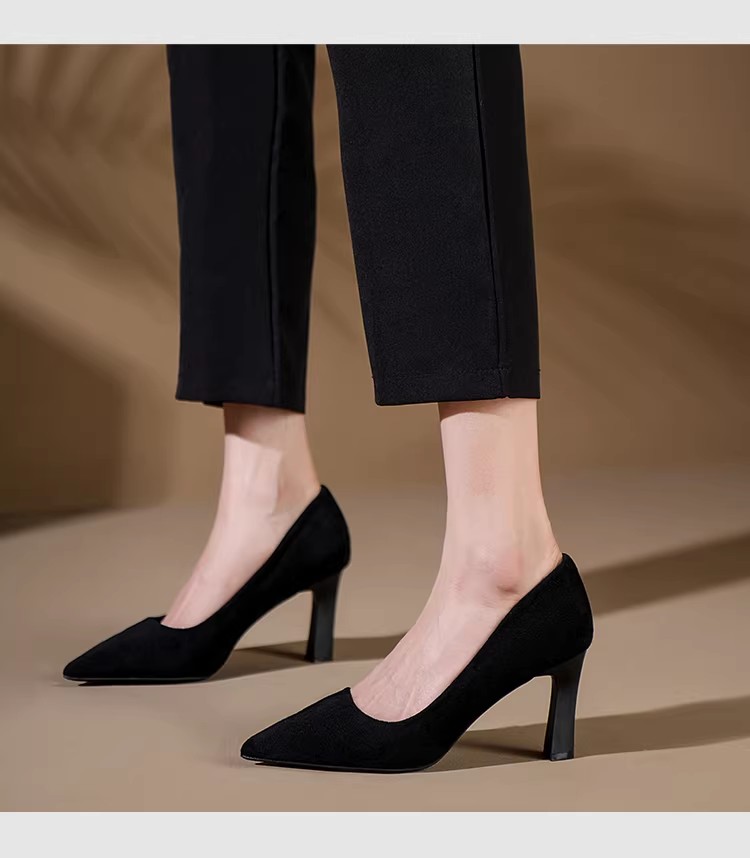
The padding is not magic. By hour seven I can feel the floor again, and the toe box is snug on the outer edge of my right foot, which is slightly wider than the left. That’s normal for me and it’s the reason I don’t wear them two days in a row. If your feet are wide, size up and use a thin insole rather than squeezing into your usual number.
The toe box decides how your afternoon goes
You can predict a bad afternoon from the shape of the toe. A sharply pointed toe compresses the front of the foot, and the front of the foot is where toes need room to spread when you walk. Squeeze them and the pressure goes into the joint at the base of the big toe. That’s the spot that aches at 4 p.m. and the spot that eventually changes shape.
Almond toes and square toes give you back roughly a centimetre of width at the widest point, which doesn’t sound like much. It’s the difference between a shoe you forget about and a shoe you’re aware of all day. I now refuse to buy anything I can’t wiggle my toes in while standing. Sounds silly in the shop. Saves a fortune over a year.
Width matters more than length, and most shops only stock one width. That’s the structural problem. If you’re between sizes, go up and add a thin leather insole rather than down and hope. Leather stretches about half a size over a few months. It doesn’t stretch wider at the toe cap, because that part is reinforced.
Fit checks you can do in 90 seconds
I do the same five things in every shop now, and it takes less time than reading the price tag twice.
- Walk on the hard floor, not the carpet. Carpet hides a stiff sole. Tile tells you the truth in four steps.
- Check the heel slip. A finger’s width of lift is fine. A whole thumb means the shoe will rub your Achilles by lunchtime.
- Press the toe box from above. If you can feel your toes through the leather straight away, there’s no room for swelling.
- Stand on one foot. If the shoe rolls outward, the sole is too soft for long days.
- Go at 5 p.m., not 10 a.m. Feet swell through the day, sometimes by half a size. Shop at the end of the afternoon and you buy for your real foot.
That last one is the single best piece of shoe advice I’ve been given, and I got it from a fitter who’d been measuring feet for twenty years. She also told me that most people buy their shoes a size too small because they’ve been told a tight fit means support. It doesn’t. A tight fit means pressure.
If you want a lower-cut pair that still reads smart, the shallow-cut pair with the softer vamp sits lower on the instep, which helps if you have a high arch and normally feel a band pressing across the top of your foot.
Leather, suede, patent, and what happens by month two
Material decides how the shoe ages, and nobody tells you this in the shop because all four look fine under shop lighting.
Calf leather takes a scuff and keeps it. It also takes polish, which means a scuff is a two-minute job rather than a permanent mark. This is the material I’d pick for a daily work shoe if I only had one pair.
Suede is softer from day one, which is why it’s so appealing when you try it on. It also marks in rain and holds dust. A suede brush costs about £6 and fixes 80% of it. The remaining 20% is the day you get caught in a downpour, and there’s no fixing that.
Patent looks polished and needs almost no care. It also doesn’t breathe, so on a warm day your foot sits in its own humidity. I wore patent courts through one August and I still remember the feeling of peeling them off.
Bonded or PU leather is the one to be careful with. It’s cheap, it looks fine for about six weeks, and then it starts to crack at the flex point across the toes. Once it cracks, it’s finished. No cobbler can save it.
What I’d buy again, and what I’d skip
Buy again without thinking: the 8cm suede pair above, because after a year of twice-weekly wear the sole is still even and the lining hasn’t gone bald. Also a plain black leather loafer at 3cm, which is the most useful shoe I own and the one I reach for when I have a nine-hour day and no meetings.
Skip: anything with a heel thinner than a pencil if you’ll be on your feet more than two hours. Skip anything with a synthetic lining if your feet run warm, because it will smell by week three and no amount of powder fixes it. And skip the trend pair in a colour you love but can’t match to two outfits, because it will sit in the box.
There’s a related trap, which is assuming a trainer is automatically kinder. A soft-soled sneaker with no structure can be worse for a long day than a proper low heel, because your arch gets no help at all. I wrote about that in the piece on black sneakers for a five-day office week, and the short version is that support beats softness once you pass four hours.
If you’d rather see the whole range side by side, the women’s shoe section of the site is organised well enough to browse by shape rather than by brand.
Repair is cheaper than you think
A heel tip costs about £8 to replace. A full sole about £35. Stretching a tight pair, roughly £12. Those numbers matter because they change the maths of a work shoe completely. A £110 pair that gets re-tipped twice and re-soled once will run you about £140 over four years. Four £30 pairs over the same period cost £120 and none of them will feel good in year two.
So the cheap option isn’t actually cheap. It just moves the cost to your feet.
What’s worth repairing: heel tips, soles, a split seam, a stretched lining. What isn’t: cracked bonded leather, a collapsed heel counter, or anything where the insole has worn through to the board. Shoe repair as a trade is having a quiet revival for exactly this reason, and a decent cobbler will tell you honestly when a pair is past it.
I keep a small kit by the door now. Suede brush, neutral cream, a spare pair of heel tips I bought online for £5. Total cost of maintaining three pairs: maybe £25 a year. It’s the least glamorous habit I have and the one that’s saved me the most.
Tights, socks, and the half size nobody accounts for
Every winter I watch the same thing happen. Someone buys a work shoe in September, it fits over a bare foot, then October arrives, tights come out, and the shoe is suddenly tight across the instep by 11 a.m. A 40-denier tight adds maybe a millimetre. A wool sock adds three. Neither sounds like enough to matter, and both are enough to change how a shoe feels by the end of the day.
So if you wear socks or tights for five months of the year, try the shoe on with them. I know that’s awkward in a shop in August. Bring a pair in your bag. It sounds ridiculous right up until the moment you avoid a £90 mistake.
The workaround most people land on is a thin insole that comes out in summer and goes back in for winter. A 3mm leather insole costs about £10 and takes up exactly the space a sock needs. It also gives you a little arch support, which helps if you’re on hard floors. That’s the cheapest fix in this whole area, and almost nobody does it.
One warning about insoles. If the shoe is already snug across the top of your foot, an insole will make it worse, because it lifts your foot into the upper rather than giving it room. Take the original insole out first and compare thickness. If the replacement is thicker than what came out, size up.
Heel grips are the other small purchase worth making. A suede heel grip stops slip without changing the fit, and it costs £4. I keep a pack in the drawer because the pair I wear most has a heel that was always a fraction loose. Two years in, the grip is still there and the shoe still works.
Two decent pairs beat one expensive pair
This is the advice I give most often and follow least consistently. Shoes recover. The leather dries out, the foam in the insole springs back, and the sweat evaporates, but all of that takes about 24 hours. Wear the same pair two days running and you’re putting your foot into a shoe that hasn’t finished recovering. Do it five days a week for a year and the lining compresses in the shape of your foot on a Tuesday, permanently.
Two pairs in rotation last longer than two pairs worn in sequence. Not twice as long, but close. The cost per wear drops, and your feet get a different pressure pattern every other day, which matters more than most people realise.
If your budget is £150, you’re better off with two £70 pairs than one £150 pair. I’ve tested this accidentally more than once. The £150 pair I bought in 2023 is still going, but the £70 pair I bought the same month has done more days and looks better, because it rested every other day.
What to look for in the second pair: a different heel height from the first, so your calves and Achilles aren’t held at the same angle all week. If your main pair is 7cm, make the second 3cm or flat. If your main pair is flat, make the second 5cm block. Your body notices the variation even when you don’t.
And keep them somewhere they can dry. A closed cupboard keeps moisture in. I hang mine on a rail by the window and they last noticeably better than the ones I used to shove under the desk.
A short checklist for Monday morning
Before you put a pair into your work rotation, run through this. Closed toe, yes or no. Heel at 6cm or under if you’re standing more than four hours. Toe box wide enough to wiggle. Sole that doesn’t flex in the middle when you twist it. Lining that’s leather or a breathable knit rather than plastic. Heel tip intact, because a worn tip is what makes a shoe feel unstable.
Six checks. Two minutes. Most professional shoes for women fail one of them, and it’s usually the heel tip, because nobody looks until it’s worn down to the plastic.
One last thing, and it’s the one I wish someone had said to me at 24. Buy for the day you actually have, not the day you’d like to have. If your Tuesday is eight hours at a desk and a 20-minute walk to the station, you need a shoe that handles the walk. If your Tuesday is a wedding fair with 11,000 steps on a concrete floor, you need a different shoe entirely, and no amount of “it goes with everything” will fix that. Professional shoes for women only work when they match the day you’re actually having.
Your feet will tell you by Thursday either way. Better to hear it in the shop.
