

You’re standing on a platform at 7:50 in the morning, it’s already 28°C, and the train is late. Whatever you put on your feet this morning has to survive another four hours of heat before you sit down at a desk.
This is the situation backless tennis shoes for women were made for, and it’s also the situation where they fail most often. The design removes the part of the shoe that holds your heel. That’s the whole point, and it’s also the risk.
Below is the test I’d run before buying a pair, the numbers that matter, and the three cases where I’d tell you to pick something else.
Decide three things first: how far you actually walk in a day, whether your feet run hot, and whether you need the pair to pass at work. Get those wrong and no shoe will save you.
There’s also a price reality check. A backless pair costs less to make than a laced one, so you shouldn’t be paying premium prices for the design itself. Anything over $90 in this category needs to justify itself with a proper sole and a footbed you can replace.
What a backless tennis shoe actually is
Take a low-profile sneaker, remove the heel counter and the collar, and keep the laces or the elastic panel across the instep. That’s the category. Some pairs look like mules with a sporty sole. Others are closer to a slipper with a rubber outsole and a bit of structure.
The engineering trade-off is simple. You gain ventilation at the back of the foot and you lose the grip that keeps your heel from sliding forward. On a normal sneaker, the heel counter does two jobs: it holds your foot back in the shoe, and it stops your ankle rolling inward. Remove it and both jobs fall to the lacing and to the shape of the sole.
That’s why quality varies so much in this category. A well-made pair has a sole that curves up slightly at the heel and an upper that grips the instep. A cheap pair is a flat slab with a fabric top, and your foot slides forward with every step.
Look at the side profile of the sole. The good ones taper down towards the heel and then hook up by about 8mm. That hook does the job the missing heel counter used to do. If the sole is perfectly flat, nothing is holding your foot back.
Weight is the other spec worth checking. Most backless tennis shoes for women land between 180g and 260g per shoe. Under 200g feels barely there, which is lovely until the sole turns out to be too thin for a pavement with tree roots. Over 260g and you’ve lost the main advantage of the design.
One thing worth knowing: the term “tennis shoe” here is marketing, not sport. Nobody plays tennis in a backless pair. The history of the sneaker is mostly about lacing and support, and this design removes both.
If you’re weighing these against a laced pair, it’s worth reading how three sizes of cream sneakers fit on the same foot before you decide. The laced version solves the heel-hold problem entirely and gives up very little in heat, because the collar is only a few centimetres of material. What you lose is the two-second slide-on, which matters more than people admit on a hot morning.
You’ll see three sub-types in shops. The mule has a stiff sole and a closed toe, closest to a clog. The elastic-gore slip-on has a softer upper that grips the instep. The true backless trainer keeps laces across the top and drops only the collar. For walking, the elastic-gore version holds your foot best. For sitting at a desk, the mule is the most convenient to kick off.
The 32°C test: what happens by hour three
I wore three pairs through a hot week in July, on days that hit 31 to 33°C, with a 25-minute walk to the station each way. Here’s what the timeline looked like.
First hour. Fine. Better than fine, actually. The open back lets air move across the heel and the difference is noticeable within ten minutes of walking.
Second hour. The first problem shows up: the sole of your foot starts to slide on the footbed. Sweat does that. Pairs with a leather or suede footbed handle it better than pairs with smooth synthetic lining, which turns slippery fast.
Third hour. If the pair has no arch shape, your foot has flattened into it and your toes are doing the gripping. That’s when you notice the front of the shoe pressing on your toes, because your foot has moved forward by 3 to 5mm.
Fourth hour. Either the pair has held its shape and you’ve forgotten about it, or you’re aware of your feet with every step. There’s rarely a middle result.
The variable that predicts the outcome best isn’t the price. It’s whether the insole has a raised arch and whether the upper grips the top of your foot. Two cheap features. Both easy to check in the shop.
You can replicate the test in an afternoon without the heat. Wear the pair for three hours at home on a warm day, walk 400 metres every hour, and note the moment you first become aware of your feet. If that moment comes before hour two, the pair isn’t going to survive August.
Track three things while you do it: where the pressure shows up, whether your heel has moved forward, and whether the insole feels flatter than it did at the start. The third one is the most reliable signal, and it’s the one most people never check.
Humidity changes the result, by the way. A dry 32°C is a different test from a humid 32°C, because sweat can’t evaporate when the air is already full of water. In a humid city, the sliding starts about an hour earlier, and the pair that passed in Madrid can fail in Bangkok.
Fit rules that matter more than size
With a normal sneaker, the heel counter forgives a certain amount of fit error. Without it, every millimetre counts. Three checks cover most of it.
- Heel seat. Stand and try to slide your heel back. It should move less than 5mm. More than that and you’ll be gripping with your toes all day.
- Instep grip. The upper across the top of your foot should feel snug, not tight. If you can lift your foot inside the shoe, the laces or elastic aren’t doing their job.
- Toe gap. 8 to 10mm in front of the longest toe. In a backless shoe, err toward 10mm, because your foot will slide forward as you walk.
Sizing advice for this category is usually wrong. Most guides say to size down because there’s no heel. Don’t. Size for length first, then use the instep adjustment to control the slide. Sizing down gives you a short shoe and the same movement, which is the worst of both.
If you’re between sizes, take the larger one and add a thin insole. You can always take up space. You can’t create it.
Socks change the calculation. With a no-show sock, the upper grips skin and fabric, and the slide is smaller. Barefoot, sweat makes everything worse and the shoe will smell within a fortnight. If you plan to wear backless tennis shoes for women without socks, budget for a washable insole and a second pair to rotate.
There’s a cheap fix for a pair that’s already sliding: adhesive heel grips, about $6 a pack. They add 3mm at the back of the footbed and change the angle enough to keep your foot in place. Not elegant, but effective on a pair you otherwise like.
Wide feet need a different approach. Because there’s no heel counter to hold you, a narrow backless pair will let your foot splay out over the sole edge, and that looks as bad as it feels. Check that your foot stays inside the footbed when you stand. If it doesn’t, no amount of lacing will fix it.
Where backless works, and where it doesn’t
Honest boundaries, because this design is not universal.
Good for: short commutes under 2km, office days with a lot of sitting, warm weather, quick errands, airports. Anywhere the walking is broken up and the ground is flat.
Bad for: stairs in a hurry, driving, long continuous walks, uneven pavement, and anything involving a train you have to run for. The lack of heel hold is exactly what makes these unsuitable for those situations. I’ve done the stair test in a pair with a smooth sole and it was genuinely unsafe.
Worth avoiding if you have a high arch and no insole support. The design lets your foot flatten, and a high arch with nothing under it gets tired fast. You can fix it with an insert, but then you’re paying for two things.
There’s also a social consideration that nobody writes about. A backless sneaker reads as casual in a way a laced sneaker doesn’t. In a relaxed office nobody notices. In a client meeting, some people will. If you’re unsure, keep a closed pair at your desk.
Weekend use is easier. These are the shoes I take to a market, a coffee run, a short lunch walk. They’re also the pair I’d pack for a summer trip where the hotel room is small and shoes take up half the suitcase. Flat, light, and easy to slide on at security.
Rain is the other limit. Mesh holds water and takes hours to dry, so a backless pair is the wrong choice in a wet city even in summer. If you live somewhere with sudden afternoon storms, keep a second pair at work from June to September.
Driving deserves its own warning. Without a heel counter, your foot can slide forward onto the pedal, and that’s not a comfort issue. Several transport authorities advise against loose or backless footwear when driving. If your commute involves a car, change shoes or keep a flat pair in the passenger footwell.
Materials that survive heat and sweat
Three materials decide whether a pair stays comfortable past hour two.
Upper first. Knit and mesh breathe. Leather doesn’t, but it holds shape better. For hot weather, mesh with a reinforced toe is the practical choice. It also dries faster after the walk home.
Lining next. Leather lining wicks better than synthetic and doesn’t hold odour. Synthetic lining feels cooler for the first twenty minutes and then becomes the problem.
Underfoot, the footbed matters most. Suede-topped or leather-topped footbeds grip a sweaty foot. Smooth synthetic footbeds don’t, and that’s where the sliding starts. If the footbed is removable, you can swap it for a better one, which is the single best upgrade you can make.
On sweat generally: the physiology of sweating explains why feet produce more moisture per square centimetre than most of the body. A shoe that can’t move that moisture away will smell by week two, no matter how much you paid.
Sweat, odour and the washing question
Mesh uppers can be washed. Most people don’t, which is why so many pairs get binned at the end of one summer. The routine that works: cold water, a soft brush, a drop of mild detergent, no machine, no dryer. Stuff with newspaper and leave them in shade. Heat is what kills the glue.
Two pairs rotated beat one pair washed weekly. Moisture needs about 24 hours to leave a shoe properly, and a pair worn daily never gets that. The same logic applies to the insole, which is usually the part that smells first and the cheapest part to replace.
If odour has already set in, a sprinkle of bicarbonate inside overnight helps for a week or two. It doesn’t fix a synthetic lining that’s holding bacteria. At that point the honest answer is a new pair, because the lining is the smell.
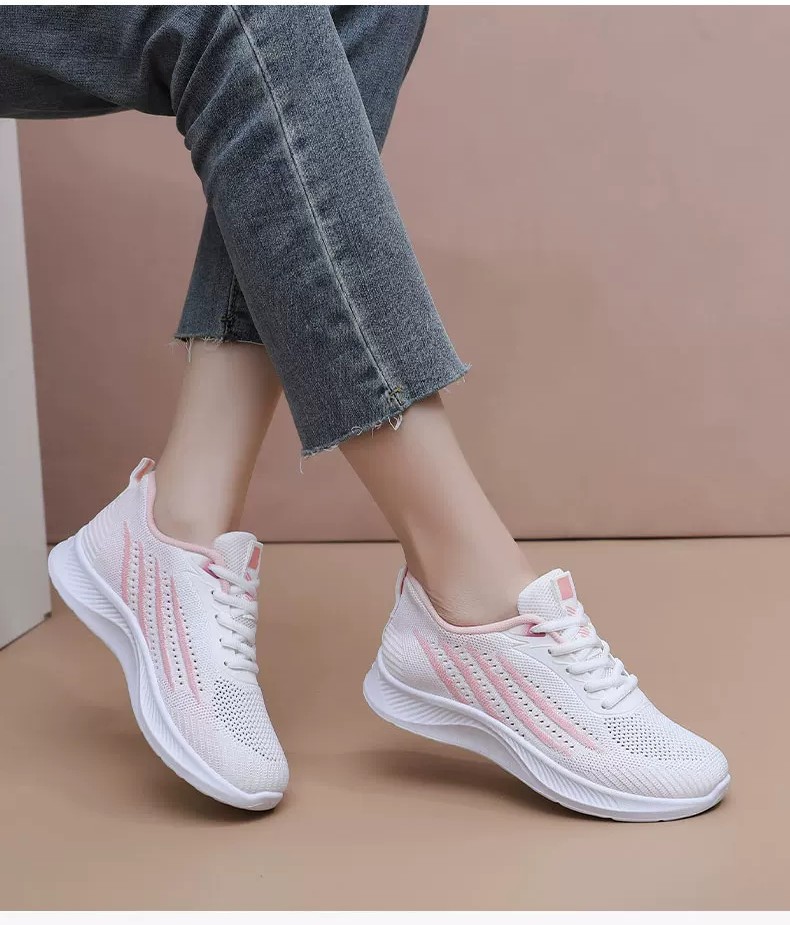
Three pairs worth testing in this style
If you want starting points, these are the shapes that worked for me. All three are under $60, which is where I’d start before spending more on a design this simple.
The prices matter less than the replacement cycle. A $46 mesh pair that gets worn three summers in a row is better value than a $120 pair that falls apart at the first wash. Judge this category by how well it tolerates cleaning, not by the label.
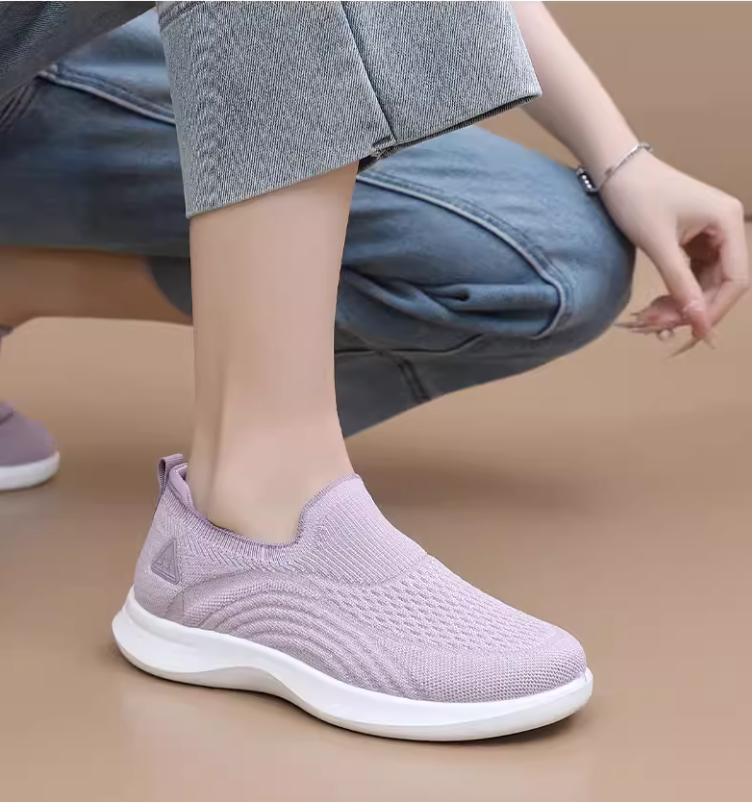
Cheapest of the three is a mesh slip-on with a soft sole at $46. Light, breathable, and the upper grips the instep well enough that my heel stayed put on a 1.5km walk. The sole is thin, so it’s not a pair for long distances.
Next up is a breathable mesh walking shoe at $49. More structure than the first, slightly heavier, and it handles uneven pavement better. This is the pair I’d take on a city break.
Third option: a sports and leisure slip-on at $57. Thicker sole, better grip on wet tile, less breathable than the other two. Best of the three for a commute that includes a station concourse.
A short buying list for hot weather
- Try the pair on in the afternoon, when your feet are at their largest.
- Walk 200 metres on a hard surface and check the heel slide.
- Press the footbed under your arch. If it’s flat, plan to replace it.
- Check the outsole tread with your thumb. Smooth means slippery on wet tile.
- Confirm the upper is mesh or knit, not coated synthetic.
- Buy the size that gives you 10mm at the toe, not the size that feels snug.
Do that and you’ll end up with a pair that does what the design promises: air at the back, no pressure on the heel, and enough grip that you’re not thinking about your feet at 3pm.
Where to spend the money, if you’re choosing between two pairs: spend it on the sole and the footbed, not the upper. Uppers are cheap to make and cheap to replace. A sole with real tread and a footbed with an arch are the parts that decide whether backless tennis shoes for women end up in your rotation or in the back of the cupboard.
If the honest answer is that you walk more than 3km a day, buy a laced pair instead. Backless tennis shoes for women are a hot-weather convenience, not a walking shoe, and treating them as one is how people end up limping in July.
One last check before you pay: put both shoes on and stand up from a chair ten times in a row. If your heel lifts on any of the ten, the pair is too big or the upper is too loose. That’s the test I wish someone had told me before I bought my first pair.
If you want to compare the wider range first, the sneaker collection has the laced versions alongside the slip-ons. Worth ten minutes before you commit, because a laced pair with a mesh upper solves half of the heat problem without giving up heel hold.
