

You’re standing in front of the mirror with three cream sneakers lined up on the floor, all the same colour, all labelled a different size, and none of them feels obviously right. That’s the moment most people guess. They take the middle one because it sounds sensible, wear it for a week, and then admit the toe was squeezing by Thursday.
Before you choose, check three things. The heel, the toe box width, and where the arch of your foot lands relative to the arch of the shoe. Most people get the second one wrong, because the toe box is the only part they can see. Cream makes this worse than any other colour, because it shows every crease, every scuff, and every place the shoe is fighting your foot. On a black sneaker, a bad fit hides. On cream, it draws a map.
So treat the colour as a diagnostic tool. Buy cream, and the shoe will tell you the truth within two weeks. Here’s how to make sure the truth is a good one.
Fit comes down to three points, and only one of them is length
Length is the number everyone checks, and it’s the least useful on its own. A shoe can be the right length and still be unwearable, because the volume inside is distributed differently from one last to another. Three measurements decide whether a sneaker works:
- Heel-to-ball length. From the back of your heel to the widest part of the ball of your foot. This is what determines whether the flex point of the shoe lines up with where your foot actually bends.
- Forefoot width. Measured across the widest part while standing, because your foot spreads under load.
- Instep height. How tall the top of your foot is. This is the number nobody measures and the one that causes the most returns on lace-up sneakers.
If the flex point is off by a centimetre, you’ll feel it as a rubbing sensation under the ball of your foot after about forty minutes of walking, and no amount of breaking in will fix it. The shoe isn’t too small. It’s bending in the wrong place.
That’s why trying three consecutive sizes of the same shoe is more informative than trying three different shoes in your usual size. Same last, three volumes. You learn what the last does, and then you can decide whether it suits your foot at all.
There’s a quick way to check the flex point without a ruler. Stand on the ball of one foot with the shoe on, and roll forward until your heel lifts. Your foot should bend where the shoe bends. If the shoe resists before your foot does, you’re fighting it, and the only place that fight shows up first is the seam above your little toe.
Two of those three points can be guessed from how a shoe feels. The third can’t, which is why the instep catches people out year after year.
What size you think you are is usually half a size optimistic
Most people who tell me they’re a 38 are a 38 in one brand and a 39 in the next. Shoe sizing has never been fully standardised, and the systems used to define it differ by country and by manufacturer. EU sizes are based on a Paris point of two-thirds of a centimetre, but the internal volume that number describes varies with the last, the lining, and how much padding sits under the sockliner.
Add the fact that feet change. They spread slightly through the day, they change shape in pregnancy, and they flatten a little with age. A pair that fit perfectly at 9am can feel tight by six in the evening. If you’re buying cream sneakers for a summer of walking, size for the end of the day, not the beginning.
Practically: measure your foot in the late afternoon, standing, with the socks you’ll actually wear. Write down the length in millimetres. Then ignore the size on the box and look for a shoe whose internal length is 8 to 12mm longer than your foot. That gap is your toe clearance, and it’s the difference between a shoe you forget and a shoe you resent.
For most women that lands between EU 36 and 40, with wide feet pushing up a half size and narrow feet often able to go down. Cream doesn’t change that arithmetic, but it does make the consequences visible.
One caveat about measuring at home: don’t do it sitting down. A seated measurement can be 5mm short, because your arch drops and your foot lengthens under load. Same reason you shouldn’t trace your foot in the evening after a day in heels, when the shape has been temporarily rearranged.
And if you’re between sizes on the tape, that’s not a problem to solve with a guess. It’s a signal to try both and let the heel decide, which is the next thing worth talking about.
Try 36, 37 and 38 and watch the toe box, not the length
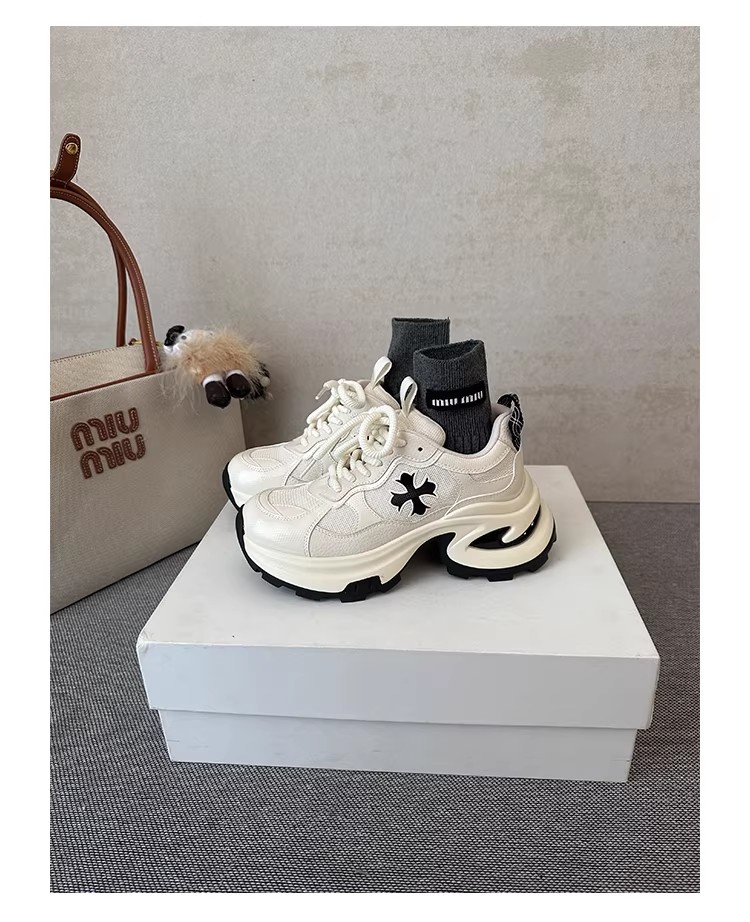
Here’s what to look for as you go up a size. In the smallest pair, the upper will bow outward at the widest part of your forefoot and the material will look stretched across the top. In cream, you’ll see fine lines radiating from the ball of the foot within minutes, because the surface has no pattern to hide them.
In the middle pair, those lines should mostly disappear when you stand still, and reappear only when you push off. That’s normal. Leather and mesh both crease; the question is whether the crease sits where your foot bends or somewhere else.
In the largest pair, look at the heel and the instep rather than the toe. A shoe that’s too long will let your heel lift, and a shoe with too much volume will let your foot slide forward on downhill slopes, which jams your toes into the front. On a cream sneaker, that forward slide shows as a dark smudge across the top of the toe within a month, because your toes are polishing the inside of the upper.
Try all three with the same sock. This sounds obvious and people skip it constantly. A shoe that fits in a thin liner will not fit in a cushioned crew sock, and cream sneakers are usually worn with both depending on the season.
Bring a sock with you if you’re shopping in person. One pair of socks in your bag removes the single most common cause of a wrong size, and it takes less space than a phone.
If you’re ordering online instead, order two sizes and return one. Most shops allow it, the return costs nothing compared with keeping the wrong pair, and the comparison is worth far more than a size chart.
The heel slip test beats any chart on the wall
Lace up, stand, and try to lift your heel out of the shoe without unlacing. You should get a few millimetres of movement, no more. If the heel comes up a centimetre, the shoe is too long or too wide at the collar, and no insole will fix it properly.
Then walk twenty steps and listen. A cream sneaker with a slipping heel will show a soft crease across the back counter within a week, and once that crease forms the shoe is committed to rubbing. It’s the single most common reason a pair comes back with 200 metres on the sole.
Two fixes exist, and both are compromises. A heel grip adds volume at the back, which works if the shoe is a half size too long. A thicker sock does the same thing less precisely. What doesn’t work is hoping it settles. Heel slip gets worse as the lining compresses, not better.
Worth naming the exception, since it trips people up. A brand-new sneaker with a stiff heel counter can feel like it’s slipping when it’s actually just rigid. Give it three short wears indoors before you judge. The counter softens at the top edge and grips differently. That’s a real effect, and it’s the only case where waiting helps.
How to tell the difference: rigid-counter slip happens at the top edge and sounds like a soft flap. True length slip moves your whole heel up and down inside the shoe, and you can feel the insole under your arch as it happens. One settles. The other never does.
Watch for the third version, which is a shoe that’s simply too wide at the heel for your foot. That one moves side to side rather than up and down, and it’s the hardest to fix. If you can rotate your heel inside the shoe without lifting it, the width is wrong and a different size won’t solve it.
Cream shows strain first at the flex line, not the sole
Everyone worries about the sole on a pale shoe. The sole is the easy part. It wipes clean and it’s out of sight. The place cream fails is the flex line across the toe box, where the upper folds every time you walk.
That fold collects dirt, and on a cream upper the dirt reads as a grey stripe. By month three, you’ll have a permanent crease that no brush reaches, because the soil is inside the fold rather than on the surface. It’s cosmetic. It also makes the shoe look older than it is.
You can slow it down. Protect the upper before the first wear, not after, and clean the flex line weekly with a soft brush and cold water rather than waiting for a visible mark. A cream sneaker kept clean looks expensive. The same sneaker left for a month looks like a gardening shoe, and there’s no recovering the difference.
Keep the brush by the door, not in a cupboard. Accessibility is the whole trick.
One more thing worth knowing before you commit to the colour: cream and white are not the same problem. White can be bleached back. Cream can’t, because the warmth in the colour comes from pigment, and anything strong enough to lift a stain will lift the pigment too. If you want a pale sneaker you can abuse, buy white and let it grey naturally. If you want the softer look, accept the maintenance.
The flex line is also the place where you can tell a good buy from a bad one after a month. If the crease is one clean line, the shoe is bending where your foot does and the fit is right. If there are two lines or a starburst of wrinkles, the shoe is too long or too wide, and it will never look new again.
A ruler, a pencil and a sheet of paper: all the measuring you need
Stand on the paper with your heel against a wall, weight on that foot, and mark the tip of your longest toe. Do it for both feet, because most people have one foot 3 to 5mm longer than the other and always buy for the shorter one. Then measure heel to ball, not just heel to toe.
Now the pencil. Take the sockliner out of the shoe and trace it. Compare the traced length to your foot length. You want 8 to 12mm of clearance at the front. Compare the widest part of the trace to your forefoot width. You want 4 to 6mm of room, which is roughly the thickness of a pencil on each side.
If the sockliner won’t come out, which is common on cemented sneakers, use the pencil inside the shoe instead: slide it down the inside of the heel and mark where the insole surface sits. Crude, but it beats guessing.
This takes four minutes and it removes almost all the uncertainty from buying pale sneakers online, where you can’t see the crease forming. It also gives you a number to quote when you ask a shop a question, which tends to get you a more useful answer than “does it run true to size”.
Keep the trace. Fold it into the shoebox and leave it there. Next time you buy the same brand, you’ll know instantly whether the last has changed, and lasts do change quietly between seasons without any announcement.
One limitation of the paper method: it measures length and width, not height. A high instep won’t show up on a trace, which is why the try-on still matters even after you’ve measured properly.
Write the numbers on the box lid rather than on your phone. It’s there when you need it, and you’ll never scroll past it.
Wide forefoot or high instep: give up length, never width
If your forefoot is wide, the instinct is to size up. Resist it for a moment. Sizing up buys width at the front and costs you length everywhere else, which is how you end up with heel slip and a shoe that bends in the wrong place.
Better order of operations:
- Find a last that’s wide enough at the ball in your true length. Mesh uppers forgive width far more than leather does, because the weave gives.
- If nothing fits in your length, go up half a size and add a thin insole to take up the extra volume.
- If your instep is high, look for a lace-up with a soft tongue and skip slip-ons entirely. A high instep in a slip-on is a losing fight.
Narrow feet have the opposite problem. Cream sneakers on a narrow foot tend to look like boats, and the fix is a lace-up with a padded collar rather than a smaller size. Buying down a full size to get a snug fit puts your toes against the front, and on a pale shoe that contact shows as a permanent dark mark.
If you’re permanently between a wide and a standard fit, the answer is usually a mesh upper in your true length rather than leather in a size up. Mesh gives where leather doesn’t, and it does it without changing the length of the shoe. You’ll feel the difference on the outside of your little toe within the first hour, and you’ll know immediately whether it’s working.
High instep is the harder one, and it’s worth naming a workaround. Loosen the lacing over the middle of the foot and tighten only at the top and bottom. That takes pressure off the highest point without letting the heel go. It’s ugly advice, but it’s what a fitter does when there’s no wider last available.
The pair that feels snug at ten in the morning will be wrong by four
Feet swell. Standing and walking pushes fluid into the tissues, and by late afternoon most people are 3 to 5 per cent larger in volume than they were at breakfast. That’s why the try-on hour matters more than the size on the box.
If you shop in the morning, allow a thumb’s width at the toe and don’t be talked into the smaller pair. If you shop in the evening, be careful of the opposite error: a shoe that feels perfect at 7pm may be loose at 8am, and loose on a cream sneaker means creasing in the wrong place.
The honest test is a full day indoors. Buy from somewhere with a real return window, wear them at home for six hours on carpet, and check three things at the end: any rubbing at the heel, any pressure across the instep, and any numbness in the toes. Numbness is the one people ignore and shouldn’t. It means the shoe is compressing a nerve, and it will get worse.
If you can only manage an hour, do it at the end of the day rather than the start. An evening try-on is the stricter test, and it’s the one that predicts how the shoe behaves on a long Saturday.
Don’t judge fit by how the shoe looks on your foot in the mirror. Cream sneakers flatter a slightly larger size, because the extra volume reads as relaxed rather than sloppy. Trust the pressure points, not the silhouette.
And if the six-hour test produces nothing worse than a slight warmth across the top of your foot, that’s normal for a new leather upper. Warmth fades. Sharp pressure doesn’t.
Do the test on a day you’re home anyway. Wearing a new pair for six hours while doing something useful feels like a chore; wearing them while watching a film doesn’t.
What each size told us, in one table
Here’s the pattern that repeats across cream sneakers with a standard medium-width last. Your numbers will differ, but the shape of the answer rarely does.
- Half size down. Looks sleek, creases hard across the toe within days, pressure at the outside of the little toe. Only works for narrow, low-volume feet.
- Your measured size. 8 to 10mm toe clearance, minimal heel slip, crease forms along the natural flex line. This is the pair to keep.
- Half size up. Comfortable immediately, then the heel starts lifting on stairs and the toe box creases in two places instead of one. Fixable with an insole, not ideal.
- Full size up. Feels roomy standing still, feels unstable walking. On cream, the extra volume shows as a deep double crease that never comes out.
The reason cream punishes a half-size error so visibly is contrast. Shadows show up on a pale surface, so every fold reads at a distance. That’s bad for vanity and good for information. If you’re unsure of your size in a particular brand, buy the cream version and you’ll know within a fortnight.
Start with your measured length, allow 8 to 12mm, keep the pair with the least heel movement, and check the flex line after a full day indoors. If you want a pale pair that behaves predictably, our white spring and summer leisure sneakers come in the simpler silhouette that shows fit errors least, and the 2026 sports sneakers in white and brown run closer to a medium width. Browse the full cream women’s sneaker range if you’ve already got your number, or start from all women’s sneakers.
Two reads worth your time before you order: how beige holds up against dirt and dye transfer, and what four months did to a pale pair. If you’re measuring for the first time, the anatomy of the foot explains why heel-to-ball length matters more than total length.
