

A pair of women’s black and gold heels arrives at a returns desk in early March, still in its box, the ankle strap wrapped in tissue. The buyer says they’re too high. The heel measures 70mm, which is the same as the pair she wears twice a week. What’s actually wrong is that the strap sits two centimetres too low on the instep, and every step pulls the foot forward into the toe.
That scene repeats often enough to be a pattern. Buyers read heel height first because it’s the number on the listing. The detail that decides whether a shoe stays in the wardrobe is usually the strap position, followed by the width at the ball of the foot.
Black and gold makes the problem harder, because the contrast draws the eye to the strap. A misplaced strap doesn’t just feel wrong. It looks wrong, and it breaks the line of the shoe at the exact point where the eye lands.
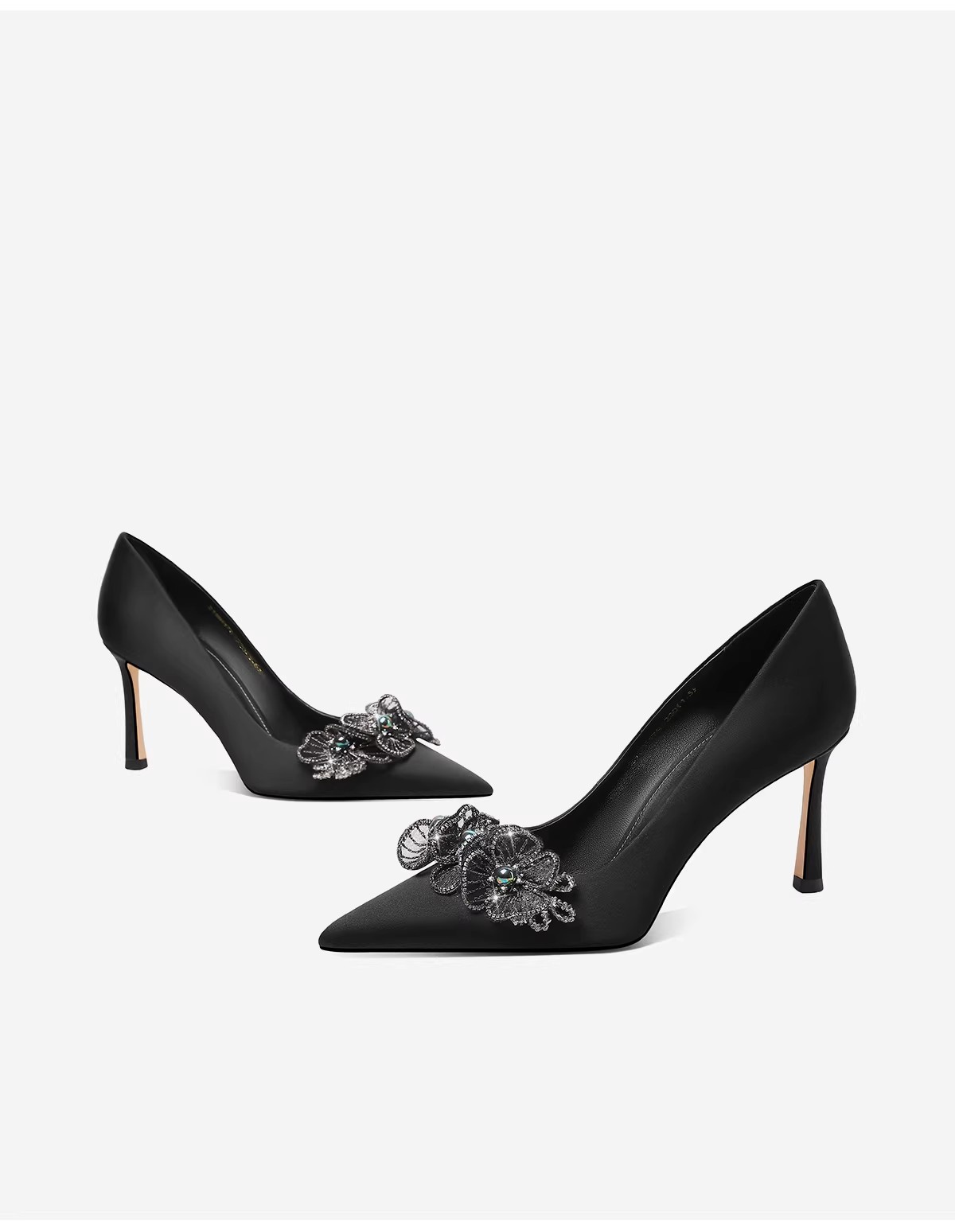
Heel height gets the attention, the strap gets the blame
Most shoe listings lead with heel height, and most shoppers use it as a proxy for comfort. The logic is understandable and mostly wrong. A 90mm heel with a gentle pitch can be easier to walk in than a 70mm heel with a steep curve under the arch. The engineering history of the high heel is largely a history of moving that curve around.
What the height number can’t tell you is where the shoe grips the foot. A pump relies on the heel cup and the vamp. A strap shoe relies on the strap, and the strap only works if it crosses the foot at the right place.
The right place is the dip just above the ankle bone, where the foot narrows. A strap there holds the heel down without pressing on anything. Two centimetres lower and it crosses the widest part of the instep, which is where the tendons sit. That’s the version that leaves a red line after an hour.
There’s a simple way to check this before buying. Put the shoe on and press a finger between the strap and the top of the foot. If the finger fits with a little room, the strap is in the right zone. If the strap is tight against the skin before you’ve even stood up, it will be unbearable by lunchtime.
The heel height then becomes a secondary question. Once the strap is right, a 70mm heel is manageable for most people for a full evening. Once the strap is wrong, even a 50mm heel becomes a shoe you want to take off under the table.
Pitch is the next thing to look at, and it’s easy to check in the shop. Turn the shoe sideways and look at the curve of the sole under the arch. A gentle curve spreads the load across the whole foot. A sharp curve puts it all on the ball of the foot, which is why two pairs at the same height can feel completely different by 4pm. If you can see daylight under the middle of the sole, the shoe is doing less work for you.
Three foot shapes, three different failure points
Feet fail shoes in predictable ways. Knowing which category a foot falls into saves a lot of returns.
Wide forefoot, narrow heel. This is the most common combination and the hardest to fit. The ball of the foot needs space while the heel needs grip, and most shoes are built on a last that favours one or the other. The result is a shoe that pinches at the toes and slips at the back. An ankle strap is the best fix, because it holds the heel down without requiring a tighter fit.
High instep. The top of the foot is pronounced, so a closed vamp cuts across it and a low strap digs in. Buyers in this group often size up to relieve the pressure, which then makes the shoe too long. The better answer is a lower vamp or an open design, not a bigger size.
Narrow foot overall. The shoe fits at the heel and gaps at the sides, and the foot slides forward on slopes. Padding helps a little. A strap helps more. A pointed toe helps least, because it funnels the foot into a shape it doesn’t fill.
These categories overlap, which is why fitting advice that ignores foot shape tends to be useless. A shoe that works for one narrow-footed buyer can be a poor choice for another buyer in the same size.
Black and gold two-tone designs make the fit visible, because the colour break usually runs along the strap or the heel counter. If the strap sits too low, the gold line cuts across the foot at its widest point. It’s a useful diagnostic, even if it’s an accidental one.
Try the pair with the socks or liners you’d actually wear. A no-show liner adds about a millimetre of volume, which is enough to change the fit of a narrow shoe, and it also stops the lining from sticking to a bare heel. If you only ever try shoes on barefoot in a shop at 10am, you’re fitting a foot that isn’t the one you’ll have at 6pm.
Where the strap sits, in numbers
Strap position is easier to judge with measurements than with adjectives.
A well-placed ankle strap sits roughly 55 to 65mm above the sole at the back of the heel, depending on shoe size. On a EU 38, 60mm is a reasonable guide. Lower than 50mm and the strap is doing the job of a slingback without the support. Higher than 70mm and it starts to rub the ankle bone instead of holding the heel.
Strap width matters too. A 6mm strap cuts into the skin under load. A 12mm strap distributes the pressure and holds better. Anything over 20mm starts to look like a different shoe, which is fine if that’s the design and a problem if it isn’t.
Buckles are the third variable. A buckle adds about 15mm of adjustability, which is often the difference between a strap that works and one that doesn’t. Elastic panels do something similar but they stretch over time, so a buckled strap usually lasts longer.
| Strap position | What happens | Who it suits |
|---|---|---|
| Under 50mm | Foot slides forward, toes take the pressure | Very low insteps only |
| 55-65mm | Holds the heel without pressing the instep | Most feet |
| Over 70mm | Rubs the ankle bone, can gap at the back | Long ankles, high arches |
This is also why two pairs in the same size can behave completely differently. The last might be identical, but a 5mm change in strap height changes the fit more than half a size does.
If the strap is adjustable, set it before trying the shoe on properly. Most people buckle it where it looks neat, which is usually one hole too tight. Leave room for the foot to swell.
Buckle placement is worth a minute of attention. Fasten it, stand up, and press down on the ball of the foot. If the strap loosens noticeably when you do that, it’s set too loose and the heel will lift when you walk. If the skin puckers around the buckle, it’s too tight. The right setting leaves a shallow dent in the skin that fades within a minute.
Toe shape changes the width, even when the size doesn’t
Two shoes labelled EU 38 can differ by 8mm in internal width at the toe. That difference is invisible on the listing and decisive on the foot.
A pointed toe narrows progressively from the ball to the tip. It looks longer and more formal, and it suits a narrow foot. On a wide forefoot it compresses the toes, and the pressure shows up as a burning sensation under the ball after about forty minutes of walking.
A square toe keeps the width further forward, which is better for wide feet and for anyone who stands for long stretches. It reads more casual, so it pairs better with trousers than with a cocktail dress.
An almond toe is the compromise. It narrows enough to look elegant without forcing the toes together. For buyers ordering online who can’t try before buying, almond is the lowest-risk shape.
Toe shape is also a historical choice as much as an aesthetic one. The broader record of shoe design shows pointed toes returning whenever footwear is meant to signal formality, and squarer toes returning when comfort moves up the list. Neither shape is more correct. They answer different questions.
The toe also affects length perception. A pointed black and gold heel adds visual length to the leg, which is why it appears so often in evening styling. A square toe reads shorter and more grounded. Neither is better. They do different jobs.
One check that costs nothing: trace the foot on paper, cut it out, and lay it over the shoe’s insole. If the paper overhangs the insole at the widest point, the shoe is too narrow regardless of what the size label says. If it fits with 3-5mm to spare at the toe, the length is right.
Toe shape also changes where the shoe creases. A pointed toe creases further back, sometimes right across the base of the toes, and that crease is where decoration rubs. If you’re looking at a beaded or embroidered pair, bend the shoe gently at the ball and see where the fold lands. Anything stiff across that line will press on the toes after an hour.
The returns pattern that repeats every season
Most returned heels come back for one of three reasons, and almost none of them are about the heel height printed on the box.
The first is heel slip. The shoe fits at the toe and gaps at the back, and the buyer walks out of it with every step. This is a last problem, not a size problem, and sizing down usually creates a toe problem instead. You can spot it in ten steps: if the heel lifts more than 3mm, the shoe will rub.
Strap rub comes second. The strap crosses the instep too low, or it’s too narrow, and the skin breaks after the first long wear. Buyers often blame the material when the position is the real issue. Move the buckle one hole and walk again before you decide to return anything.
Toe compression is third. The shoe is the right length but the wrong width, and the toes are squeezed from the sides. This one is hard to detect in a two-minute try-on, because it only becomes obvious after the foot has warmed up. Give it twenty minutes on carpet before you make the call.
All three are visible in a twenty-minute indoor walk. Most people don’t do one. They try the shoes on, look in the mirror, and decide. The mirror answers a style question. It says nothing about whether the shoe will survive a wedding.
Do the walk at the end of the day if you can. Feet swell by roughly half a size over the course of an afternoon, and a pair that feels precise at 9am can be painful by dinner. Fitting at 6pm gives you a shoe that works for the whole day, not just the first hour.
There’s a budget angle here too. A pair that costs $170 and fits properly is cheaper over two years than three $60 pairs that get returned or abandoned. The arithmetic is unglamorous, and it’s the reason experienced buyers spend more time on fit than on price.
Return windows make this easier than it used to be. If the retailer gives 30 days, wear the shoes indoors for an hour on three separate days before you commit. Most fit problems show up on the second or third wear, not the first. The same approach works for work shoes that promise comfort in the listing, where the real test is a full shift rather than a lap of the living room.
For anyone comparing options, a black slim-heel pump with a shallow vamp shows how a low-cut front changes the instep fit, while an embroidered black pair with beadwork shows what happens when decoration sits over the toe box. Both are worth trying in two sizes if the retailer allows it.
None of this is theoretical. Feet are measurable, straps are measurable, and the width of a toe box is measurable. The only thing that isn’t is the feeling of the first step, which is why the twenty-minute walk matters more than any number on a listing.
The pair that stays in the wardrobe is rarely the pair with the best photograph. It’s the pair whose strap lands in the right place, whose toe leaves room for the foot to spread, and whose heel height matches the ground the buyer actually walks on. Everything else is decoration, including the gold. The daylight check for ankle straps and dress shoes covers the same ground from a different angle, and the full range of heel shapes is the place to compare them in person.
