

A woman walks into a shop holding a screenshot of a silver tennis shoe, tries on her usual size, walks four steps, and says the same sentence every time: “It feels a bit long.” Nine times out of ten the shoe is the right length and the wrong width, and the size on the box has nothing to do with either.
That gap between the number and the fit is where most returns start. Silver tennis shoes for women are especially prone to it, because the metallic finish changes how the upper behaves, the last is often borrowed from a men’s or unisex mould, and the shoe is bought as much for how it looks with jeans as for anything to do with a court.
What follows is the shop-floor version: what the finish actually is, why a half size up can make a shoe narrower, and the three-size test that settles it in four minutes.
What “silver” is on a tennis shoe, and why it ages unevenly
Very few silver tennis shoes use metallic leather. Most use a polyurethane film with a metallic pigment, bonded to a mesh or knit base, and the quality difference sits in the film thickness and the bonding method rather than in the shine.
Three constructions turn up again and again. A foil laminate sits on top of the base fabric and reflects strongly, then creases into fine white lines across the vamp within a month. A coated PU film is more flexible and dulls gradually, which looks better but loses the mirror finish. A metallic yarn woven into the mesh is the most durable and the least shiny, because the metal is inside the structure instead of painted on it.
The trade-off is simple. The shinier the shoe in the box, the faster it stops being shiny. A duller silver at the start tends to still look silver in month eight, which is the version most people actually want after the first fortnight.
Two shop tests tell you which one you’re looking at. Bend the shoe across the vamp and watch the coating. A foil laminate shows a hard, bright crease immediately; a coated film creases softly; a metallic yarn barely changes. Then press a thumbnail into the upper and release. If the mark stays, the film is soft and will scuff into a permanent pattern within weeks. If it springs back, the coating has some resilience.
Cleanability separates them too. Metallic films hate solvent cleaners and most shoe creams, which lift the pigment and leave a patch. Damp cloth, mild soap, nothing else. A pair that needs special handling isn’t a problem as long as you know before you buy it, and that’s the part the label never says.
There’s a second problem nobody mentions at the till: silver shows crease lines more than any other colour because the coating reflects light unevenly where the upper folds. On a black shoe a crease is a shadow. On a silver one it’s a bright line. If you’re bothered by the look of worn shoes, silver will bother you sooner than leather will.
The number on the box is a length, not a fit
Every shoe size describes one dimension, and even that is approximate. A US 8 is not a fixed 25.1cm across brands, because lasts differ and the conversion tables for shoe sizes are conventions rather than measurements. In this trade, the same nominal size can run 4mm to 6mm different between two makers, which is enough to change whether your toe touches the front.
Silver tennis shoes add two complications. First, many are built on unisex lasts, so a women’s 8 may be a scaled-down men’s mould with a wider heel and a straighter big-toe line. Second, the coated upper doesn’t stretch much, so any pressure at the widest part of your foot stays pressure.
That’s why “it feels a bit long” is usually the wrong diagnosis. What’s happening is the shoe is too narrow at the ball, your foot slides forward to find room, and your heel lifts. Buy a half size down and the length feels right while the width gets worse.
Conversions are their own mess. A EU 39 is a UK 6 in some charts, a UK 5.5 in others, and a US women’s 8 or 8.5 depending on the brand’s own table. None of those is wrong, because none of them is a measurement. The only number that travels between makers is the internal length in millimetres, and even that is measured differently depending on whether the last includes a toe spring.
Some brands now publish width letters, and it’s worth favouring them. A “B” width is narrow, “D” is standard for women’s athletic shoes in US sizing, and “2E” is wide. If you know you’re a D and the shoe only comes in B, no amount of sizing up will fix it, because the shoe gets longer without getting wider.
The measurement that predicts this is foot width at the ball, taken while standing, and almost nobody knows their own. A quick version at home: stand on a sheet of paper, mark the widest points either side of the ball of your foot, measure across. Compare that with the shoe’s internal width if the brand publishes it. Most don’t, which is why the try-on still matters.
The three-size test, in the order that saves time
Try three sizes, in this order: your usual size, a half up, a half down. Not because you’ll buy three, but because the middle one only makes sense next to the other two.
- Usual size. Stand and press the top of the toe box. Less than 8mm of clearance means the length is short, whatever the label says.
- Half size up. Check the heel. If it now lifts more than 10mm when you walk, the extra length is solving a width problem badly.
- Half size down. If your toes press the front on the first step, stop. This size will not work, no matter how good the heel feels.
What usually emerges is that one size is right in length and wrong in width, and the answer is the right length plus a different lacing pattern or a thin insole. A fitter will run the laces in a straight bar across the midfoot rather than a criss-cross, which takes pressure off the top of the foot and lets the upper sit wider at the ball. It’s a two-minute change and it rescues a surprising number of pairs.
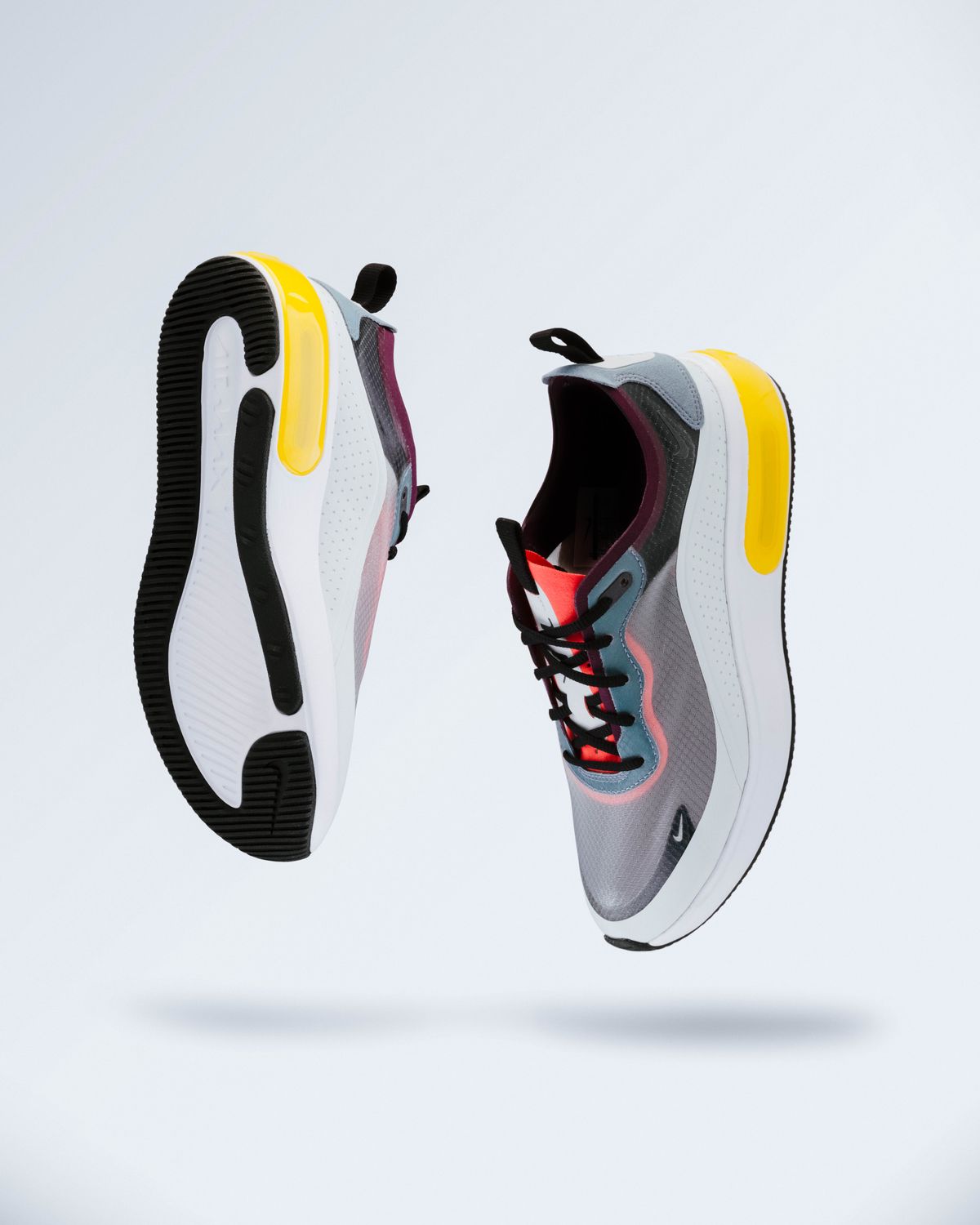
The tongue and collar get overlooked and they decide comfort on the second hour. A padded tongue that’s stitched at the top edge will press on the instep when you lace firmly, and a collar cut low at the back lets the heel slide. Look for a gusseted tongue if the shoe will see rain, because a loose tongue channels water straight to your socks.
One more check that costs nothing: try them on at the end of the day and with the socks you’ll actually wear. A tennis shoe fitted over a thin trainer sock in the morning will feel tight over a cushioned sock at 6 p.m., and feet swell by roughly 5% over a working day.
What the shoe is for decides the sole, not the colour
Silver tennis shoes for women get sold on looks and judged on the outsole, and the two are usually unrelated. A shoe with a herringbone or modified herringbone pattern is meant for a hard court. A shoe with a deep, blocky tread is meant for clay or artificial grass. A shoe with a flat, smooth outsole is a fashion trainer and will be slippery on a wet pavement, let alone a court.
Lateral support matters more than cushioning for tennis, because the sport is mostly sideways. Press the side of the shoe inward at the midfoot. If it folds easily, there’s no stability shank and your foot will roll inside the shoe on a wide shot. That’s the difference between a shoe you can play in and a shoe you can walk to lunch in.
Stack height is the number to compare if cushioning is your priority. A fashion trainer often runs 20mm at the heel, a running shoe 32mm to 40mm, and a court shoe 18mm to 24mm for a lower, more stable ride. More stack isn’t automatically better for tennis, because height costs stability on a lateral movement. For walking to the station, more stack helps. Same shoe, different job.
Most buyers don’t need a performance shoe, and pretending otherwise wastes money. If the plan is jeans, a commute and the occasional weekend knockabout, a fashion-led silver trainer with a rubber outsole is the sensible buy. If the plan is twice-weekly club sessions on a hard court, buy a court shoe and accept that it will look less interesting.
Worth knowing before you decide: the construction of a tennis shoe is built around lateral stability and pivot points, which is why court models feel stiff in the shop and comfortable in play, while fashion versions feel the opposite.
What comes back, and what it says about sizing
The returns pattern in most shops that sell this category is remarkably consistent. The single biggest reason is width, not length. The second is heel slip. The third is the customer liking the shoe but deciding the metallic finish was too much for their wardrobe, which is a taste problem and not a fit problem at all.
Width returns cluster in one place: the little toe. If a customer comes back, the mark is almost always on the outside of the fifth toe or on the top of the fourth, which tells you the upper was too narrow at the ball and the foot was pushing outward to compensate.
Heel slip returns cluster around socks. A shoe fitted barefoot in summer gets returned in October when it’s worn with a thicker sock and the heel starts to lift. That’s why a good fitter asks what you’ll wear with it, and why the answer “depends” usually leads to a half size up plus a heel grip.
And the finish complaints, which are the hardest to predict from a photo, tend to arrive at week six rather than week one. By then the shine has dulled at the creases and the shoe looks used in a way the owner didn’t expect. It’s not a fault. It’s the coating doing what coatings do.
Exchange policy shapes behaviour more than people admit. A shop that offers a straight exchange without a receipt gets more customers trying a size up “just to see”, which is good for fit and bad for the returns bin. If you’re buying online, read the exchange terms before the fit terms, because a pair that’s right but wrong-sized is only useful if you can swap it.
The useful lesson from all of that: buy silver for the shape and fit you want, and expect the finish to settle into a matte version of itself. If you need the mirror look to last, buy a smooth leather or a patent finish instead, both of which hold their surface longer than a metallic film.
Keeping a metallic upper presentable past month three
Silver shoes fail in two ways: the coating dulls at the creases, and the edges pick up dark scuffs that read as dirt from three metres away. Both are manageable, and neither needs a specialist kit.
Start with protection, applied before the first wear. A water-based protector for synthetic uppers, two thin coats, twenty minutes apart. Skip anything with solvent in it, since solvents soften the metallic pigment and leave a cloudy patch that can’t be reversed. Reapply every eight to ten wears if the shoes see rain.
For cleaning, a soft brush and lukewarm water with a drop of mild soap. Work in small circles on the mesh, and use a cloth rather than a brush on any smooth coated panel. Wipe the scuffs on the midsole with a melamine sponge, lightly, since those sponges are mildly abrasive and will dull a satin finish if you lean on them.
Drying is where people wreck them. No radiators, no hairdryers, no balcony in direct sun. Stuff the toes with newspaper and leave them at room temperature for a day. Heat doesn’t just shrink the upper, it can lift the film at the toe where the shoe flexes most, and that’s the one repair a cobbler can’t hide.
Storage matters more than most owners expect. Metallic films pick up pressure marks from other shoes, so don’t stack them under boots. Keep them on a shelf or in a cloth bag, and don’t leave them in a hot car between April and September.
One realistic note: a silver trainer worn three times a week will look noticeably less silver by month six, and there’s no product that restores a foil laminate. If the finish is the reason you’re buying, treat the shoe as a two-season item and price it accordingly. If the fit and shape are the reason, the dulling won’t bother you much.
The buying order that avoids the usual mistakes
If you’re going to buy one pair this season, do it in this sequence. It takes about twenty minutes including the walk around the shop.
- Decide the job first: court, commute, or weekend. The sole follows from that.
- Measure your foot width at the ball while standing. Write it down, since you’ll use it again.
- Try your usual size, a half up, a half down. Judge clearance at the toe, not comfort in the arch.
- Walk on a hard floor for at least twenty paces. Watch the heel.
- Re-lace across the midfoot before you reject a pair for tightness.
- Check the outsole pattern against how you’ll use them.
What to skip: silver shoes with a smooth, flat outsole if you’ll wear them outdoors; uppers with a foil laminate if you want them to look new past two months; and any pair where the shop can’t tell you whether the last is women’s-specific or unisex. That last question tells you more about the fit than the size chart ever will.
Price bands are worth understanding, since the range in this category is wide for reasons that have little to do with quality. Under about £45 you’re paying for the coating and the look, with a basic rubber outsole and a foam insole that flattens. Between £60 and £90 you usually get a stitched upper, a removable insole and a sole that can be replaced. Above £110 you’re paying for a brand, a performance last, or both, and only one of those improves your Tuesday commute.
For a first pair, a spring/summer sports and leisure shoe for women is the version that covers commute and weekend without pretending to be a court shoe. If you do want something with more structure underfoot, the shock-absorbing lightweight running shoe is a better starting point than a metallic fashion trainer.
Comparison shopping is easier once you know the width question, and the sneaker category by silhouette is a faster way through the options than scrolling a search result. If you’re weighing up walking versus court use, the notes on walking gym shoes that nearly went back cover the same fitting logic from a different angle.
One last thing about the colour. Silver works with navy, grey, white and black, and it fights with warm beige and most browns. That’s not a rule anyone will enforce, but it’s the reason a pair gets worn twice and then sits by the door. Think about the three outfits you’d actually wear them with before you decide the finish is the point. If the answer is a pair of jeans and two grey sweatshirts, buy the duller silver and wear them into the ground.
