

It’s 4:20 on a Tuesday in late October. You’ve got one shoe on each foot, your phone is propped against a coffee cup, and you’re trying to work out which pair you can photograph without apologising for it later.
This isn’t a review of Skechers and it isn’t a lab test. I haven’t measured anything and I’m not going to pretend I did. What follows is what I see when I put two pairs of walking shoes in the same flat autumn light and shoot both, plus the facts each brand prints on its own page so you can check my reasoning.
Short version: the chunky pair photographs as a shoe, and our pair photographs as part of an outfit. If your camera roll is mostly full body shots for a shop page or a look book, the second thing is what you want. If you need one picture that says “I walk a lot” at a glance, the first one gets there faster.
We’re not affiliated with Skechers. Brand names are used for identification only.
The Light You Actually Get at 4pm in October
Autumn light isn’t golden. That’s a November myth people repeat after one good weekend. What you actually get at four in the afternoon in late October is a low sun behind cloud, and cloud pushes colour temperature up rather than down. Standard references put open shade and heavy overcast somewhere around 6,500 K to 7,000 K, which is why the colour temperature of overcast daylight reads blue next to anything warm in the frame.
Translating that for shoes: a white mesh upper under that light goes slightly blue, a cream one goes grey, and a warm tan starts to look like the tan you wanted. This matters more than the shoe itself. You can fix a lot in editing, but you can’t fix a shoe that has picked up the wrong cast across its whole surface.
So the first move isn’t choosing a pair. It’s choosing a spot. Stand where the light comes in from a window at roughly 45 degrees to your foot, not straight down on it. Straight-down light flattens every panel and every seam, and both pairs end up looking like the same grey blob.
Practical version, if you are shooting on a phone at home:
- Put the shoe on a mid-grey or wood surface, never on white paper.
- Turn off the overhead light. One light source, one direction.
- Shoot at 11am or at 4pm, not at 1pm, because the angle is what gives you shadow.
- Take one frame with the shoe pointing left and one pointing right; you will only like one of them.
I do this with both pairs in the same five minutes, same window, same distance. The difference in how they read is not subtle. You’ll see it before you finish the second pair.
One thing to be honest about: if the sky is genuinely flat grey and raining, no shoe photographs well. That isn’t a brand problem. Reschedule.
Sole Depth and Mesh Are What the Camera Sees First
At thumbnail size, nobody sees your laces. What the camera registers first is silhouette, and silhouette in footwear is mostly sole depth plus collar height. A thick sole draws a strong horizontal line across the bottom of the frame. A low, thin sole lets the shoe sit inside the shape of your leg instead of cutting across it.
That single fact explains most of the difference between these two pairs in photos, and it has nothing to do with which one is “better”. It’s a compositional difference.
The second thing the camera sees is texture. Knit and mesh with overlapping synthetic panels create a lot of small tonal variation, and small tonal variation survives compression. A phone photo of a busy upper still looks like a shoe after Instagram has chewed it down to 200 KB. A smooth single-tone upper can lose its edges completely at that size and turn into a soft grey shape.
The trade is real, so make it consciously:
- Busy upper, chunky sole: survives compression, reads sporty, dominates a full body frame.
- Smooth upper, low sole: needs side light and a tighter crop, but sits quietly under tailored clothes.
If you’re shooting product images for a listing, you want the first. If you’re shooting outfits, you usually want the second, because the shoe isn’t the subject. Your coat is.
There’s a quick way to find out which one your own camera prefers. Put both pairs on the same surface, shoot the same crop of each, then shrink both photos to thumbnail size on your phone and look at them side by side. Whichever one still has a visible outline in the small version is the one your feed will read. That test takes four minutes and settles arguments faster than any spec sheet.
This is also why the same pair can look great in one photo and wrong in the next. It’s rarely the shoe. It’s whether the light was raking across the upper or falling flat on it.
The Go Walk Pair in Frame: Chunky, Bright, Hard to Ignore
Skechers has been building shoes since 1992 out of Manhattan Beach, which is longer than most of the brands currently selling you “performance” anything, and the history of the company explains the shape of the product. They got big on shoes that feel like nothing, and the Go Walk line is the purest version of that idea.
In a photograph it does one job extremely well. It announces walking. The sole stack is thick enough to draw its own line, the upper has enough panel contrast to keep its shape at small sizes, and the whole thing reads as active from two metres away. If you need a picture where the viewer instantly understands “this person covers ground”, that is the pair.
In my experience, it also photographs best from a low, slightly forward angle, roughly at the height of the sole. Shoot it from above and the toe box fills the frame and the whole shoe looks wider than it is. Shoot it from the side at sole height and the proportions come back.
Two facts from the manufacturer’s own spec are worth knowing, because they show up in photos. The Go Walk 7 is listed as machine washable, which matters if you shoot outdoors and the pair picks up mud at the collar. The midsole is their ULTRA GO compound, a fairly soft foam, which is why the side profile bulges slightly where your weight sits. That bulge is honest. It also means the shoe looks different in frame depending on whether you’ve got it on your foot or you’re holding it in your hand.
Where it fights you is under tailored clothes. A thick light-coloured sole under a wool coat pulls the eye down to your feet in every frame, and that is the opposite of what you want if the photo is about the coat. Not a fault. A mismatch.
Our Pair in Frame: One Tone, Low Profile, Easier to Crop
Our mesh soft sole walking pair does the opposite job. One dominant tone, a low outsole, and a toe shape that follows the foot rather than boxing it. In frame it stops being a shoe and starts being the bottom of an outfit, which is exactly what you want for full body shots, mirror selfies, and anything shot for a look book.
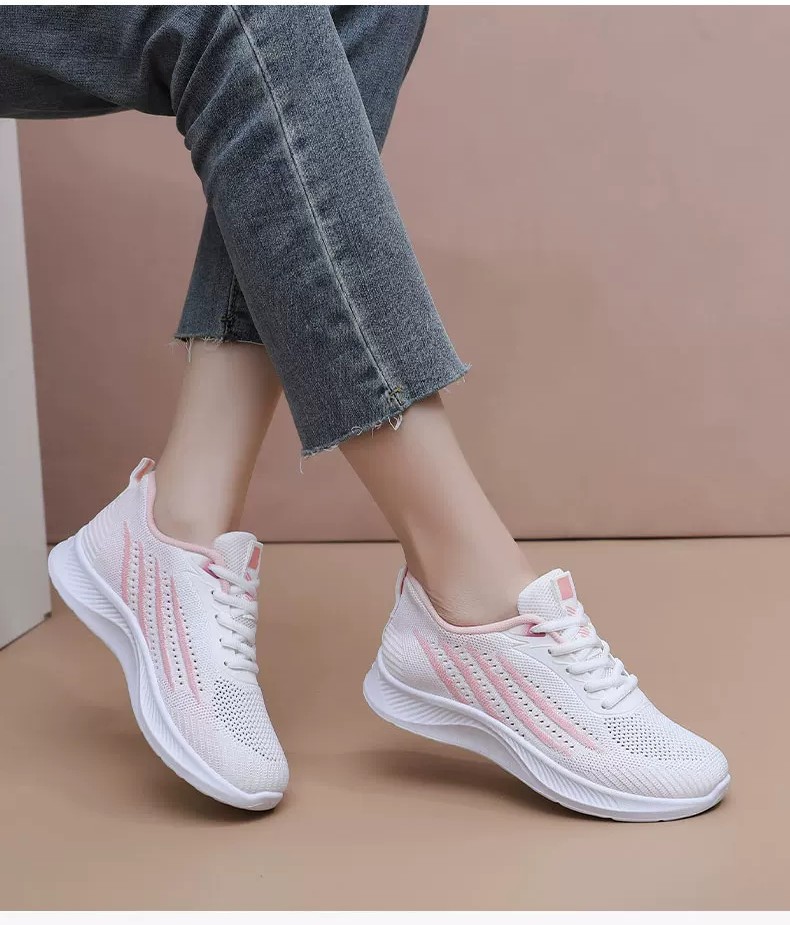
The advantage shows up in cropping. You can take a picture from the knee down and the shoe does not hijack it. You can shoot it next to a midi skirt without the sole cutting a hard line across the hem. You can put it in a flat lay with a coat and a bag and it will not fight either of them for attention.
The disadvantage is the same thing seen from the other side. In flat overhead light, a single-tone low shoe can disappear. It stops reading as a shoe and starts reading as a slipper, or worse, as part of the floor. If you shoot it badly, it looks like nothing.
This is the pair I’d shoot on a person rather than on a table. On a table it needs a stylist’s patience. On a foot, with a hem above the ankle and the toe pointing slightly away from the camera, it suddenly has a shape, because your ankle gives it the one thing it lacks on its own: a vertical line to sit against.
What fixes it, every time, is a shadow. Put the shoe somewhere the light skims across it from the side and the toe shape and the collar suddenly appear. Two minutes of moving the shoe 40 centimetres to the left of where you had it will do more than an hour of editing.
That is not a defect of the design. It is how low-profile footwear behaves on camera, and it is worth saying plainly: if you want a photo that requires no thought, ours isn’t the easy one. If you want a photo that looks like a person wearing clothes rather than a person wearing equipment, ours is doing the work.
Ten Minutes of Photos, Twelve Hours of Standing
Here’s the part that photos hide. A picture takes ten minutes. The day takes twelve hours, and you are the one who has to wear the shoe after the camera goes away.
On that measure, the two pairs are built for different days. The Skechers pair has a soft foam midsole and a fairly generous collar, and for my feet that combination is what I reach for on a day that includes a train, a supermarket, and 9,000 steps on pavement. The softness is doing the work, not the shape. If you have a high arch, the Arch Fit insole they sell in the same line is described on their site as podiatrist-designed, per the manufacturer’s spec, and that’s the version I’d look at first.
Our pair is a different bet. The outsole is thin enough that you feel the ground, which I like on carpet, on studio floors, and indoors in general, and which I do not like on gravel after 4 km. For my feet the thin sole is the honest limitation. It isn’t a walking shoe for a hiking trail and I wouldn’t sell it as one.
Socks change this more than most people expect. A thin cotton sock keeps the collar close to your ankle and the shoe stays the size it looked in the photo. A thick wool sock pushes your heel back, and suddenly the same pair that looked sharp in a July shot looks a size too long in December. If you’re shooting a winter outfit, wear the winter sock for the photo and buy for that.
So ask yourself which day you’re actually buying for:
- Commute plus errands plus a shoot: the cushioned pair, and change into the other one on location.
- Indoor day, studio, office, restaurant: ours, because the thin sole keeps you connected to the floor and looks right under a skirt.
- Standing on concrete for eight hours: neither, honestly. That’s a different category of shoe and you shouldn’t solve it with a fashion pair.
If you’re already shopping by heel height for long days, the same logic in our 45mm rule for all-day kitten heels applies here: the number matters less than where the load sits.
Outfit Math: Denim, Wool Coat, Midi Skirt
Three combinations, because three is what most autumn wardrobes actually contain.
Wide-leg denim and a cropped jacket. The chunky pair wins this one clearly in my eyes. A wide hem needs weight underneath it or the whole silhouette floats, and a thick sole gives the hem an anchor. Ours gets swallowed here. You end up with a lot of fabric and a small quiet shoe at the bottom, and the proportion reads unfinished.
Long wool coat, straight trousers. This is the one where ours pulls ahead. The coat is already the loudest thing in the frame. A single-tone low shoe keeps the vertical line going from shoulder to floor, and the photo looks calmer. Put a bright chunky sole under that coat and your eye goes straight to the floor, every time.
Midi skirt with tights. Ours, without much debate. The low collar sits under the hem instead of clashing with it, and the toe shape stays visible in a knee-down crop. The chunky pair can work here if you want the deliberate “sporty shoe with a skirt” contrast, which is a real look, but it is a look you have to mean.
Grey knit and black trousers. Either pair works, which is the useful answer here. The chunky one makes the outfit read casual and the low one makes it read office. Same clothes, two different stories, and you get to pick which one you’re telling.
One more variable worth naming: colour. Black reads heavier in low light and can lose all its detail in a phone photo. Cream and bone read lighter and photograph more forgivingly, but they also pick up every cast in the room. If you only shoot in one place, choose the tone that works in that place. That sounds obvious and almost nobody does it.
If you want a reference for how much a neutral pair can carry across a working week, our five workdays in one pair of grey heels is the same argument in a different shape.
What I Don’t Like About Ours, and One Thing About Theirs
Ours first, because it’s the pair I’d be selling you. The toe picks up scuffs fast, and on the light colourway a single dark mark on the toe box is visible in every frame until you wipe it. The thin outsole is the real limitation though. Four kilometres on gravel and I can feel every stone, and after a long day the ball of my foot is the first thing to complain.
There’s also a fit issue worth flagging. Low-profile uppers like this one give you less room to hide a thick sock, so if you size for winter socks you’ll get a shoe that looks a half size big in photos. Buy for the sock you will actually wear in the photo.
On the Skechers side, the thing that bothers me is not the shoe. It’s what the shoe does to a frame. The thick light sole is the brightest object in a full body shot, so it pulls attention to the floor whether you want it there or not. On my foot the wide toe box also makes the shoe look longer from above than it does from the side, which means the top-down shot almost never works.
The laces deserve a mention too. On ours the opening is narrow and the laces are short, so if you have a high instep you’ll find yourself loosening the whole thing to get your foot in, and a loosened lace line is the one thing that never photographs well. On my foot it took a week of wearing before the collar relaxed enough to slip on without untying. That’s a fair limitation to know about before you order, and it’s the reason I’d tell you to try them on in the morning rather than at the end of a day when your feet are wider.
None of that is a knock on the design. It’s a mismatch between what the shoe is optimised to do and what a lot of photos need. Worth knowing before you buy either one.
A Five-Minute Decision You Can Stop Thinking About
Here’s the version I’d give a friend on the phone.
Take the chunky walking pair if most of your photos are full body, if your autumn uniform is wide denim and a puffer, if you walk on pavement for hours, and if you want the shoe to do the talking. Take ours if your photos are crops and look books, if you wear midi skirts and long coats, if you’re indoors most of the day, and if you’d rather the shoe stay out of the way.
Then check three things in this order:
- Can you see the outline of the shoe in a thumbnail? If not, the light is wrong, not the shoe.
- Does the sole cut a horizontal line you didn’t want? Then the pair is too chunky for that outfit.
- Would you still wear it for the four hours after the photo? If not, you’re buying a prop.
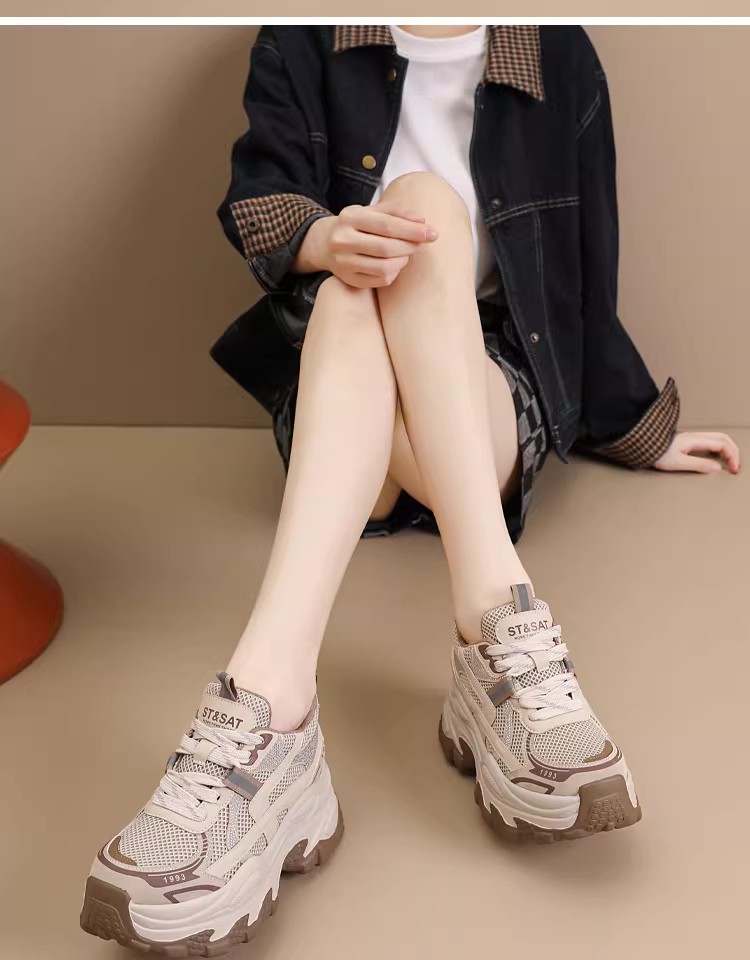
If you land on the second answer, start with the sports and leisure shoes with a cleaner upper or the thick-soled dad shoes with hidden height, depending on whether you want the sole to show. The rest of the women’s sneakers we keep in stock covers the middle ground, and if you are shopping the whole wardrobe at once, the full shoes category is where the skirts and coats live too.
And if you’re still torn after all that, buy the pair you’d wear on a day nobody photographs you. That’s the pair that ends up in the photos anyway, because it’s the one you actually put on when you’re in a hurry. The rest is wardrobe theory.
One last thing. The sneaker’s long drift into everyday dress is why both of these pairs can sit under a coat at all. Ten years ago the question wouldn’t have come up. Now it does, and the answer is mostly about the light and the hem, not the logo.
Which one are you actually reaching for on a grey Thursday, when nobody is taking your picture?
