

You already know the drill. You size up to get room across the ball of your foot, and now the shoe is an inch too long and your heel is swimming. You size down and the sides press in by four in the afternoon.
That loop isn’t your feet being difficult. It’s the last. Almost every women’s walking shoe is built on a B width, whether or not the box says so, and B is narrower than the average woman’s forefoot. Wide sizes exist. They’re just buried three clicks deep in the menu, or sold out in your size by March.
Before you read any further, know that this isn’t a story about buying a specialty shoe. Most women can get 80% of the way there with a tape measure and a different pair of socks. The last 20% is where money changes hands, and that’s the part worth understanding.
Here’s how the fitting side of the trade thinks about width, and what you can do about it in a shop without a Brannock device or a trained fitter. Some of it is free. Some of it costs $20 at a cobbler. None of it involves buying a bigger size and hoping.
Why the B-width last keeps winning when most feet don’t fit it
Width costs money. Every extra width is another set of moulds, another size run, another SKU to warehouse and discount at the end of the season. A brand offering three widths in one style has to sell roughly three times the inventory to justify the shelf space, and most can’t.
So the default is B. It’s the width that suits the largest number of people who won’t complain out loud, which is a grim way to design a shoe and also how most of the market works. In a fitting room you see the result every week: a woman who has been buying size 39 for a decade when her forefoot wants a 38 in a D.
The pattern repeats across price points. Cheap shoes skip width because the margin is thin. Expensive fashion shoes skip width because the last is the design. The middle is where you find actual options, usually in walking and running lines, because those buyers are more likely to know their width and ask.
Comfort and medical lines carry the most widths, and they’re also the lines nobody wants to look at. That’s the trade-off nobody mentions. The shoes with the best chance of fitting your foot are usually the ones the shop puts at the back.
None of this is a conspiracy. It’s inventory maths, and it explains why the assistant says “try a size up” instead of “we don’t stock your width”.
The maths also explains price. A wide-fit shoe from a brand that grades properly costs more, because the tooling is amortised over fewer pairs. That’s the real reason the $140 pair fits better than the $60 one, and it has nothing to do with the logo.
Three widths, one number: what D and 2E actually change
Women’s widths run roughly AA, B, D, 2E. B is standard. D is wide. 2E is extra wide and increasingly rare, because most brands stop at D and tell you to go up a size instead.
Each step adds about 4mm to 5mm across the ball of the foot. That sounds like nothing. It isn’t. Four millimetres is the difference between your little toe sitting inside the upper and pressing against it all day, and that pressure changes how you walk within an hour.
Two shoes can carry the same size label and sit 8mm apart across the ball. That’s why one 38 feels fine and the next 38 feels like a clamp. The label measures length. Your foot needs girth.
Ball girth is the circumference around the widest part of your forefoot. Two women with the same foot length can be 15mm apart in girth, which is nearly two full width steps. Length tells you almost nothing about fit.
So when a listing says wide fit, look for the girth or the last width in millimetres. A page with neither is asking you to gamble, and you’ve gambled enough.
The measurement nobody takes: ball girth, not length
You can do this at home in two minutes. Sit down, put your foot flat on a sheet of paper, and wrap a tape measure around the widest part of your forefoot, over the joint at the base of the big toe and around the little toe. Snug, not tight.
Write down both feet. Most people are 3mm to 6mm different between left and right, and you fit the wider one. That’s the foot that decides whether the pair works.
Now compare. If the listing gives girth, you’re done, buy the one that clears your number by 3mm to 5mm. If it doesn’t, use the width steps: D adds roughly 4mm over B, 2E adds roughly 8mm. If your forefoot needs 10mm more room than a standard shoe gives, you need a different last, not a bigger size. The standard width scales used in shoe sizing are worth a look if you’re ordering from another country, because a UK E is not a US D.
There’s a second measurement worth taking while you’re there: the height of your instep. Put the tape over the top of your foot from the floor on one side to the floor on the other. A high instep is why some shoes feel tight across the top even when the width is fine, and no width grade fixes it. You need a higher volume shoe or a different lacing pattern.
What a cobbler can stretch, and what will tear
A good cobbler can stretch a leather upper by roughly 3mm to 5mm across the ball, sometimes a little more with repeated passes. That’s a real gain, and it costs $15 to $30. It’s the cheapest fix in this whole article.
What can’t be stretched: the sole, the toe cap on a structured shoe, and anything bonded rather than stitched. Force 8mm out of a mesh trainer and the upper separates from the midsole within a week. That’s not a repair, that’s a return.
Ask three questions before you hand over the money. Can this upper take a stretch? How many millimetres, realistically? And what happens if the seam goes? A cobbler who answers all three has done the job before.
Bring the socks you’ll wear with the pair. A cobbler stretches to a size, and a thick sock is worth 2mm. Turning up in thin socks gets you a shoe that fits in the shop and pinches in December.
Also know what stretching can’t do. It relieves pressure on the sides. It does nothing under your arch, and nothing for a toe box that’s too shallow. If the pain is on the sole of your foot rather than the sides, skip the cobbler.
Timing matters too. Stretch a new pair before you’ve worn them outside, while the leather still has its factory moisture. After a month of rain and road salt, the same upper takes half the stretch and creases instead.
Laces, insoles, and the 15mm you can reclaim
Before you buy a wider shoe, try the free fixes. In a fitting room they solve roughly half the cases that walk in convinced they need a specialty width.
- Re-lace from the bottom. Most shoes leave the factory laced too tight across the forefoot. Loosen the first four eyelets, tighten only the top two.
- Skip the second-to-top eyelet. It takes pressure off the top of the foot and lets the upper open where you need it.
- Pull the factory insole out. A thick one can be 6mm to 9mm. A 2mm flat insole buys exactly that volume back.
- Wear thinner socks for a week. It’s about 2mm per side, and 2mm per side is a width step.
Add those up and you can find 10mm to 15mm of room without changing the size on the box. That’s more than one width step, for free.
The catch: thin insoles cost you cushioning, and if your heel hurts in the morning, that’s a bad trade. In that case keep the volume and change the shoe. Never trade heel comfort for forefoot room, because the heel is the part that takes the load.
One more free fix people forget. Take the laces out entirely and try the shoe on with the upper open. If it still presses on the sides, the issue is the last and no lacing pattern will save it.
What a proper wide listing looks like
Since brand names won’t help you here, use the listing as the filter. A serious wide-fit page gives you the last width, the girth, and whether the size run is graded for width or just scaled up in length.
Graded for width means the manufacturer adjusted the whole last, not just added millimetres to the end. Scaled-up length is why a 41 feels like a canoe with the same narrow waist as the 37.
Then read the upper. Knit and mesh give 2mm to 3mm of natural stretch. Leather gives a little and then holds its shape. Patent and coated synthetics give nothing, ever, and they’re the worst choice for a wide forefoot.
Look for a removable footbed, some height in the toe box, and a heel counter that isn’t rigid. Those three features matter more in a wide fit than anywhere else, because they’re what stops the extra room becoming a loose heel.
If the listing says wide but the photos show a standard last, believe the photos. And if the size chart only lists length, email and ask for girth. A brand that can’t answer doesn’t grade its widths.
Reviews are the other short cut. Search the page for the word wide and read the ones from people who mention their usual size. Three reviews saying the toe box is shallow will tell you more than a paragraph of marketing copy, and they’re written by people with the same problem you have.
One warning about sizing charts that convert between systems. A UK E, a US D and an EU width letter are not the same thing, and many charts quietly round. Always keep the measurement in millimetres as your anchor, because that number doesn’t change when the label does.
Wide feet and the heel pain nobody connects
Width and heel pain get treated as separate problems. In a fitting room they’re usually the same story. A forefoot that’s squeezed shifts weight to the outside edge, the ankle rolls, and the arch takes a load it wasn’t built for.
That’s why so many women buy an arch support when what they needed was 4mm more room. The support helps for a week, then the shoe presses again and the pain comes back.
If your arch has flattened over the years, the background on flat feet and arch height explains the mechanics without the sales pitch. The short version: a wider shoe plus a firmer insole does more than a narrow shoe plus a hero insole.
Check the order of operations. Width first, then support, then everything else. Get the width wrong and no insole can compensate, because the insole sits inside a shoe that’s already pressing on your foot.
One practical detail. When you add a firm insole, the shoe gets effectively narrower, because the insole has edges. Go half a width wider than you measured if you know you’ll be adding one. That’s the mistake I see most often in returns.
And if you’re between sizes, go with the bigger one and a thicker sock rather than the smaller one and hope. A shoe that’s 4mm long is a minor annoyance. A shoe that’s 4mm narrow is a blister by lunchtime.
The 20-minute evening test, done at home
Try shoes at 8pm, not 10am. Feet swell through the day, sometimes by half a size, and a pair that fits at breakfast can be tight by dinner. Testing late is the closest you’ll get to a real day without leaving the house.
Put on the socks you’ll actually wear and walk on carpet for ten minutes. Then check four things.
- Heel lift. Slide a finger behind your heel. More than 5mm of movement means the shoe is too long or too wide at the back.
- Side pressure. Press the upper against your little toe. If the fabric touches skin with no give, it will rub at 6km.
- Toe space. You want 8mm to 10mm past your longest toe. Wiggle room is not a luxury.
- Instep. If the top of your foot aches after ten minutes, the volume is wrong, not the length.
Keep the tags on and keep the soles clean. Most shops accept returns on carpet-worn shoes and refuse them on scuffed ones, and that single habit saves more money than any discount code.
If the pair fails one of the four, decide whether it’s fixable. Heel lift can sometimes be solved with a heel grip. Side pressure can be solved by a cobbler, if the upper is leather. A shallow toe box can’t be solved by anything, so send it back.
Do the test on a Tuesday, not the night before a trip. That gives you four days to return and reorder, which is the difference between a good pair and whatever’s left on the shelf.
When to stop looking for a wider shoe
Sometimes the shoe isn’t the problem. A bunion, a hammer toe, or a dropped metatarsal arch changes the shape of the foot, and no width fixes that. If the pressure point is always in the same spot and it’s getting worse month on month, see a podiatrist before you buy a fourth pair.
Signs it’s time to stop shopping: pain that persists in every pair, numbness in the toes, or a visible change in the shape of your foot over a few months. Those need a professional, not a wider last. A bunion, in particular, gets worse under pressure, and the clinical notes on bunions are clear that footwear width is part of management, not a cure.
For everyone else the plan is short. Measure your girth, buy the width instead of the length, try the free lace and insole fixes first, then pay a cobbler to stretch what’s left.
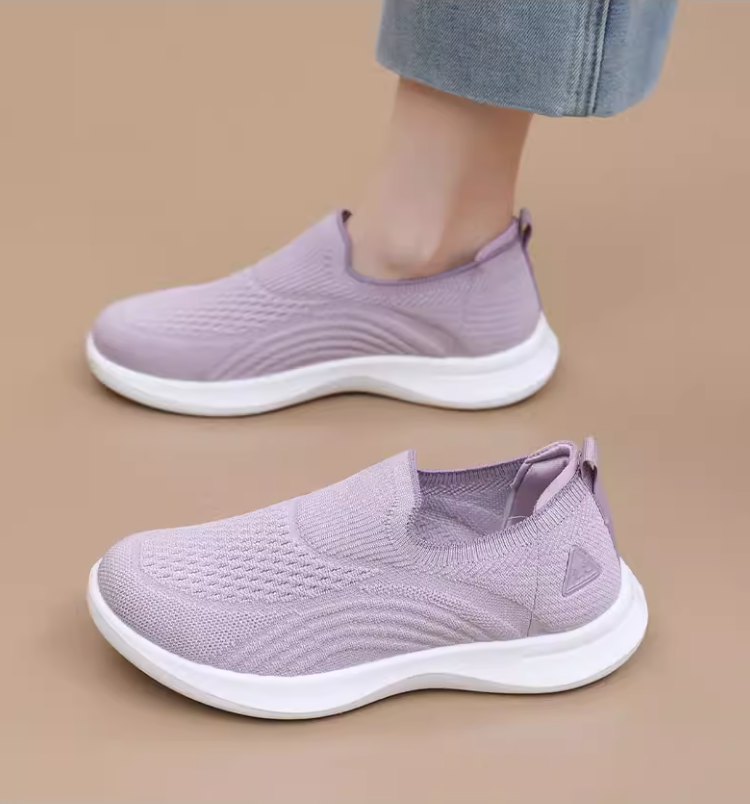
If you want a starting point with room across the ball, these flat-soled women’s board shoes in a roomier cut are the shape to compare against. For something lighter, this breathable mesh walking shoe with a removable footbed is the one to check the girth on. If width is only half your problem, the three-pair leather test on an 11°C morning shows how uppers behave after a week of wear. For the gym side of the question, this treadmill walking shoe comparison covers cushioning on a flat belt. The wider sneaker styles are worth a scan as well.
Measure your girth tonight. Two minutes, and the size-up, size-down loop ends for good.
