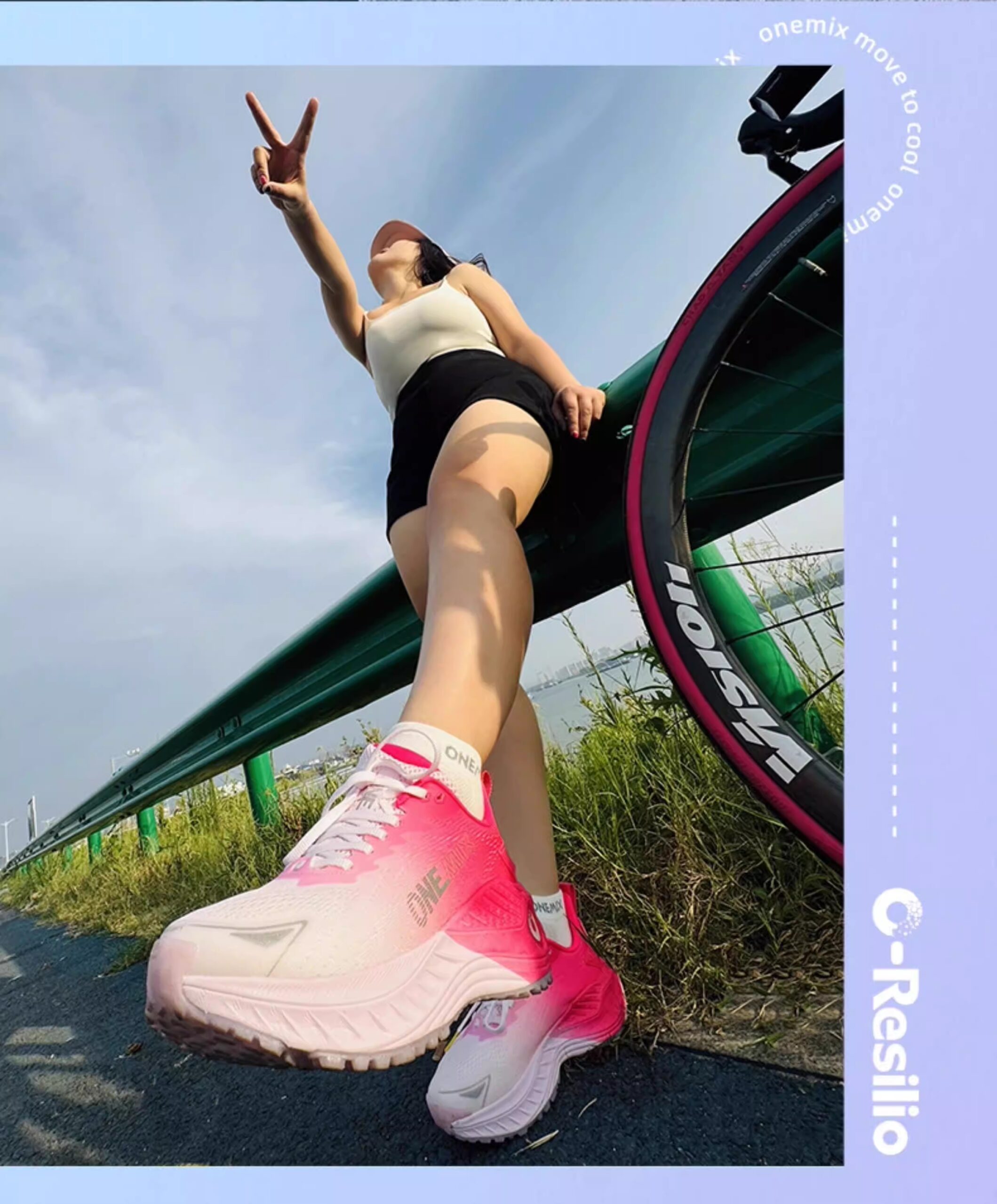
On a shop floor, red sells faster than any other running colour and comes back less often than people expect. That gap between buying and returning tells you something useful. People don’t regret the colour. They regret paying full price for a pair they wear twice a week for six months and then leave by the door.
So the useful question isn’t whether red running sneakers for women look good. They do, in a way that black and grey never quite manage. The useful question is what a pair costs you per wear, and which parts of the shoe decide whether that number lands at 40p or £2. That’s the calculation customers almost never run before they pay, and it’s the one that changes the answer.
What the running shelf is actually selling
Three tiers sit on the same wall, and the price gap between them is rarely about how fast the shoe is. It’s about the midsole, the part under your foot that compresses and returns.
The entry tier uses a single-density EVA foam, which is cheap, light and dead after about 300 to 400km. The mid tier adds a second foam or a plastic plate, which holds its bounce longer. The top tier uses a supercritical foam that’s genuinely better and costs as much as three pairs of the entry tier.
For most women buying a red pair for daily walking and the occasional jog, the entry tier is the honest answer. It does the job, it looks the same from a metre away, and the difference in feel only shows up if you’re running more than 20km a week. What the tier decides is how long the shoe stays comfortable, not how good it looks on day one.
Spec sheets are written to make the entry tier sound like the top one. Ignore the words and look for four numbers: stack height at the heel, stack height at the toe, weight in grams, and the drop between them. A standard road running shoe sits somewhere around 30mm at the heel and 22mm at the toe, which is an 8mm drop. If the sheet doesn’t list them, the shoe was designed for looks rather than mileage.
The cost-per-wear math nobody runs
Take a £110 pair worn three times a week for eight months. That’s roughly 100 wears, so £1.10 a wear. The same person buying a £45 pair that dies after 40 wears is at £1.12. Same number, and the cheap pair felt worse for most of it.
Now change one variable. If you wear them five times a week, the £110 pair drops to about 70p a wear and the gap opens up. If you wear them once a fortnight, the expensive pair is a bad buy no matter how good the foam is, because the calendar kills it before the sole does. Foam degrades sitting in a cupboard too, just more slowly.
Run the same math on a pair you wear once a week for a year. That’s 52 wears, so a £110 pair costs £2.11 a wear, and a £55 pair that lasts the whole year costs £1.06. At that frequency the cheap pair wins clearly, and buying the expensive one is a decision about comfort rather than value. There’s nothing wrong with that, as long as you know which decision you’re making.
That’s the whole trick. Cost per wear rewards frequency, and it punishes anyone buying for a version of themselves they haven’t become yet. The pair you’ll wear on the school run, the supermarket and the walk to the station is the one that earns its price. The pair saved for a hobby that happens twice a month is the one that doesn’t.
In this trade, that’s the mistake that repeats every season.
Where the money actually goes
Three components carry almost all of the cost, and only one of them is visible from outside.
- Midsole foam. The biggest line item and the one that decides comfort. EVA is the baseline; anything with a second foam or a plate costs more and lasts longer.
- Outsole rubber. Carbon rubber on the heel lasts; blown rubber at the forefoot is lighter and wears faster. A pair with rubber only in two patches is a road shoe, not a trail shoe.
- Upper and lining. Engineered mesh is cheap and breathable. Knit costs more and holds its shape better. A padded collar adds comfort and weight in equal measure.
The stitching and glue matter less than people think at this price. What separates a pair that lasts from one that doesn’t is the foam and the outsole rubber. Everything else is styling.
There’s a rough field test for foam that costs nothing. Press your thumb into the midsole at the heel, hold for three seconds, and let go. It should spring back quickly and leave only a faint mark. If the dent stays visible for more than a few seconds, the foam is already tired, which tells you something about a pair that’s been sitting in a warehouse for two years. Outlet stock is where this shows up most.
Plates deserve a word because they’re the most oversold feature. A plastic plate stiffens the forefoot and helps the shoe roll forward. A carbon plate does the same thing more aggressively and costs several times as much. Neither makes you faster in any meaningful way at walking pace, and both make the shoe less flexible, which some feet hate. If you’re not running, a plate is weight and money you don’t need.
One detail worth checking: turn the shoe over. If the outsole rubber is thinner than about 3mm at the heel, it’ll wear through to the foam within a season of daily walking, and once the foam is exposed the shoe is finished. A lightweight cushioned running pair with a proper heel patch is built for exactly that kind of daily use.
Red fades first, and it isn’t the dye’s fault
Red is the most light-sensitive colour on a shoe. Pigments in that range break down under ultraviolet light faster than black, grey or navy, and a pair left by a south-facing window will visibly shift within a season. Indoors, on a foot, the change is slow. On a sunny windowsill, it’s a different story.
What you’ll see is a fade towards orange at the toe and the collar, the two areas that catch the most light, while the panels underneath the laces stay red. The result is a shoe that looks two-toned, which is worse than a shoe that’s simply faded evenly.
Storage is the fix. Keep them in a cupboard or a box rather than on an open shelf, and don’t leave them in the car. If they do fade, there’s no product that brings the original red back. Dye pens exist for small scuffs and they work, but they can’t reverse a panel that’s gone orange.
Rain matters less than people fear. Modern mesh and synthetic uppers handle water fine. What kills them is heat, so never dry a running shoe on a radiator. Stuff with newspaper and leave it in air.
Cleaning red is easier than people expect, as long as you skip the washing machine. Lukewarm water, a soft brush, a drop of mild detergent, and a rinse with a damp cloth. Don’t scrub hard at the toe, because that’s where the mesh is thinnest and where the colour sits closest to the surface. Let them air dry with the insoles out. Putting red shoes through a hot wash is the fastest way to turn them pink.
Fit and gait: the ten minutes that matter
Running shoes are sized differently from fashion sneakers, and the gap is often half a size. Most running brands build in roughly a thumb’s width at the toe, so your usual size may feel long. That’s intentional. Your foot spreads when it lands, and the extra length is what stops your toenails from paying for it.
Try them on with the socks you run in, at the end of the day. Stand up and check the longest toe has 8 to 10mm of room. Then walk, don’t just stand. Watch for heel lift, which means the collar is too low or the lacing is wrong, and for pressure across the top of the foot, which means the instep is too shallow for you.
Gait matters more than arch height, whatever the shop assistant says. If your foot rolls inward noticeably, a firmer midsole helps. If it rolls outward, a softer one is usually kinder. Neither is a medical assessment, and anyone selling you a shoe as a cure is overselling.
If you wear orthotics, take them with you and try the shoe with them in. Most running shoes have a removable insole, and the ones that don’t are a problem, because the factory insole is usually glued in and adds a few millimetres you can’t get back. A shoe that’s comfortable with its own insole can become tight with a custom one, and there’s no fix for that except a bigger size.
If you want a pair for the gym and the walk there, rather than actual running, a spring-weight sports-leisure pair with a flatter sole is more stable for lateral movement, and it won’t feel like a running shoe you’re not using properly.
When the loud pair is the wrong buy
Red running sneakers fail in three specific situations, and it’s worth naming them before the price tag does the talking.
They fail as a single pair for a formal-ish workplace, because red reads casual at any price. They fail as a travel shoe if your trip involves dressing up once, since they’ll be the loudest thing in the bag and the hardest to match. And they fail for anyone who wants one neutral pair to do everything, because a red shoe commits you to a palette every time you put it on.
Where they win is the opposite case. If your wardrobe is denim, grey and white, a red pair is the thing that stops the outfit looking like a uniform. If you walk a lot and want the shoe to be the interesting part, red does more work than any other colour. And if you already own a neutral pair, a red second pair is a rotation decision, not a statement.
The economics support that. Two pairs rotated last about twice as long as one pair worn daily, because the foam gets 24 hours to recover between runs. If you’re spending £110 anyway, splitting wear across two pairs is the only real way to lower the cost per wear without lowering the quality.
There’s a second-order benefit to rotation that doesn’t show up in the math. Two pairs let you keep one clean for anything that matters and one for wet days and errands, which means the good pair gets worn in better conditions and lasts longer than the hours suggest. It’s the same logic as owning one dark coat and one light one, except shoes take more abuse from the ground.
Buy red if you’ll wear it at least three times a week and you already have a neutral pair to fall back on. Skip it if it’s going to be your only pair, or if you’re buying it for a version of your week that doesn’t exist yet.
Pay for foam and outsole rubber, not for the colourway. Check the heel rubber is at least 3mm, check the toe has a thumb’s width, and check the shoe is silent when you walk. Those three checks predict more about how long you’ll keep wearing them than any review.
If you want the styling side, the hot-weather commute notes on backless tennis shoes cover how a light pair behaves in heat, and the winter notes on business-casual comfort handle the other end of the year. The full women’s shoe collection is where to compare soles before you commit.
One last thing from the returns desk. The pair people keep is almost never the brightest one they tried. It’s the one that fit in the first two minutes and didn’t need convincing. Start there, and let the colour be the last decision rather than the first.