

A size 43 with a bow on the toe is not a bigger version of a size 36 with a bow on the toe. The pattern is scaled, the last isn’t, and the bow grows into a place where there’s less room for it. That gap is where most returns on bow heels come from, and it almost never gets mentioned on the product page.
Most buyers notice the bow first. The width is what decides whether the pair stays in the wardrobe past the first wedding. Above a size 10, three things move at once: the vamp gets longer, the toe box gets shallower in proportion, and the strap anchors shift outward. Bow heels for women are unusually sensitive to all three, because a bow sits exactly where the foot needs to bend.
What follows comes from fitting-room patterns rather than a single brand. Sizes are given in both EU and US so the numbers line up whichever chart the shop uses.
The bow is a structural problem before it’s a decorative one
A bow adds between 4 and 9mm of material across the vamp, depending on how it’s tied. On a small size that’s a decorative lump. On a long vamp it becomes a fold that sits over the metatarsals, right where the shoe has to flex as the foot rolls forward. Every step pushes that fold into the same spot.
That’s why so many people describe bow heels as “fine for an hour”. The first hour is seated or standing. The second hour involves walking, the vamp flexes, and the knot starts pressing. By hour three the pressure point is a red mark on the top of the foot, and no amount of gel padding fixes it, because the pad adds volume under a bow that already has none to spare.
Three construction details decide whether a bow pair will be wearable:
- Whether the bow is tacked flat or left loose. A flat-tacked bow distributes pressure; a loose one bunches.
- Where the knot sits. Centred on the vamp is safer than pushed toward the toe, because the toe has no give.
- What’s under the bow. A leather lining with a seam under the knot is the worst case. Ask, or feel it with a thumb.
The decorative side is easier to judge. Satin bows crush in storage and never come back. Grosgrain holds its shape and hides creases. Leather bows crease once, in a single line, and then look intentional. Metal or crystal bows are the ones to avoid above a size 10, because a rigid element that doesn’t flex with the vamp will rub at the edges as the foot moves.
One more thing that rarely shows in photos: a bow makes the toe look shorter than it is. On a long foot that’s usually welcome, and it’s the main reason bow heels get bought in the first place. The trade is that the same bow hides the toe box depth, so a pair that looks roomy in the shop can still pinch the little toe.
The way to check that before you pay is simple. Take the pair in your normal size, put it on, and press your thumb down on the leather above your little toe. If the leather gives without touching the toe, you have room. If your thumb hits something solid, you don’t, and the bow is hiding it.
Above a size 10, the last is graded, not scaled
Grading means each size is built from the same base pattern with proportional adjustments, usually 4 to 5mm of length and about 1.5mm of width per size. Not every factory grades width at all. Plenty add length and leave the width alone, which is why a size 42 can feel like a size 39 with extra room at the toe and nothing across the ball.
That’s the single most common surprise in this size range. The foot doesn’t get longer in the same proportion as it gets wider, and women’s lasts are usually built on a B or C width. Above a size 41, the standard width assumption starts failing for a large share of buyers. The Brannock measuring device exists precisely because length alone predicts so little, and its width scale is the part most shops ignore.
The visible symptom is a shoe that fits at the heel and hurts at the ball. The usual wrong fix is sizing up, which buys 5mm of length and about 1.5mm of width while adding heel slip. Heel slip then gets “fixed” with an insert, the insert takes up the volume, and the ball is tight again. That loop can eat three exchanges.
What actually helps is a wider last in the same length, or a style with a rounder toe and a higher vamp. Bow heels with a pointed toe and no platform are the hardest combination to grade well, because the point removes width where the foot needs it most.
Heel pitch changes with size too, and this is where the leg line goes wrong. A 90mm heel on a size 36 foot creates a steeper ankle angle than the same 90mm on a size 43, because the foot is longer and the rise is spread over more length. In practice, a taller wearer can carry a higher heel in comfort. The pair that felt fine in the shop at 85mm may be the one that aches at 100mm, even though both are “the same” shoe.
That single point explains a lot of conflicting reviews. Two people writing about the same pair at the same height can be describing completely different shoes, because their feet are 30mm apart in length. When you read a review, check the size the reviewer wore before you take the comfort note seriously.
The bow lands differently on a wider vamp
Wider vamp, longer bow. On a size 44, a bow that measures 70mm across on the size 37 pattern can be graded up to 82mm to keep the proportions looking right in photographs. That extra width pushes the bow’s loops out past the edge of the toe on some lasts, which is where the “why does this look like a gift” reaction comes from.
There’s a visual fix and a fit fix. The visual one is a smaller bow, either by choosing a style with a single-loop knot or by re-tacking an existing bow to half its spread. A cobbler will do the second for under €10 and it changes the shoe more than any other alteration at that price.
The fit fix is about where the vamp edge sits. Push a finger under the bow. If the leather lifts easily and you can feel space, the bow isn’t loaded and it’ll stay comfortable. If the leather is taut under your thumb, the bow is sitting on tension, and that tension turns into a pressure line within an hour of walking.
Wider feet also change how the bow reads from the front. A narrow foot makes a bow look like an accessory; a wider foot makes it look like part of the structure. Neither is wrong, but it explains why the same pair gets wildly different reactions from two people wearing the same size.
Where the grading goes wrong: toe box, heel counter, strap length
Three failure points show up again and again in this size range, and all three are measurable in the shop.
- Toe box depth. Should clear your tallest toe by 6mm with weight on the foot. Test by standing, not sitting. Sitting adds roughly 4mm of apparent room.
- Heel counter height. Should sit below the ankle bone, not on it. On larger sizes the counter is often graded taller, which is where the “cuts into my ankle” complaint comes from.
- Strap length. Ankle straps are frequently graded to the smallest hole, so the last hole is two holes short. A strap that only just closes will open under walking load.
Strap length is the one people underrate. A Mary Jane or slingback that fastens on the tightest hole has no reserve, so the leather stretches by millimetres over a month and the strap starts slipping off the heel entirely. Buying the pair that closes on the middle hole gives you room in both directions.
The heel counter issue has a workaround that costs nothing. If the counter sits on the bone, a heel grip pad raises the foot by 2mm and moves the contact point up. It’s a temporary fix, and it costs you 2mm of toe room, but for a pair you already own it’s often enough.
There’s a fourth problem that isn’t about grading at all: the insole. Most women’s heels above a size 41 come with the same 3mm foam insole as the small sizes, which is fine for a size 37 foot and thin for a longer, heavier one. Replacing it with a 4mm leather insole changes the whole feel of the shoe for about €12, and it’s the cheapest upgrade available.
If you’ve been wearing the pair for a month and it still feels hard under the ball of the foot, that’s the insole talking, not the shoe. Swap it before you decide the last is wrong. A surprising number of pairs get retired for a problem that a 4mm layer would have solved.
For context on how heel height and ankle angle interact, the history and mechanics of the high-heeled shoe is a decent primer. It won’t solve a sizing question, but it explains why the pitch changes what your calf does, which is the part that decides whether an evening ends at 10pm or midnight.
What to size up, and what to never size up
Sizing up is a tool, not a default. Used on the right style it solves a problem. Used on the wrong one it creates heel slip, and heel slip is harder to fix than tightness.
Size up when the shoe is closed, leather, and the only tight point is across the ball. Size up half a size at a time and check the heel before you commit. Leather gives about 3mm across the width in the first month, which is often exactly the amount you needed.
Don’t size up when the shoe has an ankle strap or a slingback. The strap is graded to the shoe, so a bigger shoe means a looser strap and a heel that lifts out. Don’t size up on suede either; suede gives more than leather and you’ll end up swimming in it. And never size up to solve a toe box that’s too shallow. Depth doesn’t come with length.
If you’re between sizes, the useful question is where the pressure is. Pressure at the widest part of the foot means width. Pressure at the toe tip means length. Pressure on top of the toes means depth, and the answer there is a different last, not a different size.
The alteration that helps most, and the one that doesn’t
A cobbler can shorten a strap, re-tack a bow, add a sole grip, and replace heel tips. None of that costs much. What a cobbler can’t do is make a narrow shoe wider, because widening a last after construction means stretching the upper, and leather only moves about 2 to 3mm before the shape goes.
The best-value alteration on bow heels above a size 10 is re-tacking the bow flatter. It takes ten minutes, costs very little, and removes the bunching that causes most of the pressure. Second best is shortening an ankle strap by 8 to 10mm so it closes on the middle hole instead of the last one.
The one that doesn’t work is adding a padded insole to a shoe that’s already tight in the toe. The padding lifts the foot into the vamp, which steals depth. It feels better for 20 minutes and worse for the rest of the day.
If the pair has a covered platform, check the platform height before any alteration. Platforms change the effective heel pitch, and a cobbler who shortens the heel without accounting for the platform will change how the shoe rolls. Ask for the pitch to be measured, not guessed.
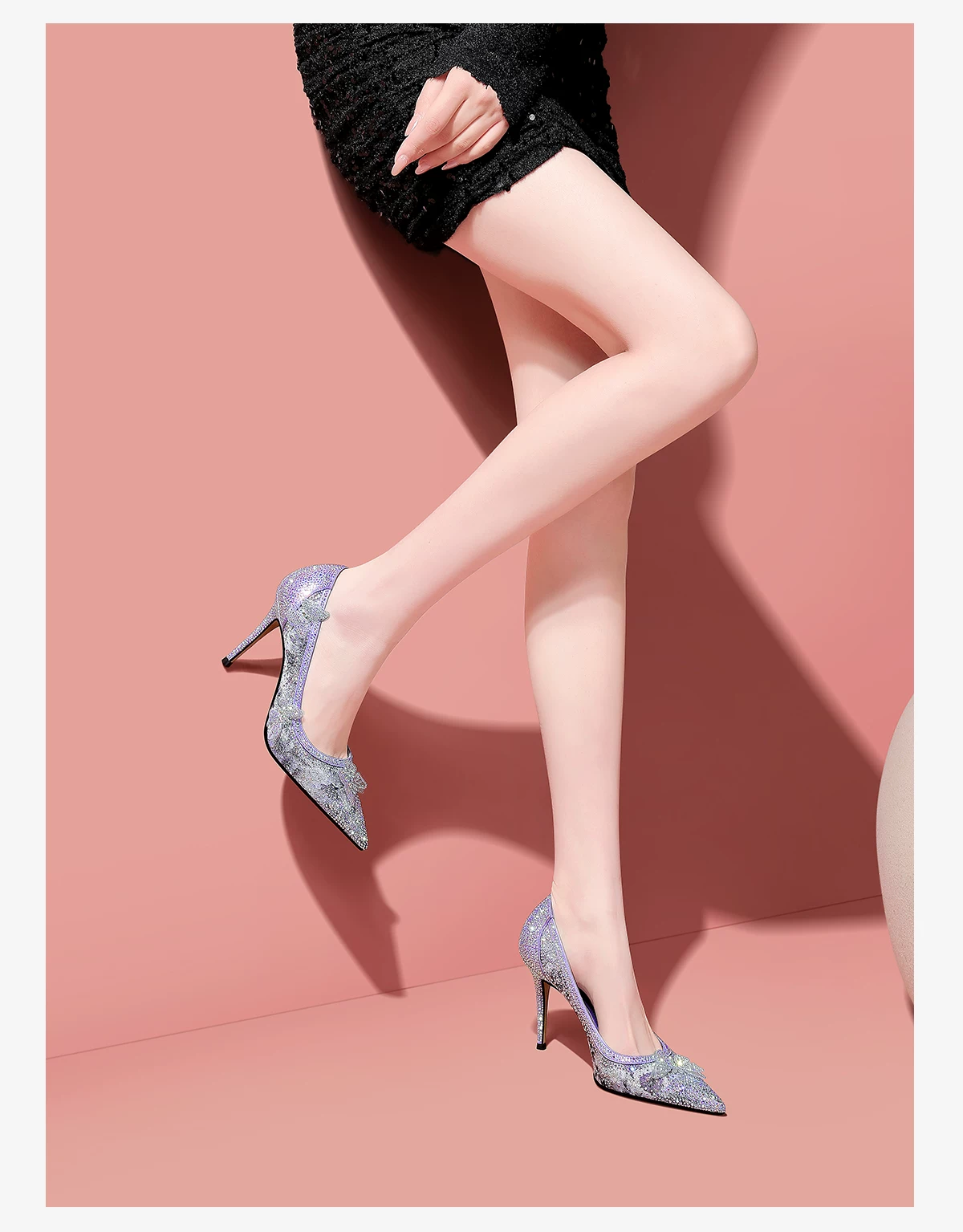
A pair with a larger bow and a wider vamp, like these crystal butterfly heels with a structured bow, is a good example of a shape that was built with volume above the toes. That’s the geometry to look for if your toes need depth rather than length.
For a pair that’s otherwise right but slightly too long, a butterfly-tie heel with a slim heel shows the geometry that tolerates a half insole well, because the vamp has room above the toes. Compare that with a low-cut pointed pair and the difference is obvious once you know to look for it.
How to test a pair before you leave the shop
The shop test takes four minutes and catches most of what a return would catch three weeks later. Do it standing, on a hard floor if there’s one nearby, and do it in the afternoon when the foot is at its widest.
- Minute one: stand still, weight even. Any pressure line on the top of the foot means the vamp is too low, and it won’t improve.
- Minute two: walk 30 steps. Listen for the heel counter rubbing at the ankle bone.
- Minute three: push off hard from the ball of the foot, five times. Watch whether the heel lifts out of the shoe.
- Minute four: sit down and check the strap holes. You want the middle hole, not the last.
If the pair passes all four, the odds are good. If it fails one, decide whether the failing point is fixable by a cobbler for under €15. If it isn’t, walk away, even at a discount. A bow heel that doesn’t fit is the most expensive kind of cheap.
One last check that sounds fussy but isn’t: look at the pair from the side while wearing them. If the bow sits forward of the toe joint, the shoe will look too small even when it fits, because the eye reads the bow as the front of the foot. A bow set back over the joint reads as part of the shoe and the proportions settle.
Take a photo from the side before you take the tags off. The camera sees the proportion more honestly than the mirror does, and it’s easier to be ruthless about a pair when you’re looking at a picture rather than your own feet in a shop you’ve already spent twenty minutes in.
None of this makes bow heels a bad buy above a size 10. It makes them a buy that rewards two extra minutes of checking. Look for a wider last, a flat-tacked bow, and a strap that closes on the middle hole, and the pair will last as long as any other shoe in the wardrobe. The bow heels collection runs across several lasts, so the same bow often exists in a shape that suits a longer foot better. Try the second one before you accept the first.
And if the pair you love only comes in a narrow last, that’s a real answer too. Some shoes are worth admiring from a distance. Buy the version with a wider toe and keep the narrow one on the wish list for a season when your feet have had an easier week.
