

You have a nine-hour day ahead: seven in the office, forty minutes of it on your feet in a meeting room, and a commute that involves two changes of train. The shoes you wear will decide whether hour eight feels like hour eight or hour eleven. Most people choose them in a shop, in ten minutes, by looking in a mirror.
That’s the wrong test. A work heel is a piece of equipment you’ll use five days a week, and it should be chosen with three measurements and one honest assessment of how long you actually stand.
Before you pick a pair, check three things. Most people get the second one wrong.
Start with your real standing time, not with the shoe
Nobody stands for eight hours. Office work is a mix: 25 minutes sitting, ten minutes in a corridor, an hour in a meeting, a walk to lunch. Ask yourself two questions and write the answers down. How many hours are you out of the chair on a normal Tuesday? How many of those hours are spent walking rather than standing still?
The answers change the shoe you should buy. If you’re seated 85% of the day with short walks to a meeting room, a 70mm heel with a slim profile is fine, and the visual benefit is worth the compromise. If you spend four hours on your feet on a tiled floor in a pharmacy or a reception desk, the calculation flips. Every 10mm of heel height adds load to the ball of your foot, and a hard floor returns none of it.
Most people overestimate how much they walk and underestimate how much they stand still. Standing still is harder on a heel than walking, because walking uses your calf and ankle to share the load and standing still parks all of it on the forefoot. A pair that feels fine on a 20-minute walk can be unbearable after 40 minutes at a counter.
One practical way to measure this: keep your work shoes in the car for a week and note the time you take them off. If you’re kicking them off under the desk by 2pm, the problem isn’t your feet. It’s the shoe, and no insole will fix a shoe that’s 15mm too tall for your day.
This is where most advice about high heels for work goes wrong. It treats them as one category, when a shoe worn for a seated desk and a shoe worn behind a counter are different tools. Before you read another style guide, decide which of those two days is yours, because the answer rules out half the market immediately.
If your week is mixed, buy for the hardest day. A pair that works on your busiest Tuesday will work on the quiet Thursday too, but the reverse is never true.
Three numbers on the box predict more than the photos do
Ignore the styling language and look for measurements. These three tell you most of what you need.
- Heel height in millimetres. Not “mid” or “high”. A 60mm to 70mm heel is the usual ceiling for a full shift on a hard floor. 85mm and above is an event shoe, not a Tuesday shoe.
- Forefoot platform or sole thickness. A 10mm platform under the ball of the foot takes 10mm off the effective pitch. A 90mm heel with a 20mm platform behaves like a 70mm heel, which is why some tall-looking shoes are surprisingly wearable.
- Toe box width at the widest point. If a listing doesn’t give it, look at the top-down photo and compare the width of the toe to the width of the heel. A toe narrower than the heel will squeeze the joint that carries your weight.
Anything the listing leaves out, assume is unfavourable. Sellers who have measured their shoes usually publish the numbers, because those numbers sell shoes to people who have been burned before.
The pitch angle matters as much as raw height. Two 80mm heels can put your foot at very different angles depending on where the heel sits under the shoe and how thick the forefoot is. That’s the difference between a shoe you can wear to a client meeting and one you carry in a bag. The same arithmetic is what makes platform heels a subtraction problem rather than an addition one.
Write the three numbers on your phone before you shop. When a listing gives you only two of them, that’s information too: it usually means the toe width is the weak point. You’ll find that most high heels for work are sold on looks and heel height alone, and the two measurements that decide comfort are the ones left in the warehouse.
Heel height: where 70mm comes from
The 70mm figure isn’t a style opinion, it’s a trade-off. Below 50mm, the shoe starts to look like a court shoe with a wedge and loses the line most people want at work. Above 85mm, the angle of your foot pushes your weight onto the ball and toes, and your calf stays contracted all day. Between those two, 60mm to 70mm keeps a recognisable heel silhouette while leaving enough range in your ankle to walk normally.
Your own range depends on ankle flexibility and calf length, which is why two colleagues can wear the same pair with different results. If you rarely wear heels, start at 50mm to 60mm and add height after a month, not after a weekend.
There’s also a fit consequence nobody mentions. The higher the heel, the further forward your foot slides, and the more your toes press into the front. That’s why a 90mm pointed shoe in your usual size can feel a size small. If you go up in height, go up in length too. Going past 80mm without toe pressure is mostly about giving your toes somewhere to go.
Height also changes how you walk, not only how your foot feels. A tall, thin heel shortens your stride, which means more steps for the same corridor and more time on the ball of your foot. If you notice yourself taking small, careful steps by mid-morning, that’s not fatigue. That’s the shoe setting your pace.
Sensible high heels for work sit in a narrow band: tall enough to keep the line you want, short enough that your heel touches down without you thinking about it. If you can hear yourself landing, the heel is too tall for the floor.
Materials decide what hour six feels like
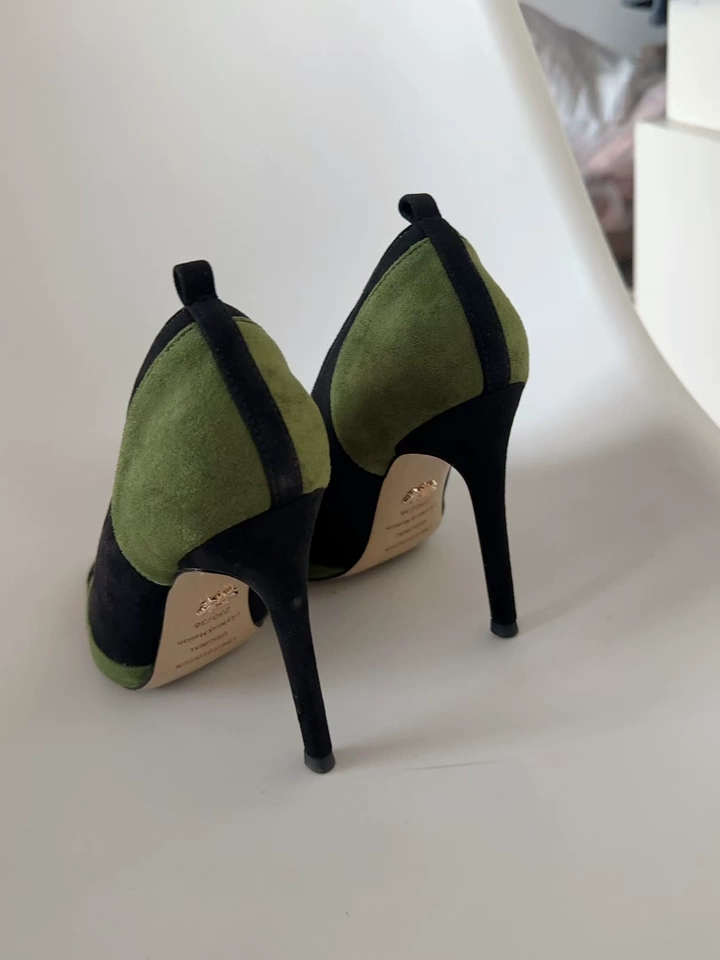
Leather and suede move with your foot and let some moisture out. Patent and synthetic patent look sharper under office lighting and breathe far less. Neither is wrong, but they suit different days. If your office is air-conditioned and you’re mostly seated, patent is manageable. If you walk to a site visit in July, it isn’t.
Lining matters more than the outer. A leather-lined shoe with a suede-covered insole absorbs sweat and stops your foot sliding forward. An unlined synthetic shoe turns into a slip hazard by mid-afternoon, and the sliding is what causes the toe crush. Turn the shoe over and look inside before you buy.
OEKO-TEX certification is a reasonable signal that the materials have been tested for harmful substances, which matters for something you wear 40 hours a week. It says nothing about breathability, so treat it as a baseline rather than a comfort promise.
For a five-day shoe, a slightly matte finish is the pragmatic choice. Patent scuffs show at the toe, and a scuff on a black patent heel reads as careless in a way that a scuff on suede doesn’t. Suede needs brushing, but it ages better in an office than a shiny synthetic that starts to craze at the flex point after three months.
The flex point is worth checking before you buy. Bend the shoe where your toes bend. If the upper creases into a hard ridge, that ridge will press on your toes every time you step. Leather creases softly. Cheap synthetic creases sharply, and the crease line is where the material eventually splits.
Stitching is the other tell. Look at the join between upper and sole. A stitched join can be repaired by a cobbler for a small fee. A glued join can’t, and once it lifts at the toe it’s finished. The pair you keep for three years is almost always the stitched one.
Weight is the number nobody lists
Pick up the shoe with one finger. A work heel that weighs over 400g per shoe is heavy enough that you’ll notice it on stairs by the end of the day, and heavy shoes are the ones people describe as tiring. A block heel distributes load better than a stiletto, but a chunky rubber sole can add 150g. That’s the trade.
You’ll feel it most on stairs and on the walk from the station. Ten flights a day with an extra 150g per foot is not nothing, but it’s also not the main problem. The main problem is usually a heel too tall for the floor you stand on. Sort the height first, then the weight.
There’s a related measurement that costs nothing to check: the heel tip. A worn tip changes the angle of the whole shoe and makes you walk on the edge of the heel. Look at a pair you already own and see whether the plastic tip is flat or angled. If it’s angled, the shoe is a repair away from feeling new again, and most cobblers replace tips for under £10.
Heel shape matters too. A block heel spreads load across a wider base and is far more stable on carpet edges and pavement grates. A stiletto concentrates everything on one small point, which is fine on an office carpet and punishing on a station platform. For high heels for work, the block is the safer geometry, and the visual difference at ankle height is smaller than people fear.
One last number: the heel-to-toe drop. Measure the height at the back and at the front and subtract. That figure, not the headline heel height, tells you how much your foot is being pitched forward before the platform has done its work.
The desk test: what to try before you pay
Shop lighting and mirrors are designed to sell. Use five minutes to gather data instead.
- Walk 20 paces on hard flooring. Carpet hides a heel that slides. Tile shows you whether the sole grips.
- Stand still for two minutes. This is the real test. If your toes go numb, the toe box is too narrow, no matter how good the sizing feels.
- Stand on the balls of your feet and back down. Any heel slip means the shoe is too long or the counter is too soft.
- Sit and cross your legs. Check whether the top line digs into your instep. If it does now, it will all day.
Do all of that in the afternoon, ideally after 4pm, when your feet are at their largest. Feet swell by a few millimetres over a working day, which is enough to turn a good fit into a tight one.
If you’re buying online, repeat the same sequence at home on a hard floor within the return window. Keep the box until you’ve worn them indoors for an hour. I’d rather return a shoe twice than wear a bad one for a year.
There’s one more test worth doing, and it takes a full day: wear them to work on a day you know will be ordinary. Not a presentation day, not a day with a client lunch. An ordinary Tuesday is the only honest test of high heels for work, because it’s the day that repeats 200 times a year.
Note when you first notice them. If you’re aware of the shoe in the first hour, you’ll be thinking about it by three. If you forget about them until lunch, that’s a good sign, and if you forget them entirely until you take them off at home, buy a second pair in another colour.
The kit that makes a work heel survive the week
Two products, under £15 total, do most of the work.
A thin leather or felt insole. It absorbs sweat, stops the forward slide, and takes up the half-size gap if you bought slightly large. Replace it every few months; they flatten.
Heel grips or a heel pad. Not for comfort, for stability. A heel that moves a few millimetres causes blisters and makes you walk with a shorter stride, which is what actually tires you out.
What you don’t need: expensive gel cushions that lift your heel out of the shoe, sprays that promise to stretch synthetic uppers (they mostly don’t), and a drawer full of blister plasters you’re using instead of fixing the fit. Plasters are a symptom patch, and the underlying problem is shoe length or width.
One more item worth keeping at your desk: a second pair. Alternating shoes gives the lining a full day to dry out, which doubles the life of the shoe and reduces the smell problem that synthetic linings develop in summer. Two pairs worn alternately last longer than three pairs worn out of rotation.
If your feet still hurt after all of this, the problem may be the floor rather than the shoe. A thin rubber mat under your desk costs less than a new pair and takes pressure off the forefoot while you stand. Several offices will supply one if you ask, and it’s a much easier conversation than a request for a shoe allowance.
For anyone who stands for most of the day, a 20-minute stretch routine in the evening does more for next morning’s comfort than any product in this section. Calves and ankles carry the load when you’re in heels, and they’re the parts nobody thinks to stretch.
Where a work heel is the wrong call
If your job involves ladders, loading bays, wet floors or 15,000 steps, no heel is the right answer, and no amount of product research will change that. A low block heel can work in an office, not on a warehouse floor. Safety first, always.
It’s also the wrong call if you have an existing forefoot problem. A heel above 50mm transfers load to the ball of the foot and the toes. If you already have pain there, a heel will make it worse, not better. The biomechanics of high heels are well documented, and the summary is that they change how you walk rather than just how you look.
The honest version: for many office jobs, a 40mm block heel or a smart flat is the smarter buy, and nobody in the room notices the difference. High heels for work are a preference, not a requirement. If your workplace expects them, that’s worth a conversation with HR, not a conversation with a podiatrist in five years.
Here’s a rule I’d apply: if the shoe hurts before you leave the house, it will hurt at lunchtime too. Pain that appears in the first ten minutes doesn’t fade. Pain that appears after four hours is usually a height or floor problem, and it’s worth solving with a different shoe rather than a different insole.
There’s also a professional angle that rarely gets said out loud. Turning up in pain doesn’t read as commitment. It reads as distracted, and the person who is comfortable in a 50mm heel across a long meeting usually performs better than the one in an 85mm heel counting down the minutes.
One last case: clients who visit sites, showrooms or factories. Concrete floors and steel stairs are unforgiving, and a heel tip on a steel tread is a slip risk rather than a style statement. Keep a flat pair in the car for those days and change at the door. Nobody has ever been judged for arriving in trainers and putting heels on at the entrance.
A buying order for a first proper pair
Height first: 60mm to 70mm, or lower if you’re new to heels. Then toe shape, with round or almond beating pointed for a full day. Then material, with leather or suede lining ahead of unlined synthetic. Then colour, and black or a dark neutral will outlast anything else in a work wardrobe.
A pair that fits this brief doesn’t have to look boring. A commuting heel with a moderate pitch covers the brief and still reads as a heel from across a meeting room. If your office leans formal, a suede soft-soled pair in black is the version that survives five days a week without looking tired by Friday.
And if you want the same logic applied to boots for the colder months, the measurements are the ones the size chart leaves out of boot listings.
Buy one good pair before you buy three cheap ones. The maths is boring and it works: a £110 pair worn five days a week for two years costs less per wear than a £35 pair that dies in four months, and it hurts less along the way. Keep the receipt, keep the box for a fortnight, and be willing to send a pair back.
When you’ve found a shape that works, buy the same shape again in another colour rather than experimenting. The second pair is the one you’ll actually wear, because by then you know it fits. Most people’s favourite work shoe is a repeat purchase, not a discovery.
The test at the end of all this is simple. At 6pm, are you still standing the way you stood at 9am? If yes, the shoe is doing its job. If you’re shifting from foot to foot and counting the minutes to the train, the height is wrong, and the fix is 15mm, not a new personality for your wardrobe. Browse the rest of the heel range with a tape measure in hand, and buy the pair that matches your Tuesday, not the pair that matches a photo.
