

Picture the last time a pair of shoes made you look at your legs and think, that’s not what I expected. Not the shoes. The line. You put on a black and white pair, turned to the mirror, and something about the proportion read wrong, so you blamed the skirt.
Nine times out of ten the hem was fine. The shoe was the variable. Two-tone shoes cut the foot into blocks of colour, and each block changes where your eye decides your leg ends. Change the hem by 3 cm and the same pair looks completely different, which is why black and white heels for women get returned more than plain black ones. People keep the shoe and change the outfit, or keep the outfit and give up on a shoe that was never the problem.
Walk through this with me and you’ll stop guessing.
Where the hem lands on a 160 cm frame and on a 172 cm frame
Stand barefoot in front of a full-length mirror and find the point where your leg looks longest. It’s usually a hand’s width above the kneecap, maybe 10 to 13 cm, and it’s higher than most people assume. That point doesn’t move much with height. What moves is how far down the shoe you can go before the line breaks.
On a 160 cm frame, a hem at 12 cm above the knee with a 50 mm heel leaves a long unbroken stretch of leg between hem and shoe. The two-tone shoe then works, because the white block at the toe acts like an arrow pointing down and the leg reads longer than it is. Drop that hem to 2 cm above the knee and you’ve lost the stretch, so the white toe starts to look like a separate object sitting on your foot.
On a 172 cm frame the maths flips. There’s enough leg for a lower hem, and you can wear the same shoe with a skirt that ends mid-calf without it costing you anything. What you can’t do as easily is the very short hem plus a heavy two-tone shoe, because the shoe starts to read as the widest, loudest element in the frame.
So the useful rule isn’t “shorter women need higher heels.” It’s that the gap between hem and the top of the shoe does the work, and that gap should be at least 15 cm if the shoe has a colour break near the ankle.
Heel height shifts the whole picture by a couple of centimetres, so pin the skirt in flats if that’s what you’ll wear to work and accept that the same skirt will read differently at 70 mm. You can’t own one hem that suits every shoe. You can own two skirts.
Why a two-tone shoe reads shorter than a nude one
Colour at the foot either continues the leg or interrupts it. A nude or skin-tone shoe continues. A black shoe ends the leg at the ankle and starts a new line. A black and white shoe does that twice.
The interruption isn’t automatically bad. It’s a deliberate look, and it’s been one since the 1920s, when the heeled shoe moved from riding and court dress into everyday fashion and contrast panelling became a way to make a plain outfit look considered. The trick is knowing that you’re trading length for contrast, and adjusting the hem to pay for it.
White also carries a seasonal signal that has nothing to do with proportion. In northern Europe a white toe in February reads as a mistake to some eyes, and the same shoe in July reads as the point of the outfit. If you wear yours year-round, expect a few comments and ignore them.
If you want contrast without the shortening effect, keep the light colour at the toe and the dark colour at the heel, not the other way around. A dark toe with a light ankle strap pulls the eye down and inward, and it makes the ankle look thicker than it is. It’s the less forgiving arrangement of the two, and it’s the one most common in cheap versions of the style because a white toe cap is easier to pattern.
There’s a third option that gets ignored: the nearly-two-tone shoe, where the contrast is black against cream or black against grey rather than black against white. The colour break still happens, but the jump is smaller, so the leg reads as one piece with a detail instead of two pieces stacked. If you’ve tried the full black and white look and found it too graphic for an office, this is the version that solves it, and it’s usually the pair you end up wearing weekly.

The ankle strap position that helps, and the one that cuts
An ankle strap is a horizontal line across the thinnest part of your leg, and horizontal lines stop the eye. Placement decides whether that’s flattering or brutal.
A strap that sits just above the ankle bone, right where the leg narrows, works because the contrast happens at a narrow point. A strap that sits 3 cm higher, on the lower calf, cuts across a wider section and makes the whole lower leg look shorter and thicker. On a two-tone shoe this effect doubles, because the strap is often the white part.
Test it before you buy. Put the shoe on, stand with your feet together, and look at where the strap crosses. If the strap is sitting on the widest part of your ankle, try a lower-cut design or a slingback with no ankle strap at all. This one detail matters more than heel height for most people.
If the strap is the problem and you can’t give up the style, a block-heel pair with a lower-cut vamp is the practical compromise. The wider heel keeps you stable, and the lower vamp means the strap sits right at the ankle bone rather than above it.
There’s a workaround worth knowing if you love the look. A strap that’s thin (6 to 8 mm) interrupts less than a wide band, and a strap in the same colour as your skin or your tights interrupts least of all. Thin dark straps over bare legs read as a deliberate detail. Wide light straps read as a boot cut off at the ankle.
Buckle placement matters too, and it’s the detail that separates a pair that looks expensive from one that doesn’t. A buckle on the outside of the ankle is visible from the front and adds a hard point to the line. A buckle on the inside hides it. Most good designs put it inside for exactly that reason, and it’s worth checking in the shop before you get attached to a pair.
The toe shape adds or removes a centimetre
Pointed toes extend the line of the foot, and on a two-tone shoe the pointed white tip acts like an arrow. If you’re 160 cm and wearing a hem 12 cm above the knee, a pointed toe buys you a visible centimetre that nothing else will.
Square and round toes cut that line flat. They’re more comfortable for a wide forefoot, and they’re the better choice if your second toe is longer than your big toe, because a pointed shoe will press on it all evening. You pay for the comfort in line length. That’s a fair trade, as long as you know you’re making it.
Heel height enters the same calculation and gets too much credit. Going from 50 mm to 90 mm adds height but changes the visual line less than most people think, and it changes how you walk a lot. If you want the leg to read longer, a 45 mm heel paired with the right hem usually beats a 90 mm heel with a hem in the wrong place. Proportion is the lever. Height is the decoration.
One more element that changes the toe line: a platform. Twenty millimetres of platform under the ball of the foot doesn’t change how long the shoe looks from the side, but it does change the angle of your foot, which changes how you stand and where your knee sits. In photos the effect is subtle. On your feet at hour four it’s the difference between still walking properly and shuffling.
Worth saying plainly: the pointed toe that buys you a centimetre is also the toe that squeezes your toes together. If you have a bunion or a wide forefoot, the line gain isn’t worth the trade, and an almond toe gets you most of the length with none of the pinch.
Measure with the shoes on, not barefoot
This is the mistake I see most often, and it’s easy to fix. People decide a hem length while standing barefoot, then put on a 70 mm heel and the hem is suddenly 4 cm higher relative to the floor. The hem is the same distance from your waist. The leg underneath it isn’t.
So pin the hem in the shoes you’ll actually wear. If you’re between two pairs, and one of them is the black and white pair you’re trying to build outfits around, pin for that one and accept that the same skirt will sit differently with flats. That’s normal, and it’s why tailored trousers get one hem and casual ones get another.
The convention most tailors work to is 3 to 4 cm of turned-up fabric inside the hem, which is also roughly how much you can let a skirt down later without a visible mark. That number is worth keeping in mind when you buy something at the exact length you want: there’s a little room to move, and it’s usually described in the standard notes on hem construction rather than on the label.
Two numbers worth taking once: your heel-to-floor height in the shoes you wear most, and the distance from your natural waist to the floor in those shoes. Write them in your phone. When you’re shopping for a skirt online and the model is 178 cm in a 90 mm heel, you can do the arithmetic instead of hoping.
If you’re pinning at home, use a tape measure and chalk rather than pins on a hanger. A skirt on a hanger hangs straighter than a skirt on a body, so the hem you mark there will sit about a centimetre higher when you’re wearing it. Mark it on your body, in the shoes, standing up, then take it off and pin along the chalk line. That’s the whole method, and it takes five minutes.
How to shorten a hem without wrecking the drape
If a skirt or dress is 2 to 4 cm too long for a two-tone shoe, shortening it is usually the right call. Past 5 cm, the shape of the garment starts to change, because you’re removing width along with length.
A-line and full skirts take a 4 to 6 cm lift without complaint. Straight skirts and bias cuts don’t. A bias-cut skirt shortened by 5 cm will hang differently, and the flare you liked at the original length disappears. If that’s the garment, raise the shoe instead of the hem, or leave both alone and change the shoe colour.
Ask the tailor to keep the original hem finish if it’s a visible stitch, and to press the new hem for a day before you judge it. Freshly shortened skirts hang short for about 24 hours, which is enough to make people think they’ve ruined something that’s actually fine.
Doing it yourself works for one case only: a straight, unlined hem with a machine stitch you can follow. Iron the hem up, pin every 3 cm, and stitch along the old line. On anything with a lining, a curve, or a visible topstitch, the result usually looks home-made, and you’ll have spent an evening to make a garment worse.
One thing in your favour: hems are the easiest tailoring job there is. Nothing structural is involved, the seam is a straight or gently curved line, and a mistake is invisible from the outside because it lives inside the fold. That’s also why a hem is the cheapest thing to have fixed, and why a skirt you like but never wear can become a skirt you wear weekly for less than a new one.
Cost is worth weighing. A simple straight hem at a local tailor runs the price of a coffee and a sandwich in most cities, and a lined or bias hem costs more. If the skirt was 30 euros, the tailoring can be a third of the purchase, so the honest question is whether you’ll wear it twice as often at the right length. Sometimes the answer is yes. Sometimes the right move is to buy the shoe in a plain colour and never think about it again.
Trousers are the harder case
Skirts have one line to manage. Trousers have two, the hem and the break, and a two-tone shoe complicates both.
The classic trouser length with a heel is a slight break at the instep, hem sitting about 1 cm off the floor at the back. With a black and white shoe, that length hides the white toe entirely when you’re standing still and flashes it when you walk. Some people love that. Others buy the shoes for the look and then never see it.
If you want the toe visible, go for a hem that ends at the top of the foot, roughly 2 cm above the shoe’s vamp. That’s a cropped-ish length that works with a 50 to 70 mm heel and reads intentional rather than short. If you want a clean column, take the trouser to the floor and keep the shoe plain. A two-tone shoe under a floor-length trouser is a wasted detail.
Wide-leg trousers change the calculation again. They already move a lot of fabric, so a busy shoe underneath gets lost. Keep the shoe quiet in shape and let the colour do the talking, or keep the shoe loud and choose a narrow leg.
Winter makes this easier and summer makes it harder. With boots and opaque tights, the hem question mostly disappears, because the tights do the continuity work and the shoe is just a foot at the end. In bare-leg weather the same trouser needs the shorter hem, or the fabric pools on the top of the foot and the white toe never shows. If you only want one pair for both seasons, plan for the summer length and add an ankle boot for the cold months.
One last thing on trousers: check the length sitting down, not just standing. A hem that sits 2 cm above the vamp while you’re upright can ride up over the shoe when you sit and cross your legs, which turns a clean line into a gap of bare ankle at the worst possible moment.
What the camera does differently
You’ll see your outfit in photos more than in mirrors, and the two don’t agree.
A photo taken at chest height flattens the leg and shortens the gap between hem and shoe. A photo taken low exaggerates the shoe and makes the two-tone block read twice as large. Neither is wrong. They’re just different crops of the same thing, and if you’re choosing an outfit for an event with a photographer, that matters.
Practical version: take one photo at eye level and one from waist height before you decide. If the shoes look enormous in the second and fine in the first, that’s normal and it’s not a reason to return them. If they look wrong in both, the hem is probably 3 cm off.
Phone lenses make this worse than it used to be. A wide-angle rear camera at close range stretches whatever is nearest the edge of the frame, and if you shoot downward at your own feet, the shoes take up a third of the picture and look twice their size. Step back two metres, hold the phone at chest height, and let someone else take it. The outfit you see in that photo is closer to what other people see than anything you can shoot one-handed.
Group photos add one more variable: whoever is standing next to you. A bright white heel beside someone’s dark trousers becomes the brightest thing in the frame and pulls attention down. In a wedding line-up that’s usually fine. In a work photo it’s the reason you keep looking at your own feet.
Also check the back view, which almost nobody does. A black heel with a white counter can look great from the front and heavy from behind, especially with a short hem. Ten seconds with a second mirror saves an evening of discomfort about something you can’t see.
Three outfits, and the one swap that fails
Here’s how the same pair behaves across a week, with exact swaps rather than vague advice.
- Work: midi skirt, hem 6 cm below the knee, opaque 40 denier tights. Works because the tights continue the leg into the shoe’s dark section, so the colour break happens at the toe where it’s least disruptive. Swap the tights for sheer 15 denier and it still works. Swap to bare legs and the outfit gets 3 cm shorter instantly.
- Dinner: straight-leg black trousers, hem at the top of the vamp. The white toe shows when you walk and disappears when you sit. This is the most reliable use of a two-tone shoe, and it needs no other styling decisions.
- Weekend: denim midi, hem 10 cm above the ankle, no tights. Loose and easy, and the shoes read as a deliberate odd note. This is the one that divides people, and it’s the one I’d test in a mirror before committing to a whole afternoon out.
The swap that fails is a knee-length skirt with bare legs and a wide ankle strap. Three horizontal lines within 20 cm of each other, no vertical to break them up, and the leg loses about 8 cm of apparent length. If you want to wear that combination, choose a strap-free slingback instead, or add a boot to cover the ankle entirely.
For the version of this shoe in a softer material, a satin pair in the same two-tone blocking behaves slightly differently in photos, because satin picks up light where patent reflects it, and the white block looks less hard-edged under evening lighting. There’s more on how lower heels change the whole silhouette in this breakdown of what 50 mm does to a long day, and if you’d rather compare shapes side by side, the women’s shoes range is sorted well enough to do that in one sitting.
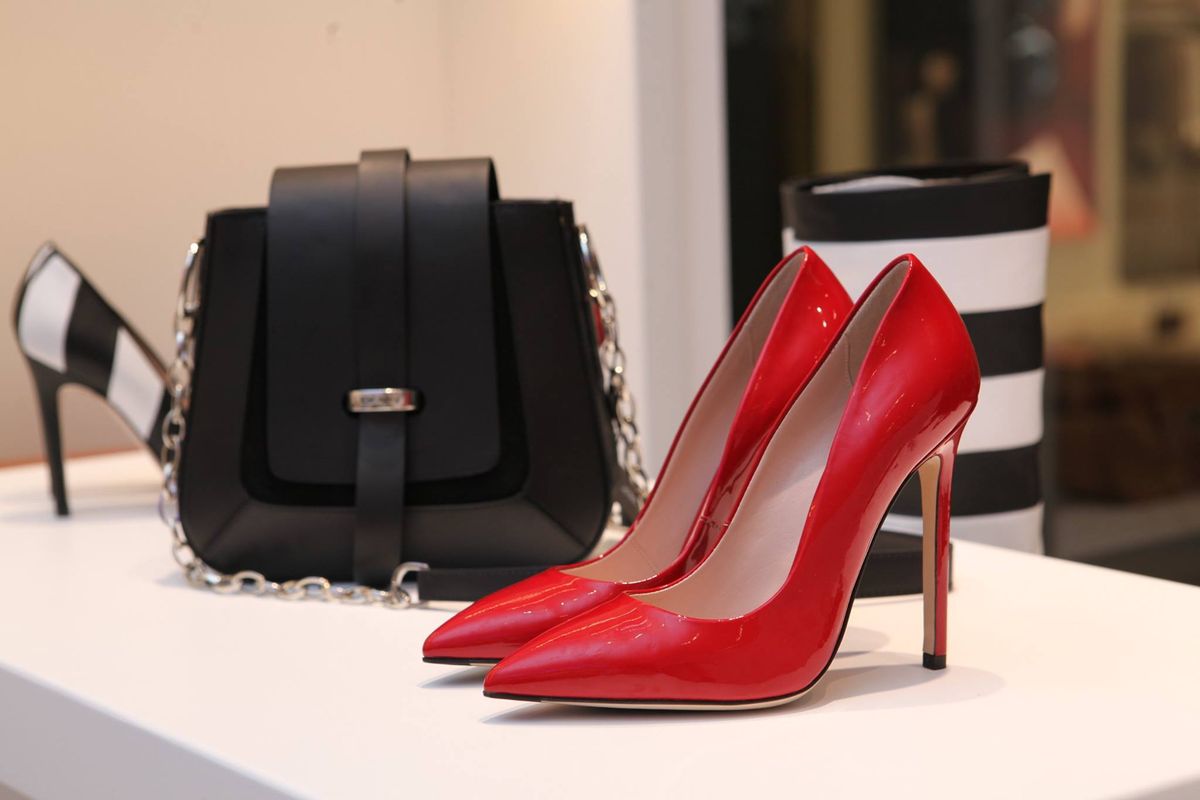
Before your next event, do one thing. Put the outfit on with the shoes, stand in front of a mirror at eye level, and mark with your hand where the hem sits relative to the strap. If the gap is smaller than a hand’s width, either the hem goes up or the shoe goes back in the box. Both are cheaper than spending an evening pulling at your skirt in the bathroom queue.
