

Last July I stood in a hotel car park outside Reading at 34°C with one shoe in my hand, watching the other stay welded to my bare foot. The heel was clear. My foot was not. Everything in between had turned into a small greenhouse, and the insole had crept forward until my toes jammed against a plastic edge.
I’d bought those clear heels for a wedding. In the mirror at 6pm they looked like the best decision I’d made all year. By 9pm I was walking like someone crossing a wet deck.
Three pairs later, I have opinions. Clear heels photograph beautifully and behave badly, and almost nobody mentions the second half because it ruins the first half. So here is the version I wish someone had handed me before I spent £80 on a pair I wore once.
Sweat isn’t a side effect. It’s what the material does
Most clear heels are PVC, some are TPU, a few are a polyurethane blend. All three share one property: they don’t breathe. Leather and suede pull moisture away from your skin and let some of it escape. A solid sheet of clear plastic does neither. Your foot sweats, the sweat stays put, and the shoe becomes a warm little terrarium with your toes inside it.
The standard reference on polyvinyl chloride is blunt about this. The material is impermeable to water. That’s why it’s used for drainage pipes. It’s also why your heel starts sliding around by the second drink.
The first hour isn’t the problem. The first hour is fine, because you’re mostly standing, and standing feet sweat less than walking feet. Trouble starts around minute 40, after you’ve done a lap of the room, hugged eleven people and queued at the bar. That’s when the lining, if there is one, gives up and the shoe starts gripping your skin instead of your foot.
What it actually feels like: a slippery suction under the arch, a small squelch when you lift your heel, and a hot patch on the outside of your little toe where the plastic edge rubs. By hour three my left foot had a red line across the top of the toes that took two days to fade.
You can’t argue with physics, but you can slow it down. A thin cotton or bamboo liner buys you maybe 40 minutes before it’s saturated. Antiperspirant spray on the sole of your foot works better than powder, in my experience. And if you’re choosing between a closed-back clear heel and one with a heel strap, take the strap. Air movement matters more than most people expect.
One more thing about the greenhouse effect: it doesn’t stop at your foot. The condensation has to go somewhere, and in a closed-back clear shoe it goes into the insole. After four wears my first pair had a permanent grey shadow under the ball of the foot. I scrubbed it, soaked it, tried bicarb, and the mark stayed. That’s the shoe telling you what it’s been through. Clear on the outside means honest on the inside, whether you want that or not.
Every clear pair I’ve owned ran at least half a size small
My normal size is 38. In clear heels I buy 39, and I go up again if the toe is pointed. The reason is the same one that causes the sweat: there’s no give anywhere.
Leather stretches. Patent stretches a little. PVC doesn’t stretch at all, and with no lining to compress, the shoe measures exactly what it measures on day one. Put a foot that’s swollen from a warm room inside a rigid shell and you’re asking plastic to do something plastic won’t do. The long history of the high-heeled shoe is mostly a history of shape, not of comfort. Materials got stiffer over time, not kinder.
A pointed clear toe box is the worst combination on the market: rigid material, narrow end, zero flex. If your feet are wide, look for a square or round toe instead. A naked-look thin heel with a rounded vamp is a friendlier shape than most of what gets sold as a clear court shoe, mainly because your toes have somewhere to sit.
One measurement nobody lists: the height of the plastic across the top of your foot. Clear styles tend to have a high vamp line that cuts straight across the toes, and if your instep is high, that edge presses on bone rather than flesh. Try them at the end of the day, not the morning. My best-fitting pair felt perfect at 9am and unbearable by 7pm.
Width is the other number the size chart leaves out. A size 39 clear heel from one brand can be 2mm narrower across the ball than a size 39 from another, and with no stretch, those 2mm decide whether you keep walking or sit down. Measure your foot across the widest point at the end of the day, write it down, and compare that number to the insole width in the product photos rather than to the size label.
If you can’t try before buying, order two sizes and send one back. Postage is cheaper than a shoe you’ll wear once and then hide behind the door.
The squeak is air, and two fixes actually worked
Squeaking isn’t bad luck. It’s air and moisture. When your foot slides a couple of millimetres inside a sealed shoe, the sole flexes and pushes air through the gap between insole and upper. It sounds like a small animal is following you. Clear heels do it more than any other style because the whole shoe is one smooth, non-porous surface and your foot has a layer of sweat to skate on.
Fix one: a felt or suede insole cut to shape. It kills the sliding and the noise in the same move. Fix two: rough up the inside of the heel counter with a nail file. Twenty seconds gives the plastic enough texture to grip a liner or bare skin, and it costs nothing.
What didn’t work: baby powder, which turns to paste in about twenty minutes and then squeaks louder. Hairspray, which holds for an hour and leaves a residue that stained one of my pairs yellow. And stacking two insoles, which lifts your heel out of the shoe until the whole thing flaps when you walk.
If the noise comes from under the sole rather than inside the shoe, press along the edge with your thumb. Any movement between upper and sole is a manufacturing fault. It won’t settle down, and no insole will save it. Send them back and say the sole is delaminating. In my case the shop replaced them without a debate.
There’s also a social version of this problem. Squeaking is quiet in a carpeted room and loud in a tiled lobby, a museum, or a church. If the event has hard floors and a lot of standing still, the noise becomes the thing people remember about your outfit, which is not the impression the shoe was chosen for. Test any new pair on a hard floor at home for ten minutes before you commit to a public appearance.
What I check before paying, in this order
Four checks, done in the shop, even with an assistant hovering two feet away. They take about ninety seconds and they’ve saved me from three bad purchases.
- The knuckle test. Press your thumb into the widest part of the shoe. If there’s zero give, go up a size, not down a half.
- The wet-hand test. Rub a damp finger on the inside of the heel. If it slides, you’ll slide. That pair needs a liner from day one.
- The edge test. Run a fingertip along every plastic edge that touches skin. Sharp moulding lines on the toe box will find your foot at hour two.
- The strap test. If there’s an ankle strap, fasten it and stand up. Any gap that closes when you stand is a strap that will cut in when you sit.
Do these while wearing the tights or socks you’ll actually have on, because the difference between bare skin and a 20-denier tight is roughly half a size. I learned that one the expensive way, at a wedding, in front of a photographer.
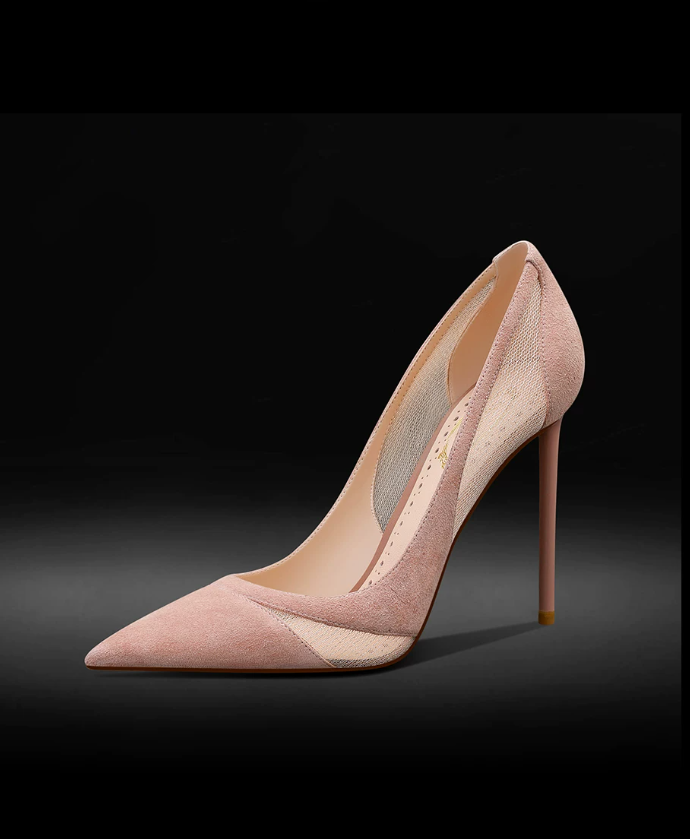
Check the insole colour too. A white insole in a clear shoe will show every drop of sweat by hour two, and there’s no way to hide it. A nude mesh heel with a diamond grid hides more than a fully transparent one, simply because texture breaks up the view.
The last check is the walk. Not a step or two in front of the mirror, but twenty paces down the shop and back, on the hard floor by the till. Most shops will let you do it. Any pair that already feels tight on that walk will feel like a vice by 10pm, and no amount of stretching or liner will change the shell itself.
If you’re buying online, do the same checks at home within the return window, on carpet first and then on tile. Keep the packaging until you’ve worn them for an hour indoors. Every pair I’ve regretted, I could have caught in those first sixty minutes.
Cleaning them without making it worse
Clear plastic scratches if you look at it wrong, and the scratches are what turn a pair from new-looking to tired. I clean mine with a damp microfibre cloth and a drop of washing-up liquid, nothing else. No scouring pad, no paper towel, no glass cleaner. Paper towels leave a fine haze that shows under indoor light.
For the inside, a paste of bicarbonate and water, left for ten minutes, lifts most of the grey. Rinse properly, or the powder will cake when you next sweat. Then dry them upside down with the insoles out, away from a radiator. Heat warps PVC, and a warped clear heel is finished.
Storage matters more than cleaning. Clear plastic yellows when it’s exposed to light and air for months. Mine go back into a dust bag with a sachet of silica, which sounds precious until you’ve thrown away a pair that went amber in a wardrobe over one summer. If you only wear clear heels twice a year, this is the part that decides whether you get a third wear.
Don’t store them in a shoe box on a windowsill, and don’t leave them in a hot car between the ceremony and the reception. Heat plus sunlight is what turns transparent PVC cloudy, and the change is permanent. I keep mine in the bottom of a wardrobe, in the bag they came in, and after two years they’re slightly less glassy than new but still wearable.
The straps need attention too. Clear straps are usually a softer plastic welded to the upper, and that weld is the first thing to fail. Check it after every wear by pulling gently. If you see a white stress mark at the join, stop wearing them for anything that involves stairs. A strap that lets go halfway down a staircase is a hospital trip, not a fashion problem.
Liners, powder and the tricks that only half work
I’ve spent real money on this, so you don’t have to. Here’s the honest ranking.
Terry cloth liners, £6 a pair. Best value. They absorb, they stop the squeak, and they wash. Downside: they add 2mm, which is enough to change the fit of a snug pair. Buy them before you decide on a size.
Antiperspirant with aluminium chloride. Applied to dry feet the night before, it genuinely reduces sweating for six to eight hours. It’s the only thing here that addresses the cause rather than the symptom. It can irritate sensitive skin, so test it on a normal day, not on a wedding day.
Gel heel grips. Useful if your heel lifts. Useless if your problem is sweat, and they make the squeak worse because gel against plastic is a squeaky combination.
Powder. Fine for the first twenty minutes, then it clumps. If you’re going to use it, use it sparingly and take a second pair of shoes for the trip home.
My current setup costs about £9 and works for a five-hour event: a terry liner cut to the shape of the insole, antiperspirant on the night before, and a spare pair of flats in the car. Not glamorous. Neither is limping.
If you sweat heavily in general, the shoe isn’t really the variable. Talk to a pharmacist about a stronger antiperspirant, because the same product that works on hands works on feet, and it will do more than any insole. Material certification bodies such as OEKO-TEX test for harmful substances in shoes and textiles, but they don’t test for breathability, so a certified clear heel can still be a sweaty one.
One thing that surprised me: the cheaper my clear heels, the louder they squeaked. The pair I paid £27 for had a hollow-sounding sole and no lining at all. The pair at £95 had a suede-lined insole and a slightly thicker sole unit, and it was quiet from the first wear. When you look at the range of clear high heels on offer, weight is a decent proxy. A very light clear heel is usually a very thin one.
Where clear heels are a bad idea
I’ll say the unpopular thing: clear heels are not for long days. A wedding where you’re seated for the ceremony and dancing for forty minutes, fine. A 10-hour city day with 12,000 steps, no. Your feet will swell, the plastic won’t move, and by mid-afternoon you’ll be inventing reasons to sit down.
They’re also wrong for grass, gravel or a slope. A clear sole on damp grass has about as much grip as a dinner plate. I once crossed a lawn at a garden party and did a small, undignified slide in front of the bride’s grandmother.
And they show everything. Dust, sweat, a scuff on the toe. If you’re the kind of person who notices a mark on a shoe, clear is a stressful choice. Mine live in a dust bag between wears and still look cloudier every season.
One more: they don’t work with every outfit. The whole point of a clear shoe is that it disappears and lets the dress do the talking. Put one under a heavy wide-leg trouser and it looks like a mistake, because there’s no visual weight at the bottom of the leg. Clear heels want a hem that ends above the ankle, or a slit, or bare legs. Anything that covers the shoe is wasted money.
They also read differently on different skin tones, which is a conversation the product photos avoid. Against very pale skin a clear strap nearly vanishes; against deeper skin it draws a visible line. Neither is wrong, but if you bought clear because you wanted the strap to disappear, try them on in daylight first and see whether it does.
And skip them for interviews or anything where you’ll be judged on being understated. A clear heel is a statement, even when it’s trying not to be. If the room is formal and conservative, a nude or black court shoe does the same job with less explaining.
How I’d buy the next pair
Size up half. Choose a strap over a closed back. Prefer a liner or a suede-lined insole. Take a matte or mesh finish over fully transparent if you care how they look by hour four. And if the reviews say nothing about sweat, assume the reviewer wore them for twenty minutes in an air-conditioned room.
The pair I kept isn’t the prettiest one I bought. It’s the one with a 70mm heel, a strap, and a slightly textured upper that doesn’t show every mark. I’ve worn it to two weddings and one very long dinner, and I didn’t take it off in a car park. That’s the bar. Not how they look in the box, but whether your heels are still on your feet when the evening ends.
If you’re choosing between clear and something else for a specific outfit, read up on what the open toe version costs you in practice first. The problems overlap, and a second opinion is cheaper than a second pair.
Would I buy clear again? Yes, once, for a specific dress and a specific evening, with a liner already cut. Not as an everyday shoe, and not as the pair I wear when I don’t know how long I’ll be standing. Clear heels can be the right answer. They just need a plan for the sweat, the size and the squeak before you leave the house.
