

Before you decide whether a pair of strappy heels is expensive, answer one question honestly: how many times will you actually wear them in the next twelve months? Most people guess eight. The real number for a pair bought for events is usually between three and five, and that changes the arithmetic completely.
This is the decision framework worth using, in order. Establish the honest wear count first. Calculate cost per wear against it, not against a fantasy number. Then check the three construction details that decide whether the pair survives to wear number five at all. Everything else, including how they look in the box, comes after.
A sandal with four thin straps and a 90mm heel is not an everyday purchase pretending to be one. Treat it as event equipment and the numbers get much easier to judge. Treat it as a wardrobe addition and you’ll buy badly, twice.
Count your wears before you count the price
Open your calendar and count the events in the next year that genuinely call for a dressy strappy sandal. Not the ones you’d like to attend. The ones already in the diary, plus the category of thing that turns up reliably: weddings, work dinners, birthdays at restaurants with a dress code, a couple of evenings out a month if you’re honest about your energy levels.
For most people the answer lands between three and seven. If it’s three, you’re buying a costume, and that’s a perfectly reasonable thing to buy as long as you price it as one. If it’s seven or more, a strappy sandal starts to behave like a real shoe and deserves a real budget.
The number matters because it divides everything else. A £120 pair worn four times is £30 a wear. A £55 pair worn twice because the straps cut is £27.50 a wear and it’s sitting in your cupboard taking up space. Cheaper per unit, more expensive per use.
Be careful with the wear count, though. The trap is counting events you’d attend if you had the shoes, which is the same logic that sells exercise equipment. Count what’s booked.
There’s a second-order effect too. Once a pair is in the cupboard, the events that call for it seem to multiply, because you start saying yes to things you’d otherwise skip. That’s real, and it cuts both ways: some people genuinely grow into a pair, and some people buy a shoe and then invent reasons to justify it. You know which one you are.
A working compromise: assume the number you counted, then add one. If the maths only works at double your honest count, it doesn’t work.
What a strap actually has to do, and the three numbers that decide it
A thin strap on a sandal is doing structural work with very little material, and three measurements tell you whether it can. Get these right and the pair will hold your foot for six hours. Get them wrong and no amount of adjusting helps.
Width of the strap. Under 6mm and it will cut into skin under load, no matter how soft the leather. Between 8mm and 12mm is where a strap holds without biting. Above that it starts to look heavy, which is a design decision rather than a fit one.
Anchor points. A strap fixed at both ends to the sole is stable. A strap that loops through a single ring and relies on tension will rotate as you walk, and once it rotates, the buckle ends up under your arch. Look at where the straps meet the sole. Stitching through to the insole is better than a glued tab.
Heel-to-toe drop. A 90mm heel with no front platform means your whole weight transfers to the ball of your foot when you stand. A 90mm heel with a 15mm platform behaves like 75mm. If you’re choosing between two pairs, the one with the platform is the one you’ll still be wearing at 11pm.
None of this is visible in a product photo, which is why buying strappy heels for women online is a gamble unless the listing gives you actual measurements. Ask for strap width in millimetres. A seller who knows their product can answer in a minute.
There’s a fourth check that’s less about structure and more about the hours you’ll spend in them: where the straps cross your instep. Two straps crossing low, close to the toes, distribute load across the widest part of your foot. Two straps crossing high, near the ankle, put all of it on tendons. The high version photographs beautifully and feels like a hand around your ankle by the second hour.
If you’re between sizes, size for the strap, not the length. A sandal that’s 5mm long can be lived with. A sandal whose ankle strap is on its last hole cannot.
The maths, worked through on three real price points
Numbers make the argument better than adjectives do. Take three pairs at three prices, each worn the honest number of times.
Spend £45 at a fast-fashion shop and wear the pair twice before the straps stretch: that’s £22.50 a wear. It also generates a return trip to the shop or a donation bag, which has a cost in time if not in money.
Move up to £120 from a mid-range label worn five times and you’re at £24 a wear in year one, then £12 a wear in year two if the straps hold and you wear it five more times. That second year is the whole point. It’s why the more expensive pair usually wins, and it’s also why the more expensive pair sometimes doesn’t: if you only ever wear it three times, you paid £40 a wear for the privilege.
Then £280 worn fifteen times over three years lands at £18.70 a wear. That’s the best number of the three, and it’s also the least likely outcome, because fifteen wears means the shoe became part of your actual life rather than your event wardrobe.
The useful conclusion isn’t “buy expensive”. It’s that the middle band, roughly £90 to £150, is where the maths works most often. Cheap enough that a mistake isn’t painful, expensive enough that the straps are leather and the heel is attached properly.
One more variable people forget: the second pair. If you own two dressy sandals, each one gets worn less and the cost per wear on both goes up. If you own one, it gets worn to everything and the number comes down. Counter-intuitive, but it’s why people with large shoe collections often have terrible cost per wear on the dressy end of it.
Resale changes the sum as well, though less than sellers claim. A barely worn pair of a recognisable brand might return a third of its price. The same pair in a no-name label returns almost nothing. If you’re treating the purchase as a rental, brand matters. If you’re treating it as a shoe, it doesn’t.
Where cheap gets expensive
Synthetic straps are the biggest hidden cost. PU doesn’t breathe, so under a strap on a warm evening your skin gets damp, and damp skin plus a non-porous strap equals rub. The rub shows up as a red line within an hour and a blister by the end of the second wear. At that point the shoe is finished regardless of what you paid. Real leather behaves differently because it moves moisture, and the material standards behind that difference are set out by bodies such as OEKO-TEX.
Heel attachment is the second. On cheap sandals the heel block is often glued and pinned into a compressed fibre board, and the first sign of trouble is a slight rock when you set the shoe on a table. Once it moves, it will loosen. A cobbler can sometimes re-pin it, but the repair often costs a third of what the shoe cost.
Third is the insole. A synthetic insole stays slick, your foot slides forward with every step, and your toes end up gripping the front edge to stay in. That’s the real reason thin-strapped sandals feel exhausting: you’re using your toes as brakes all evening.
The honest limitation of this whole argument: some cheap strappy sandals are fine. If you find a pair under £50 with leather straps and a stitched sole, buy it and ignore the price tag. The label isn’t the variable. The construction is.
Where cheap really bites is in the second season, not the first. A new sandal looks good for about six wears regardless of what it cost. The difference shows up when the straps have been flexed a hundred times and the sole has been walked on damp pavement. That’s when the £45 pair starts to look tired and the £120 pair starts to look broken in.
Check the sole edge before you buy. A stitched sole with visible thread can be repaired. A glued sole on a synthetic midsole can’t, because there’s nothing for the glue to grip once it separates. It’s a two-second check that tells you whether the shoe has a second life in it.
How to raise the wear count without lying to yourself
The cost per wear only drops if you wear the pair more, and there are practical ways to do that which don’t involve pretending a rhinestone sandal is office wear.
Pick a colour that works with more than one outfit. Black and gold cover most of what people actually wear to evening events. A bright colour coordinates with one dress and then sits out the rest of the year. If you want colour, buy it as a second pair, not a first.
Choose a heel you can stand in for four hours. The difference between 75mm and 100mm is roughly the difference between wearing a pair six times a year and twice. Lower heels get worn to dinners that don’t strictly require heels, which is where the extra wears come from.
Get the straps adjusted once. A cobbler can shorten an ankle strap or add a second hole for a small fee, and a sandal that fits properly gets worn two or three more times a year than one that doesn’t. This is the highest-return £10 in the whole calculation.
Store them stuffed. A pair of strappy sandals crushed in a box for eight months comes out with bent straps and a creased heel. Rolled tissue inside the toe and a shoe bag keeps the shape, and shape is what makes you reach for them again.
Wear them to the smaller occasions. This is the one nobody does. The dinner with two friends, the gallery opening, the Thursday drink that doesn’t need heels but doesn’t forbid them. Those are the wears that move the average, and they’re also the ones where a 75mm sandal is genuinely the right shoe rather than an overreach.
Keep a spare heel cap in the bag. The top piece on a slim heel wears to the nail in about 40 wears of pavement walking. If you’re at an event when it goes, you’ll walk home on metal and damage the heel itself. A pair of caps costs less than a coffee and buys the shoe years.
None of these tricks turns a party shoe into a workhorse. What they do is move four wears to six, and six is often the number where the maths flips from tolerable to good.
If you want to see how much strap placement alone changes the wear count, the comparison in what strappy heels look like against a window is a useful check before you commit. Light behind the shoe tells you more about strap thickness than any studio shot will.
Three pairs that fit the framework
The useful way to apply all of this is to look at specific shoes and ask the wear-count question about each.
Take the single-button strap sandal with a thin heel first. It’s the event-equipment case: one strap, clean line, four to six wears a year. Price it as a costume and it’s fine. Expect it to be an everyday shoe and you’ll be disappointed.
The thick-heel pair built for standing is the opposite trade. Less delicate, more wears, and the maths usually comes out better over two years. If your honest count was seven or above, this is the shape to look at first.
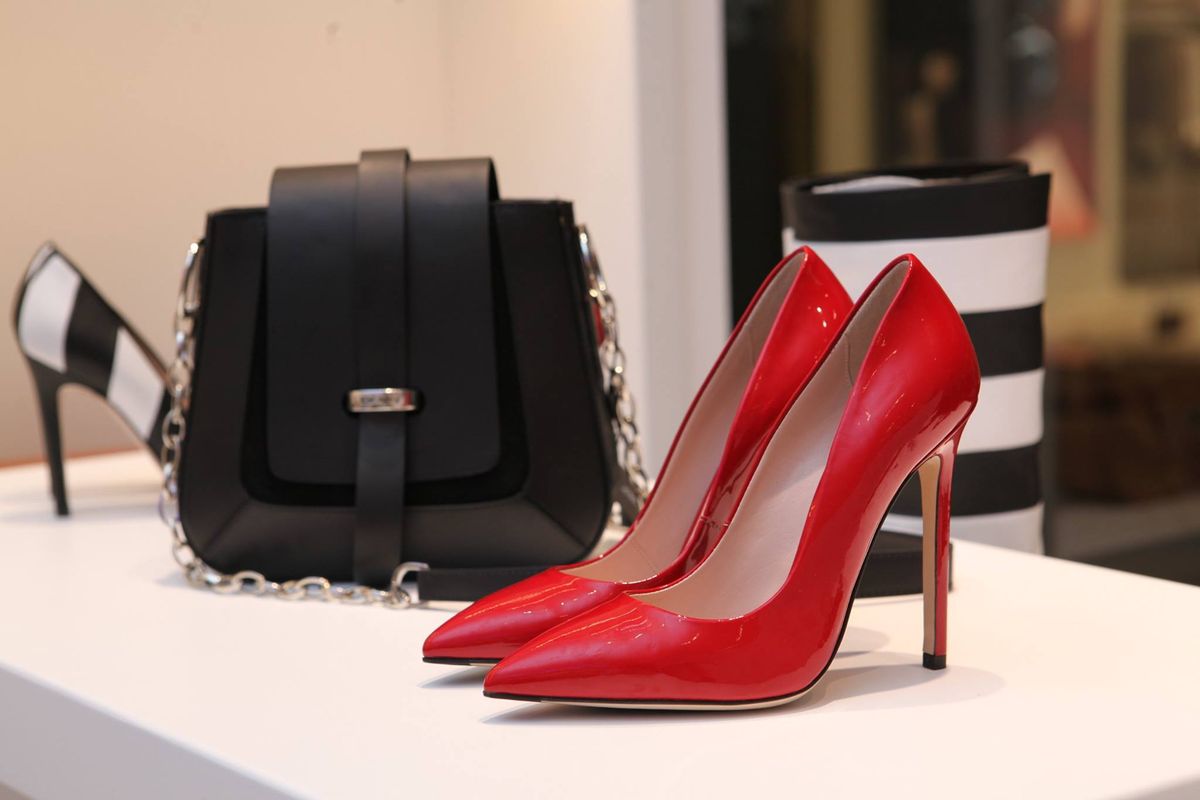
And the pointed pair with rhinestone detailing sits in between: dressy enough for an evening, closed enough to wear to a dinner in October. That wider window is worth paying for if you’ll use it. The full range is under women’s shoes by shape.
On the styling side, the wider question of how much heel height changes a look is covered well in fashion coverage rather than product copy; Vogue’s fashion desk has documented the cycle often enough that the silhouettes stop being surprising. The mechanics of what a raised heel does to your gait are simpler to check in the general reference on heeled footwear and walking posture.
When the maths says don’t buy
Three situations where the honest answer is to walk away, and they’re more common than the industry would like.
If your honest wear count is two or under, rent or borrow. The cost per wear on a purchase is worse than any rental fee, and you avoid storing something you’ll resent.
If you can’t stand in the pair for ten minutes in the shop, you won’t stand in them for four hours at an event. Sandals don’t break in the way closed shoes do, because there’s no material to soften around your foot. What you feel at minute ten is what you’ll feel at hour three.
There’s one exception worth knowing. A leather insole will mould to your foot over three or four wears, so a sandal that feels slightly hard underfoot on day one is fine. A sandal that feels tight across the straps is not, because the straps are already at their longest.
If the strap cuts across the front of your ankle bone rather than sitting below it, no size will fix it. The last is wrong for your foot, and the only cure is a different shape entirely. This is the single most common reason a pair of strappy heels for women ends up unworn, and it’s visible in the shop in under a minute.
The wider principle behind all three: a dressy sandal is equipment for a specific job, and equipment gets judged on whether it does that job. Buy it as equipment and you’ll make a clear-eyed call. Buy it as a treat and you’ll rationalise whatever you wanted anyway. Both are allowed. Only one of them keeps the cupboard tidy.
Do the sum before the trying on
Nothing here is an argument against buying the pair you love. It’s an argument for knowing what it costs you per evening before you decide, because that number is the difference between a purchase you enjoy and one you quietly regret every time you open the cupboard.
Do the sum first. Count the events, divide the price, then check the strap width and the anchor points. If the number and the construction both hold up, buy them and wear them until the straps give out. That’s a good outcome for a pair of strappy heels for women, and it’s rarer than it should be.
