

In a shop that sells both, the 80-dollar pair and the 140-dollar pair sit about a metre apart on the same wall, and to most customers they look like the same idea twice. Same shape, same colour family, same promise on the shelf talker. The difference shows up at 4pm on a Thursday, when one of them has started to feel like a sock full of warm gravel.
That gap is what comfortable business casual shoes for women actually come down to. Not softness in the first ninety seconds, which is easy to fake and easy to sell. Softness at hour seven, on a hard floor, after a commute and two meetings.
Working backwards from what fails first is the useful way to compare. In this trade the returns come in three waves: week one for sizing, month two for soles that flattened, month five for uppers that cracked at the flex line. Each wave has a price threshold under it.
The price ladder, in one line
Below 60 dollars, the shoe is assembled to hit a price. Between 60 and 110, it’s assembled to survive a season. Above 110, you’re paying for materials that hold their shape and for construction that can be repaired rather than replaced. That’s the whole ladder, and the rungs are further apart than the numbers suggest.
What people notice first is weight. A cheap business casual shoe is usually light, because the sole is a low-density foam and the upper is thin. That lightness reads as comfort in the hand and stops being comfort by lunchtime, when a low-density midsole has compressed under the heel and the shoe has lost the little bit of structure that was holding your arch.
Heavier isn’t automatically better. A heavy shoe on a stiff sole is a different kind of tiring. What separates them is density and recovery: a midsole that springs back when you press your thumb into it and leaves no dent after ten seconds will still be doing its job in month eight.
The other early tell is the smell. Fresh PU has a distinct chemical sweetness. Leather-lined shoes with a proper footbed mostly smell of leather and glue. It’s not a scientific test, but it’s a reliable one in a shop.
Something else shifts at every rung of that ladder: how much of the shoe can be taken apart. Cheap shoes are built as one sealed unit, so a worn heel means a new pair. Above roughly 120 dollars the sole is usually attached in a way a cobbler can undo, and that single fact changes what you’re buying from a disposable item into a repairable one. It’s the difference between a 130-dollar shoe that lasts four years and a 90-dollar shoe that lasts fourteen months, and it never appears on the price tag.
What the extra money buys in the sole
Soles are where the honest money goes, and where the dishonest money is saved. Three materials cover most of the market.
EVA foam is light, cheap, and cushions well for about three months of daily wear. Then it compresses permanently and the shoe feels flat. EVA is fine in a shoe worn twice a week. It’s the wrong material for a shoe worn five days a week on concrete.
PU is denser and heavier, and it holds its shape far longer. It’s also less bouncy from day one, which is why people sometimes reject the better shoe in the shop. A PU midsole with a rubber outsole is what most 120-dollar work shoes actually are, and it’s the cheapest combination that survives a year.
Rubber on the bottom is the part that decides grip and wear. A thin blown-rubber layer wears through at the outer heel within months if you walk with any supination. A solid rubber outsole with a defined heel block can be replaced by a cobbler for a fraction of a new shoe.
Construction matters as much as material. Most shoes under 100 dollars are cemented: the upper is glued to the sole unit. It’s fast, it’s cheap, and when the bond fails it fails along the whole edge at once. Stitched construction costs more and can be repaired, which is the actual reason it appears on more expensive shoes.
One test in the shop, no tools: hold the shoe by the heel and the toe and twist gently. A sole that folds in the middle like a paperback has no shank, and it will let your arch collapse with every step. A sole that resists and then flexes at the ball is the one built for walking.
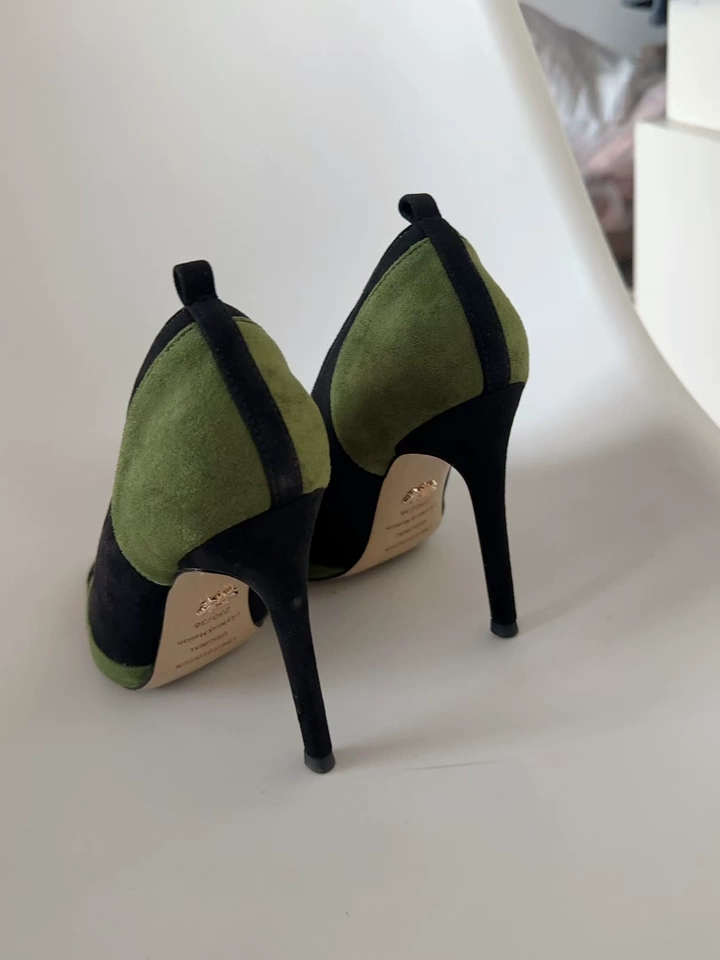
Heel height deserves its own line because it changes the physics rather than just the look. A block heel of 40 to 50mm spreads load across a wider area than a 70mm stiletto and moves the pressure point forward, which is why a lower block feels stable on tile and a higher slim heel feels fine on carpet. Most people who say they can’t wear heels are describing a heel they wore at the wrong height on the wrong surface, not a limitation of their feet.
The outsole compound is the last part of the sole worth checking. Soft rubber grips well on dry tile and wears fast on pavement. Harder compounds last years and get slippery in the rain. Neither is universally right, but a business casual shoe worn mostly indoors wants the softer one, and it should be priced as something that gets replaced rather than resented.
Uppers: leather, knit, and the middle ground
Business casual is a strange category because it has to look tidy and behave like a sneaker. That tension is where uppers get decided.
Full-grain or decent top-grain leather creases in fine lines, holds a shape, and can be conditioned. It also takes two weeks to stop pressing on the top of your foot. Nubuck and suede are more forgiving immediately and show rain. Knit uppers feel like nothing for the first month and then stretch where your toes push, which is fine for a trainer and wrong for anything you’d wear to a client meeting.
The middle ground is a leather upper with a textile lining and a padded collar. It looks like a dress shoe, flexes like a soft one, and the padding hides the break-in. Most of the 90 to 130 dollar range is this, and it’s a reasonable compromise if the sole underneath is PU rather than EVA.
What quietly ruins an upper is the finish. A sprayed pigment on corrected-grain leather looks uniform and slightly plastic under office lighting, and it cracks at the flex line in the second winter. Aniline or semi-aniline leather varies across the surface, which some buyers read as a flaw and is actually the sign of a hide rather than a coating.
Lining is the part nobody inspects and everybody feels. A leather lining manages moisture and keeps the inside from turning slick after a hot commute. A bonded synthetic lining is smoother and cheaper, and it doesn’t breathe, so the foot slides forward against it as the day goes on. If the listing describes the interior as soft fabric, that’s what it is, and it’s the reason a pair can feel wonderful at 9am and loose by 5pm.
Padding is the other half of the same story. A padded collar and tongue hide the break-in period entirely, which is genuinely useful, and they compress within a year. A thin, firm collar takes a fortnight to soften and then holds its shape for the life of the shoe. Buyers who try both in a shop for ninety seconds pick the padded one every time, which is why the market keeps making it.
The insole is where most of the money hides
Almost nobody checks this, and it’s the single most predictive part of the shoe. Take it out if you can. A removable insole with a moulded heel cup and a firm arch is a sign that the maker expected you to walk. A thin glued-in foam pad is a sign that the maker expected you to try it on.
Memory foam is the most oversold material in footwear. It takes an impression of your foot, which feels wonderful for twenty minutes and then means the foam is shaped around your foot rather than supporting it. After two months of daily wear, memory foam has flattened where you press hardest, which is usually the ball of the foot.
Latex and PU insoles are less immediately pleasant and last considerably longer. If you have high arches, look for a shoe where the insole can come out and be replaced with your own, because that single feature extends the life of the shoe by years.
Seam placement matters too. A seam running across the ball of the foot, where the shoe flexes with every step, will rub through the lining within a season. Run your thumb along the inside of the vamp and feel for it before you buy. It’s the kind of thing that never shows up in a review because the buyer never works out why the shoe hurt.
For anyone wearing orthotics, the whole calculation changes. Most inserts add 3 to 5mm of volume, which means the shoe needs a removable insole and a little extra depth. A shoe that fits perfectly with its own footbed will be tight across the instep with an orthotic in it, and shoes with a fixed foam footbed simply can’t be adapted. Ask whether the insole lifts out before you even try the pair on.
Fit: the last, the toe box, the arch
Fit is not sizing. Two brands can both sell a 38 and mean two different feet. In this trade, the term is the last, and it decides where the widest part of the shoe sits relative to the widest part of your foot.
Measure at the end of the day, standing, with weight on the foot. Feet spread by two to four millimetres under load. Then check the toe box: for a business casual shoe with a closed toe, you want roughly a thumb’s width past your longest toe and enough height that your toes don’t touch the top when you stand. Toe boxes get shallower as shoes get more formal, which is why so many people end up between sizes in this category.
Heel slip is the other failure. If your heel lifts more than about 5mm when you walk, the shoe is either too long or the counter is too soft, and no insole fixes a soft counter. Slipping is not the same as sliding out. A little movement is normal in a new leather shoe and settles after a week.
Wide feet have a specific problem in this category: widths are rarely made. If the shoe is available only in a standard width, size up and add a thin insole rather than accepting pressure across the ball. PU midsoles don’t stretch. Leather uppers stretch about 3 to 5mm across the ball over a month, which is often just enough and never more.
Narrow feet run into the mirror-image problem. A shoe wide enough at the ball and snug at the heel is unusual in ready-to-wear, so most narrow-footed buyers end up with heel grips, which work for a week and then peel. A suede heel pad glued in by a cobbler lasts considerably longer, and costs less than the grips sold in three-packs at the checkout.
What shops do to make cheap shoes feel good for ninety seconds
Retail isn’t a conspiracy, but it is a set of techniques, and knowing them shortens the decision.
- Cold floors. Trying shoes on a carpeted floor hides hardness. Walk to the tiled area near the till instead.
- Sock thickness. Shops hand you thin nylon try-on socks. Bring the socks you actually wear, or try them barefoot as you will at home.
- Seated fitting. Almost everyone tries shoes sitting down. Stand, walk twenty steps, and go up a flight of stairs if one exists.
- Single-pair lighting. One shoe under a warm spot looks better than two on your feet in daylight. Take both to the window.
You can also ask what the return rate is on the model. Staff usually know which shoes come back, and a direct question about returns gets a more honest answer than a question about comfort.
The last technique is the mirror. Mirrors in shoe shops are angled and lit from the front, which flatters the shoe and hides the ankle. Look down at your own feet instead. That’s the view you’ll have for the next ten hours.
Time the fitting properly, too. A shoe tried on at 10am is being fitted to a foot that hasn’t swollen yet. If you can only shop in the morning, buy the pair that feels very slightly roomy and take the insole out at home if you need to. The reverse decision, buying tight in the morning because it’ll stretch, is the one that produces the returns.
Where the extra money gets wasted
Not every 180-dollar shoe is better than a 110-dollar one. Above roughly 150 dollars, an increasing share of the price goes into finishing, packaging and the brand’s margin rather than into the parts that touch your foot.
Hand-stitched welts, burnished edges and leather-covered footbeds are lovely and almost irrelevant to a shoe worn to an office. If your feet hurt at 4pm, none of those features will help. The features that help are a dense midsole, a firm heel counter, a removable insole and a shape that matches your foot. All four exist in the 100 to 140 band.
The reverse is also true. Paying 60 dollars for a shoe you’ll replace three times a year costs more than paying 130 once, and it costs more in feet as well, because the cheap shoe is the one that flattens fastest.
Spending above that band makes sense in one situation only: a shoe worn more than three days a week for years, where a repairable sole and a leather upper that can be reconditioned actually pay back. Everything else is a preference, and preferences are allowed to be expensive as long as you know that’s what you’re buying.
What’s genuinely wasteful isn’t the high-end pair. It’s the mid-priced shoe bought for a season, worn forty times, and thrown out with the upper still intact because the sole was glued on. Four of those over five years cost more than one repairable pair and produce four times the discomfort along the way. If a shop can’t say whether the sole can be replaced, that’s the answer.
Staff in a good shop will tell you which models come back and which never do. That information is worth more than any specification on the box, and it’s free if you ask before you’ve decided.
If you want to compare shapes in person, these commuting block heels sit in the wearable middle of the range, and these low thick heels built for a long day show how much a wider heel block changes stability. The women’s shoes collection is grouped by heel height, which makes side-by-side comparison easier than a single scrolling page.
Two related reads: four outfits, four different reads from one black pair, and the 4mm the size chart hides in a wide toe box.
The short version for a Saturday afternoon in a shop: twist the sole, press the midsole with a thumb and count to ten, pull the insole out if you can, and walk on tile rather than carpet. If all four checks pass at 120 dollars, the 180-dollar pair next to it has to work considerably harder to justify itself.
