

Sunday, 4:40 in the afternoon. The light outside has gone that flat gold colour it only gets in late October, and your friend wants four decent photos of you before dinner. You’re standing in the hallway with one walking shoe on each foot, phone propped against a plant pot, trying to work out which pair reads better on a screen you’ll look at on Tuesday.
That’s the small, real decision behind this piece. Not which shoe is better. Which one photographs the way you want to be seen in the six weeks when the sun sits lower than the buildings.
Here’s my answer up front. If your photos happen between 4 and 5:30pm, on a phone, indoors near a window or outside on pavement, I’d hand you ours: the pale mesh pair with the soft sole. If you’re spending the autumn on concrete for hours at a time and the photos are an afterthought, the Nike Motiva is the one I’d put on your foot first. Different jobs, and the difference shows up in the frame.
We’re not affiliated with Nike. Brand names are used for identification only. What follows is my own opinion, formed from wearing both, not a lab test.
Autumn light does most of the work, and it’s fussier than you think
Between early October and mid November, the sun in most northern cities sits low enough that its colour shifts warm hours before it sets. The colour temperature of late afternoon light drops into the 3,000 to 4,000 kelvin range, which is the same neighbourhood as a warm bulb in a bedside lamp. Skin looks good in it. Grey looks good in it. Very white things start to glow.
That last part is the bit people miss. Your eyes compensate automatically, so a white upper looks white to you while you’re standing there. The phone doesn’t compensate. It exposes for the middle of the frame, and if your shoes are the brightest thing in it, they clip: the mesh goes to pure paper white, the laces disappear, and the shape of the toe box flattens into a blob.
You’ve probably seen this and blamed the colour. I did too, for years.
Three things actually control whether a shoe survives that light:
- How much texture the upper has, because texture holds shadow, and shadow is what makes a shape read as a shape.
- Whether the sole has a visible line or a colour break against the upper, which gives the eye an edge to follow.
- How far the shoe sits from the brightest patch of pavement behind it, since contrast at the edges decides whether your feet look grounded or floating.
None of that is about brand. It’s about how a surface behaves under a specific kind of light, and it’s why one pair can look expensive in a screenshot and odd in a hallway mirror.
Indoor autumn light is a different problem. Between 3pm and 5pm your window is throwing a low, hard-edged patch of sun across the floor, and anything that lands in it gets a bright rim on one side and a deep shadow bruise on the other. Shoes standing in that patch look dramatic and slightly wrong. Two steps back, in the soft part of the room, they look like themselves. If you’re shooting inside this season, that step back is the whole trick.
Pale uppers photograph louder than you’d expect
Contrary to what most people assume, white walking shoes don’t photograph badly. They photograph loud. There’s a difference, and it matters when you’re the person in the photo rather than the person taking it.
A pale upper pulls the eye before anything else in the frame. In a full-body shot that’s fine, even flattering, because your feet anchor the composition. In a seated photo at a cafe table, where the shoes are near the bottom third and half hidden by a chair leg, that same brightness competes with your face.

My rule, and it’s mine rather than a rule: pale shoes for full-length shots outdoors, mid-tone shoes for anything seated or close. If you only own one pair this season, the mid-tone option is the safer bet for a mixed camera roll.
The pale pair still earns its place. On wet autumn pavement, which goes dark the moment it rains, a light upper separates cleanly from the ground and the sole line stays readable. That’s the shot everyone wants in November and almost nobody plans for. You can see the same effect in the daylight and flash test on all-black walking shoes, just in reverse: dark uppers hold their shape in shade and lose it in direct sun.
If you’re building an autumn rotation, the sneaker shapes we keep in stock for autumn mostly sit in the middle of that range for exactly this reason. Sand, stone, warm grey. Not because they’re safer to sell, but because they hold detail in low sun.
The rocker shape of Nike’s Motiva, seen through a phone lens
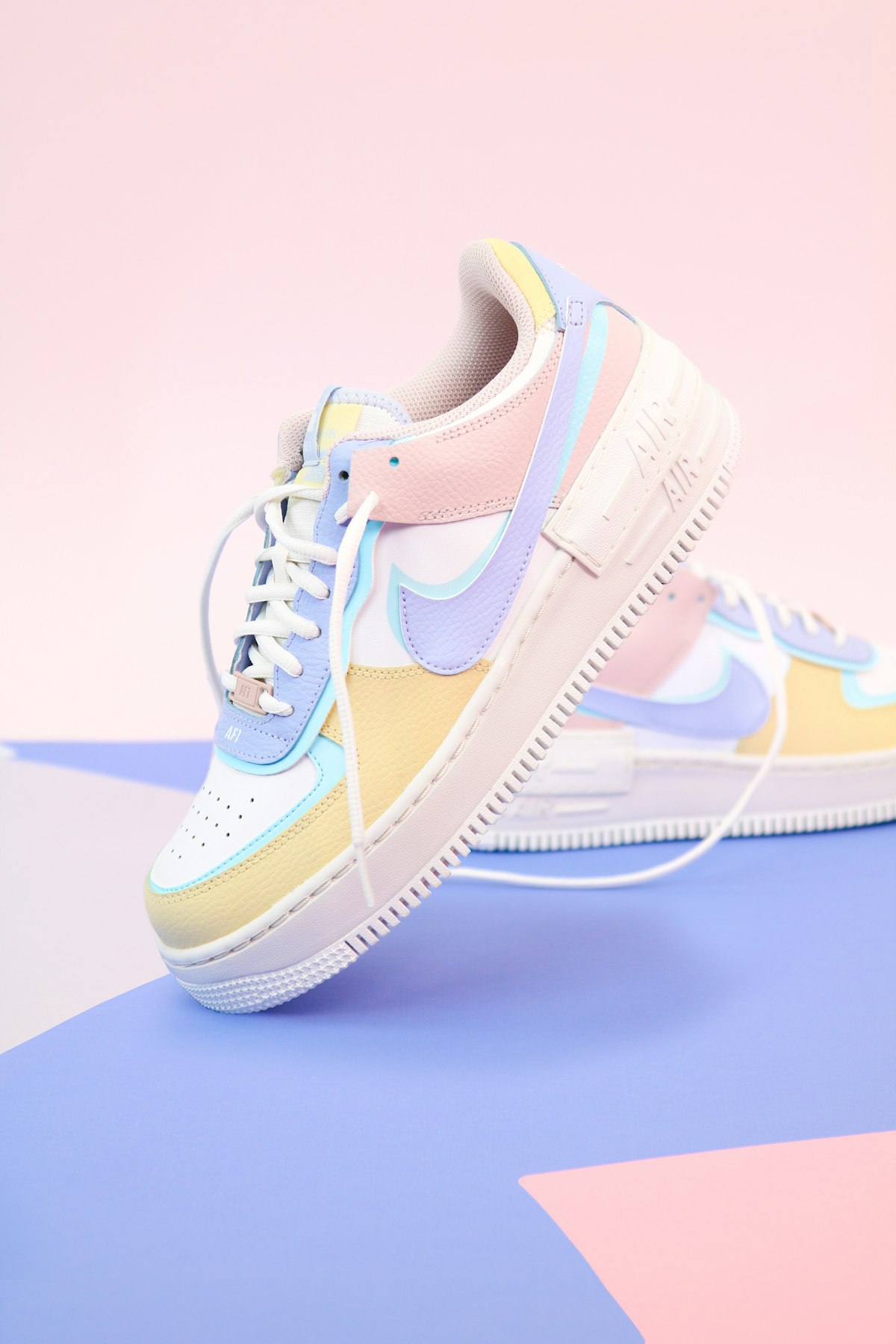
Nike lists the Motiva as a women’s walking shoe built on a rocker-shaped foam midsole with a mesh upper, per the manufacturer’s spec on Nike’s own product listing. Translated out of marketing language: the sole curves up at the heel and toe, so your foot rolls forward instead of landing flat.
In photos, that curve does something specific. It gives the shoe a rising line from heel to toe, and rising lines read as movement even in a still photograph. When you’re walking in the frame, the shoe looks like it’s going somewhere. When you’re standing still, it keeps a little forward lean.
Ours sits flatter. The sole is even from heel to toe, which means when you stand still, the shoe looks planted rather than mid-step. Not worse. Quieter. In a group photo where you want your outfit to read and not your footwear, quiet is what I’d choose.
Two more differences I notice in the frame, and one background note first: the flat everyday walking silhouette itself is a relatively recent arrival, given how the sneaker moved from court shoe to everyday wear over the last fifty years. That’s why both shoes read as casual in a photo regardless of what you pair them with.
- Stack height. The Motiva’s midsole is visibly thicker, roughly a finger’s width more under the heel in my eyes, so it adds a small amount of height to your silhouette. If you’re the shortest person in a family photo, you’ll notice.
- Toe shape. The rocker pulls the toe up and slightly rounder. Ours finishes lower and more tapered, which photographs narrower from the front, and slightly wider from above.
Neither of those is a claim about which shoe is built better. I don’t have the data for that and wouldn’t trust anyone who says they do from a photo. They’re observations about geometry, and geometry is the one thing a phone camera is genuinely good at recording.
Five outfits I’d shoot in October, and the shoe I’d put with each
This is the part that actually decides it for most people. You don’t buy a shoe for a photoshoot. You buy it for the fourteen outfits you’ll wear it with between now and December.
- Wide-leg wool trousers, cropped at the ankle. Ours, in pale sand. The flat sole keeps the hem from bunching, and the light upper picks up the trouser’s texture instead of fighting it.
- Straight-leg dark denim, cuffed once. The Motiva. The thicker sole balances the weight of dark denim; a flat pale shoe under a heavy dark hem looks a bit like an afterthought to me.
- A long knit dress, mid-calf. Ours again. Anything with a rocker reads busy under a soft hem in a photo.
- Tailored shorts with tights, early October only. The Motiva, if you’re walking far. Anything with a lift helps the leg line in a seated shot.
- A trench over anything, raining. Ours, and shoot on the wet pavement. This is the one shot I’d plan the whole afternoon around.
Notice how much of that is about hem weight and hem width rather than colour. That’s not an accident. In autumn photos, the heaviest thing in the frame sets the visual weight of everything else, and in most outfits that’s your coat or your trousers, not your shoes. If you match the shoe’s visual weight to the hem, the whole silhouette holds. If you don’t, the shoes look stuck on.
If you want the pale pair specifically, the breathable mesh walking shoe in sand is the one I keep reaching for in October, mostly because it disappears into a warm palette instead of arguing with it.
There’s a version of this that costs nothing to try. Put on the outfit you’re planning, stand in front of a window at 5pm, and take one photo with each pair. Don’t look at the shoes. Look at whether your legs look like they belong to the rest of you. That single check has saved me from two bad purchases.
One more outfit note, because it comes up constantly in October: bare ankles. A cropped hem plus a low shoe plus bare skin gives you three horizontal breaks at the ankle, and in a phone photo that reads as shorter legs. Tights, a sock in a similar tone to the shoe, or a longer hem solves it. It’s not a shoe problem, and swapping shoes rarely fixes it, which is why I’d rather you adjust the hem than buy a second pair for the sake of one photo.
If you’re shooting for a shop or a feed rather than for yourself, shoot the flats from slightly above and the thicker-sole pairs from slightly below. The angle does more for proportion than the footwear does, and you’ll notice it immediately on the first three frames.
The 4:40pm test: what I actually check before I press the shutter
If you want a repeatable method instead of a mood, here’s mine. I do it on the pavement outside my building, facing away from the sun, with the phone at chest height. It takes ninety seconds.
- Look for the sole line. Can you see where the upper ends and the sole starts? If it merges into one pale mass, move two steps sideways so the light hits at an angle.
- Check the lace shadow. Laces should cast a faint shadow on the tongue. No shadow means the exposure is blowing out, and your shoe is about to look like a paper cut-out.
- Look at the gap under the arch. A visible dark gap under the middle of the shoe tells the eye the foot is lifted. Both pairs do this; the rocker does it more obviously.
- Turn 45 degrees. Three-quarter angles flatter almost every shoe, because you get the toe taper and the heel curve in one shape.
In that light, ours holds detail from about 4:20 onward and starts to flatten after 5:10 when the sun drops behind buildings. The Motiva holds a bit longer, mostly because the thicker midsole gives it a second edge to catch light. If your photos always happen at the last minute, that extra twenty minutes is a real advantage.
One thing that surprised me: flash at dusk made both pairs look worse than either does in plain shade. Direct on-phone flash kills the texture you’ve spent all afternoon chasing. If it’s too dark, find a white wall and let it bounce, or just wait for the streetlights and accept a warmer shot.
Sizing and fit notes that show up in photographs
Fit changes the picture more than most people expect, and it’s one of the few things you can check before you buy rather than after.
Our mesh walking pair runs true to size in my experience, and the upper has enough give that a half size up doesn’t slop around. What it does do is widen slightly across the ball of the foot after a few weeks of wear. In photos that reads as a rounder toe from above, which is fine for most people and less fine if you’re shooting a lot of top-down outfit photos for a shop or a feed.
Two fit details worth knowing before you size:
- If you wear thick autumn socks, go a half size up rather than trying to break the shoe in around them. Mesh doesn’t stretch the way leather does, and a tight mesh upper bulges at the sides, which is the least flattering thing a shoe can do in a photo.
- If your feet are wide at the ball, the flat sole is more forgiving than a rocker, because a rocker pushes your foot forward into the front of the shoe when you walk.
For the fit side of this in more detail, there’s a useful breakdown in what survives four days of travel in waterproof walking shoes. Different weather, same principles about volume and toe room.
And if you want the pale option with a bit more structure around the toe, our soft-soled mesh sports shoe photographs slightly more defined than the walking pair, because the overlay panels catch light along the edge.
Where Nike’s Motiva makes more sense than ours
I’d be doing you a disservice if I pretended this was close for everyone. There are days when I reach for the Motiva without thinking about cameras at all.
Concrete, for a start. If your week is four hours of standing on a hard floor, or a commute that involves a lot of pavement, the rocker does something ours doesn’t: it keeps you rolling forward, so your stride doesn’t stall. On my feet, that translates to less ache behind the toes by mid afternoon. That’s a feeling, not a measurement, and your mileage will differ.
Long days also favour the thicker midsole. Not because it’s better engineered, but because more material under your heel means less of the pavement reaching your foot. Simple as that.
Height matters too, and nobody says it out loud. If you’re 160cm and most of your photos are taken by a taller friend at chest height, an extra centimetre of stack changes the proportions in your favour. Ours won’t do that for you. It’s a flat shoe and it looks like one.
Where I’d still hesitate: the Motiva’s rocker curve is a strong shape, and in close-up cropped shots it takes over the composition. If you’re shooting detail photos for a lookbook, you’ll end up composing around the sole instead of the outfit.
There’s also a colour question that has nothing to do with either shoe’s shape. Autumn in most cities is a low-contrast season: brown pavement, grey sky, muted coats. A shoe with a strong colour break against that background will always pop more than one that blends. If popping is what you want, lean into the contrast. If you want the outfit to lead, choose the shoe that disappears into the scene and let the coat do the talking.
My own compromise, and it’s an odd one: I keep the pale pair for photos and the thicker-sole pair for the days when I know I’ll be walking. Two pairs, two jobs, and neither of them sits in the cupboard for a season. That’s the test I’d apply to your own shelf before you add anything new.
When I’d tell you to skip ours
Here’s the honest part, and it’s the reason I’d rather you read this than a product page.
Skip ours if you need cushioning for a job on your feet. The flat sole is lovely for a two-hour dinner and a walk to the car, and it’s not what I’d choose for a twelve-hour shift. On my feet, by hour six, I want something with more material underneath.
Skip it if your autumn is wet most days. Mesh dries fast and it also drinks. One properly soaked afternoon and the pale colour is a slightly different pale colour, and no amount of cleaning brings it back exactly. I’ve made peace with that; you might not want to.
And skip it if you want one pair for everything. Ours does one thing well, which is look like an outfit in low warm light. It’s not a shoe I’d pack as my only pair for a week away, and I’d rather tell you that now than have you find out in a hotel corridor.
Where it earns its keep is the specific job in that headline: you, in October light, in clothes you actually like, wanting a photo that doesn’t look like it was taken during a gym run. For that, the flat pale shape is the easier answer. It gets out of the way of your outfit, and in a photo, getting out of the way is most of the work.
So: put both pairs on this Sunday at 4:40, take one photo of each in the outfit you’re actually going to wear, and look at your legs rather than your shoes. Whichever pair makes you look like you dressed on purpose is the pair you keep wearing until the clocks change.
