

You bought a taupe pair online because the photo showed a soft, expensive-looking neutral. What arrived was beige with a pink cast that made your legs look grey.
That’s not bad luck. Taupe sits in a narrow band between grey and brown, and a shift of two degrees in the dye bath moves it from warm neutral to muddy. Most product photos are shot under bright studio light, which flatters the warm version and hides the pink.
So the useful question isn’t whether taupe sneakers for women look good. It’s which taupe, in which light, and with which sole. Get those three right and the shoe works with almost everything you own. Get them wrong and it sits in the box.
Taupe is not one colour
The word describes a family, not a shade. Taupe is technically a grey-brown, and everything in that description can move: more grey, more brown, a hint of mauve, a hint of olive.
Three versions show up most often in women’s sneakers, and they behave differently against skin and clothing.
- Warm taupe has a yellow-brown base. It flatters warm skin tones and works with cream, camel and rust. Against cool grey clothing it looks slightly dirty.
- Cool taupe leans grey with a mauve edge. It works with navy, charcoal and denim, and it’s the version that photographs like greige.
- Olive taupe has a green base and reads almost khaki. Great with white and denim, risky with anything beige, where it turns the outfit into a single muddy mass.
You can work out which one you’re looking at by holding the shoe against a plain white sheet of paper in daylight. Warm taupe looks slightly yellow next to white. Cool taupe looks slightly lilac or blue. Olive taupe looks green.
Then hold it next to your forearm. If the shoe makes your skin look sallow, it’s the wrong undertone for you, no matter how good it looked in the photo. If your skin looks clearer, buy it.
Why it photographs better than white
White sneakers are the default because they’re easy to style, but they’re also the hardest thing to keep looking clean in a photo. At any distance over three metres, a white shoe becomes the brightest point in the frame and pulls the eye down to your feet.
Taupe doesn’t do that. It sits at roughly the same value as most skin tones and most denim, so it reads as part of the outfit rather than a highlight. In group photos, that difference is noticeable.
It also hides wear. A white midsole picks up every scuff and shows the grey line where it meets the upper. A taupe midsole absorbs that. You get an extra two or three months of still-looks-new for free.
That’s the honest trade: taupe is more forgiving day to day and less striking in a photo. If you want the shoe to be a feature, buy white. If you want it to disappear into a good outfit, buy taupe.
The other advantage is seasonal. White sneakers look off in November in a way that taupe doesn’t. A warm neutral sits comfortably next to wool, corduroy and dark denim, which is why taupe gets worn from September through March while the white pair stays in the cupboard.
The sole decides the mood
Same upper, three soles, three completely different shoes.
Gum sole. A tan rubber sole adds warmth and a slightly vintage feel. It works beautifully with warm taupe and terribly with cool taupe, where the yellow and the mauve fight. Gum also shows dirt along the edge quickly, because it’s a light colour with a matte surface.
White sole. The cleanest option and the most modern. A white sole lifts a taupe upper and makes the shoe look lighter. It also creates a hard line at the bottom of the shoe, which shortens the leg slightly. On a short frame, a taupe upper with a taupe midsole is the better choice.
Black or dark sole. This is the sleeper option. A dark sole under a taupe upper gives the shoe weight and makes it work with black trousers, which a white sole never quite does. It’s also the easiest to keep clean.
If you’re buying one pair to wear with everything, take a taupe upper with a mid-tone sole that sits within two shades of the upper. It’s the version that doesn’t fight anything, and it’s the one that looks most expensive in daylight.
Care: taupe hides dust and shows stains
This is the part that surprises people. A taupe shoe looks cleaner than white for the first month, then a single coffee splash ruins it, because a stain on a mid-tone surface creates a visible darker patch that you can’t bleach out.
Suede and nubuck taupe are the worst case, and also the most common. Water marks dry into rings. Mud dries into a lighter crust that looks like a scuff. Salt in winter leaves a white tide line along the sole.
The routine that works: brush dry with a suede brush after every wear, in one direction. Treat with a protector spray when new and again every six to eight weeks. Blot spills immediately with a dry cloth, let the shoe dry away from heat, then brush the nap back up.
Never rub a wet suede stain. Rubbing breaks the nap and leaves a permanent shiny patch that catches the light differently from the rest of the shoe. Press, don’t rub. If the mark is oil-based, give it 24 hours to settle and then use a suede eraser, which lifts the surface rather than pushing the oil deeper.
Smooth leather and synthetic taupe are much easier. A damp cloth, a drop of mild soap, and a wipe. The risk there is different: over-cleaning. Leather that’s wiped weekly with detergent dries out and cracks along the flex point over the toe. Clean it when it’s dirty, condition it twice a year.
If you’re choosing between suede and smooth leather in taupe, and you live somewhere with real weather, take the smooth leather. It’ll look worse on day one and better on day 300.
What to wear it with
Taupe is one of the few neutrals that works with both black and navy, which is why it’s such a useful travel shoe.
With blue denim, a cool taupe looks like a considered choice and a warm taupe looks slightly off. Test this by holding the shoe against the jeans in daylight. If the denim looks greener than before, the shoe is too warm.
Black is the easy one. Almost all taupe works, and the darker the sole, the better. A taupe upper with a black sole under black trousers gives you a continuous line with a soft break at the shoe, which is more interesting than an all-black outfit.
Cream and ecru want warm taupe. The colours sit in the same family and the outfit reads as tonal rather than mismatched. This is the combination that makes taupe look expensive.
Grey is where it flips. Cool taupe works and warm taupe doesn’t. Grey wool trousers with a yellow-based taupe sneaker is the classic mismatch: both are neutrals, but they’re not related.
For the specific care rules on the suede version, keeping a tan suede colour from going patchy covers the products and the order to use them. Most of it applies directly to taupe, because the two shades age the same way.
Where taupe goes wrong
Three failure modes, all common.
The first is the pink cast. A taupe that leans pink looks lovely on its own and terrible on most legs, because it turns the skin next to it slightly green. If the shoe looks faintly rose in daylight, walk away.
Contrast with your legs is the second issue. On very pale skin, a dark taupe creates a hard band at the ankle. On deeper skin, a very light taupe can look dusty. Neither is a rule, but both are worth checking in a mirror before you commit.
Matching taupe to beige clothing is the third trap. Two neutrals a shade apart look like a mistake; two neutrals three shades apart look deliberate. If you want to wear taupe shoes with a beige outfit, make the difference obvious, or match exactly. The in-between is what looks off.
And one non-colour issue that catches people out: taupe shows creasing more than black. A soft leather taupe sneaker will develop visible fold lines across the toe box within a month. That’s normal. Black hides it, taupe doesn’t. If creasing bothers you, choose a firmer leather or a knit upper.
The nap problem on suede taupe
If the pair you’re looking at is suede, there’s a second variable on top of colour: the nap. That’s the fine, brushed surface that gives suede its softness, and it’s why the same dye lot can look like two different shades depending on which way you stroke it.
Suede is leather that’s been sanded on the flesh side, so the fibres stand up in one direction. Stroke the shoe one way and it looks lighter. Stroke it the other way and it looks darker. Manufacturers photograph suede with the nap brushed towards the camera because that version reads warmer and richer.
In real life, the nap settles in whatever direction your hand and your trousers push it. Within a month, a taupe suede sneaker develops lighter patches around the flex point and darker patches at the heel. That’s not damage. It’s the material behaving the way it’s supposed to.
What you can control is how even it stays. Brushing in one direction once a week keeps the nap consistent. Wiping with a wet cloth destroys it, which is why water is the enemy of a suede taupe shoe in a way that it isn’t for white canvas.
Nubuck is the same idea with a shorter nap, so it holds colour more evenly but scuffs more visibly. If you want taupe without the maintenance, look for a smooth leather or a matte synthetic. You lose the texture, and with it most of the reason people like taupe in the first place.
There’s a practical test for nap quality. Rub the side of the shoe lightly with your thumb. A good suede shows a clear light-to-dark change and brushes back. A cheap one either doesn’t change at all, which means it’s bonded, or it goes shiny and stays shiny, which means the fibres are too short to recover.
If you’re weighing suede against something more robust, what survives a wet week in suede is a realistic look at how the material ages through autumn. Spoiler: it survives better than people fear, as long as you don’t panic and scrub it.
Two pairs that get the shade right
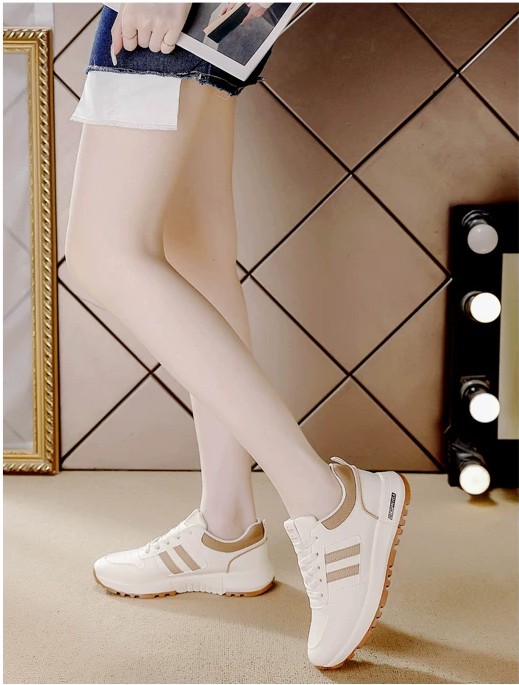
If you want something soft and light, these spring and summer women’s sports and leisure shoes sit in that warm-neutral band, with a low collar that keeps the ankle line clean. Good with cream, denim and light wool.
Want more structure from the same palette? The leather sports shoes with a soft broken-in feel take the colour in a firmer upper. They crease less and clean up more easily, which matters if you’re wearing them four days a week.
Both work better than a white pair from October onwards. That’s not a rule about fashion weeks. It’s just that a warm neutral looks less out of place next to dark clothing and wet pavements.
The daylight test
Buy taupe in daylight or don’t buy it at all. Shop lighting is engineered to make warm colours look richer, and it will sell you a shoe that looks wrong in your hallway.
Take the shoe to the door of the shop and hold it next to your hand, then next to your trousers. If both look right, buy it. If either looks off, try the cooler or warmer version of the same shoe, because most brands make both.
And if you’re shopping online, read the returns policy before the colour. Taupe is the shade most often sent back, and it’s usually the undertone rather than the fit. Have a look through the women’s shoe range with a photo of your favourite trousers on your phone, and compare before you add to basket.
One taupe pair, correctly chosen, will out-earn three pairs of white sneakers between October and March. It just has to be the right taupe.
