

You’re standing in the kitchen at 7:40 on a Tuesday, waiting for the kettle, and your feet already hurt. You wore sneakers. They were supposed to be the easy option.
That’s usually the moment when “lightweight” stops being a word on a shoebox and turns into a real question about grams. A pair that feels feathery in the shop at 11am can feel like a pair of bricks by the time you’ve done the school run, a supermarket lap and the walk back from the station. The difference between 260g and 420g per shoe is not something you notice in the first ten minutes. You notice it at hour nine.
So this is a piece about weight, but not in an abstract way. It’s about which lightweight sneakers for women actually hold up over a full day, where the weight savings come from, and the point at which a light shoe quietly becomes a cheap shoe. If you’ve bought a pair that felt great for a fortnight and then started to feel thin under the ball of your foot, you’ll recognise most of what follows.

What 260 grams actually means on your foot
First, a calibration. Shoe weight is usually listed per single shoe in an EU 38, and the numbers cluster in a way that’s useful once you know them. A leather fashion sneaker with a cupsole tends to land between 380g and 460g. A canvas plimsoll sits around 250g to 300g. A knit running-style shoe with a foam midsole can go as low as 200g. And the chunky, dad-shoe silhouettes that have been everywhere since 2021 often weigh 480g to 550g, which is not a problem in itself if you like how they look, but it is a number you should know before you commit.
Anything under roughly 300g per shoe counts as genuinely light for a women’s sneaker. Between 300g and 380g is normal. Above 420g you’re in “sturdy” territory, and your legs will feel it on stairs.
Where the grams come from matters as much as the total. The outsole is the heaviest single component on most casual sneakers, which is why a rubber cupsole can add 120g on its own. The midsole foam is next, and density varies a lot: standard ethylene-vinyl acetate foam used in most budget midsoles is noticeably denser than the newer supercritical foams that puff the same volume with less material. Then the upper. Leather and suede are heavy and don’t stretch much. Engineered mesh and flat knit are lighter, cooler, and much less forgiving of a bunion.
That last trade-off is the one nobody mentions in the product copy. Going light almost always means going softer somewhere, and the softness usually shows up around the heel or under the arch.
Why the last 2,000 steps are the ones that count
Here’s the part that makes weight worth caring about. Every step you take requires your leg to lift the shoe and then stop it coming down. Extra mass at the end of your leg costs more than the same mass carried on your back, because you’re accelerating and decelerating it thousands of times a day.
Sports scientists have measured this for decades, and the figure that keeps reappearing is roughly 1% extra energy cost for every 100g added to each foot. That sounds tiny. Then you do the arithmetic: a 450g leather sneaker against a 260g knit one is 190g per foot, so call it 2% more energy per step. Over 9,000 steps, that’s the difference between finishing the day with something left and finishing it with nothing left.
You won’t feel 2% in the first hour. You’ll feel it when you’re climbing the stairs at 6pm wishing you hadn’t.
There’s a second effect that matters more to most people. Heavier shoes tend to have stiffer soles, and a stiff sole changes how your foot rolls through each step. If your ankle doesn’t move much, your knee and hip pick up the slack. That’s fine for an hour of standing and less fine for a five-kilometre wander around a city on a Saturday.
- 200–280g: knit or mesh upper, foam midsole, thin rubber pads. Great for warm days, poor in rain.
- 280–340g: the sweet spot for most commuters. Enough structure, still light.
- 340–420g: leather uppers, thicker outsoles. Durable, but you’ll feel them late in the day.
- 420g+: platforms, chunky soles, heavy hardware. A style choice with a stamina cost.
Where the saved grams actually come from
Three components do most of the work, and it helps to know which one a pair has skimped on.
The upper is the biggest visual giveaway. A single-layer engineered mesh with bonded overlays is the lightest option that still holds a shape. Flat knit is next, then knit with a synthetic cage, then canvas, then leather. If a shoe has leather panels across the toe and heel, it is not going to be light, no matter what the box says.
Real engineering sits in the midsole. A plain EVA midsole is cheap and light but compresses permanently after a few hundred kilometres. A dual-density midsole puts a firmer foam under the arch and a softer one under the heel, which costs maybe 15g and buys you a lot of comfort at hour eight. That’s a trade worth taking every time.
Outsole construction is where brands hide weight. Full rubber coverage gives grip and durability. Partial rubber, with exposed foam between the rubber pods, saves 40g to 60g but wears through fast on concrete. If you walk 8,000 steps a day on pavements, exposed foam under the ball of the foot will be gone inside four months.
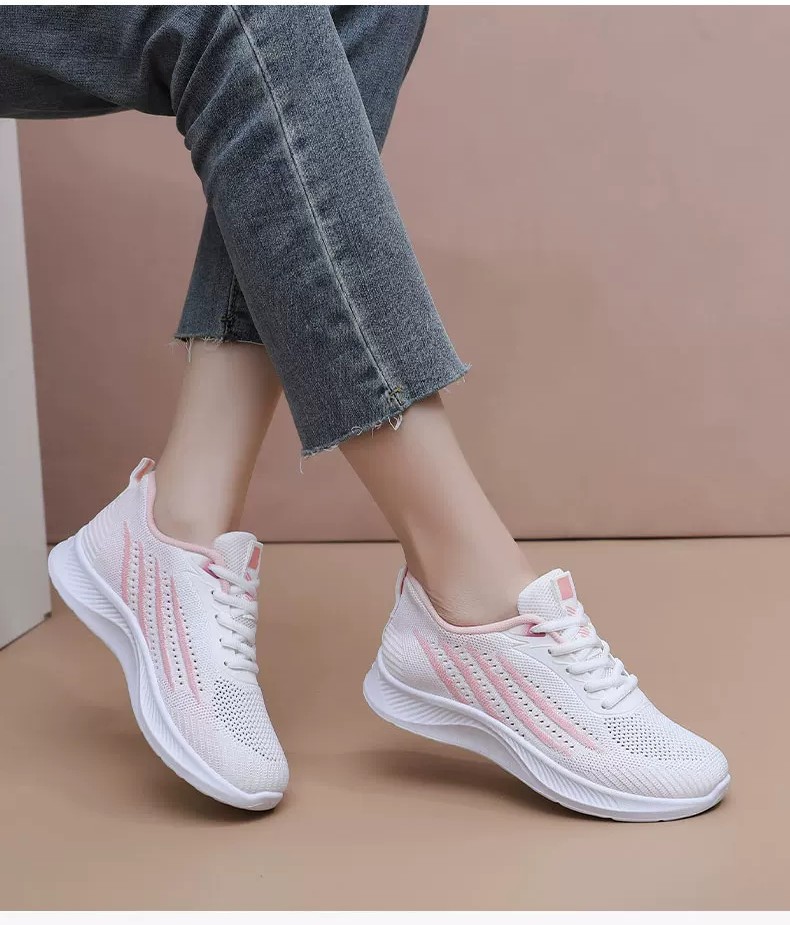
If you want a reference point, this ultra-light running-style pair for women shows the pattern clearly: mesh upper, foam midsole, rubber only where the foot actually lands. It’s built for the 200g-to-300g bracket, which is why it feels the way it does on the first try-on.
One more thing worth knowing. A removable insole is usually 25g to 40g. Swap a thick memory-foam insole for a thin flat one and you’ve saved more weight than most brands manage with a year of design work. You’ll also lose cushioning, so do it only if the shoe already has a decent midsole under it.
The 90-second test you can run in the shop
You don’t need a scale to work out whether a pair is genuinely light and well made. You need about a minute and a half and a bit of nerve.
- Hold one shoe in your hand and shake it. A well-built light shoe is quiet. If you hear the insole rattling or the lining shifting, the construction is loose.
- Press your thumb into the midsole under the heel. It should give 3mm to 5mm and spring back. If it collapses fully, it’s a foam that will be flat by spring.
- Twist the shoe lengthways, then fold it at the ball. It should flex at the ball and resist twisting through the middle. A shoe that twists like a wet sock has no shank and will roll your ankle on a kerb.
- Squeeze the heel counter. It should hold. If it folds between your fingers, the back of the shoe will collapse inward within weeks.
- Weigh it if the shop will let you. Many independents keep a kitchen scale behind the counter. 280g in an EU 38 is a good target.
That twist test is the one I’d keep if I could only keep one. Lightweight uppers hide a lot, and a floppy midfoot is the single most common failure in sub-300g casual sneakers.
Where light turns into flimsy
Honest section. Not every lightweight sneaker is a good buy, and the failures are fairly predictable.
The first is outsole wear. A 240g shoe with minimal rubber will not survive 1,500km of pavement. If it’s your only pair, expect to replace it in a year, maybe less if you’re a heel-striker. That’s not a defect; it’s the physics of putting less material between you and the ground.
Second, arch support. Ultra-light knit shoes often have a flat, removable insole and nothing underneath. If you have plantar fasciitis or a history of it, a 220g shoe with no shank is close to the worst thing you can put on your foot for a long day. You’d be better off at 380g with a firmer midsole.
Water is the third problem. Mesh dries fast but it lets everything in, and once the foam midsole is soaked it takes 24 hours to dry on a radiator and smells like a wet dog for a week. Cities with real weather need at least a treated upper or a stitched-on toe bumper.
And the fourth: cheap lightness. Some 260g sneakers are light because everything is thin, including the lining and the stitching. You can usually spot these by the price and by the way the tongue sits. If the tongue won’t stay upright when you lace up, the shoe was assembled in a hurry.
One genuinely light pair I’d point someone towards for everyday wear is these mesh soft-sole women’s sports shoes. They’re forgiving on width, they breathe, and the sole is soft enough for a school run without feeling like a slipper. Not a trail shoe. Not a rain shoe. But a very decent Tuesday shoe.
What to wear them with, without looking like you’re going to the gym
Light sneakers have one styling advantage that heavier ones don’t: they don’t drag the eye down. A chunky sole visually anchors an outfit and makes cropped trousers look deliberate. A slim, light shoe disappears, which means your hems and your ankles do the talking.
Wide-leg trousers want a low-profile lace-up in a colour close to the fabric. Grey wool trousers with a light grey mesh sneaker reads as intentional. The same trousers with a white chunky sneaker read as a commute.
Midi skirts need the sock situation settled first. No-show socks with a 7/8 skirt is the cleanest look. Visible white crew socks with a long skirt is a look, but it needs a cropped jacket to balance it, otherwise you’re 60% sock.
With jeans, almost anything goes, and this is where a lighter shoe earns its keep. A 280g sneaker under straight-leg denim keeps the line of the leg clean. A 500g dad shoe turns the whole silhouette into a wedge. If your jeans are wide and cropped, a pair of breathable flat-sole board sneakers sits under the hem without fighting it.
If you want to see how different sole shapes change that balance, this piece on retro sneaker soles that still work in 2026 goes through it with photos. The short version: thin soles flatter long legs, thick soles flatter short ones, and the wrong pairing makes both look off.
Colour is simpler than people think. Grey, off-white, navy and black cover 90% of wardrobes. If you own a lot of beige, an off-white shoe will look cleaner than a pure white one, which goes chalky against warm neutrals.
Keeping them light for longer than a season
A light shoe ages faster, so maintenance isn’t optional. The two things that kill them are dirt in the mesh and compressed foam.
Brush the mesh dry before you wash it. A soft brush or an old toothbrush, dry, once a week, takes 30 seconds and stops grit working into the fibres where it acts like sandpaper on the lining.
When they need a real clean, take the laces and insole out, use cool water and a drop of detergent, and scrub with a brush rather than soaking them. Then stuff them with newspaper and let them dry away from direct heat. A radiator will shrink the upper and cook the adhesive. This is the single most common way people ruin a light sneaker in one afternoon.
Foam compression is the other clock. Most EVA midsoles lose about 30% of their cushioning after 500km to 800km of walking, which for an average commuter is roughly 10 to 14 months. You’ll notice it as a flat feeling under the ball of your foot and a return of the ache you thought you’d solved.
Rotate. Two pairs worn alternately last far longer than two pairs worn one after the other, because the foam gets 24 hours to recover between wears. If you walk a lot, this matters more than any feature on the spec sheet.
So what should you actually buy
Walking under 5,000 steps a day, mostly with jeans? Buy the lightest pair that passes the twist test. Weight is your friend at that volume, and you’ll notice the difference by Friday.
On your feet for eight hours? Go 280g to 340g with a dual-density midsole and full rubber under the ball. Slightly heavier, much better at 6pm.
Arch pain changes the maths. Stop optimising for weight. A 400g shoe with real support will feel lighter at the end of the day than a 240g shoe that leaves your plantar fascia doing the work.
Replacing a pair right now? Weigh the old ones first. That number tells you more about what you actually need than any review, including this one. Have a look through the wider women’s shoe range includes the lighter pairs too with a number in your head, and you’ll shop very differently.
Your feet will tell you the truth at 6pm. They always do.
