

You’re 158cm, you’re standing in front of the mirror in a pair of chunky sneakers, and somehow you look shorter than you did in flats. That’s the moment most people give up on the idea that shoes can change anything.
They can, but not the way the marketing suggests. Height is only half of it. What actually reads as taller is the unbroken line from your hem to your toes, and most sneakers break that line in the worst possible place: right across the ankle, in a contrasting colour, at the widest part of the foot.
This is a practical piece for anyone under about 162cm who wants sneakers that work with their proportions. No magic. Just sole heights, collar heights, hem lengths, and the combinations that make a difference you can see in a photo.
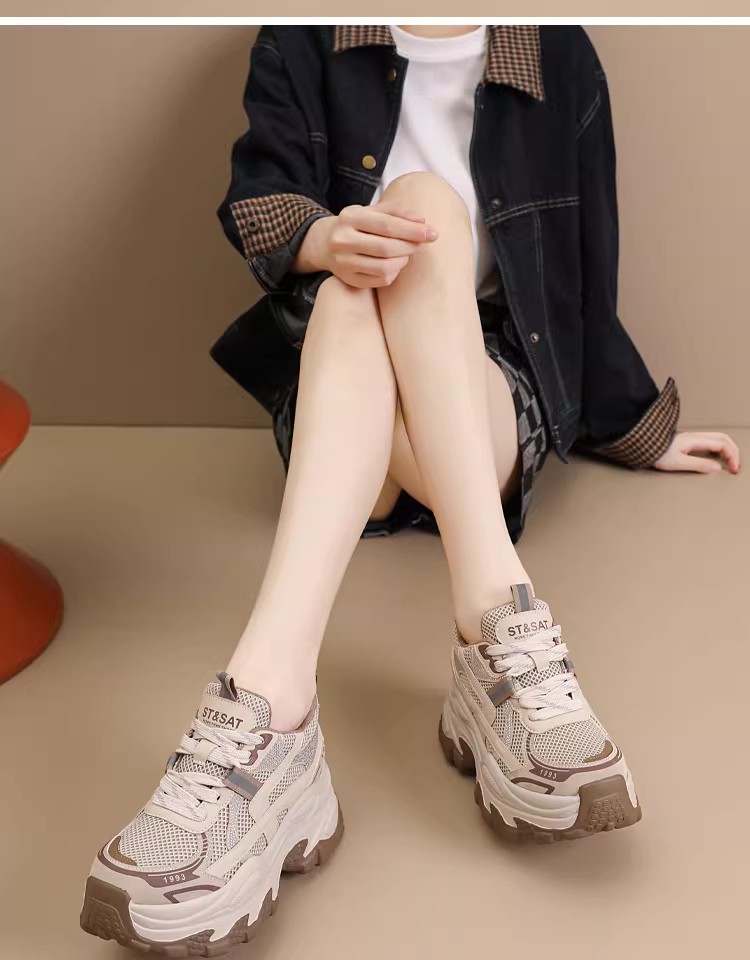
The ankle collar is the number that matters more than the sole
Picture two shoes with the same 40mm sole. One has a collar that stops 60mm below your ankle bone. The other comes up over it, like a high-top. On a short leg, the first one lengthens the visible leg. The second one cuts it, because the eye now reads your ankle as the end of the leg and the shoe as a separate block.
That’s why low-profile sneakers can make a short person look taller than platforms do. The sole adds height, but the collar decides where the leg appears to end.
You can test this in ten seconds. Stand in front of a full-length mirror, side-on, and look at where the top edge of the shoe sits relative to the bony bit on the outside of your ankle. If the shoe’s collar is above that point, it’s eating your leg line.
The exceptions are specific. A high-top in the same colour as your trousers can work, because the eye runs the colour straight through. A high-top in white, with black trousers, splits you in half at the ankle. Same shoe, opposite result.
If you want the detail on collar heights, where a high-top actually sits on the ankle covers the measurements. The short version: anything above 95mm from the insole needs a colour match to earn its place.
Sole height: what 30mm actually does
Let’s be honest about the maths. Nobody notices 20mm. At 30mm most people feel a difference in how an outfit hangs, but not in your height. From 40mm up, you get a visible change in silhouette, mainly because the whole leg gets pushed up relative to the hem.
The catch is that a taller sole changes your gait. A 40mm platform with no drop between heel and toe makes your calf work harder and your ankle less stable on uneven ground. That’s fine for a shopping trip and not fine for a 6km walk.
There’s also the visual weight. A thick sole under a slim leg looks like a wedge and makes the leg look thinner, which is usually good. A thick sole under a wide leg just makes the whole bottom half look heavy.
What works for most short women is 30mm to 45mm of sole with a low collar, in a colour close to the trouser. That’s a modest amount of height and a large amount of line. Compare that with a 60mm platform in white under black jeans, which adds height and subtracts proportion at the same time.
The history of the platform shoe is basically a history of that trade-off. Every era that embraced it also had to solve the same problem: how to stop the wearer looking like they’re standing on a block.
One colour from hem to toe
This is the single most effective thing you can do, and it costs nothing if you already own the clothes.
When your trouser, your sock and your shoe are all within a couple of shades of each other, the eye reads one continuous vertical line. It doesn’t matter much whether the line is light or dark. What matters is that it isn’t interrupted.
Black jeans, black socks, black sneakers: the leg looks 5cm longer than it is. Grey wool trousers, grey socks, grey sneakers: same effect, softer. Blue jeans with white sneakers and bare ankles: three breaks in one outfit.
Most people resist the sock part, because visible socks feel unfashionable. In practice, a sock that matches the trouser reads as nothing at all. It’s the white sock with black trousers that draws the eye, not the sock itself.
If you’d rather not think about socks, buy the shoe in a colour that already exists in your wardrobe. Taupe if you wear beige. Off-white if you wear cream. Black if you wear black. The shoe then does the matching for you.
A word of caution: tonal dressing works best with a shoe that has some texture or detail. All-black trousers with plain black sneakers can look like a uniform from a distance. A visible stitch line or a slightly different finish on the sole gives the eye something to land on.
Three proportions that quietly shrink you
These show up again and again, and none of them are about the shoes being wrong. It’s about the combination.
- A cropped trouser with a high-top. Two horizontal lines at the ankle, one from the hem and one from the collar. The gap between them gets read as “leg ends here”.
- A long, wide trouser with a chunky sole. The volume doubles. A wide hem over a wide shoe turns the bottom third of your body into a rectangle.
- A midi skirt at mid-calf with a low sneaker. The most horizontal part of your calf is exposed right above the shoe, which is the least flattering place to put a colour break.
Fixing them isn’t complicated. Hem the trouser to just above the shoe collar, or wear it long enough to cover the top of the shoe entirely. Swap the chunky sole for a lower one under wide trousers. Move the midi hem to just below the knee, or up to just above the ankle.
The hem rule that works most often: the trouser should end either clearly above the shoe or clearly over it. In between is where proportion goes to die.
Platforms: when they help, when they look like bricks
A platform can be brilliant for a short frame. It adds height without the arch angle of a heel, which means you can walk in it. That’s a real advantage.
It also adds a horizontal band at the bottom of the outfit, and horizontal bands shorten. So the question becomes whether you want the height more than you want the line.
Where a platform earns its place: under a slim, straight trouser that covers the top of the shoe. The platform then reads as a continuation of the leg rather than a separate object. It also works under a midi skirt with a strong vertical element, like a column silhouette or a single dark colour.
Where it fights you: under cropped trousers, under wide legs, and with anything that already has volume at the hem. In those cases you’re stacking two horizontal shapes at the same height, and the body looks shorter from every angle.
One thing nearly everyone gets wrong: platform sneakers in white with a black outfit. The white band at the bottom is the brightest element in the frame, so the eye goes straight to your feet and stops there. If you want the height, take the platform in black or dark grey and let the outfit stay continuous.
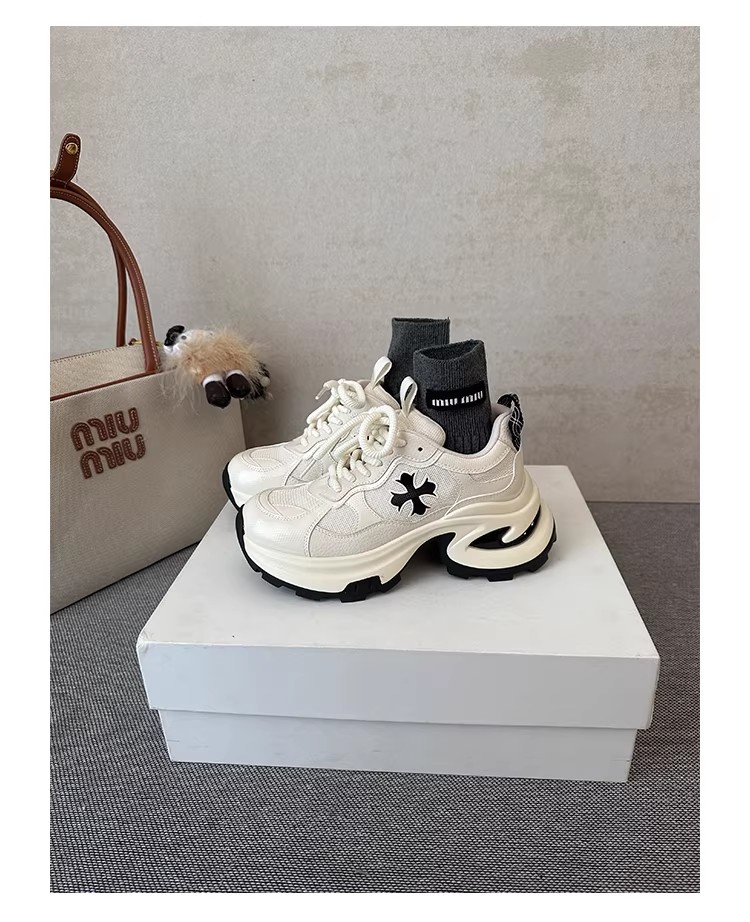
Hem length, and the 5cm rule
For a short frame, trouser hem length does more work than the shoe itself. There’s a rough rule that holds for most people: your hem should sit within about 5cm of the shoe’s top line, either above or below it. Any gap bigger than that starts to look like a mistake.
With straight-leg jeans and a low sneaker, a hem that just brushes the shoe is the cleanest option. With wide-leg trousers, a full break that covers the laces works, because the width needs the length to balance it.
With cropped trousers, the ankle becomes the focal point, so the shoe needs to be visually quiet. A slim low-top in the same colour as the trouser. Not a high-top, not a contrast sole, not a bright colour.
If you’re buying trousers specifically for sneakers, get them hemmed with the shoes on. It sounds obvious and almost nobody does it. Take the pair you’ll actually wear, put them on in the shop, and have the assistant pin the hem while you’re standing. Ten minutes of tailoring changes the whole proportion.
And if you’re short in the leg but long in the torso, the fastest fix isn’t shoes at all. A higher waistband moves the visual waist up, which adds more apparent leg length than 40mm of sole ever will. The shoe then has less work to do.
Width and toe shape do more than you’d think
Length gets all the attention, but width and toe shape change how a shoe reads on a smaller frame. A wide, rounded toe box makes the foot look bigger in every direction. Pointed or tapered toes make the same foot look longer and slimmer.
That’s why a slim skate-style sneaker in a taupe or grey can make you look taller than a chunky trainer in the same colour. The eye follows the taper. It’s a small effect, maybe 1cm in perceived length, but it compounds with everything else in the outfit.
Toe shape also affects comfort more than people expect. A tapered toe squeezes the little toe joint, which is where most women get that ache after three hours. If you have a wide forefoot, look for a shoe with a straight inner edge and a rounded outer toe, which is the shape a lot of running shoes use for exactly that reason.
Then there’s the platform edge. A sole with a visible lip that extends past the upper adds visual width at the bottom of the shoe. On a short leg that’s the last thing you want. A sole that sits flush, or wraps up slightly at the toe, keeps the shape tight.
Heel width matters too, and almost nobody checks it. A narrow heel cup on a wider foot means your heel slides, which is the single most common reason women return sneakers. Compare the width of your own heel against the shoe’s collar when you try them on. If there’s a visible gap on both sides, the shoe will roll.
One last detail: tongue thickness. A thick padded tongue pushes the whole shoe forward on the foot and makes the toe box feel shorter than it is. On a smaller foot, a thin tongue usually gives you 5mm of usable length without sizing up.
Bulk is a style question as much as a proportion one, and the general shape vocabulary of sneakers is worth knowing before you shop, because the names on the box rarely tell you what the silhouette actually does.
If you want to see how sole shape changes an outfit in practice, the piece on which retro soles still work in 2026 compares thin and thick profiles on the same leg length. It’s the quickest way to see the effect before you spend anything.
What actually works, in one paragraph
Low collar, 30mm to 45mm of sole, colour close to your trouser, hem within 5cm of the shoe. That’s the formula for most short women, and it’s boringly reliable.
If you want a bit more height with a bit more presence, the thick-sole dad sneakers with hidden height inside do the job without a visible platform edge, which keeps the line cleaner than a straight platform does. The hidden insole is the trick there: you get 4cm or so without the horizontal band.
If you’d rather stay flat and work with colour instead, a simple low-top in taupe, grey or off-white does more for your proportions than any 60mm sole. These 6cm white casual dad shoes sit in the middle: enough sole to matter, low enough not to chop the ankle.
The mirror test before you commit
Stand side-on in the mirror with the shoes on and the trousers you’ll wear them with. Then check three things, in this order.
- Is there a colour break at the ankle? If yes, can you close it with a sock or a different trouser?
- Does the hem cover the top of the shoe, or sit clearly above it? Anything in between needs tailoring.
- Does the sole look like part of the leg, or like a separate block? If it’s a separate block, the outfit needs a longer hem.
Then take a photo from waist height, not from above. Phone photos taken at chest height make everyone look shorter, and they’ve convinced a lot of people that their proportions are worse than they are.
If the photo looks right, it’ll look right in real life. If it looks wrong, no amount of sole height will fix it. Have a look through the full women’s shoe range with the collar height in mind rather than the platform height, and you’ll end up with a very different shortlist.
You’re not trying to look tall. You’re trying to look like one continuous line from shoulder to floor. That’s a different problem, and it’s much easier to solve.
