

The pair arrives on Thursday. You try them on in the hallway light, and they look exactly like the photo. Then you wear them to a work dinner and catch your reflection in a shop window at 7:40pm, and something has changed. Same shoe, different animal.
Red is the only colour that does this. It shifts with the light, it pulls attention to wherever you’re standing, and it makes every other item in your outfit declare itself. Buy the right red and you’ll wear the pair forty times. Buy the wrong one and it lives in the box.
This is about picking the right one. No colour-wheel theory, just the stuff that shows up when you’re standing in a doorway deciding whether to change shoes.
Why red looks different at noon and at eight in the evening
Red sits at the long-wavelength end of the visible spectrum, around 620 to 750 nanometres, and your eye is unusually sensitive to it. That’s why a red shoe reads as “loud” even when the shoe is small. The physics of how red light behaves also explains why the colour changes character under different bulbs: warm restaurant light pushes it toward orange, cool office fluorescents push it toward blue, and daylight shows you what you actually bought.
Practical consequence: try red heels near a window, not in a fitting room lit by one warm bulb. If you’re ordering online, look at the photo on a phone screen outdoors and ask yourself whether the colour looks like blood, brick, or cherry. Those three read completely differently against skin.
The same physics explains why red accessories photograph badly. A phone camera blows out the red channel first, so the shade in the listing is often brighter and flatter than the shoe on your foot. Assume the real pair is a shade deeper than the picture.
Four reds, and what each one does to an outfit
Most red shoes on the market fall into four groups. Knowing which one you’re looking at solves half the buying decision.
True scarlet. Orange-leaning, high saturation, the colour of a London bus. It’s the hardest to wear and the most striking. Scarlet wants a neutral outfit and a confident heel height; it looks cheap on a low block and expensive on a slim 90mm. If your wardrobe is mostly black and denim, this is your red.
Cherry. Slightly blue, slightly deeper, closer to a ripe fruit than a fire engine. Cherry is the friendliest red for most people because it has enough depth to read as “grown-up” in daylight. It flatters pale skin and deep skin equally, which is rarer than it sounds.
Oxblood and burgundy. Red with brown or purple mixed in, dark enough to pass as a neutral from three metres away. This is the red you can wear to an office with a dress code. It also hides scuffs better than any other shade, which matters if you actually walk in your shoes.
Brick and rust. Warm, dusty, slightly faded. Brick is the shade to pick if bright red makes you feel like you’re in costume. It pairs with camel, olive, cream, and denim, and it survives being worn with brown boots and a brown bag, which true red never does.
One number to keep in mind: a red with more than about 20% black mixed in starts behaving like a dark neutral. That’s the oxblood zone, and it’s where most people should start if they’ve never owned red shoes.
The outfit maths: what actually works with red heels
Red heels fail when they’re the only red thing in the room. They work when the red is echoed somewhere, even quietly. You don’t need a matching bag. A red lip, a thin red stripe in a scarf, or a red phone case is enough to make the shoe look intentional.
The combinations that hold up in real life:
- Red and raw denim. Straight-leg jeans, white tee, red slingbacks. Zero effort, always works.
- Red and navy. The safest pairing in the book, and the one that reads most expensive.
- Red and camel. Warm on warm, best in autumn, forgiving on every skin tone.
- Red and all-black. Strong, but only with a heel you can walk in. A wobbly walk ruins the whole effect.
- Red and grey. Underrated. Soft grey flannel or a grey knit makes red look considered rather than loud.
What doesn’t work: red shoes with a floral print that already contains six colours, red with a bright pink, or red with a large logo print. In each case two things are competing to be the loudest object, and your eye doesn’t know where to land.
If you want the shade logic in more detail, the approach in this piece on choosing a brown heel shade around what you already own applies to red as well. Start from the wardrobe, not the shoe.
Does your skin tone decide your red? Less than the internet claims
Search red women shoes heels and you’ll hit a wall of articles telling you cool undertones need blue-reds and warm undertones need orange-reds. It’s not wrong, exactly. It’s just not the main variable.
Contrast matters more than undertone. If your skin is deep, a bright scarlet creates a strong contrast at the ankle and looks deliberate; an oxblood blends in and reads softer. If your skin is fair, the reverse happens. Neither is better. It depends on whether you want the shoe to announce itself or to sit quietly.
Here’s the part the shade guides skip: your outfit sets the contrast, not your skin. Red shoes against bare legs look different from red shoes against black tights, and different again against pale denim. The same pair can look understated at a winter wedding and loud at a summer lunch.
So instead of memorising undertones, do this. Hold the shoe against the clothes you’d actually wear it with. If it holds its own against all three outfits, buy it. If it only works with one, you’ve found a costume, not a shoe.
Satin, suede, patent: the finish changes the red
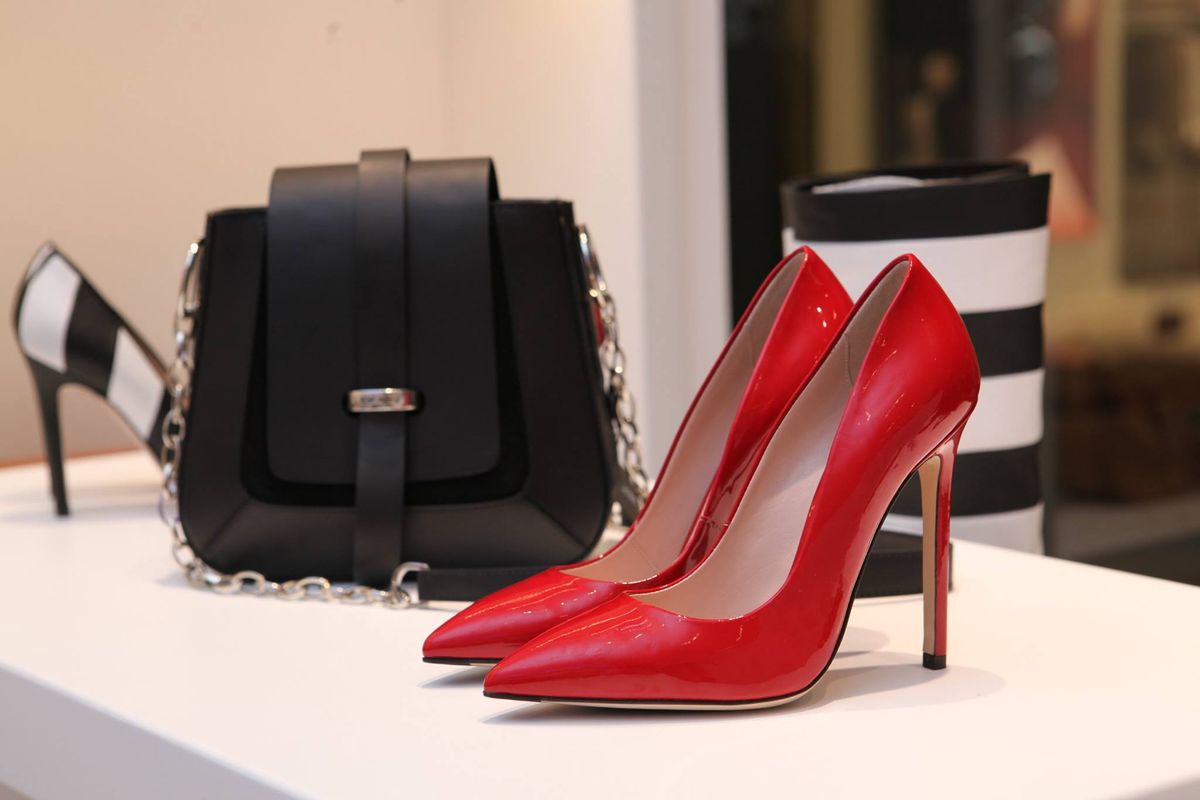
Two shoes in the same dye can look like different colours because of surface texture. Glossy finishes reflect light and appear lighter and brighter. Matte finishes absorb light and read deeper. This is why the patent pair in the window looks like cherry and the suede pair in your hand looks like oxblood.
Patent is the most dramatic and the most high-maintenance. It shows every scuff, it creases at the toe in a way that’s visible from a metre away, and it can stick to the back of your heel in humidity. On the other hand, patent red is the version that survives a rainy commute, because water beads off it.
Suede gives you the richest red and the softest look. It also stains. One wet pavement and you’ve got a dark patch at the toe that never quite lifts. If you go suede, spray it before the first wear and keep a brush by the door, and read up on how suede heels hold up against rain and road salt before winter.
Satin is the evening option, and it’s less fragile than people think as long as you keep it away from rough surfaces. A satin pair like these satin heels with a slim heel does the same job in red that it does in black: it catches light and makes a plain dress look like an occasion.
If you want the red without the commitment, a printed pair is the workaround. Cherry-print styles like these cherry print pointed heels read red from a distance and give you a pattern to hide scuffs in. It’s a bit of a cop-out, honestly, and it works.
One sizing note that catches people out: deeply dyed leather comes back stiffer than black or nude. Red pumps often need two or three wears before the toe box softens, and the first wear can feel half a size small. Don’t size up on day one. Wear them around the house for twenty minutes twice with thick socks, then decide.
Three ways red heels go wrong, and how to avoid them
Dye transfer. Cheap red lining bleeds onto pale feet and pale tights, especially on a warm day. Test with a damp white tissue inside the heel before you wear them anywhere that matters. If the tissue turns pink, return them. Leather and lining dyes that sit against skin all day should carry a safety certification for skin contact; if a listing mentions none, that’s your answer about the price.
Scuff visibility. Red shows damage more than black or brown. The heel tip and the inner toe are the first to go. Ask a cobbler to fit a rubber sole guard before the first wear; it costs very little and doubles the life of the pair.
Dress-code trouble. Bright red is a statement at a wedding where the bride is in white and the family is in pastels, and it can read as attention-seeking in a conservative office. Oxblood solves both. So does a lower heel. If the invitation says black tie, red is fine. If it says garden party, brick is safer than scarlet.
One more: red heels with a very pointed toe and a very high heel is the combination most likely to hurt by hour two. The toe box narrows right where your foot is sliding forward. If you want both the colour and the comfort, choose a rounder toe or a 70mm heel. You’ll wear them far more often.
Four occasions, four reds
Colour choices get easier when you name the event. These four cover most of what’s in a normal calendar.
Office, Monday to Thursday. Oxblood, 50 to 60mm, closed toe. It reads as brown from across the room and as red when you’re sitting at your desk. Nobody will comment, which is the point.
Dinner, any night. Cherry, 70 to 80mm, pointed or almond toe. Cherry has enough depth for a dim restaurant and enough brightness to show up in photos. Pair it with navy or black and let the shoe be the only colour.
Wedding, as a guest. Brick or rust, block heel. You’ll be standing on grass, gravel or a terrace for six hours. A 60mm block in a warm, dusty red looks intentional and keeps you upright, which no stiletto does after the third hour.
Party, where you know people. Scarlet, 90mm, whatever toe you like. This is the pair that gets compliments and the pair you take off under the table at 11pm. Neither is a problem if you planned for it.
If you only buy one, buy the oxblood. It covers the office, the dinner and half the weddings, and it’s the shade that survives three winters of pavement without looking tired. The scarlet pair is more fun. The oxblood pair gets worn.
Buying red online without getting burned
Three checks before you pay. First, find a photo of the shoe on a person, not just the product shot, because the colour on a white background is almost always wrong. Second, read the returns policy properly. Red is the colour people most often send back, and you want to know the window before you order.
Third, check the heel height in millimetres rather than inches, and compare it against a pair you already own. That single comparison prevents most of the “they looked smaller online” returns.
If it’s your first red pair, start with oxblood or brick and a 60 to 70mm heel. Wear them three times before you decide anything. The first wear feels louder than it is; by the third, red stops being an event and becomes part of how you get dressed.
And if you’re still deciding between shades, look at the rest of the heels collection with your three most-worn outfits in mind. That’s the only test that predicts whether the box stays closed.
