

It’s 7:35 on a Tuesday and you’re holding one black heel and one white one, trying to work out which pair the grey suit wants. Neither looks wrong. Neither looks right either. That’s the small problem two-tone shoes were invented to solve.
A black and white heel does something a single-colour pair can’t. The dark section anchors the bottom of your outfit and stops the eye sliding past your feet. The pale section bounces light back up at your ankle. On a 70mm pump, that split second of contrast buys you roughly two inches of apparent leg length. Free height, basically.
It’s also why the combination keeps coming back while louder colour blocking dies after one season.
Two colours, two different jobs
Look at where the white sits before you look at anything else. That placement decides whether the shoe flatters you or fights you, and it matters more than heel height.
A pale toe box lengthens the foot. It draws a line from your ankle down to the tip, and the eye reads that line as leg. A pale strap across the ankle does the opposite. It cuts you off at the narrowest point of your leg and hands back every centimetre you just gained. Same shoe, two placements, opposite results. If you’re 5’2″ and shopping for women’s black and white high heels to wear with a midi skirt, check the strap first.

The classic cap-toe pump is the safest version. Black body, white toe, or black toe on a white body. The small pale patch reads as deliberate rather than decorative. A flat black pump is background noise. Add the toe and people notice the shoe without being able to say why.
Then there’s the question of which way round to buy it. Black body with a white toe behaves like a black pump, so it slots into everything you already own and the pale tip keeps a dark outfit from going flat. White body with a black toe is the louder buy. It reads summery, photographs beautifully, works with pale denim, and looks wrong in November. If you live somewhere with four real seasons, expect to wear it five months and store it seven.
Full white with a black heel is the riskiest version. From the front it’s a white shoe, and white shoes make feet look bigger. From the side the dark heel cuts the profile. It suits narrow feet and a strong ankle, and it can look wonderful on them. On a wide foot it often doesn’t.
Printed versions are a different animal altogether. Polka dots, dalmatian spots and contrast stitching all lean casual, and small busy prints look dated within a season. A large, clean contrast panel ages better.
Try the pair on with the outfit you actually plan to wear, not the jeans you keep for trying things on. The answer usually shows up in about ten seconds.
The spectator pump never really left
This shape has been in and out of fashion for about 150 years. It started as a sporting shoe in nineteenth-century Britain, built for tennis and golf where white leather was the practical choice. Between the wars it moved into daywear, and it has cycled back roughly every generation since. The history of the spectator shoe is worth ten minutes if you like knowing why a shoe looks the way it does.
What made it stick is the same thing that makes it easy to wear now. The white section reads as summer and the black section reads as office, so the shoe sits in the middle of the dress code and refuses to pick a side.
Chanel’s two-tone slingback, launched in 1957, took the idea and turned it into a leg-lengthening trick: beige body to match skin, black toe to define the end of the foot. That version gets copied every single season, which tells you the logic works. The wider lesson from the development of the high heel is that shapes change and the visual math doesn’t.
Fair warning, though. Retro shapes come with retro proportions. Authentic spectator pumps tend to run narrow through the toe and shallow through the vamp, and they were cut for feet that never met a pavement in winter. If your feet are wide, size up half a size or walk away.
Modern versions split into two camps worth knowing about. The reproduction pairs copy the 1930s last almost exactly, with a narrow toe and a thin leather sole, and they look incredible for about two hours. The reworked pairs keep the panel and drop the period details: a block heel instead of a stiletto, a slightly rounder toe, a padded insole. You lose some of the sharpness and gain a shoe you can wear to work. Most women’s black and white high heels sold today sit in that second camp, and that’s usually the right call.
One tell for quality, whatever the era: the contrast panel should be stitched and joined, not printed or glued on. Printed panels crack along the flex point within a few months and the crack collects dirt, which is exactly the sort of detail that makes a decent shoe look cheap.
70mm is the height most people can actually walk in
Here’s the breakdown, measured on a hard floor rather than a carpeted shop.
- 50mm (2 inch): all-day wear, no thinking required, reads slightly formal in a kitten-heel way.
- 70mm (2.75 inch): the sweet spot. Long enough to change your posture, short enough that you forget about them by lunch.
- 90mm (3.5 inch): fine for a wedding or a dinner, rough for a commute with stairs in it.
- 100mm and up: a seated shoe. Great in photographs, punishing by hour three.
Above 90mm, most of your body weight shifts onto the ball of the foot and your toes start doing work they weren’t designed for. You feel it as a burning sensation under the big toe joint around the 90-minute mark. Some people tolerate it for years. Most don’t, and no insole fixes it because it’s geometry rather than materials.
One test beats every size chart: walk 20 paces on tile, not carpet. Carpet hides a heel that slips. Tile doesn’t.
Then run three checks with your hand. Squeeze the widest part of the shoe against the widest part of your foot; they should line up, and if your little toe bulges over the sole edge you need a wider last, because leather only stretches about 2mm across the width in three months of wear. Pinch the heel counter; if it collapses completely between your fingers it’ll fold under your heel within a month. Hook one finger under the ankle strap; tighter than that and it’ll rub your Achilles raw by lunchtime.
Buy in the afternoon. Feet swell about 5% by evening, and a shoe bought at 9am is a shoe bought too small.
If you want the shape broken down properly before you commit, this guide to the main heel shapes and what each one does to your feet covers toe-box differences better than most product pages do.
What to wear them with
The two-tone thing is louder than a plain pump, so let the rest of the outfit stay quiet. That’s the rule that keeps these shoes from looking costumey.
- Grey or navy tailoring. The white section keeps the outfit from looking flat, the black section stops it looking like a uniform.
- Dark straight-leg jeans, cuffed once, no rips. This is the version you’ll reach for most often.
- A plain midi dress in one colour. Let the shoe be the only pattern in the frame.
- Black tights, black dress, black coat. This is where a white toe earns its keep, breaking a column of black at the very bottom.
- Wide-leg cropped trousers. Only if the hem sits above the ankle strap. Otherwise the trouser eats the shoe.
Skip busy prints. A floral midi with a spotted heel is two arguments happening at once, and neither one wins.
Texture does more work than colour here. Wool, raw denim and matte cotton all sit well next to a patent or satin finish, because the shine becomes the single point of interest. Swap in a glossy fabric top and the shoe starts competing with your shoulders for attention.
Hem length is the other lever. A hem that stops just above the ankle bone shows the strap and the toe at once, which is the version most people look best in. A hem that lands mid-calf hides the ankle strap and leaves a white toe floating under a dark skirt, and the proportion goes odd.
Jewellery is the easiest place to overdo it. Silver reads cleaner against black and white than gold does, and one piece is enough when the shoes are already doing the talking.
If you’d rather have a plain pair to rotate in on the days you don’t want to think, the main heels collection runs from kitten heights to full stilettos and most of it is single-colour.
When black and white looks wrong
It isn’t a universal shoe, and pretending otherwise wastes your money.
The contrast reads formal. Worn with athleisure, shorts or a swim cover-up, it looks like you got dressed in a hurry and grabbed the wrong pair off the rack. It also fights patterns, and it goes strange with very pale stone or cream outfits where the white section disappears and you’re left with what appears to be a black shoe with a floating toe.
There’s a seasonal problem too. Black and white is a spring and autumn combination. In deep winter, with heavy wool and dark tights, the white panel can look like a mistake under grey light. Not always, but often enough to notice.
And one practical downside nobody mentions in the styling posts: white leather shows every scuff, every splash off a wet pavement, every dark mark from a car door. Black hides all of it. If you’re rough on shoes, women’s black and white high heels are a high-maintenance buy, and a plain black pair will outlast them by years.
They’re also not a walking shoe. If your day runs past about 6,000 steps, leave them at home.
Three situations where you should pick something else instead:
- A job interview at a conservative firm. Two-tone reads creative, and that can work against you in a room full of plain black pumps.
- A winter wedding with a long walk from the car park. Wet gravel and white leather don’t negotiate.
- Any day you’re carrying a toddler. You need a base you can trust, and a slim heel on a marble floor isn’t it.
None of that makes them a bad buy. It just means women’s black and white high heels belong in the part of your wardrobe that plans ahead, next to the dress you keep for occasions, rather than in the row you grab from on a normal Wednesday.
Keeping the white actually white
Clean them the day you scuff them, not at the end of the month. Fresh marks lift with a damp cloth and a drop of mild soap. A month-old mark has already bonded to the finish and needs a professional.
Patent leather takes a soft damp cloth and nothing else. No acetone, no nail polish remover, no melamine sponge, all of which cloud the surface permanently and can’t be polished back.
Matte or smooth leather wants a pH-neutral leather cream worked in with a cloth, left ten minutes, then buffed. Do the whole shoe rather than the dirty patch, or you’ll create a shiny spot that never blends in again.
Store them away from dark shoes. Black dye transfers onto white leather in a warm wardrobe and it does not come off. Keep the pair in a cotton bag with both heels pointing the same way so the toe boxes don’t press against each other and crease.
Rotate. Wearing the same pair three days running traps moisture in the lining and speeds up creasing at the vamp. Two days on, one day off is enough.
Now the repair math, which is where most people lose money. Heel tips wear through in about 40 to 60 wears of regular pavement walking. Once the plastic cap is gone, the metal pin inside starts grinding the leather-wrapped heel down from within, and you go from a five-minute fix to a full heel rebuild. Check them with a thumbnail every couple of months. If you can feel the pin, book the cobbler.
Resoling is worth it on a stitched leather sole and rarely worth it on a glued synthetic one, which comes back with a slightly different profile that never sits right again.
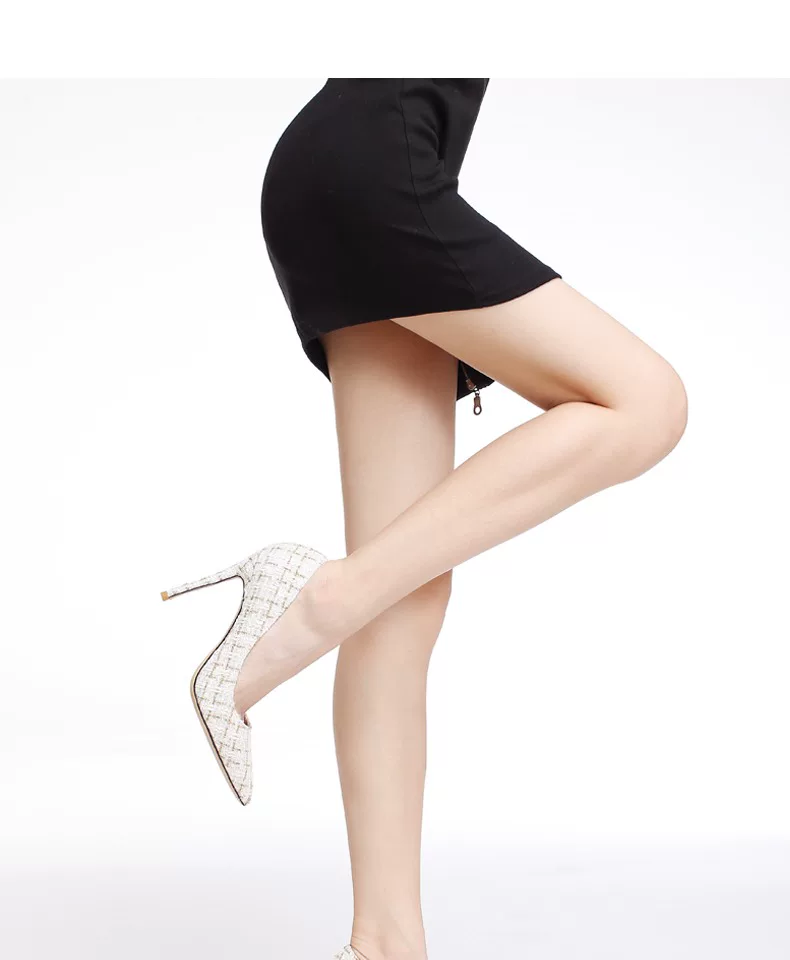
For the rotation itself, a satin black pair with a pointed toe handles the evenings, and woven leather white heels cover warm days when solid black feels heavy. Something like white heels with a slim heel and a clean vamp sits in the middle and works with jeans and tailoring both, which is the whole point of owning one pair instead of four.
And if you want to know what a lower heel does to a genuinely long day, what 50mm actually does to a long day is more useful than any styling advice, because the answer is usually a shorter heel on a wider base.
So buy the two-tone pair for the days you want to look like you made an effort, and keep something plainer for the days you have to walk. If you’re only buying one pair of women’s black and white high heels, work out which of those two kinds of day you have more of.
