

You own eleven pairs of heels. Two get worn. The other nine sit in the closet because hour one felt fine and hour four did not.
That’s the whole trap. You buy by how a shoe looks on the shelf, and the shape of the heel quietly decides how your foot lands for the next six hours. Nobody explains that at the checkout.
Here’s the short answer first. If you need to stand through a workday, buy a block heel at 60mm or under. If you want the long leg line for a dinner, a stiletto is fine for ninety minutes of sitting and twenty of walking. Everything else lives between those two poles.
What follows is a working map of the main types of women’s heels, what each one does to your feet, and where each one usually fails. A few of these I’d buy again. One of them I’d skip.
Two numbers beat any style name
Ignore the label on the box for a second. The two figures that decide whether a pair will hurt you are the heel height in millimetres and the width of the toe box.
Heel height you already know. Toe box width is the one people miss, and it’s why a 60mm shoe can wreck you while a 90mm shoe feels fine. If the widest part of the shoe doesn’t match the widest part of your foot, your toes get compressed with every step, and no amount of gel inserts fixes a shape problem.
There’s a third number worth doing arithmetic on: effective pitch. Subtract the platform from the total heel height and you get the angle your foot actually holds.
- 100mm heel with no platform = 100mm of pitch
- 100mm heel with a 25mm platform = 75mm of pitch
- 120mm heel with a 40mm platform = 80mm of pitch
That’s why a tall-looking platform sandal can be gentler than a modest-looking stiletto. The eye reads height. Your ankle reads angle.
The reference material on high-heeled footwear describes the same mechanics from the other direction: raise the heel and you shift load onto the forefoot while shortening your stride. Nothing mystical happens. It’s a lever, and your toes are on the wrong end of it.
One more thing before the list. Heel type and heel height are separate decisions. You can get a 100mm block heel and a 40mm stiletto. Most shopping advice collapses the two, which is how people end up buying the wrong shoe twice.
Stilettos: a different walk, not just a taller shoe
A stiletto is defined by the heel itself: a long, thin spike, usually under 10mm across at the base. The history of the stiletto heel runs back to the 1950s, and the shape hasn’t changed much since because it does one thing extremely well.
What it does is throw your weight forward and put almost all of it on the ball of your foot. That’s the look. That’s also the cost.
You’ll notice it first in your calves. A stiletto shortens the Achilles and keeps it shortened, so after an hour your calf feels tight in a way a block heel never causes. Walk a city block in a 100mm pair and you’ll feel the difference in your lower back by evening.
So when does a stiletto earn its place? Three situations, honestly.
- You’re sitting for most of the event, standing only to greet people
- The floor is carpet or smooth stone, not cobblestone
- You have a car or a taxi at both ends of the trip
Add a heel grip if the back slips. That’s not a fit flaw in most cases, it’s just a narrow heel cup plus a narrow heel, and a 3mm suede insert usually sorts it.
Here’s the part I’d push back on. Plenty of advice says a stiletto gets comfortable once you break it in. That’s only true for the upper. The pitch never changes. If a 100mm stiletto hurts on day one, it will hurt on day thirty, just in a slightly different spot.
If you love the silhouette but your day involves 6,000 steps, look at a 70mm stiletto instead of a 100mm. Same line from the side, roughly a third less load on the forefoot, and you stop bracing with your toes.
Block heels do the work a stiletto can’t
A block heel spreads the same height across a wide base, so your weight lands on the whole heel rather than a spike. Walk on grass, gravel or a wet train platform and the difference is immediate. You stop thinking about your feet.
That’s the real benefit. Not comfort in the abstract, but the ability to forget you’re wearing heels at all.
Block heels have one genuine drawback, and it’s visual: the wider base reads heavier, especially in light colours and chunky shapes. A cream 90mm block heel can look like a doorstop next to a cream stiletto of the same height. If that bothers you, go darker or go lower.
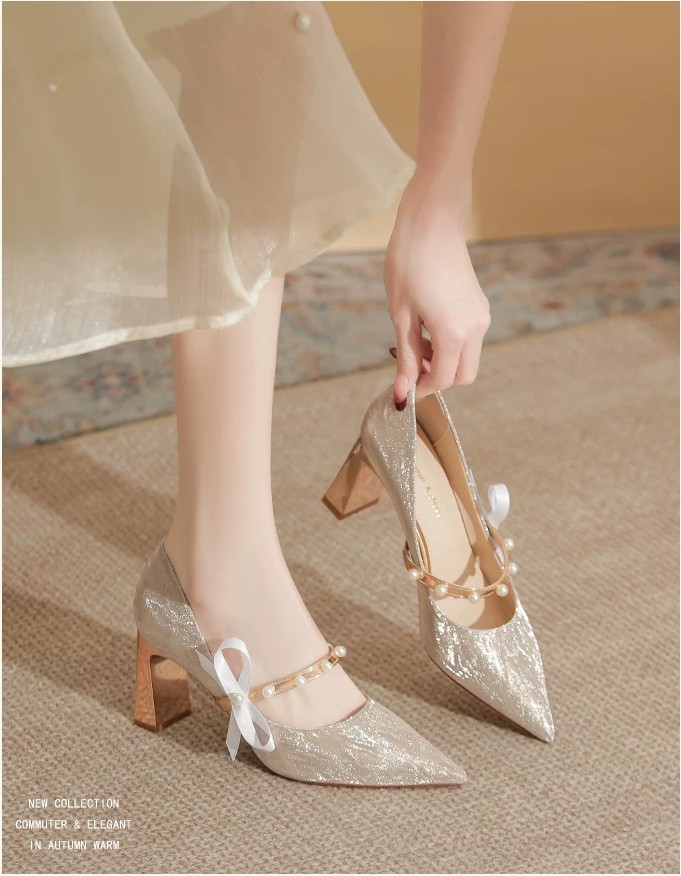
Where block heels shine for most people is the 50 to 70mm band. At that height you get lift without the forward slide, and the shoe stays stable on tile, which matters if you spend your day on office flooring or hospital corridors. If you want a pair that survives a standing shift, these thick-heel styles built for long standing hours are the shape to copy: broad base, low pitch, closed toe.
One caveat worth repeating. A block heel doesn’t automatically mean comfortable. A heavy block at 100mm with a stiff leather upper will still fight you, because the weight drags and the upper doesn’t give. Check the sole flexibility before you fall for the base width.
Kitten heels: 40 to 50mm, and the comeback that stuck
A kitten heel sits between 35mm and 50mm, usually with a slight curve that sets the heel under the arch rather than at the very back. It was a teenage shoe in the 1950s and a punchline by the 2000s, and now it’s back on every second runway.
The reason is simple math. At 50mm the pitch is shallow enough that you can walk normally, and your forefoot doesn’t take the load. You get a heel, a lifted arch, and a shoe you can wear from 8am to 6pm without a second thought.
If you’re deciding between 50mm and 70mm, read what 50mm actually does to a long day before you commit. The short version: 50mm is a walking shoe with a heel on it, and 70mm is not.
Two things to watch with kitten heels. First, because the heel is short and slim, some pairs tip outward when you stand still. Test by standing on one foot in the shop; if the shoe rolls, the heel placement is off and it won’t improve. Second, the low heel pushes the toe box flatter, so a pointed toe at 50mm can pinch more than a pointed toe at 90mm. Counterintuitive, but true.
If you want the widest choice, the collection of 2-inch heels is where most kitten and low-block options sit. It’s a good place to start if this is your first low heel and you’re not sure about the shape yet.
My honest take: kitten heels are the most underrated type on this list, and also the one most likely to look dated if the toe shape is wrong. A round or square toe reads current. A very long, very sharp point at 40mm reads 2011.
Pumps and court shoes are the same shoe
American sites say pump. British sites say court. They mean the same thing: a closed shoe with no laces, no straps, and a heel, cut low enough at the sides to show some foot.
This is where the naming gets messy, because “pump” gets used as a catch-all. A pump can be a stiletto, a block heel, a wedge, or a kitten heel. If a product page says pump and nothing else, you still need the heel height and heel type before you know what you’re buying.
The description of the court shoe makes the distinction clear: the term describes the cut of the upper, not the heel underneath.

Fit is the thing that decides whether a pump works for you, and there are only three measurements that matter. Heel slip should be under 5mm when you walk. The vamp, the part across the top of your foot, shouldn’t press on the bone. And your longest toe should sit 5 to 8mm from the end.
Material changes all three. Patent leather doesn’t stretch, so buy it snug and expect it to stay snug. Soft calf leather gives about 2mm over the first month. Satin gives almost nothing and marks if it gets wet, which is why satin pumps in a 75mm heel are a good dinner shoe and a bad commuting shoe.
If a pump pinches across the vamp on day one, size up half a size or walk away. That seam doesn’t relax the way a leather upper does at the sides.
Slingbacks, mules, and ankle straps: three fit traps
These three get grouped because they all leave part of your foot exposed. They also each fail in a predictable way.
Slingbacks. The strap sits behind your heel and holds the shoe on. When it’s elastic, it will stretch out within a season and start flopping. When it’s buckled leather, it lasts but you’ll spend ten seconds fastening it every time. Check the strap tension by walking five steps; if it slides down, it’s cut too long for your heel.
Mules. No back at all, so your toes do the gripping. That’s fine for a two-hour dinner and terrible for a trade show. If you want mules anyway, look for a slight rise at the heel counter, about 10mm, which catches your heel and stops the clench.
Ankle straps. Great for security, bad for legs if the strap lands at the wrong height. A strap that crosses at the narrowest point of your ankle looks fine. One that crosses higher, or sits at the widest point, visually cuts the leg. Try a pair of ankle-strap block heels and look in a full-length mirror from three steps back, not straight down.
Wide feet run into one more problem here. Straps sized for a standard instep will dig in across the top of the foot. If you already know your feet are wide, look at square-toe shapes that forgive wide feet and skip thin single straps entirely.
Wedges and platforms: height without the pitch
A wedge runs solid from heel to toe. A platform raises the front of the shoe on a slab. Both let you add height while keeping the angle shallow, which is why they’re the friendliest tall options for anyone who has given up on stilettos.
Wedges have one flaw people don’t mention: they’re stiff. Because the sole is one solid piece, it doesn’t flex under your foot, so you walk from the hip instead of the ankle. Over a long day that shows up as tired hip flexors rather than sore toes. It’s a different kind of tired, not the absence of it.
Platforms bring a separate risk: the ankle. A 40mm platform lifts your foot away from the ground, and on uneven pavement that extra height is where sprains happen. If you’re walking on anything other than flat ground, keep the platform under 30mm.
Both shapes work best in summer, both look wrong with a heavy winter coat, and both are terrible on stairs. That’s the whole trade.
Booties and heeled sandals: seasonal maths
Heeled booties solve a specific problem. They cover the ankle, so you can wear a heel in November without freezing, and the shaft holds the shoe on your foot better than any strap.
The fit issue is the shaft circumference, not the length. A bootie that’s 5mm too tight around the ankle will rub the same spot raw every single time. Measure your ankle at its narrowest point and compare it to the shaft measurement on the product page, not the size chart’s generic advice.
Heeled sandals are the opposite problem. Almost nothing holds your foot in place, so your toes grip with every step. Thin straps make it worse. If you’re standing at a wedding for four hours, a sandal with a strap across the instep and another behind the heel will hold up far better than a two-strap slide.
Bridal is its own subcategory, and it’s where people overspend on looks and underspend on the insole. A six-hour wedding day needs a padded footbed more than it needs crystal. If that’s your situation, bridal styles with a soft sole and a lower pitch will get you through the reception without sitting down during photos.
The 90-second test in the shop
You don’t need to walk around for twenty minutes to know if a pair will work. You need ninety seconds and a hard floor.
- Walk ten steps on tile, not carpet. Carpet hides instability.
- Stand on one foot for five seconds. If the shoe rolls outward, the heel is misplaced.
- Press your thumb across the widest part of the toe box. It should give slightly.
- Check that your heel lifts less than 5mm as you walk.
- Stand still and see whether your toes curl. If they do, the pitch is too steep for you.
Do this at the end of the day, not the morning. Feet swell by roughly 4% over a day, which is about half a size. A pair that fits at 9am can be unwearable at 6pm.
And buy for the longer foot. Most people have one foot about 3mm longer than the other, and it’s almost always the left. If you’re between sizes, that decides it.
If you’re only buying one pair this year
Buy a 60mm block heel in a colour that matches your skin tone within two shades. Not black, not nude as a concept, but the actual shade that disappears against your foot. It works with jeans, with a dress, with a suit, and you can wear it for eight hours.
Then, if you want a second pair, buy the one you keep looking at. The stiletto, the satin pump, the ridiculous platform. You’ll wear it four times a year and you’ll be glad it’s there.
Knowing the types of women’s heels is really about knowing which trade you’re making. Every pair gives you something and takes something back. The trick is picking the trade you can live with on a Tuesday.
