

You have the dress. It’s black, it’s a bit much for a Tuesday, and it’s the only thing in the wardrobe that fits the invitation. Now you need shoes, and the shop is showing you forty pairs of sparkly high heels that all look the same size on a screen. This is where most people buy the wrong pair, and they usually work it out around hour three, standing in a corner with one foot lifted.
The fix is to stop shopping by sparkle and start shopping by evening. Four heel heights produce four genuinely different looks with the same outfit, and each one has a different tolerance for standing, stairs, and taxi queues. Below are the four I’d actually put in front of you, in the order I’d try them.
Start with the evening, not the shoe
Before you open a single product page, answer three questions. Most people skip the second one and regret it. And if you’re shopping for sparkly high heels in November, add a fourth: is this pair for one night or for the next three winters? The answer changes almost every recommendation below.
- How many hours will you be standing, not sitting? Sitting time is almost free. Standing time is what your feet remember.
- What’s underfoot? Carpet and parquet are forgiving. Polished tile, cobbles, and gravel are not, and a slim heel on cobbles is a genuine ankle risk.
- Where does the hem land? If it grazes the floor, nobody sees the shoe and you can wear whatever’s comfortable.
Those three answers narrow forty pairs to about six. Then the sparkle question becomes easy, because you’re choosing a finish for a known room rather than guessing.
A screen makes every pair look taller and shinier than it is. Product photos are lit from two directions, shot at ankle height, and often retouched at the toe to remove creasing. In a real room, with one overhead light and a phone camera, the same shoe loses about a third of its sparkle. Expect that gap. If a pair looks borderline too much online, it will look about right in person, and if it looks right online it will probably look quiet at the party.
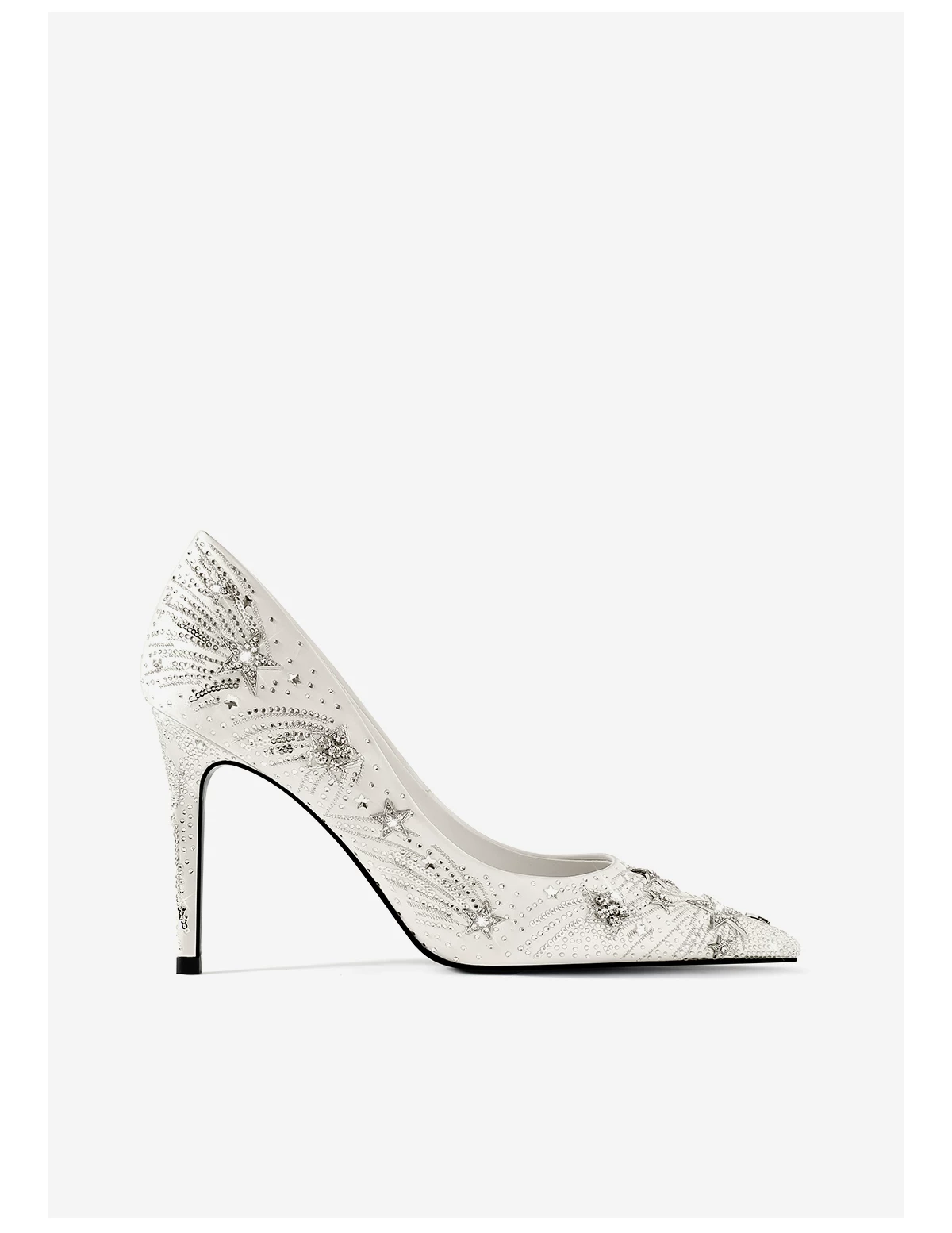
One boundary worth stating early: sparkle has a maximum useful density. Past a certain point, more crystals don’t read as more expensive. They read as noise, especially in photos, because the camera can’t resolve individual stones at two metres. A shoe with crystals on the toe and heel counter, and a plain vamp between them, almost always photographs better than a fully covered pair.
Read one: 50mm with a light scatter
A 50mm heel with a dusting of small crystals is the dinner shoe. Two hours seated, forty minutes standing, one set of stairs. In that envelope it’s genuinely comfortable, and it doesn’t fight a dress that already has something going on.
What it does to the outfit: it keeps the line low and slightly retro. With a midi dress, the shoe sits under the hem and only shows when you walk, which is a nice effect if you like the idea of sparkle without the announcement. With a mini, it reads young and a bit casual. Neither is wrong, but they’re different outfits.
The failure mode is proportion. A 50mm heel on a very long leg looks like a flat from a distance, and the sparkle then reads as decoration on a boring shoe. If you’re tall, this height is at its best with a wider trouser or a long skirt, where it doesn’t have to carry the silhouette on its own.
Comfort notes, since this is the height people ask about: the sole is the variable, not the heel. A 3mm sole on tile will ache by hour two. A 6mm sole with a padded insole is a different shoe entirely, and it’s worth checking the listing for that number before you buy. If you can’t find it, assume 3mm.
This is also the height that works with tailoring. A 50mm sparkly heel under a wide black trouser is one of the few ways to wear sparkle to an office party without looking dressed up for the wrong event. The hem covers most of the shoe when you stand still, and the crystals show only when you move. That half-hidden effect is worth more than a brighter pair that’s fully visible.
Read two: 70mm, the wedding-guest height
Seventy millimetres is the height that does the most work for the fewest complaints. It’s tall enough to change your posture and short enough that four hours on carpet is realistic. For a wedding, a christening, or a work awards dinner, this is the pair I’d shortlist first.
With a knee-length dress, 70mm puts the ankle at a flattering angle and keeps the calf engaged. With a floor-length dress, it lifts the hem just clear of the floor, which is the difference between walking and shuffling. That’s a practical gain, not a style one.
Where it struggles: polished stone floors after a few drinks, and any venue with a lawn. A 70mm slim heel sinks into grass. If the ceremony is outdoors, look for a wider heel at the same height, or accept that you’ll be walking on the balls of your feet across the lawn and change into flats for the reception.
Photo behaviour at this height is the best of the four. The shoe is visible in a full-length shot without dominating it, and the sparkle catches light at about the right level: enough to register, not enough to blow out. If the event has a photographer, this is the height that will look most like you in ten years.
One practical detail for parquet and old wooden floors: heel width changes the sound. A slim 70mm tip clicks loudly, and in a quiet room that click becomes the loudest thing about your entrance. An 8mm tip is quieter and more stable. If you’re the kind of person who thinks about that, it’s a real reason to pick one pair over another.
Read three: 90mm, the evening and photo height
Ninety millimetres is where sparkly high heels start behaving like jewellery rather than footwear. The arch is high, the foot is angled, and the whole leg reads longer. It’s also the height where the shoe stops being something you forget about.
Use it for a seated dinner, a gallery opening, a short party. Ninety minutes of standing is fine. Three hours is a negotiation. Four hours is a decision you’ll feel the next morning in your calves, and no insole fixes an arch that steep for that long.
The outfit pairing that works: a simple dress with a defined waist and no other sparkle. The shoe becomes the loudest element and the outfit holds together. The pairing that fails: a beaded or sequinned dress plus 90mm crystal heels. Two competing textures at the same visual weight cancel each other out, and the result looks busy rather than rich.
There’s one more consideration at this height that nobody mentions in listings. The pitch of the shoe changes how you walk, and a steep pitch pushes weight onto the ball of the foot. According to the general mechanics described in the standard account of how heel height changes posture, that shift is what produces the shortened stride you see in photos. It looks elegant. It also means you’ll take more steps to cover the same distance, which is worth knowing if the venue is spread across three floors.
Seated photos at 90mm are where this height earns its money. Crossing the ankles puts the shoe in full profile, the arch looks higher than it is, and the crystal catches the table candle instead of the ceiling light. Sit slightly forward, keep both feet on the floor for the first shot, and only cross them for the second. The uncrossed version is the one that looks like you.
Read four: 110mm with a platform, and where it fails
A 110mm heel with a 20mm platform has an effective pitch closer to 90mm, which is why people who can’t wear a true 110 can often wear this. The platform absorbs some of the angle. It also adds weight, and weight is what you notice at the end of the night.
This is the entrance shoe. Photos at the door, the walk to the table, the toast. It’s excellent for the first hour and increasingly hard work after that. If you’re being driven and seated most of the evening, it’s a reasonable choice. If you’re on public transport and standing at a bar, it isn’t.
Two specific failures. Stairs, because a platform catches the nosing and the shoe has less ground feel. And wet pavement, because the sole is usually smooth and the platform raises your centre of gravity. I’d avoid this height entirely for an outdoor winter event.
Toe shape decides whether the platform looks deliberate or clumsy. A pointed toe keeps the whole shoe looking long and sharp, and it hides the platform thickness because the eye follows the taper. A round or square toe makes the sole look like a block, and the shoe reads heavier than it is. If you want the height without the weight in the silhouette, go pointed.
The read it gives is dramatic and slightly retro, especially in a pointed toe. It’s the height that gets the most comments, and the one most likely to be taken off under the table by 10pm. That’s not a reason to avoid it. It is a reason to bring a folding flat.
Weight is the number to check before you buy this height. A 110mm platform typically runs 380g to 450g per shoe, against about 250g for a 70mm pair. Half a kilo of difference doesn’t sound like much until you’ve climbed two flights of stairs in them. If the listing gives a weight, use it. If it doesn’t, assume the heavier end.
What actually changes at the ankle
Heel height gets the attention, but the ankle is where an outfit is won or lost. Three details do most of the work.
- Strap position. A strap across the ankle bone shortens the leg. A strap 2cm above it, or a slingback that sits behind the heel, doesn’t.
- Hem clearance. Five centimetres of visible leg between hem and shoe is the sweet spot. Less looks cut off, more looks like the dress is short.
- Toe shape. A pointed toe extends the line. A round toe makes a 90mm heel look like a 70mm one from the front.
If you’re between sizes, the ankle decides it. A shoe that’s 5mm too long at the toe but grips the heel properly will be more comfortable than one that fits the toe and slips at the back. Slipping at the heel causes you to claw with your toes, and that’s what makes a long evening painful.
Tights complicate all three details. A 15 denier sheer barely changes the fit and keeps the leg looking continuous. A 40 denier opaque adds about 1mm of volume, which is enough to make a snug pair uncomfortable by the second hour, and it also dulls the sparkle at the ankle. If the shoe is already tight across the instep, wear it with bare legs or go up half a size for the tights version of the evening.
The comfort math, in numbers
Cost per wear is the metric that makes these decisions easier. A £120 pair worn six times costs £20 a wear. A £60 pair worn once costs £60. The cheap pair is the expensive one if it only suits one event.
Same logic applies to height. If you own one pair of sparkly high heels, buy 70mm. It covers weddings, dinners, and anything with a dress code. If you own three, the 50mm and the 90mm earn their place. The 110mm is a fourth pair, not a first.
Practical add-ons that change the night: a gel heel grip for the slipping shoe, a 4mm insole for anything over 80mm, and a folding flat in the bag. That’s about £15 total and it buys you two extra hours.
There’s also a rental argument worth running. If you need a 110mm crystal pair for one black-tie event a year, renting costs a fraction of buying and you skip the storage problem. Buy the 70mm, rent the drama. That split is how most people I know end up with a shoe collection that actually gets worn, rather than a shelf of single-use purchases.
The pairing I’d talk you out of
Sparkly high heels with a very casual outfit. I know it’s a look. The problem is that it only works when everything else is deliberate, and in practice most people end up with a shoe that looks like it wandered in from a different evening.
Same for sparkle plus a heavy statement bag plus statement earrings. Three shiny things in one outfit means none of them lands. Pick one, and let the shoes be the answer.
There’s a middle option that gets overlooked: sparkly high heels with a plain outfit and no other jewellery at all. Black dress, bare neck, crystal shoes. It reads confident rather than decorated, and it’s the version of the look that survives a change of venue, a change of plan, and a photo taken from an unflattering angle.
And the honest one: don’t buy a 100mm+ pair for a venue you’ve never seen. Height is a promise about the floor, and you don’t know the floor yet.
Weather is the other thing that ruins a good plan. Crystals and slush don’t mix, and a plated heel that gets salted will pit at the seam within a week. If the forecast is wet, take the 50mm and a spare pair of tights. Nobody has ever regretted being slightly underdressed at the shoes. Plenty of people have regretted a soaked, salt-stained pair they loved.
If you want a starting point, these full crystal banquet heels for a black-tie room sit at the dramatic end of the range. For something you’ll wear more often, pointed rhinestone pumps in a lower heel cover more evenings. And if you want sparkle that doesn’t shout, pearl-embellished heels that read softer on camera are the quieter option.
For the money side of the argument, I worked through what three pairs of platform heels cost per wear over a year, and the same arithmetic applies here. If you’re still deciding between finishes, the three-size glitter test is a useful read before you order two sizes. You can browse heel heights across the range or the wider full women’s range if you’d rather compare silhouettes side by side.
One more reference point, because toe shape decides more than most people expect: the difference between a court shoe and a pointed pump is about 1cm of visible toe, and that centimetre changes how tall the whole outfit reads.
So: pick the evening first, then the height, then the sparkle. If you do it in that order, you’ll end up with a pair you wear six times instead of once, and that’s the only test that matters after the photos are forgotten.
