

You put them on in the shop, walk four steps to the mirror, and decide they’re fine. Then you get home, take the lift down, and discover that a staircase is a completely different shoe.
That’s the story with most black platform heels. They sell on the standing-still test and get returned because of the walking one.
I’ve spent enough time around shoe floors to know the pattern, and it’s rarely about quality. It’s about which numbers the listing gives you and which ones it leaves out. Here’s what actually decides whether a platform works for you.
What a platform actually does to your ankle angle
A platform raises the front of the shoe. That’s the whole trick, and it’s why a 10cm platform heel can feel gentler than a 7cm stiletto: your foot isn’t pitched as steeply, because the ground under your toes has come up to meet you.
The number that matters is the difference between heel height and platform height. A shoe with a 10cm heel and a 4cm platform has an effective pitch of 6cm. A shoe with a 7cm heel and no platform has a pitch of 7cm and will feel steeper, even though the listing makes it look tamer.
Ankle angle follows the pitch, not the heel. The long history of raised soles backs this up: platforms appear across centuries and cultures precisely because they add height without adding pitch. Every degree you add pushes load onto the ball of your foot and shortens your calf. Your gait adapts by shortening the step, and that’s why people in platforms walk differently: shorter strides, flatter foot strike, more of a glide than a march.
Nothing wrong with that, provided you know it. The trouble starts when someone buys a 12cm platform believing the platform makes it a walking shoe. It doesn’t. It makes it a shorter-stride shoe.
If you want the technical side, the mechanics of a platform sole are simple: height added under the forefoot, which changes the angle rather than the load. The load still goes somewhere. It just goes there differently.
One more consequence of the pitch: your knee stays straighter in a platform, so the work moves up to the hip and lower back. That’s why some people find platforms easier than stilettos for a long evening and harder for a long walk. Different load, different complaint.
If you have a high arch, the platform actually helps, because the front of the foot is lifted and your arch doesn’t have to reach as far. If you have a flat foot, the lack of ground contact under the midfoot is the thing you’ll notice first.
The ankle base is where cheap platforms fail
Look at a platform from behind. The heel block should sit under your heel bone, not behind it. When the block is set too far back, your ankle has to hold the shoe up with every step, and that’s the pair you’ll see someone carrying home barefoot.
In the trade this is a last problem, not a price problem. Some very expensive platforms get it wrong, and some cheap ones get it right. You can spot it standing still: if you can lift your toes inside the shoe and feel the heel block tilt, the geometry is off.
You can also check this by eye on a shelf: the back edge of the heel block should line up roughly with the back of the shoe, not sit proud of it. A block that sticks out further than the upper is the giveaway.
A second check on the base: put the shoe on a flat surface and push it gently from the side. A stable platform rocks once and settles. An unstable one tips over. That tells you more about a 12cm pair than any description of the upper.
The base width matters too. A heel block that measures 4cm across spreads load. A 2cm block concentrates it and turns every pavement crack into an ankle event. On black platform heels the width is easy to see because the block is usually a single solid piece, which is one advantage of the style.
A quick way to judge the base without tools: stand on one foot in the shoe and count to ten. If your ankle is still making small corrections at eight, the base is too narrow or the block is misplaced. If you’re steady by four, the geometry is working with you.
Also look at how the upper meets the sole. A clean bond with no gap at the waist suggests the sole was pressed properly. A visible gap or a glue line you can feel with a fingernail is where water gets in first.
Where black platform heels go wrong: the toe box
Platform shoes lift the front, and something has to fill that space. Usually it’s a thicker sole and a squashier toe box, which sounds generous and often isn’t, because the toe box gets shallower as the sole gets thicker.
Take a pair with a 4cm front sole. Your toes now sit 4cm above the ground inside a box that may only be 3cm deep. In a pointed toe that’s a pinch across the top of the big toe by mid-afternoon. In a round toe it’s usually fine, which is why so many platforms come round-toed.
Press the top of the toe box with your thumb. If it has no give, your toes will feel that edge at the end of a long day. If it gives a few millimetres, you have room to break in.
Then check where the toe box ends. A short vamp, cut close to the toes, looks sharp and presses on the joint at the base of the big toe. A longer vamp covers more of the foot and holds it in place, which is why it feels more secure when you walk.
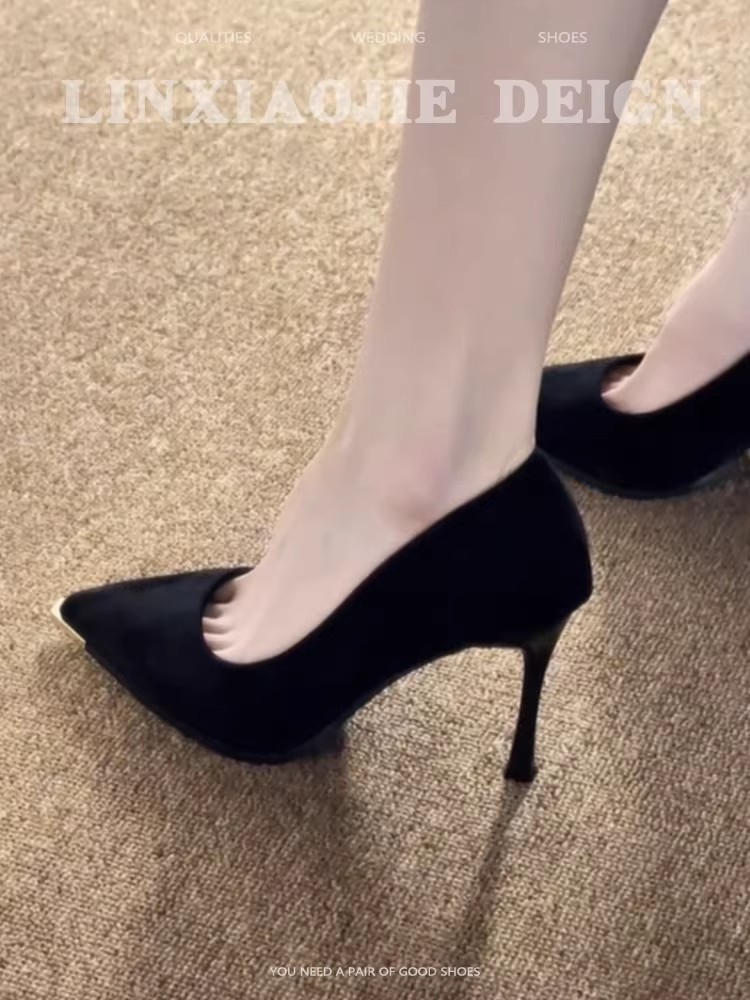
For a black pair with a longer vamp and a genuinely comfortable sole, this pointed style at $89 is the shape I’d start from if platforms keep pinching you. It has no platform, but it shows how the toe box should feel before you add height at the front.
Worth knowing: a platform with a square toe gives you the most room of the three shapes, and it still looks sharp in black because the colour removes the bulk. If you’ve been sized out of pointed platforms by a wide forefoot, try square before you give up on the style.
Then check the lining at the toe. A leather lining softens against the skin. A synthetic one can be fine, but if the seam runs across the top of your toes it will press all afternoon, and that’s the seam you’ll remember, not the height.
Weight, and why the sole is the real story
Pick up a single platform shoe and weigh it in your hand. Most people are surprised. A chunky-looking 12cm pair can come in lighter than a slim stiletto, because the sole is often EVA or a hollowed rubber rather than solid leather board.
Light is good up to a point. Too light and the shoe feels unstable, because there’s less mass to damp the wobble. As a rough guide, anything from 350g to 550g per shoe in a size 38 walks acceptably. Above 700g you’ll notice it in your calf by the afternoon, especially going upstairs.
The sole material also decides grip. Rubber with a tread pattern holds on wet pavement. A smooth synthetic sole is an indoor sole, whatever the listing says. Black platform heels with a smooth sole are the pairs that end up in the back of the wardrobe after one rainy commute.
Then there’s flex. Bend the shoe at the ball of the foot. A platform should flex a little at that point and not at all in the middle. If it bends in the arch, the sole is too soft and your foot will do the work of the missing support.
One more thing worth knowing: a thick sole insulates. That’s pleasant in November and unpleasant in July. If you’re buying black platform heels for summer, look for a cut-out or a lighter sole, because a solid 4cm rubber slab holds heat like a baking stone.
There’s a balance point here. Too light and the platform skates on smooth floors because there’s nothing pressing it down. Too heavy and your calf pays. I’d rather have 450g with a rubber sole than 350g with a hard synthetic one, because grip matters more than a hundred grams.
Ask about the sole construction if you can. A moulded sole with a rubber insert at the heel is the practical middle ground, and it’s what most mid-priced platforms use. A leather sole under a platform is beautiful and slippery, and I’d avoid it for city wear.
Fit: the two measurements shops rarely give you
Ask any shoe floor and they’ll tell you the size. Ask for the insole length in centimetres and you’ll often get a blank look, which is strange, because it’s the only number that predicts fit.
Measure your foot at the end of the day, standing, from heel to longest toe. Then compare that to the insole figure the listing gives. You want 5-8mm of clearance in a round toe, and 8-10mm in a pointed one. Less than that and you’re relying on the leather to stretch, which it won’t at the tip.
The second number is the width across the ball of your foot. Most platforms are built on a standard last, and a wide foot in a pointed platform will press on the little toe within an hour. Go up a size if your foot measures more than 9.5cm across the ball, and accept a slightly loose heel.
Heel slip is fixable with a heel grip. Toe pressure isn’t fixable at all. Size for the front and solve the back, every time.
One thing that surprises buyers: the platform changes how the size feels, not the size itself. Same last, same length, but your foot sits higher and further forward, so the same 38 can feel shorter. If you’re between sizes in a platform, take the larger one.
And if your foot is wider than standard, a thick-heel style like a wide-based block heel at $115 gives you the height without the narrow toe box problem. It’s not a platform, but it solves the same complaint most people bring me.
If the listing gives you nothing, order two sizes and return one. On a platform that’s the cheapest test available, because the difference between sizes is usually 5mm and 5mm is the difference between a toe box that works and one that doesn’t.
Try them on with the sock or tight you’ll actually wear. A platform with a leather lining and a thin sock feels different from the same shoe with a wool sock, and in December that gap is a full half size.
Stairs, the test nobody runs in the shop
Walk down a flight of stairs in platform heels and you’ll learn two things in ten seconds: whether the sole grips and whether your ankle trusts the base.
Down is harder than up. Going down, your weight lands on the front of the shoe with the heel in the air, and a stiff platform gives you no feedback about where the step edge is. That’s why people take stairs sideways in platforms, and it’s not a joke, it’s a workaround.
Try it before you buy. If the shop has a step, use it. If not, use the edge of a low display plinth. You’re checking whether the sole flexes enough that you can feel the edge through it.
Try a second descent with your hand on a rail and your weight slightly back. If that feels dramatically more secure, the shoe is asking you to lean back, and that’s a posture you don’t want to hold for a whole commute.
Going up is easier but reveals weight. If you feel the shoe dragging on the second step, it’s too heavy for daily wear.
I’d also suggest a simple habit for the first week: hold the rail. Not because the shoes are dangerous, but because a platform changes your sense of where the ground is, and that adjustment takes a few days.
One habit that helps in the first week: come down stairs at a slight angle, placing the whole sole on each step rather than the toe. It looks odd for two days and then it becomes automatic, and it takes the load off the front of the shoe.
If the stairs in your building are the open-tread kind, with gaps between steps, be more careful. A platform can catch an edge in a way a thin sole can’t, and that’s a genuine risk rather than a style note.
What buyers ask me that they should ask instead
The question I hear most is whether a pair is true to size. The question that would actually help is how the pair behaves after three hours.
Here’s the substitution list I’d hand over:
- Instead of “is it comfortable”, ask where the pressure points are after 5,000 steps.
- Instead of “is it good quality”, ask whether the sole is stitched or glued.
- Instead of “will it go with outfits”, ask whether you own three things it works with.
- Instead of “is it true to size”, ask for the insole length in centimetres.
On the stitched-or-glued point: a glued sole on a platform is normal and can last years. A stitched one can be resoled. Neither is a scam, but a $200 platform with a glued sole has a limited life and you should price that in.
Another substitution: instead of asking whether black is versatile, ask which black. Patent black is glossier and shows scuffs as white marks. Matte black absorbs light and hides wear. Suede black goes grey at the toe after a season. All three are called black platform heels and none of them behaves the same.
The last one is about returns. Ask the return window before you ask about the discount, because platform shoes are the category most likely to go back, and a 14-day window in December is not the same as a 30-day one in June.
One more question worth adding: what does the pair weigh? A seller who knows their product can answer that in a minute, and the number tells you more about a platform than any adjective.
The other thing I’d ask is whether the pair has been returned before. Most shops won’t say, but some will tell you a style runs narrow based on returns, and that’s the most useful data in the building.
Care: scuffs, shine, and the black that goes grey
Black is forgiving until it isn’t. A scuff on matte black leather disappears with cream polish. The same scuff on patent stays visible as a dull patch, because you can’t buff a coating back to a mirror finish at home.
For matte finishes, a cream polish in black every six weeks is enough, worked in with a cloth and left to dry before buffing. Skip the silicone sprays, they attract dust and make the leather look plastic within a month.
For suede, a brass brush after every wear. That’s it. Water is the enemy, and once suede goes grey at the toe from rain, no product brings the depth back.
The sole is the part people ignore. Wipe it with a damp cloth once a month, because grit trapped in the tread abrades it from the inside. If the heel block wears unevenly on one side, that’s a sign your gait loads that edge, and a cobbler can add a rubber top piece before the block itself goes.
Storage matters more than most people think. Platform shoes stored upright on a shelf keep their shape. Stacked in a box with weight on top, the sole can compress at the arch. Mine live on a shelf with a shoe tree in the vamp, and the pair I’ve had longest still looks new after three winters.
If your pair has a fabric-covered platform edge, treat that part like a garment. It scuffs against kerbs and there’s no polish that fixes a torn fabric wrap. A drop of clear nail polish on a frayed edge stops it running, but it shows, so keep it to the inner side.
And rotate. Two pairs worn alternately last roughly three times as long as one pair worn daily, because the leather dries out between wears. That’s the cheapest maintenance trick there is, and it costs nothing but shelf space.
Which pair to buy first if you’re starting from zero
If this is your first platform, buy the boring version. A 7-8cm heel with a 3cm front sole, round or soft-square toe, matte black leather, rubber sole with a tread, and a heel block at least 3.5cm wide.
That combination walks, photographs well, and works with jeans, a midi skirt, and a suit. It won’t be the most exciting thing on the shelf and it will be the pair you reach for on a Wednesday.
Then, if you want the dramatic version, buy it second and buy it knowing what it’s for. A 12cm platform with a 5cm front sole is an evening shoe. Wear it to dinner, not to a train station. That’s not a limitation of the shoe, it’s how the geometry works.
And ignore the one piece of advice I hear most, which is that platforms are a substitute for learning to walk in heels. They’re not. They’re a different bargain: less pitch, more weight, a higher centre of gravity. If you can walk in them, it’s because you adjusted, not because they’re secretly flats.
One last note on fit checks, because it saves returns: take the pair home, wear them indoors on carpet for twenty minutes, and then decide. Twenty minutes on carpet won’t damage the sole, and it will tell you more about the toe box than a mirror ever will. The women’s shoe range has enough platform and block-heel options that comparing two shapes side by side is easy, and it’s worth doing before you commit to 12cm.
If your wardrobe is mostly denim and knitwear, buy the round toe. If it’s tailoring, buy the soft square. That single decision does more for how often you wear them than the heel height does.
And set a rule before you buy: if you can’t walk 500 metres in them without thinking about your feet, they’re an evening pair, and you should pay evening-pair money for them. That’s the honest version of the advice I give when someone asks me to help them choose.
