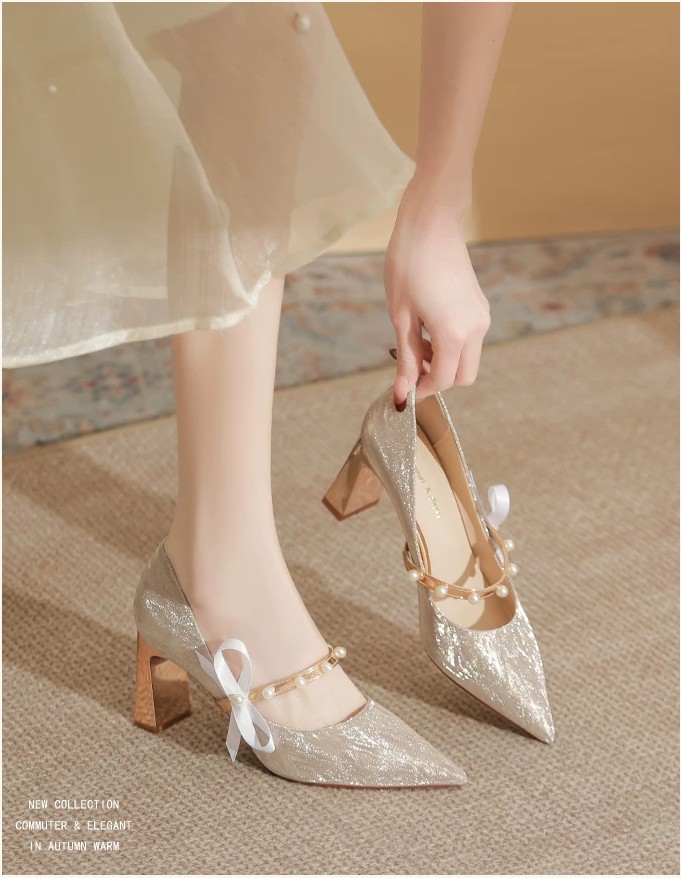
The return comes back with a note that says the same thing every August: comfortable for an hour, then the ball of the foot starts burning. The shoe is a wedge. It was sold as the comfortable heel. Somebody wore it to a wedding and spent the reception sitting down.
In shops, this is the most predictable failure in the women’s shoe department, and it has almost nothing to do with heel height. A 90mm wedge can be easier to walk in than a 50mm stiletto, and a 60mm wedge with the wrong sole can be worse than both.
What separates the two is where the sole sits under your foot, and that’s a geometry question you can check in about ninety seconds if you know what you’re looking at.
The complaint that arrives every August
Wedge shoes for women comfortable enough to stand in exist. They’re not rare and they’re not expensive. But the category has a marketing problem: the wedge is sold on the promise that height plus a solid sole equals comfort, and that equation only holds when the sole is shaped correctly.
Here’s the pattern shops see. A customer buys a wedge for a specific event, wears it for four hours, and reports that the front of the foot ached, or the ankle rolled, or the shoe felt like it was pushing her forward. Three different complaints, one cause.
The cause is that most cheap wedges are a flat sole with a block glued under the heel. The footbed stays horizontal, so the foot stays flat while the body is tilted. Your ankle has to do the work of the ramp, and your toes have to grip to stop you sliding forward. Four hours of that and everything hurts.
A properly built wedge has a contoured footbed that follows the ramp. There’s a slight heel cup, a raised arch, and a toe area that sits level rather than pointing downhill. The shoe does the tilting. Your foot stays neutral.
There’s a second thing the shops see, which is that the returns cluster around specific events. Weddings, graduations, long days at a trade fair. Occasions where the shoe has to work for six hours rather than one. The wedge gets bought for the event, fails at the event, and comes back with the note.
Another detail from the shop floor: the note almost never mentions the price. A £200 wedge gets returned for the same reason a £60 one does, and the expensive pair is often the worse offender because the sole is heavier and the footbed is flat.
Which is why the useful question isn’t “is this wedge comfortable” but “how long is this wedge comfortable for”. Almost every wedge is fine for an hour. The ones worth buying are fine for six.
That difference is invisible in a product photo and obvious the moment you stand up in them.
Where the sole sits matters more than how tall it is
Three measurements decide whether a wedge works, and none of them appear on the box.
The heel-to-toe drop. That’s the height difference between the back of the sole and the front. A wedge with a 70mm heel and a 20mm toe has a 50mm drop. A wedge with a 70mm heel and a 5mm toe has a 65mm drop, and that extra 15mm is what your calf and ankle have to absorb with every step.
Second, the sole thickness under the ball of the foot. Under 10mm and you’ll feel every paving slab. Over 25mm and the shoe stops bending where your foot bends, which makes you walk from the hip. The useful range for a walking wedge is roughly 12mm to 20mm.
Third comes the width of the platform at the toe. A narrow toe platform on a tall wedge is a balance problem disguised as a design choice. It’s also where the ankle sprains come from.
- Best all-day geometry: 60-70mm heel, 20-25mm toe, 45mm drop or less
- Occasion-only geometry: 80-90mm heel with a 30mm toe platform, fine for four hours
- Walk away from: 90mm heel with a 5mm toe and no contour in the footbed
The contour is the part most people miss. Run a finger along the footbed from heel to toe. A contoured one dips at the heel, rises under the arch, and flattens under the ball. A flat one is a plank, and a plank forces your foot to hold itself in position all day.
There’s a simple physical reason the wedge beats a stiletto at the same height. Load spreads across the whole sole instead of concentrating on a 10mm tip. That’s why a wedge feels stable on gravel and a stiletto doesn’t. The trade-off is weight, since more sole means more material, and a heavy wedge tires your legs in a different way.
A word on the 30mm of extra sole under the toe, because that’s what people think is the whole trick. It isn’t. The platform only helps if the footbed above it is shaped, otherwise your foot sits on a sloping surface and the platform just makes the slope taller.
Grip matters here too. A wedge with a smooth sole is a hazard on wet paving, and the tall ones put more torque through the ankle when they slip. Look for a rubber outsole with a defined pattern, not a painted finish.
Weigh them if you can. Anything over about 450g per shoe starts to feel like work by the end of a long day. Under 350g is light for a wedge and usually means a hollow or foam core, which is fine until it isn’t.
Three foot shapes, three different failures
The same wedge can be comfortable on one person and unwearable on another, and the reasons are specific.
Wide forefoot. The failure is pressure across the ball of the foot, because a wedge’s toe box is often cut narrow to keep the shape sleek. The fix isn’t a bigger size; it’s a wider last. Look for a rounded or square toe and check that the sole is wide enough to support your foot rather than the other way round.
High instep. The failure is pressure across the top of the foot, right where the vamp meets the ankle. Wedges with a high-cut vamp and a strap across the instep are the worst offenders. An adjustable ankle strap or an open vamp solves it, and no amount of breaking in will.
Flat feet or a low arch. The failure is the ankle rolling inward, which a soft, uncotoured footbed makes worse. These feet need a firmer footbed with a raised arch, not a softer one. Cushioning feels good in the shop and does nothing for support.
There’s a fifth pattern that’s less about shape and more about gait. People who heel-strike hard feel the impact travelling up through the wedge, because the sole transmits rather than absorbs. A thin rubber layer under the heel helps. A solid wooden wedge doesn’t, and that’s why the wooden-soled versions feel elegant for twenty minutes and brutal after that.
There’s a fourth group worth naming: anyone who’s had an ankle injury. A wedge concentrates lateral load on a taller lever, so a rolled ankle on a wedge is worse than the same roll in a flat. If that’s you, a 50mm wedge with a wide base is the sensible ceiling.
Worth adding: the strap position changes the failure mode more than the width does. A strap that crosses at the narrowest part of the ankle holds well. One that crosses lower, over the instep, presses exactly where a high instep can least take it.
None of these are about body size or shape in the way the phrase usually means. They’re about where the pressure lands, and you can find that out standing in the shop for two minutes rather than guessing from a size chart.
Ninety seconds in the shop, and what each check tells you
Start with the footbed, not the upper. Press your thumb into the arch area. If it gives easily, the shoe has no support and will flatten under your weight within a month. Firm with a slight spring is what you want.
Then stand up. Shift your weight forward and back. If you feel your toes curling to hold position, the drop is too steep for you and the shoe will hurt by hour three. If you feel pressure at the instep, the vamp is too high.
Next, walk ten steps on a hard floor. Listen for a slap. A wedge should land quietly. A slap means the sole is stiff and the shoe is pivoting rather than flexing.
Then check the ankle strap. It should hold your heel down without cutting in. Most wedge complaints about “walking out of the shoe” come down to a strap that’s decorative rather than functional.
- Footbed: firm at the arch, slight heel cup, no hard ridge under the ball
- Drop: you should be able to stand without gripping with your toes
- Flex: bends at the ball, not in the middle
- Weight: under 450g per shoe if you’ll walk more than a kilometre
- Toe width: all five toes flat on the footbed, no overhang
Try them at the end of the day if you can. Feet swell by up to half a size, and a wedge that fits at 10am is often tight at 5pm. That’s the single most common reason a pair gets returned after one wear.
Bring the socks or tights you’d actually wear. Sounds obvious, and it’s still the most common thing people skip when they’re trying shoes on during a lunch break.
One more test that separates a good wedge from a decorative one: stand on one foot for ten seconds. If your ankle wobbles or your toes curl, the base is too narrow for you. A wedge should let you balance without thinking about it. If it doesn’t, the shoe is doing the posing and your ankle is doing the work.
Then walk away and come back five minutes later for a second try. The first fitting is always more forgiving than the second, because your feet are still fresh. If the second try feels tight at the instep or the toes, believe it.
Which pairs earn their place, and which to skip
The honest split is between wedges built as shoes and wedges built as props. Props are fine for a photograph and useless for a day. Shoes have a contoured footbed, a strap that works, and a sole that flexes at the right point.
Two examples of the second kind: this thick-heeled wedge with a broad base sits in the stable range, and the rounded block-heel version in a softer upper is the one to look at if you’re on your feet for a full shift.
What to skip: any wedge with a heel over 90mm and a toe platform under 10mm, regardless of the price. Also skip the ones sold as “lightweight” with a hollow sole and no arch support, because the weight saving comes out of the part that was holding your foot up.
Price is a poor guide here. There are £150 wedges with flat footbeds and £60 wedges with proper contouring. What tracks quality is the sole construction: a stitched or cemented sole with a rubber outsole and a moulded footbed, rather than a single foam block with fabric glued on top.
The drawback nobody mentions is that a well-built wedge is heavier and looks chunkier than a stiletto. That’s the cost of the stability. If you want the thin silhouette, you’re buying a different shoe with different problems, and the comfort claims on the box are marketing rather than engineering.
For a wider look at how height changes the load on the foot, there’s background on high-heeled shoe mechanics that explains why the wedge spreads load differently. And material certification is worth checking if you’re wearing the same pair five days a week in warm weather.
If you want to compare this against other heel shapes, there’s a useful piece on how one tan shade behaves across three different heel shapes, and another on the two measurements that stop a heel purchase going wrong.
One last thing worth saying plainly. A wedge isn’t a comfortable shoe by default, and no brand can make it one by putting the word on the box. It’s a shoe with a geometry that either suits your foot or doesn’t. Ninety seconds of standing in the shop tells you which.