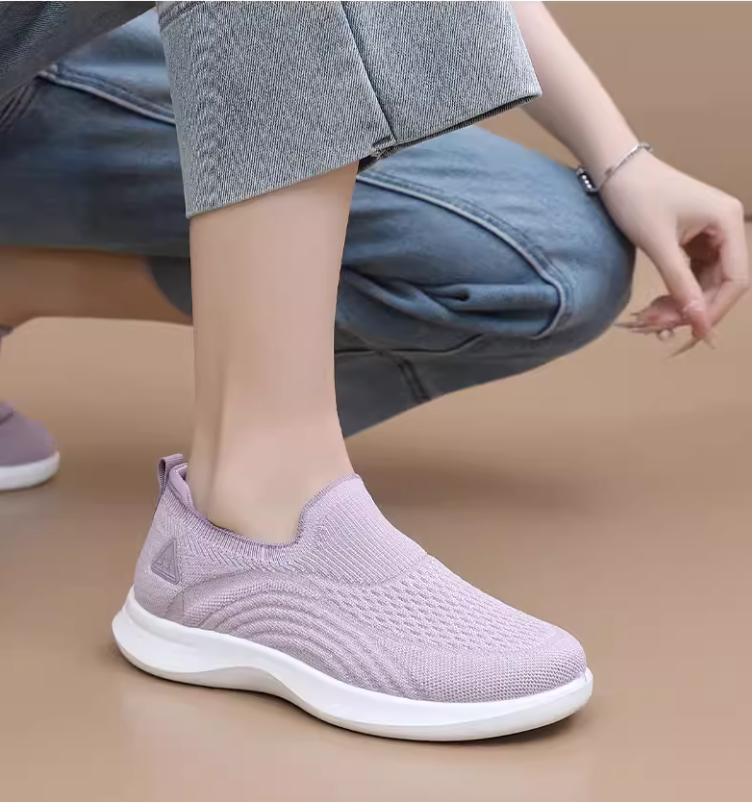
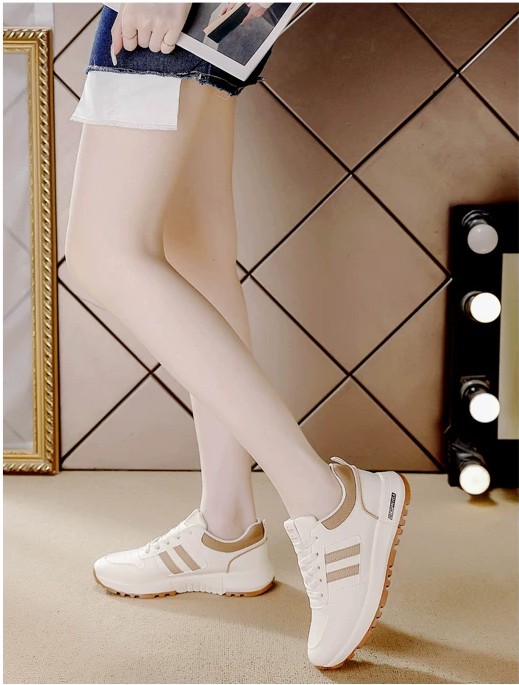
It’s 7:40 on a Tuesday in late September. Your phone says 12°C, the sky is that flat white that means rain later, and you’ve got a nine-minute walk to the station plus a day of standing. By 3pm it’ll be 22°C and you’ll be carrying your jacket.
This is the two-week window where most shoes fail. Boots are too hot by lunch. Sandals are a joke at 7:40. And the pair of slip-on casual shoes for women that looked fine in the shop turns out to have a lining that turns into a swamp by 11am.
You don’t need a different shoe for each hour. You need one pair that holds up across a 10-degree swing, and there are about four things that decide whether yours will. None of them are about how the shoe looks, which is why the pair you bought for the colour is often the pair that ends up living under your desk.
One pair, two temperatures: what’s actually being asked of it
Think about what your foot does between 7:40 and 6pm. It’s cold and slightly stiff on the way in. It swells by maybe half a size over the day, which is normal and not a sign of bad shoes. It gets warm and damp on the commute home, especially if you take the stairs.
A shoe that works in this window needs to do three jobs at once. Hold warmth without trapping it. Let moisture out when your foot heats up. Stay on without laces, since the whole point of a slip-on is that you can leave the house in four seconds.
Those three jobs pull against each other. The upper that keeps your toes warm at 7:40 is usually the one that cooks them at 2pm. That tension is the whole design problem, and it’s why cheap slip-ons feel fine for a fortnight and then get pushed to the back of the cupboard.
Here’s the short version before the detail: a knit or mesh upper with a thin leather collar beats a fully leather upper for this specific two-week window. Leather wins in November. Knit wins in September.
There’s also a version of this problem that has nothing to do with temperature. In the two weeks where the weather can’t decide, you’re often going from a cold platform into a warm carriage into an air-conditioned office and back out again. Four environments before lunch. No single shoe handles all four well, so you pick the one that handles the worst of them.
For most people the worst of them is the warm, crowded, standing-up part. That’s why I’d rather have a pair that’s slightly chilly at 7:40 than one that’s unbearable at 4pm. Cold feet you can fix with a sock. Overheated feet you can’t fix with anything short of taking the shoe off.
At 12°C your feet are cold, not frozen, and that changes the fit
Cold feet are slightly smaller feet. Blood vessels in your extremities constrict, and the whole foot pulls in a little. That means a pair that fits perfectly at 4pm can feel loose and flappy at 8am, and that’s where heel slip starts.
Most people solve this by tying tighter or buying smaller. Both are wrong for a slip-on, because there are no laces to tie and buying smaller just moves the problem to the afternoon.
What you want instead is a shoe with some grip at the collar and a sole that doesn’t turn rigid in the cold. Squeeze the sole in the shop if you can. A firm EVA midsole stays flexible at 10°C. Cheap PVC goes hard and starts feeling like a plank, which is why your first twenty steps on a cold morning feel clumsy.
There’s a simple test you can do at home. Put the shoes on with thin socks, walk to the kitchen and back twice, then stop and lift each heel halfway out. If the shoe comes with your heel, the collar is too loose for cold mornings and you’ll be gripping with your toes all the way to work.
- Cold-morning fit: you want light contact at the instep, no pressure on the toes
- Warm-afternoon fit: the same pair should still let you wiggle all five toes
- Deal-breaker: heel lift of more than about 5mm when you walk
The half-size question comes up every time. If you’re between sizes in a slip-on, take the smaller one only if the upper has some stretch. In a stiff leather or coated canvas pair, take the larger and add a thin insole. You can always take an insole out at 3pm when your feet have swollen.
Watch the instep too. A high instep plus a slip-on with a low vamp means the top of the shoe presses on the bridge of your foot, and you’ll feel it within an hour. There’s no lace to loosen. Try the pair on late in the day when your feet are at their largest, and give the instep a firm press with two fingers.
The 22°C walk home is where the cheap pairs give up
Afternoon is the honest test. Your feet have been in the same shoes for eight hours, they’re warm, and the walk home is uphill or through a station concourse with the heating on.
Two things happen in a bad pair. The lining stops breathing, so moisture collects and your foot slides forward. And the insole compresses under the ball of your foot, so the shoe that felt cushioned at 8am feels flat by 5pm.
You’ll notice the slide before the heat. It shows up as your toes jamming into the front on the downhill stretch, or your heel riding up on the flat. By the time you get home, the shoe has effectively become half a size too big and completely the wrong shape.
Linings matter more than uppers here. A leather lining absorbs and releases moisture. A bonded synthetic lining doesn’t absorb anything, so sweat sits between your foot and the shoe. That’s the difference between a pair you can wear for a 10-hour day and one you’re desperate to kick off at 3pm.
If you can only check one thing before buying, push your hand into the shoe and feel the inside of the heel counter. Smooth and cool means synthetic. Slightly sueded and warm means leather or a leather blend. The second one costs more and it’s worth it in this window.
The other afternoon problem is the insole, and it’s usually invisible until it fails. A moulded EVA insole with a slight heel cup keeps your foot from sliding forward. A flat foam sheet lets it slide, and once your toes are touching the front you’ll start curling them to keep the shoe on. That’s the reflex that gives you a sore arch by evening.
Try this when you get home: take the insole out and look at where your heel sits. If there’s a visible depression after two weeks, the foam is too soft for the amount of standing you do. Swap it for a firmer 3mm insole and the shoe behaves like a different pair.
None of this is expensive. It’s just the stuff nobody tells you at the till.
Socks make or break the whole thing
This gets skipped in every buying guide, and it’s the cheapest fix available. The same pair of slip-ons can be a 12°C shoe or a 22°C shoe depending on what’s on your feet.
For the morning, a thin merino sock is the best thing you can buy. Merino regulates temperature rather than just insulating, so it’s warm at 7:40 and doesn’t cook you at 2pm. Cotton is the worst option in both directions: cold when damp, hot when dry, and slow to dry either way.
For the afternoon, if you’re going straight from work to somewhere else, a no-show sock in a bamboo or merino blend stops the slide without adding bulk. The cheap multipacks are almost all polyester, which is exactly the material you’re trying to avoid.
One practical note on bare feet, since a lot of people wear slip-ons without socks in September. Bare feet plus a synthetic lining is the fastest route to a smell you can’t get rid of. If you’re going sockless, choose a pair with a leather lining and give them a day off between wears.
If you do get a hot spot on the back of your heel in week one, deal with it that evening rather than toughing it out. A plaster plus a day in different shoes is usually enough. Ignore it for three days and you’ve got a blister that makes every pair painful, and you’ll blame the shoes when the real problem was the socks.
Two pairs of thin merino socks and one pair of no-shows cover the whole fortnight. That’s maybe £25 and it will do more for your comfort than spending an extra £60 on the shoes.
Wash them cold and skip the fabric softener, which coats the fibres and kills the wicking. Line dry. They’ll last two seasons if you do that, and one month if you tumble them.
Knit, canvas, or leather: pick by the weather, not the outfit
All three are sold as “casual slip-ons” and they behave completely differently across a 10-degree swing. The difference between knit structures alone explains why one $40 pair breathes and another doesn’t.
- Knit: breathes best, dries fastest, holds shape worst. Good for the warm half of the day, weak in rain.
- Canvas: cheap, structured, and terrible when wet. A cotton canvas upper soaks through in about 90 seconds of steady rain and takes a day to dry.
- Leather or suede: best temperature control, worst in a downpour unless treated, and the most expensive to replace.
- Coated mesh or technical textile: the compromise most brands land on. Light, quick-drying, and usually the best pick for this exact window.
If your September looks like mine, meaning one proper rain shower a week and mornings that need a jacket, a knit or technical mesh upper with a leather-lined collar is the sensible buy. You get breathability where your foot heats up and structure where it needs to hold.
Worth knowing: the finishes used on casual uppers are regulated, and OEKO-TEX tests for restricted substances in exactly this kind of material, which is a reasonable thing to look for on the label.
Canvas is the one I’d avoid if you’ll be caught out. It’s not that it’s bad. It’s that a wet canvas slip-on stops being a shoe and becomes a wet sock with a sole, and there’s no fixing that until it dries.
One more option worth naming: the closed-toe woven styles sold as summer shoes. They breathe beautifully and they’re hopeless in this window because the weave lets in every puddle you step near. Save those for July.
What about the cheap “water resistant” pairs sold at this time of year? They’re usually a knit with a spray coating, and the coating wears off in about three weeks at the flex point across the toe. Once it goes, you’ve got a knit shoe with a slightly stiff surface. Fine, but not what you paid for.
Sixty seconds at home: the three checks that predict whether they’ll survive
You can test a pair properly without wearing them for a week, and it’s worth doing before the tags come off.
- The flex point. Bend the shoe where your toes bend. It should crease there and nowhere else. A sole that folds in the middle will fight your arch for eight hours.
- The twist test. Hold the toe and heel and twist gently. A little give is good. A shoe that twists like a wet cloth has no shank and will feel unstable on stairs.
- The collar spring-back. Press the heel counter inward and let go. It should return. If it stays pressed, you’ll walk out of the shoe within a month.
Do all three in the shop, then do them again after a week of wear. If the collar has softened to the point where it stays folded, the pair is done as a walking shoe and becomes a car-to-desk shoe.
There’s one more check that only works in real life: wear them on the longest walk you’d realistically do in them, on day two rather than day ten. If your arch aches at the 4,000-step mark, no amount of breaking in will fix it. That’s a last-shape problem, not a stiffness problem.
And check the opening. Put the shoe on, then look down. If the sides gape away from your foot by more than a finger’s width, the last is too wide for you and the shoe will always look slightly borrowed. Nothing wrong with the shoe. Wrong foot.
Stairs are the other test. Walk up one flight without holding the rail, and listen. A slap on each step means the sole is too stiff for your gait, and a slip-on that slaps will rub your heel raw by the end of a week. Soft and quiet is what you want.
Three weeks in: what actually wears out first
Not the upper, in my experience. The upper on a decent knit or mesh slip-on lasts years. What fails first is the insole at the ball of the foot, then the elastic gusset that holds the shoe on.
Insoles compress. A 5mm foam insole loses maybe half its thickness in the first 200 hours of wear, and after that you’re standing on the board. You can replace it with a 3mm leather or memory-foam insole for very little money, and it buys you another season.
The gusset is the part nobody thinks about. That’s the elastic panel under the tongue that lets you slide your foot in. It stretches with every wear, and once it’s gone slack the shoe starts to gape at the sides when you walk. Check whether the gusset is stitched into a seam or just glued. Stitched lasts; glued peels.
The third failure point is the sole edge, where the rubber meets the upper. On cheap pairs this is glue only, and it lifts after a wet autumn. Look for a stitched or vulcanised edge if you want the pair to see next September.
You’ll also see the toe box collapse if you store them squashed in a bag. Stuff them with a pair of rolled socks when they go in the cupboard and they hold their shape for years. It costs nothing and takes ten seconds.
And the colour goes before the material does, on pale pairs. A cream knit slip-on picks up denim and pavement dust and looks tired by October. Dark grey hides the same wear for another year. That’s not a style opinion, it’s laundry maths.
For a sense of where the seams sit on a good example, this breathable mesh casual walking shoe shows the stitch line running continuously around the sole, and the lightweight sports slip-on with a padded collar is the version I’d pick for a commute with stairs.
What I’d actually buy for these two weeks
Two pairs, if you can. Not because you need variety, but because alternating gives each pair a day to dry out, and drying time is what separates a pair that lasts three autumns from one that lasts one.
Pair one: a technical mesh or knit slip-on in a dark colour, leather-lined if the budget stretches, for the commute and the standing-around days.
Pair two: something flat and plain for the days when you’re mostly sitting, so the first pair isn’t carrying every mile. A flat-soled casual board shoe does that job and dries faster than anything with a padded collar.
Skip the weatherproof coating unless you’re commuting by bike. Most spray-on waterproofing on a knit upper reduces breathability, which is the one thing you bought the knit for. A pair that breathes and dries overnight beats a pair that beads water and steams your feet.
And keep a thin pair of merino socks in your bag from mid-September to mid-October. It sounds like a small thing. It’s the difference between the 7:40 walk being unpleasant and being fine.
If you can only afford one pair, buy the technical mesh one in black or dark grey. It’ll look right with almost everything you own for six weeks, and it’s the pair that fails least often in this weather. Add a second, cheaper pair next autumn when you know what you actually wear.
If you want to compare shapes before you commit, the casual and sneaker range has the low-profile silhouettes that work with this window, and this piece on one tan shade across three pairs and nine outfits is useful if you’re trying to keep the palette simple while the weather makes up its mind.
One last thing, and it’s the bit that took me three autumns to learn. Buy the pair for the afternoon, not the morning. Mornings you can solve with a sock. Afternoons you can’t solve with anything except the right shoe.