

Three boxes arrived on a Wednesday. Same shoe, same colour, three sizes, because I’d got it into my head that my usual 37 was the problem and not the shoe. I lined them up on the kitchen floor next to a tape measure and a mug of tea, and spent the next forty minutes walking between the fridge and the door in each pair.
I’m telling you this because beige heels are the hardest colour to buy online. Black hides a bad fit. Beige shows every millimetre of gap at the heel and every wrinkle across the toe, and it has to sit next to your skin without looking like a bandage.
The short version: I kept the 37.5, sent back the other two, and I was wrong about which one would work for the first twenty minutes.
What I thought my size was, and where it pinched
The 37 is what I wear in almost everything. Trainers, boots, the loafers I’ve had for four years. I put the beige pair on and it felt fine for about ten steps.
Then I stood still. There’s a spot on the outside of my right foot, just behind the little toe, where a pointed toe box always catches me, and it caught me here too. Not painful. More like a warning.
Here’s what surprised me when I measured: the insole on that 37 was 243mm, and my foot at 6pm on a warm day is 241mm. Two millimetres of clearance is nothing. Not in a round toe, and definitely not in a pointed one where the shoe tapers before your toes have finished.
I also checked the ball width. 78mm across the widest part of the 37. My foot measures 96mm around the ball, so the upper was doing all the work with a stretch panel that wasn’t there.
If you’ve ever wondered why a shoe that fits in the shop hurts by lunchtime, that’s usually it. The length is close enough and the width is where the lie happens. Feet swell by up to half a size across a day, more in heat, and a beige shoe gives you nothing to hide behind because the pressure points show as creases.
The half size up, and the heel problem nobody warns you about
The 37.5 gave me 247mm of insole and the pinch behind the little toe went away completely. I could flex my toes. I walked to the corner shop in them and forgot I was wearing heels, which almost never happens.
The catch was at the back.
With the extra four millimetres my heel lifted about 6mm with each step. Not enough to walk out of the shoe, but enough that I could hear it. A soft click, then nothing, then the click again. By the end of the street my heel had rubbed a hot spot the size of a five-pence piece.
That’s the trade-off with pointed beige pumps: the length that fixes the toe ruins the heel. Three fixes, in the order I’d try them.
- A heel grip, the suede kind rather than the gel kind. Gel squashes after a month; suede keeps grip until it wears through.
- A forefoot pad behind the ball, which pushes your foot back into the heel cup and buys you 3mm without changing the size.
- An ankle strap, if the style has one. It’s the only fix that works while you’re walking rather than while you’re standing.
The 38 solved the toe completely and made the heel worse, which is exactly what you’d expect. 251mm of insole, heel lift closer to 10mm, and a shoe that felt like someone else’s. I put it back in the box after one lap of the kitchen.
The ruler trick I now do before every online order
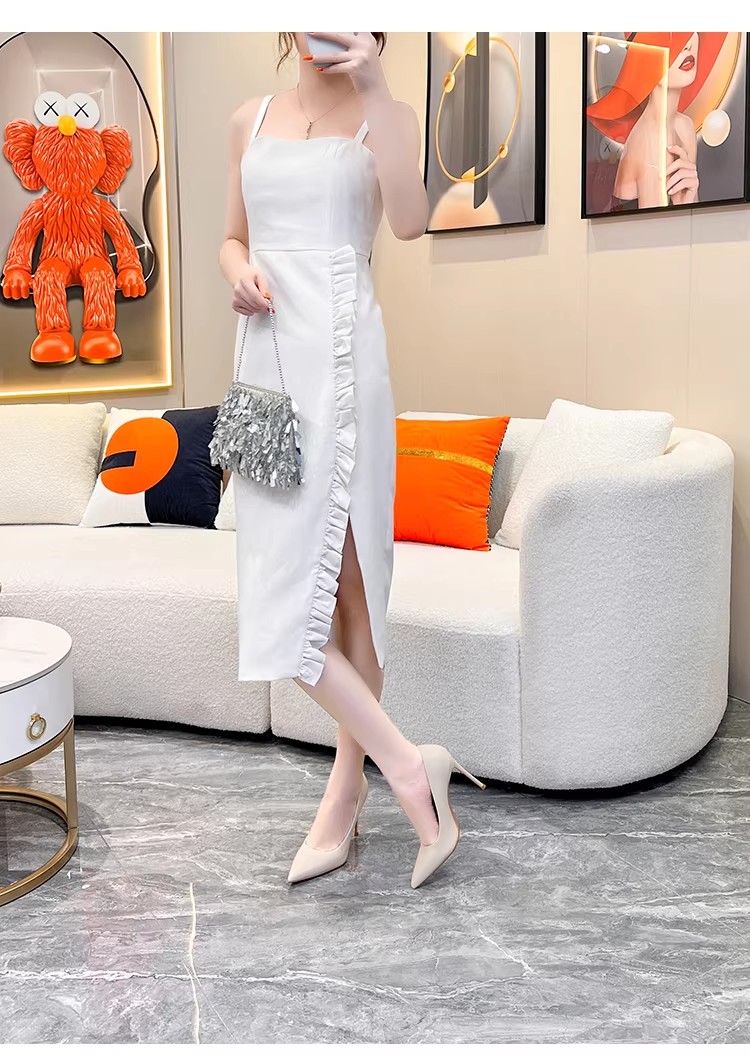
Stand on a sheet of A4 with your heel against a wall at 6pm, not 9am. Mark the tip of your longest toe and measure. Then add 5mm and compare that number to the insole length on the product page. If the listing doesn’t publish an insole length, that’s information in itself.
For a pointed shoe I add 8mm rather than 5mm, because the taper starts before the toe ends. Round toes are more forgiving and 5mm is plenty. This is not a secret method, it’s just the sizing logic that’s been standard in manufacturing for a century: shoe sizing systems are built on last length, not foot length, which is why the same number means different things in different brands.
Width matters just as much and almost never gets published. Measure around the ball of your foot with a soft tape while standing. Anything under 88mm is narrow, 88 to 96 is average, above 96 is wide. If a beige pump is listed as narrow and you’re at 98, size up and add the pads. Don’t hope.
I keep both numbers in a note on my phone now. 241mm long, 96mm around. It takes thirty seconds to check and it has saved me two return labels this year.
Why the toe box decides everything on a pale pump
A black pump can pinch and you’d never know from across the room. A beige one announces it. The leather creases where your toes push, and those creases catch the light. That’s why the toe box is the part I check first now, before length or heel height.
Press the top of the toe with your thumb. There should be a little lift before it touches the ground. If it’s flat and hard, your toes will fight it all evening. Then look at the shape from above: a true pointed toe narrows from the ball, which is where your foot is widest. The good ones stay wide until the last third and then taper quickly.
My 37 failed that test. The taper started too early, about halfway down, and my little toe was sitting in the narrow part instead of behind it. That’s the single most common reason women buy beige heels half a size up and then complain the heel slips.
People blame their feet for this. It’s the last, usually. Shoe lasts are graded from a single prototype size and scaled up and down arithmetically, which means a 36 and a 40 can behave like different shoes even in the same model and colour. When a brand offers a half size, take it seriously; it’s often cut from a different grade rather than scaled down by hand.
There’s one more thing worth checking in the shop, and it takes three seconds. Put the shoe on a flat surface and look at it from the side. The heel and the forefoot should both touch down. If the toe lifts off the floor, the sole is rockered and you’ll feel it as a push under your arch after an hour.
Beige is three different colours, and one of them will look wrong on you
This is the part I got wrong first, before the sizing. I ordered what the site called beige and got something closer to a warm sand. On my skin it read yellow. Next to a cream dress it read dirty.
There are three beiges in women’s shoes and they behave completely differently.
- Warm sand. Yellow undertone. Great with olive and tan skin, tricky against very pale skin in winter.
- Pink beige. The classic nude. Disappears against most light and medium skin tones, which is the whole point.
- Greige. Grey undertone. Reads cooler and slightly more formal. Best with black, navy and grey outfits, worst with cream.
Hold the shoe next to your bare foot in daylight, not in the shop’s warm lighting. If you can see a clear line where the shoe ends and your skin starts, it’s not a nude for you. That’s not a fault, it’s just a different job: a shoe with visible contrast works with tailored trousers, and a true nude works with bare legs and shorter hems.
If you’re buying for a wedding where you’ll be photographed in daylight, pick the pink beige every time. If you’re buying for an office where you wear grey and navy, greige looks more expensive than it costs.
What I paid, and whether a cheap pair would have done
These were 89 euros, down from 110 in a mid-season sale. My friend bought a 35-euro pair in almost the same shade two months earlier, and by July hers had a crease across the toe that never came out, plus a heel tip worn down to the plastic.
So no, the cheap pair wouldn’t have done. But the expensive one wasn’t obviously better either. What I got for the extra money was a leather upper that softened instead of cracking, an insole that didn’t slide, and a heel that landed straight when I put weight on it. Nothing glamorous. All of it measurable.
My rule of thumb now: under 40 euros, a beige pump is a one-summer shoe and I buy it knowing that. Between 70 and 120, it should last three summers if you rotate it. Above that you’re paying for a name, and the leather isn’t three times better. If you want to test that theory, hold two pairs from different price brackets next to each other and look at the edge of the sole. The expensive one is usually stitched, the cheap one glued.
One thing I’d skip regardless of budget is a very high, very thin beige heel. The colour puts all the attention on the shape of your foot, and a 100mm needle heel is unforgiving on anything but a red carpet or a car-to-door walk. My 75mm has been fine for four-hour stretches. Ten millimetres more and I’d be sitting down by the second hour.
I also bought a small pot of cream polish in the same shade while I was at it. It lives in the box. That one detail has done more for the look of these women’s beige high heels than anything else I’ve tried, and it cost six euros.
Walking in them for a week: what actually changed
I wore the 37.5 for five days, roughly two hours a day, with the suede heel grip in from day one. Day one, the strap over the instep felt tight for the first twenty minutes. Day three, it stopped. Day five, I wore them for a four-hour stretch that included two train platforms and a supermarket.
By the end of the week the beige had picked up two marks: a grey scuff on the outer toe from a car door, and a faint blue line on the heel where my jeans had rubbed. Neither came off with a damp cloth. The scuff needed a dab of colour-matched cream, and it’s still faintly visible if you get close.
That’s the honest cost of a pale shoe. It shows everything.
There’s a reason pale leather marks so easily, and it’s a structural one rather than a quality problem: dye sits in the grain, and a scuff breaks the surface layer that holds it. Tanneries test for this. The rub-fastness standard behind most leather labelling is set by OEKO-TEX and similar testing bodies, and it’s why a very lightly dyed beige can score worse than a dark brown on the same test.
Break-in was milder than I expected. The leather softened across the vamp after about eight hours of wear, and the toe box didn’t collapse, which tells me the upper is at least partly real leather rather than a coated synthetic. If a beige pump creases sharply in the first hour and stays creased, that’s your answer about the material.
One thing I’d do differently: I’d have bought them a month before I needed them, not ten days. A pump that’s been worn around the house for three evenings behaves completely differently at a wedding.
Where beige heels earn their keep, and where they don’t
They’re the most useful pair I own between April and September, and close to useless in December. That’s the honest split.
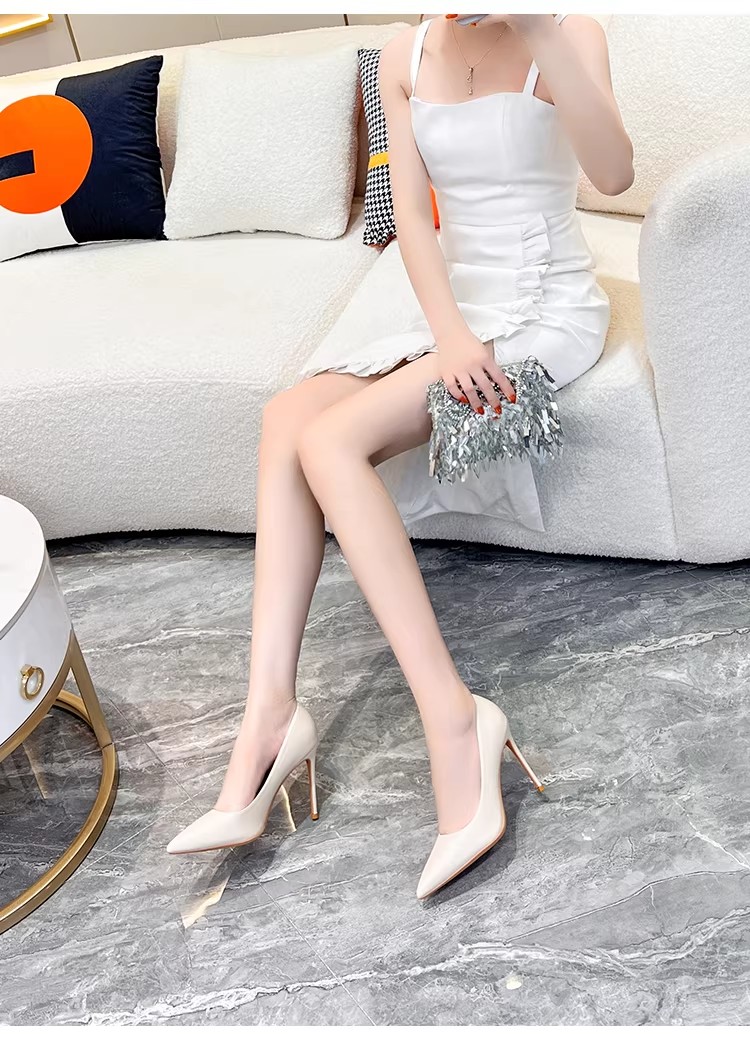
They work with bare legs, pale denim, cream, white, olive and any print that already has a warm neutral in it. They work at weddings, at long lunches, at the kind of meeting where you’re standing for an hour and then sitting for two.
They don’t work with black tights. The contrast is too harsh and the shoe looks like it belongs to another outfit. They also don’t work in rain, for obvious reasons, and they don’t work if you’re going to be on your feet for eight hours on concrete. For that, a lower block heel is the only sensible answer, and something like a thick-heeled pair with a wide base will do the job without wrecking your knees.
If you want the same soft neutral with a bit more going on, champagne heels with embroidery sit in a similar place in a wardrobe but read dressier. Champagne is more forgiving than beige against most skin, honestly. It has a little shimmer to hide scuffs.
There’s a seasonal rhythm to it as well. In spring, beige works with everything pale and nothing dark. By September the same pair looks tired next to burgundy and charcoal, which is why mine get cleaned, polished and put away around the end of the month. A pale shoe has a window, and pretending otherwise just makes you wear it in the wrong weather.
If you’re on the fence about colour, borrow the trick from makeup: match the shoe to the inside of your wrist rather than the back of your hand. The inner arm is closer to the tone of your legs, and it’s the comparison people actually see when you’re standing there in bare legs.
The full range of what’s available in this colour family is worth a browse with your outfit in mind: the women’s heels category has everything from stilettos to wedges, and comparing shapes side by side is faster than guessing from a single product page.
What I’d tell you before you order three sizes
You probably don’t need three. Two is enough: your usual size and a half size up. If neither works, the shoe is wrong for your foot, and a full size up won’t rescue it. I only ordered three because I was stubborn.
Order from somewhere with free returns, and try them at the end of the day on a hard floor. Keep the boxes until you’ve walked around for twenty minutes, because the decision changes once your feet warm up.
And check the colour against your skin before you decide about the fit. A pair that looks slightly too pale in the box can be exactly right on your foot, and a pair that photographs beautifully can look like a plaster cast in daylight. The mirror test takes ten seconds and it’s the one thing no size chart can tell you.
One last note on storage. Keep beige shoes out of direct sun and away from the radiator, because pale leather yellows unevenly and the yellowing doesn’t reverse. Mine live in a cotton bag in the bottom of the wardrobe, which is dull but effective. If you want to see how I handled a similar decision with a different pair, this piece on keeping two pairs out of four covers the returns side in more detail.
Beige heels are not a neutral. They’re a colour you have to match to your own skin, and once you do, they solve more outfits than any black pair in the cupboard. Get the half size right and the rest follows.
