

December gives you three invitations in ten days, one pair of shoes that has to work for all of them, and a phone camera with a flash that fires whether you want it to or not. The photos will outlast the evening. The shoes have to survive both.
Here’s the short answer before the detail. A 60 to 70 mm block heel in satin, suede or a matte metallic survives a December better than anything glittery or strappy, and it photographs better too, because flash bounces off glitter and makes it look like tinsel. Closed toe if you’re walking anywhere. And test the pair under a phone flash before you commit, not in daylight.
That’s the whole decision. The rest is the reasoning, which matters when you’re standing in a shop with two pairs in your hands.
The flash test, run in a shop doorway
Party photographs are taken with a phone flash at about 1.5 m in a dark room. That’s a completely different light from the shop mirror, and it changes how three materials look.
- Glitter finishes reflect the flash directly back at the lens. The result reads as a bright, blown-out patch with no shape, and the shoe looks cheaper in photos than it did in the shop.
- Patent leather produces a hard white highlight on the toe. Fine in a still life, odd on a foot, and it also shows every scuff from the taxi rank.
- Satin and suede absorb most of the light and keep their shape. They photograph as the colour you bought.
You can run the test yourself. Take the shoe to the shop doorway, hold it at about the height of your foot, and take a photo with your own flash on. Look at the image, not the shoe. If the surface blows out to white, it will do the same in every group photo for the next six weeks.
The same test tells you about the colour. Deep reds and greens photograph close to how they look. Pale champagne and silver go almost white under flash, which is fine for a wedding and slightly flat for a party. Black stays black, and it will look like a black shoe in every photo, which is either the point or not.
One detail worth knowing: the phone flash fires from about 10 cm above the lens, so it hits the top of the shoe at a steep angle. That’s why you see dust and scuffs in photos that you can’t see in the mirror.
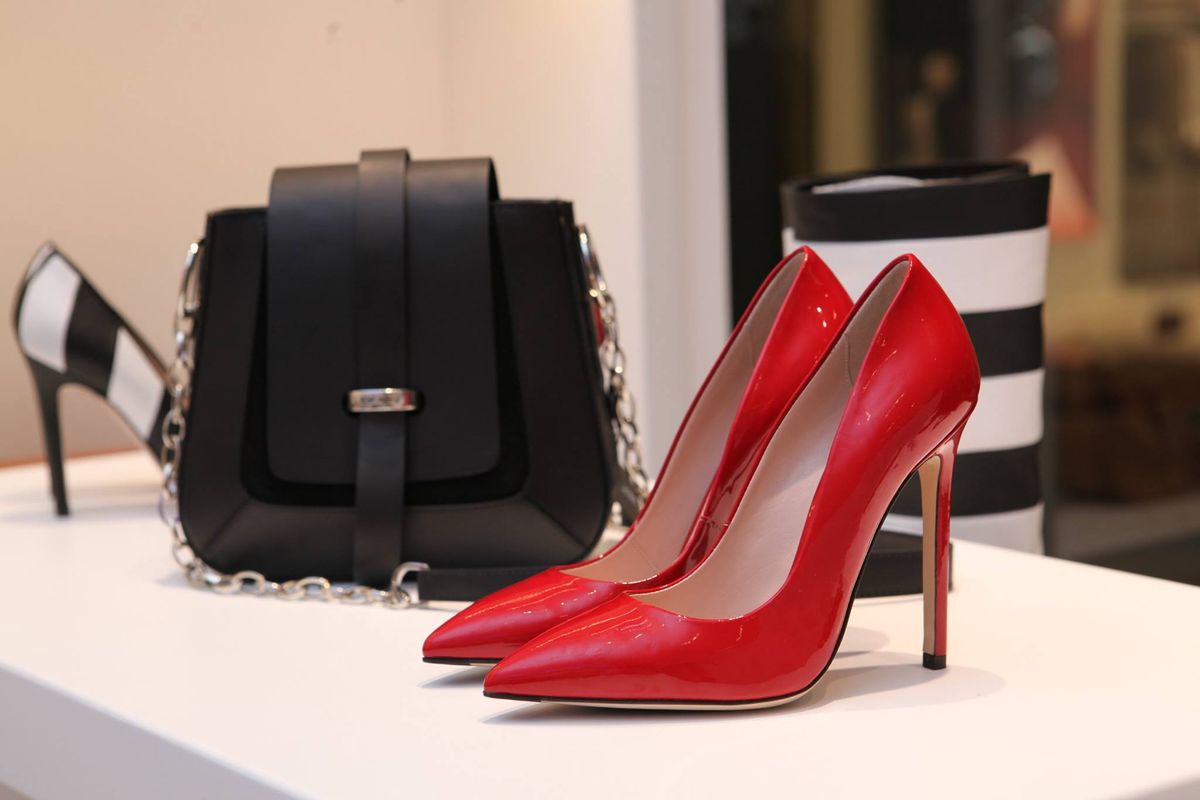
Wipe the pair down before you leave, and keep a cloth in your bag.
There’s a version of this test you can run at home, and it’s worth doing two days before the event rather than on the night. Put the pair on with the outfit, stand 2 m from a wall, and take three photos: one with flash, one with the room light on, one with the phone propped up at chest height. The chest-height shot is the one that matches what other people see.
What you’re looking for in those photos is not whether the shoe looks nice. It’s whether the shoe looks like itself. If a silver pair turns into a white pair, or a deep red turns brown, you’ve learned something a mirror can’t tell you. Cloth also hides a surprising amount: a quick wipe removes the dust that flash turns into bright specks.
Heel height against December floors
December involves three floor types, and they’re all worse than an office carpet. Polished stone in hotel lobbies. Old wooden boards in restaurants. Wet pavement between the two.
Seventy millimetres is where most people start to notice. At 60 mm with a block heel, you can stand for four hours and walk two blocks without thinking about your feet. At 85 mm with a stiletto, the same evening costs you the next morning.
A block also solves the floor problem. A tapered heel on polished stone is a genuine slipping risk, and the people who fall at parties are almost always in thin heels on a wet lobby floor. A 60 mm block with a rubber tip grips and stays quiet.
Here’s the comparison I’d use in a shop, and it’s short:
| Evening shape | Standing time before it hurts | Photographs as |
|---|---|---|
| 60 mm block, closed toe | 4 to 5 hours | Clean line, no glare |
| 60 mm tapered | 2 to 3 hours | Same, but slips on stone |
| 85 mm stiletto | 60 to 90 minutes | Elegant in stills, awkward walking |
| Flat ballet | All night | Reads casual in a dress photo |
If your December includes a lot of standing, the honest answer is a block at 60 mm and a second, flatter pair in the car.

Nothing about that is defeatist. It’s just arithmetic.
Insoles are the cheap fix that actually works in a dress shoe. A 3 mm gel pad under the ball of the foot moves the pressure off the metatarsals and buys you roughly an hour, and it fits inside almost any party shoe without changing the fit. Skip the full-length gel insole: it lifts your heel out of the counter and makes the shoe slip, which is worse than the ache it was meant to solve.
Heel grips are the other one worth carrying. If the shoe is half a size too big, which is common when you size up for a wide forefoot, a grip at the back stops the slip and costs about the same as a coffee.
Materials that survive slush and still look right
You’ll walk through at least one wet pavement in December, and the material decides whether the pair survives it.
Suede is the prettiest option and the least waterproof. One walk through slush leaves a salt line that never fully comes out. It’s fine if the car is at the door and the walk is 20 m. It’s wrong for a 400 m walk to a station.
Satin is fine in light rain and disastrous in snow, because the water marks dry into rings. Treat it with a spray before the first wear and it will handle a taxi-to-door evening without complaint. If you’re buying for one specific dinner, a champagne pair with a low slim heel photographs warmer than silver in a room lit by candles.
Metallic leather and foil finishes are the most practical of the dressy options. They wipe clean, they don’t show salt, and they photograph without blowing out as long as they’re matte rather than mirror-bright.
Patent wipes clean in seconds and shows every scratch. If you go this route, look for a slightly grained patent rather than a glassy one; it photographs with more depth and hides scuffs better.
Colour interacts with what you wear underneath, and that’s where party outfits go wrong quietly. Nude tights with a black satin shoe read as a gap at the ankle in photos, because the tone break is obvious at flash. Either match the tight closely to the shoe or go with a sheer black, which connects the leg to the shoe instead of interrupting it.
If the pair is metallic, keep the jewellery in the same temperature. A warm gold shoe with silver earrings looks accidental in a group photo even though nobody can name what’s wrong. Warm with warm, cool with cool, one exception at most.
Whatever the material, do two things before the first party. Spray the whole shoe, not just the toe, and let it dry for a full day. Then walk 200 m in them on pavement, not carpet, so you find out whether the sole grips before you’re doing it in the dark.
One pair, three invitations
The outfit maths is easier than it looks, and it’s mostly about colour and hem length rather than the shoes.
Office party, 6:30 pm, hotel bar. Dark trousers or a midi skirt, and a 60 mm block in black or deep red. The heel is invisible under a midi hem, which means the pair reads formal without anyone seeing the height. Bring the flat shoes and change at your desk if the walk from the station is long.
Dinner, 8 pm, restaurant with wooden floors. Same pair, different top, or satin black heels that hold their colour under flash if you want the photo to read sharp rather than soft. A satin shoe works here because restaurant lighting is warm and low, which is the light satin was made for. Wooden floors are the one surface where a stiletto is actually safe, which is why so many people wear the wrong shoe to the lobby and the right one to the table.
New Year’s Eve. This is the one that justifies a second pair. Four hours of standing, then a walk to a car at 1 am on wet pavement. A 60 mm block with a closed toe; anything strappy will be regretted by 11 pm.
If you’re choosing one pair for all three, pick the closed-toe block in a mid-tone: black, oxblood, or a warm metallic. It disappears under trousers, holds its own with a dress, and doesn’t look out of place in a photo next to someone in glitter.
Bags are part of the same maths. A small clutch held in front of you covers the hem and half the shoe in every photo taken at waist height, which is most of them. If the shoes are the part you spent on, carry the bag in the other hand or wear it on the shoulder. It sounds trivial until you look back at last year’s photos and realise you can’t see the shoes in any of them.
One last outfit note: floor-length trousers with a party shoe are a waste of the shoe and a tripping hazard at the hem. If you’re wearing wide trousers, the shoe needs to be visible from the front, which means a 60 mm heel and a hem that ends 5 mm above the floor in bare feet.
The hem matters more than the heel. A floor-length dress hides everything, which is why tall heels are wasted on long skirts. A midi that ends two fingers below the knee shows the ankle, and that’s where a 60 mm heel changes the line. Full-length photographs are taken at chest height, so the ankle is what the camera sees.
What to skip, and what to keep in your bag
Three things are not worth buying for December, and one thing is worth carrying.
Three things are not worth buying for December:
- Glitter. It photographs badly, it sheds on tights, and it looks dated in a photo within a year. If you want shine, matte metallic does the same job and lasts longer.
- A strappy sandal with a thin heel, unless your December is genuinely warm. Cold feet in a sandal look exactly as uncomfortable as they are, and no photo fixes that.
- A brand-new pair worn for the first time on the night. A shoe you’ve worn twice is a known quantity. A shoe you’re trying at 7 pm on a Saturday is a gamble with a bad payout.
What to keep in your bag: a pair of foldable flats, and a plaster. Neither weighs anything, and both have saved an evening. If you’re wearing tights, add a spare pair; a ladder at 10 pm ends the night faster than sore feet.
One more piece of advice that doesn’t fit anywhere else. Buy the December pair in November, wear it three times around the house and once outside, and by the first party it will feel like a shoe rather than a risk. The pairs that ruin evenings are always the ones bought at 5 pm on the day.
Returns are worth planning for, too. Most shops give you 14 to 30 days, and shoes have to come back unworn outdoors with the sole clean. That’s another argument for the 200 m pavement walk: it tells you whether the pair works while there’s still time to take it back. Wear them indoors only and you learn nothing about grip.
If you’re buying online, order two sizes in the same style and return one. It costs nothing at most retailers and it removes the guesswork about width, which is the measurement product pages never list.
Before you pay
Four checks, five minutes. Photograph the shoe with your flash on. Walk 50 m on pavement. Stand on a hard floor for two minutes and see whether your toes press. And check the heel tip: a hard plastic tip on a block will be silent on carpet and loud on stone, while a rubber tip is quiet everywhere.
If all four pass, you’ve got a pair that will get you through three evenings and look right in the photos afterwards. December is short. The photographs aren’t.
For the walking half of the month, the maths is completely different, and the pair that handles four days in a carry-on is covered in two pairs for four days in Europe. The party half is simpler than it feels: one closed-toe block, one colour that survives flash, one test under your own phone. The history of the high heel explains why the shapes we call party shoes are so recent, and how a camera flash works explains why the shiny pair photographs badly. None of that helps at 7:40 pm, but it makes the shop decision faster.
