

The parcel arrives on a Thursday. The box says wide, the picture on the site showed a roomy toe, and the first thirty seconds on the foot feel fine. Then the person walks to the kitchen and back and something changes at the little toe. By Saturday the pair is back in the box with the returns label printed.
Wide toe box walking shoes for women fail at a specific point, and it’s usually between minute eight and minute twelve of the first proper walk. Not the length. Not the heel. The width across the ball of the foot, combined with how much volume the upper has above the toes.
What follows is the check that decides the outcome, plus the two design details that separate a genuinely wide shoe from a normal shoe with a wider label.
What a wide toe box actually measures
Toe box width is the internal space across the widest part of the forefoot, roughly at the joint of the big toe. Most women’s walking shoes sit between 88 and 95mm there in a EU 38. A true wide fitting adds 5 to 8mm, and an extra-wide adds 10 to 12mm.
Those numbers almost never appear on a product page. What appears instead is a letter, usually D or E or 2E, borrowed from men’s sizing conventions where the letters are calibrated differently. A women’s D is not the same width as a men’s D. When a listing says “wide fit” with no letter at all, it usually means the last was cut slightly fuller, which is not the same as a wide fitting.
The practical result: two pairs labelled wide can differ by 6mm across the forefoot, which is more than half a size. That’s the whole gap between comfortable and returned.
There’s a second measurement that matters as much and gets discussed even less: toe box height. A shallow toe box presses down on the top of the toes even when the width is generous. Anyone with a high instep or a bunion will notice height before width, and no amount of extra width fixes a low ceiling.
So the label on the box tells you part of one number. The rest has to be checked on the foot.
There’s also a shape question behind the numbers. A rounded toe box and a square one can measure the same width and feel completely different, because the pressure lands in different places. Rounded suits a foot whose longest toe is the second one. Square suits a wide forefoot with toes of similar length, and it’s the shape most bunion-friendly shoes end up using.
None of this is visible in a product photo taken from above, which is why the same pair gets five stars from one buyer and two stars from another with the same size. Their feet aren’t the same shape, and the shoe only suits one of them.
The ten-minute check nobody does in the shop
Most buyers decide in ninety seconds, standing in front of a mirror, on carpet. That test cannot detect a wide toe box problem because standing still doesn’t load the forefoot the way walking does.
The version that works takes ten minutes and needs a hard floor:
- Minutes 1 to 2. Put both shoes on with the socks you’ll wear, lace them normally, and stand up. Feel the outside edge of the little toe. Any pressure here gets worse, not better.
- Minutes 3 to 6. Walk on a hard floor, not carpet, for a few hundred steps. Carpet hides pressure that tile reveals.
- Minutes 7 to 9. Walk downhill, or on a slight slope if one exists. If the heel lifts, the shoe is too long or the heel counter too soft, and a wide toe box won’t save it.
- Minute 10. Take the shoe off and look at the foot. Red marks on the little toe or across the top of the toes are the answer, and they appear before pain does.
That last step is the one that catches almost everything. Skin tells the truth faster than sensation does, especially in a shop where the carpet is soft and the visit is short.
If you can only do one of the four, do the hard-floor walk. It’s the step that separates a shoe that works for a commute from one that only works for a lap of the living room, and it takes four minutes out of the ten.
A home version for online orders: wear the pair indoors for twenty minutes on the day it arrives, on a hard floor, with the returns label still attached. Twenty minutes indoors doesn’t void your return in most shops and it prevents a month of hoping they’ll stretch.
They won’t stretch where it matters. Uppers give slightly across the instep because that’s where the material flexes. The toe box holds its shape because there’s a stiffener built into it. Pressure at the little toe in week one is pressure at the little toe in week twenty.
Where wide shoes go wrong: heel slip and a baggy midfoot
A last cut wider at the front usually gets wider everywhere, which creates the second problem. The midfoot loses grip, the heel counter stops holding, and the foot slides forward on every step until the toes press against the front.
That’s why some people buy a wide shoe, feel the room, and then find the pair almost unwearable after a kilometre. The toe box was right. The rest of the shoe became a bucket.
There are two ways manufacturers get around it. The better one is a wide forefoot with a normal midfoot, which needs a more complex last and costs more to make. The cheaper one is to widen everything and add extra lacing. Both are sold as wide.
How to tell them apart in the hand: pinch the upper at the midfoot, just behind the ball of the foot. If it moves a centimetre or more between your fingers with the laces loose, there’s a lot of excess volume there. Then look at the heel counter. Press it inward. If it folds flat, the shoe has given up on holding the back of the foot.
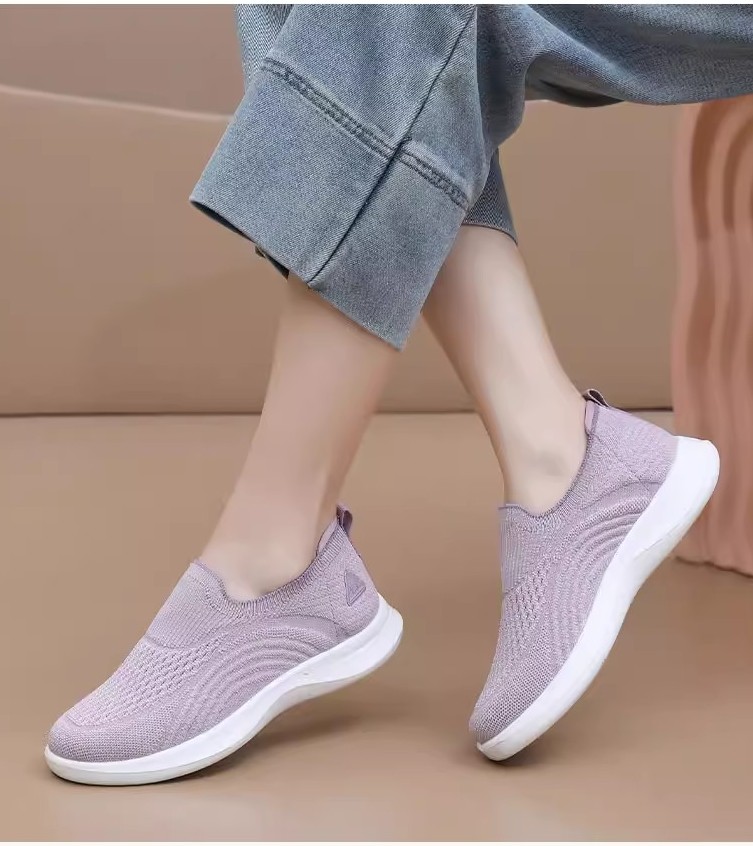
For anyone with a narrow heel and a wide forefoot, which is common, the combination to look for is a wide toe box with a firm heel counter and a lace system that starts further back on the foot. Laces that begin close to the toes can’t tighten the midfoot, so the whole shoe has to be tight or the whole shoe has to be loose.
You can test the midfoot volume without walking. Lace the shoe, then push your thumb down between the laces and the top of your foot. If the leather or mesh sinks 8mm before it meets resistance, the upper is holding nothing. If it stops almost straight away, the shoe will hold the foot but may press on a high instep.
Adding a heel grip is the usual workaround for slip, and it’s a poor one. It fills space at the back without fixing the volume in the middle, so the foot still slides forward. A tongue pad under the laces does more, because it takes up the volume where the foot is actually moving.
Wide toe box walking shoes for women with a normal heel are a smaller category than the marketing suggests. It’s worth comparing shapes directly rather than trusting the word wide, which is what makes the fit comparison in our walking shoes against a mainstream trainer useful: same foot, two lasts, visible difference at the forefoot.
Materials that keep their shape once the toe stretches
Every upper relaxes a little in the first month. Mesh relaxes more than leather, knit relaxes most of all. For a wide forefoot, that relaxation is either help or damage depending on how much room you started with.
Mesh with a structured toe cap is the safest choice. The cap keeps the shape at the front, the mesh gives across the ball of the foot, and the combination handles a hallux valgus deformity without pressing on it. Knit uppers feel wonderful for the first week and then become shapeless in exactly the place where support matters.
Leather is the slowest to give and the most predictable. A leather wide fitting that feels slightly snug at the little toe on day one will usually be right by day ten. A mesh one that feels slightly snug will be right by day three and slightly loose by day thirty.
Lining matters for a different reason. A wide shoe with a thick padded lining loses 2 to 3mm of internal width to the padding. Look for a thin, smooth lining in the forefoot and padding only at the collar and heel. That’s a small design decision that shows up as a full width difference on the foot.
One more material note: the insole is removable in most walking shoes, and swapping a 5mm footbed for a 3mm one buys a couple of millimetres of height and width. That’s the cheapest fix available, and it’s reversible, unlike stretching.
If you do want to stretch a pair, take it to someone who does it for a living. Home stretchers push outward at the widest point and can distort the toe box shape, which is the one part you were trying to preserve. A shop stretch is gentle, targeted, and costs less than the shoes are worth.
Breathability also changes the maths. A wide shoe with a lot of internal volume and a non-breathable lining turns into a warm, damp space by mid-afternoon, and a damp foot spreads out and starts sliding. That’s why some buyers find a wide pair comfortable for an hour and sloppy by four o’clock.
When to send them back, and the note to write
Roughly a third of wide-fitting returns would have been avoided with the ten-minute check. The rest are genuinely wrong purchases, and the useful question is which one you’re holding.
Send them back if:
- There’s a red mark on the little toe after twenty minutes indoors.
- The heel lifts on a slope even with the laces snug.
- Your toes touch the front when you walk downhill.
- The upper wrinkles deeply across the instep when laced, which means the volume is wrong rather than the width.
Keep them, and give them a week, if your only issue is slight pressure on the top of the foot where the tongue meets the laces. That area does relax, and it’s the one place where patience pays.
The return note matters more than people think. “Too small” gets a size up, which is usually the wrong fix. “Wide enough at the toe but the heel slips” tells the shop the last is wrong for the foot, and a good shop will point to a different model rather than a bigger size.
If your return window has already closed, the second-best option is a pair of thin wool insoles and one week of short wears. Half a millimetre of give in the upper plus a thinner footbed is sometimes enough to turn a marginal fit into a workable one. If it isn’t, the pair belongs on the resale pile rather than in the daily rotation.
The honest limitation of this whole category: a wide toe box helps with bunions, wide forefeet, and toes that need room to spread. It does not fix plantar fasciitis, and it doesn’t replace arch support. Anyone buying wide shoes hoping for pain relief in the arch is solving the wrong problem, and the general guidance on plantar fasciitis from the Mayo Clinic is a better starting point than a wider last.
What a wide pair does buy is the end of that specific daily negotiation: the moment of deciding whether to wear the shoes that hurt or the shoes that don’t match. Most people who get the width right stop thinking about their feet entirely, which is the actual goal. If the pair also needs to work for a wedding or a long day on your feet in something dressier, that’s a separate purchase: the thick-heel pair built for hours of standing covers the occasions where a walking shoe isn’t invited. For the formal end of that same week, the embroidered champagne heels for evening events do the job a wide walking shoe can’t.
And for the days when the wide pair stays home, the full walking shoes range is sorted by shape rather than by colour, which makes the comparison quicker than scrolling a general category. Same foot, fewer wrong turns.
One closing thought for anyone mid-return: the pair that felt too tight in the shop is rarely the pair that fits in a month. Your feet don’t shrink, and shoes don’t grow. The ten-minute version of that test is cheaper than the twenty-minute one at home, and both are cheaper than a pair that sits by the door being avoided.
