

You’ve seen the pair in the shop window, all warm shine and a chunky heel, and it looked like the answer to a wedding invite. Then you got them under the bathroom light at home and something was off. Not broken, not damaged. Just cheaper than they looked at 4pm in a shop.
Gold is the most unforgiving finish in footwear. It reflects everything, it shows every scuff, and the wrong tone makes a good leather shoe look like a party favour. Womens gold block heels can be genuinely great, though, if you know what you’re looking at before you pay. Here’s the difference between the pairs that hold up and the ones that end up at the back of the wardrobe.
The undertone decides everything
Gold isn’t one colour. It’s a family, and the undertone is what separates a rich metallic from a brassy one. Look at the shoe next to a sheet of white paper in daylight. If the gold pulls yellow-green, it’ll look cheap against most fabrics. If it pulls warm bronze or soft champagne, it’ll look like metal rather than paint.
The cheapest gold finishes are a thin metallic foil over a synthetic base, and they have a flat, uniform shine that reads as plastic. Better finishes use a metallic pigment in a leather finish or a laminated leather, which has depth: the shine changes as the shoe moves, and the colour shifts slightly in shadow.
Here’s the trick I use in shops. Tilt the shoe away from the light and look at the part in shadow. A good metallic still looks like gold in shadow. A cheap one goes grey or muddy, because there’s no depth under the surface, only reflection on top of it.
Pantone’s work on metallic and seasonal colour direction is where most footwear brands take their palettes, and the trend for the last few seasons has been away from bright yellow gold toward softer, warmer metallics. That’s good news if you’re buying now, because the champagne and antique tones on shelves are more wearable than the hard yellows of a few years ago.
Three golds, three different jobs
Before you decide on a heel height, decide which gold you’re actually buying. They behave completely differently.
- Yellow gold. Bright and warm, closest to jewellery. Looks best with black, navy, cream and deep green. Least forgiving on a scuffed toe.
- Rose gold. Pink-leaning and softer. Flatters most skin tones and works with blush, grey and white. Can look slightly juvenile on a very chunky heel.
- Champagne or antique gold. Muted, slightly brown. The most versatile of the three, and the one that reads as expensive most reliably.
If this is your first metallic pair, buy champagne. It behaves almost like a neutral, which means you can wear it with the same things you’d wear a nude heel with, and it doesn’t demand a whole outfit built around it.
Yellow gold is the statement pair. Buy it when you already know what you’re wearing it with, ideally something dark. Rose gold is the one people regret least, in my experience, because it’s flattering and easy, but it photographs slightly pinker than it looks in person, which surprises people when the wedding photos come back.
Why the block heel is the right partner for metallic
Metallic finishes draw the eye down. A slim stiletto in gold looks like a piece of jewellery and demands a very polished outfit. A block heel in gold is more forgiving, because the visual weight at the bottom balances the shine and stops the shoe looking like it’s floating.
Practical reasons too. A block heel of 60mm to 80mm spreads your weight over a wider footprint, so you can stand through a ceremony, a receiving line and a dinner without your calves giving out. Gold pairs are usually bought for events, and events involve a lot more standing than people plan for.
Height still matters for proportion. At 60mm the shoe reads as a comfortable dress heel and works with midi lengths. At 80mm it reads as a proper evening shoe and needs a hem that clears the floor. Above 90mm, a gold block heel starts to look like a costume piece, especially in a bright yellow tone.
Check where the metallic finish stops. On cheaper pairs, the gold wraps the whole shoe including the heel block, and the block is the part that gets knocked on kerbs and stairs. A pair with a gold upper and a plain or wrapped heel in a slightly deeper tone survives much longer, because the damage happens where nobody’s looking.
The contrast test that takes ten seconds
Hold the shoe against the back of your hand and against your forearm. You’re not looking for a match. You’re looking for the gold to sit next to your skin without either one looking dirty.
Warm golds next to cool, pink-toned skin can make the skin look red. Very pale champagne next to deep skin can look washed out and chalky. The fix isn’t to avoid gold. It’s to pick the undertone: cooler skin tends to suit rose and pale champagne, warmer skin tends to suit yellow and antique gold.
This is not a rule, and honestly the lighting in most shops is bad enough to make the test unreliable. Do it near a window if you can. If the shop has no daylight, take a photo of the shoe on your foot with your phone and look at it later, away from the shop lights.
Also test the shoe against the fabric you’ll wear. Gold against cream silk is elegant. Gold against cream polyester can look off, because the two surfaces fight each other: one has depth, one doesn’t. Bring the dress if you can, or at least a photo.
What to wear them with, and the outfit that fights them
Gold block heels work with black, navy, deep green, burgundy, cream, white and most denim. They work best when there’s one other metallic element in the outfit, like a bag clasp or a piece of jewellery, and nothing more. Two competing metallics is where it gets messy.
They work less well with pastels. A gold block heel under a pale lilac dress tends to look like the wrong decision, because the shoe has more weight and shine than everything above it. If you want a metallic with pastels, go silver or a very pale champagne.
And they clash with busy prints. A floral midi plus gold block heels is a lot of information in one outfit. Pick one. If the dress is loud, the shoe should be quiet, and gold is rarely quiet.
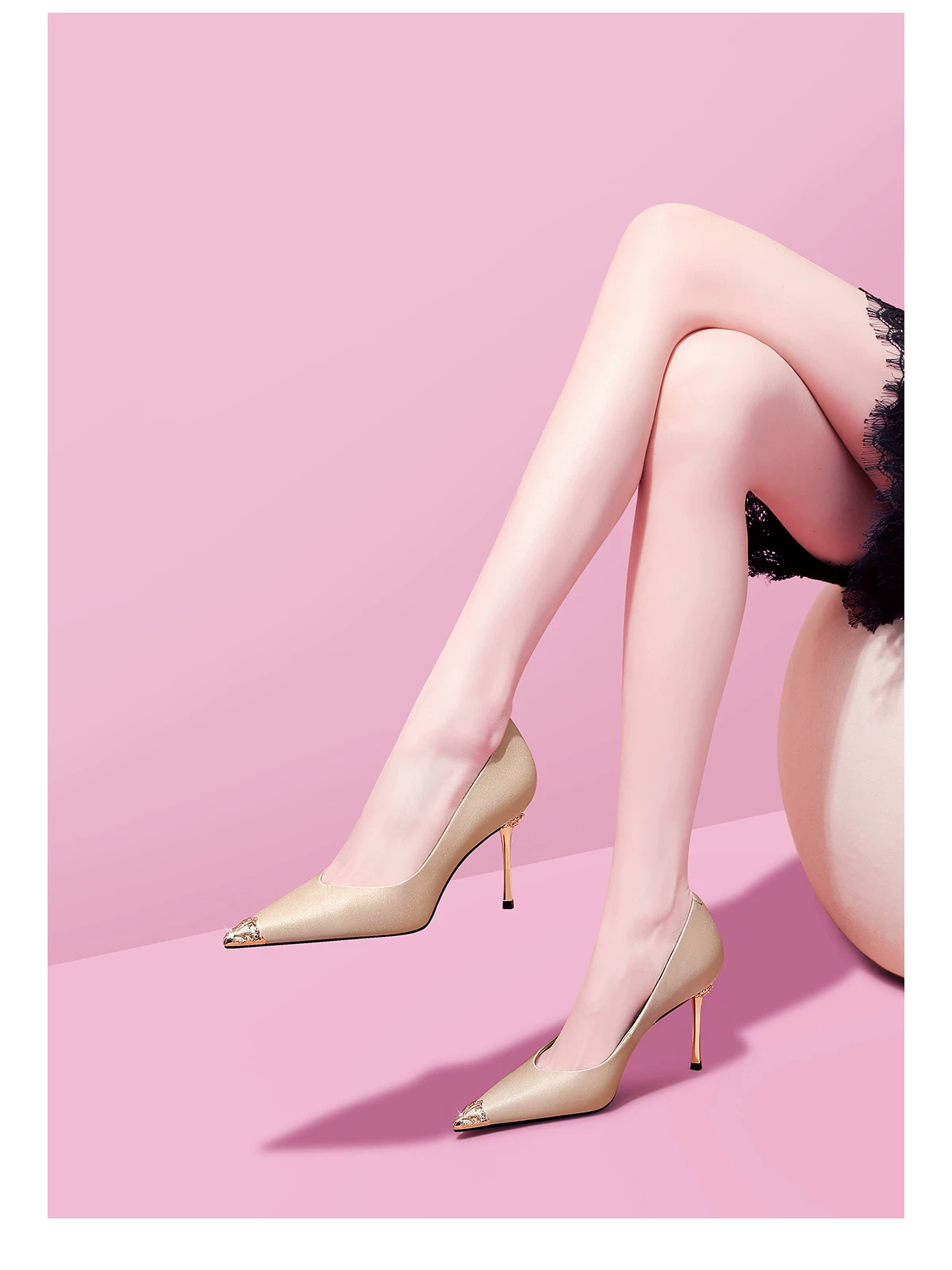
For evening events, a champagne pair with a bit of embellishment covers the gold-and-crystal look without going full bridal. These champagne heels with a slim heel sit in that space, and they photograph well under warm indoor light, which is where most event photos get taken.
If you want the detail without the slim heel, an embroidered champagne pair gives you the same warmth on a base you can actually stand on for a long ceremony.
What happens to the finish after twenty wears
Metallic finishes age faster than any other leather finish. That’s the honest downside and it’s worth knowing before you spend on a pair.
The failure pattern is predictable. First the toe scuffs and the gold goes dull in a patch the size of a fingernail. Then the flex crease across the vamp starts to show a lighter line, because the metallic layer breaks where the leather bends. By twenty wears, a cheap pair looks patchy. A good pair looks worn but still gold.
You can slow this down but you can’t stop it. Keep them out of the rain, because water spotting on metallic leather leaves pale rings that don’t come out. Don’t use coloured polish on them, because gold polish rarely matches and mismatched touch-ups look worse than the scuff. Use a neutral cream sparingly, and buff with a soft cloth rather than a brush.
Store them in dust bags, separately. Metallic finishes can transfer onto other shoes if they’re pressed together in a cupboard, and a gold smudge on a black leather toe is not removable.
The good news is that gold block heels are event shoes. They don’t need to survive daily wear, they need to survive eight evenings a year. If you buy them knowing that, the wear pattern is fine. If you’re planning to wear them to the office twice a week, buy champagne leather instead of metallic, because it’ll look better at wear fifty.
Buying checks that catch the bad pairs
- Look at the inside edge of the heel block. Seams should be sealed, not raw and flaking.
- Bend the shoe at the ball. A metallic finish that cracks on the first bend will crack on your foot.
- Check that the gold is even at the toe, where the last is stretched. Patchiness there shows up fast.
- Press the insole. A hard, thin insole in a block heel means you’ll feel every step.
The bend test is the one that matters most. Take the shoe and flex it at the ball of the foot, the way it’ll flex when you walk. If the finish shows a white line at the crease, it’ll be a visible crack within a month. Leather with a proper metallic finish bends and recovers. Foil over synthetic doesn’t.
Also check the heel tip and the sole material. A gold block heel on a hard plastic sole is slippery on tile, and events happen on tile. Rubber or a rubber-topped leather sole is worth paying for.
Size carefully. Metallic leather has less stretch than plain leather because the finish adds a layer, so a gold pair that feels snug in the shop will still feel snug in three months. If you’re between sizes, take the larger one and use a heel grip. The finishing and coating processes used on leather explain why: the surface is sealed, so it doesn’t mould to your foot the way unfinished leather does.
How to store and travel with a metallic pair
Metallic shoes are the ones that get wrecked in a suitcase. They’re bought for events, events mean travel, and a gold block heel jammed against a hairdryer for six hours comes out with a dull patch and a bent heel pin.
- Wrap each shoe in a cloth or its dust bag, never bare against other shoes.
- Pack them heel-to-toe with the toes pointing in opposite directions so the blocks don’t press on the uppers.
- Keep the heel block at the top of the bag, not under a wash kit.
- Take the shoe trees out for travel and stuff the toes with socks instead.
The heel block is what breaks, not the leather. It’s the heaviest part of the shoe and it’s the part that lands on airport floors, so give it the protected end of the bag. If the pair comes with a shaped box, that box is worth keeping for exactly this reason.
At home, store them upright on a shelf rather than piled in a basket. The finish on the heel block picks up marks from whatever’s next to it, and a gold block with grey scuffs on the side is very hard to touch up because the colour match is never right.
One more travel note: don’t wear a brand-new metallic pair to the event. Wear them for two hours at home first and walk on carpet, then check the flex crease. If the finish is going to crack, you want to find out in your hallway rather than in a hotel room with no spare shoes.
Where gold block heels are the wrong call
They’re wrong for a job interview. They’re wrong for a funeral. They’re wrong for anything where you want to be looked at less, not more.
They’re also wrong if your event is outdoors on grass. A block heel helps, but a metallic finish and wet grass don’t mix, and gold shoes with mud on them are finished. If the wedding is in a field, wear leather.
And they’re the wrong first pair of heels if you don’t already own a plain pair you can walk in. Gold gets noticed, and a shoe that gets noticed while you’re limping is a bad combination. Build the basics first.
If you already have the basics, the metallic pair is genuinely fun. Start with a mid-height block and a muted gold, wear it to one event, and see how you feel about the shine. You’ll either want more or you’ll know it’s not your thing, and both answers are useful.
Have a look at the square toe shapes that work best in a wide fit if your feet need the room, and browse the full heel collection for the plain-leather pair you’ll wear between events. One good gold pair and one good black pair covers almost every invitation you’ll get this winter.
