

It’s six in the evening, you’ve been in the same pair since nine, and your big toe has started sending messages. The shoes aren’t too small. They’re the right size and the wrong shape, and the shape is the part nobody measures.
Square toe heels exist because feet aren’t pointed. Your forefoot is widest across the joints, roughly where the shoe tapers hardest on a classic pump. Move the taper back and the pressure disappears.
That’s the short version. The longer one involves which square, how much heel it can carry, and why some pairs look like clown shoes while others look like money.
Square toe is a width promise, not a style statement
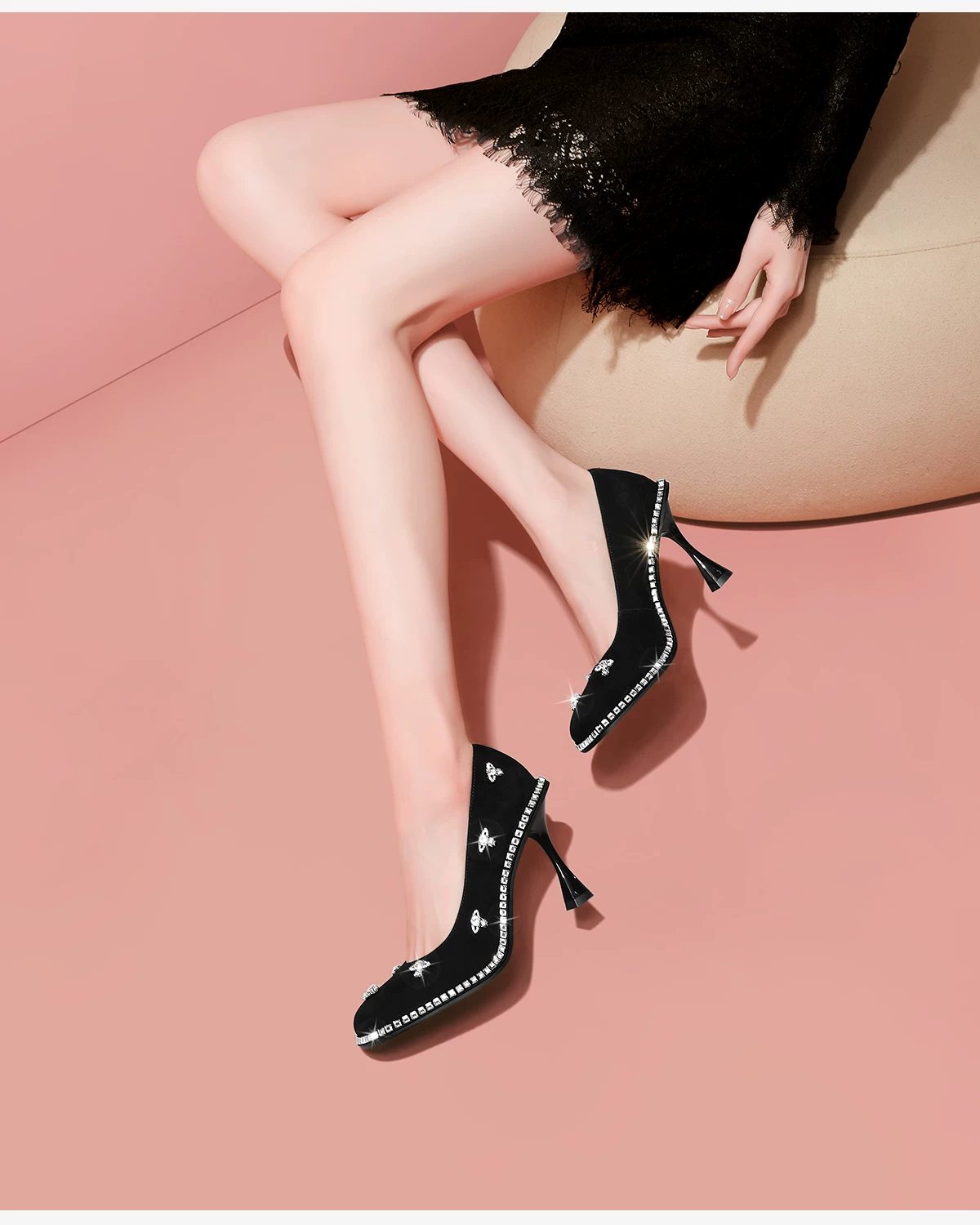
Look down at your bare foot while standing. The outline is a rounded wedge: narrow at the heel, widest across the ball, then a blunt front edge. A pointed shoe asks that blunt edge to fold itself into a triangle. A square toe lets it stay where it is.
In numbers, a true square toe box gives roughly 8 to 12mm more width across the metatarsal heads than a pointed last at the same size. That’s not a marketing figure, it’s geometry, and it’s why the shape keeps coming back every decade or so. Fashion cycles get the credit. Physiology deserves it.
Who benefits most:
- Anyone with a wide forefoot, where the little toe normally sits on the edge of the sole.
- Anyone with a bunion or a tender joint at the base of the big toe. Pressure on that joint from a narrow toe box is one of the most common reasons heels get abandoned.
- Long toes, which get squashed forward in a pointed shoe even when the length is right.
- Anyone who spends the day standing rather than sitting, because the load stays spread across the whole front of the foot.
Who it doesn’t suit: narrow feet with long, thin toes. On a slim foot, a square toe has nothing to fill it, and the shoe looks like it’s wearing you. If that’s your foot, a soft almond shape does the same job with half the visual weight.
The honest caveat is that square toes are not automatically comfortable. A square toe box that’s too shallow on top will press down on your toes with every step, and that hurts more than a narrow shoe that’s the right depth. Width alone isn’t the answer. Depth is the other half.
Three square shapes, and only one flatters most feet
“Square toe” covers a range, and the range is the difference between a shoe you wear weekly and a shoe you photograph once. Heel and last construction has always varied by era and by maker, and the square toe follows the same pattern.
First, the true square. A flat front edge, corners at almost 90 degrees, sides running straight back. Very 1990s, very editorial. It needs a straight-legged trouser or a column dress to look intentional, and it makes a wide foot look wider. Buy it if you know what you’re doing.
The soft square, sometimes called squoval. The front edge is flat in the middle and rounded at the corners. This is the version that works on almost everyone, because it keeps the extra width at the joint but loses the hard geometric line that reads as heavy. If you’re buying your first pair, buy this one.
The tapered square. Wide at the widest point of the foot, then a short taper to a squared-off tip. It’s the most elegant of the three and the least roomy, since the taper brings back some of the pressure a square toe is supposed to remove. Good for medium-width feet, not much use for wide ones.
There’s also a height dimension nobody mentions. A square toe reads best when the vamp sits slightly higher, because the straight line across the front draws the eye downward if the opening is very low. A 5mm higher vamp makes the whole shoe look shorter and more expensive. It can also cut across the top of your toes, so try it standing.
Which brings up the visual rule: the wider the toe, the more the shoe needs structure. Flimsy leather on a square toe collapses and looks like a slipper. Firm leather on a square toe holds the line and looks deliberate.
Heel height: what a square toe can and can’t carry
Here’s the mismatch that ruins a lot of pairs. A square toe is a heavy visual shape. Stick a 100mm stiletto under it and the shoe looks like two different shoes glued together. The proportions fight.
What works: 45mm to 70mm, in a block, a stacked heel, or a slim-but-not-needle heel. That range keeps the shoe balanced and, not by coincidence, is also the range most people can walk in for a full day. There’s a reason a 45mm block heel beats a stiletto on real pavement, and the square toe happens to be the shape that suits that height best.
Above 80mm, a square toe usually needs a platform or a very tapered last to stay in proportion. Below 40mm, it turns into a loafer with extra steps, which is fine if that’s what you want, but don’t buy it expecting height.
Two things make more difference than the millimetre count:
- Heel footprint. A 60mm heel with a 25mm-wide base is far more stable than a 60mm heel with a 10mm base. On a square toe shoe, the wider base also looks more correct.
- Heel set-back. A heel planted under the middle of the heel seat rather than at the very back edge takes load off the ball of your foot. You’ll feel it at hour four, not hour one.
If you want the shape without the height, a 45mm slingback in a soft square is the most wearable version of this trend that exists. It also gets worn to work, which a 95mm pair doesn’t. Something like these large-size block heels with a roomy front does the same job for wider feet.
Sizing: square toes run differently, and the rule is 5mm
Most people buy square toe heels in their usual size and find them a touch long. That’s the shape, not the maker. Because the toe doesn’t taper, the internal length is used differently: your toes sit further back from the tip, so the shoe feels roomy up front while the heel area stays the same.
Before you order, measure your foot properly. Stand on a sheet of paper, weight on both feet, trace the outline, and measure from the back of the heel to the tip of your longest toe. Do it in the evening. Compare that number to the brand’s internal length chart, not to your old shoe size, because sizes drift between makers by up to 8mm.
Then apply this: if the measurement puts you between sizes, take the smaller one on a square toe and the larger one on a pointed toe. Half a size down is often right here, and it’s the opposite of what most people assume.
Check heel slip with a walk, not a wiggle. Twenty steps on hard floor. Your heel should lift less than about 6mm. More than that and the shoe is long, and once the leather softens it will get worse, not better. A heel grip helps for a week and then stops helping.
Wide feet need one more step. Square toe shapes are wider at the front but they don’t fix a wide heel or a high instep, and the numbers that decide a wide fitting aren’t the same as the ones that decide toe room. Measure both if you’re ordering online and can’t try anything on.
Five outfits where a square toe beats a pointed one
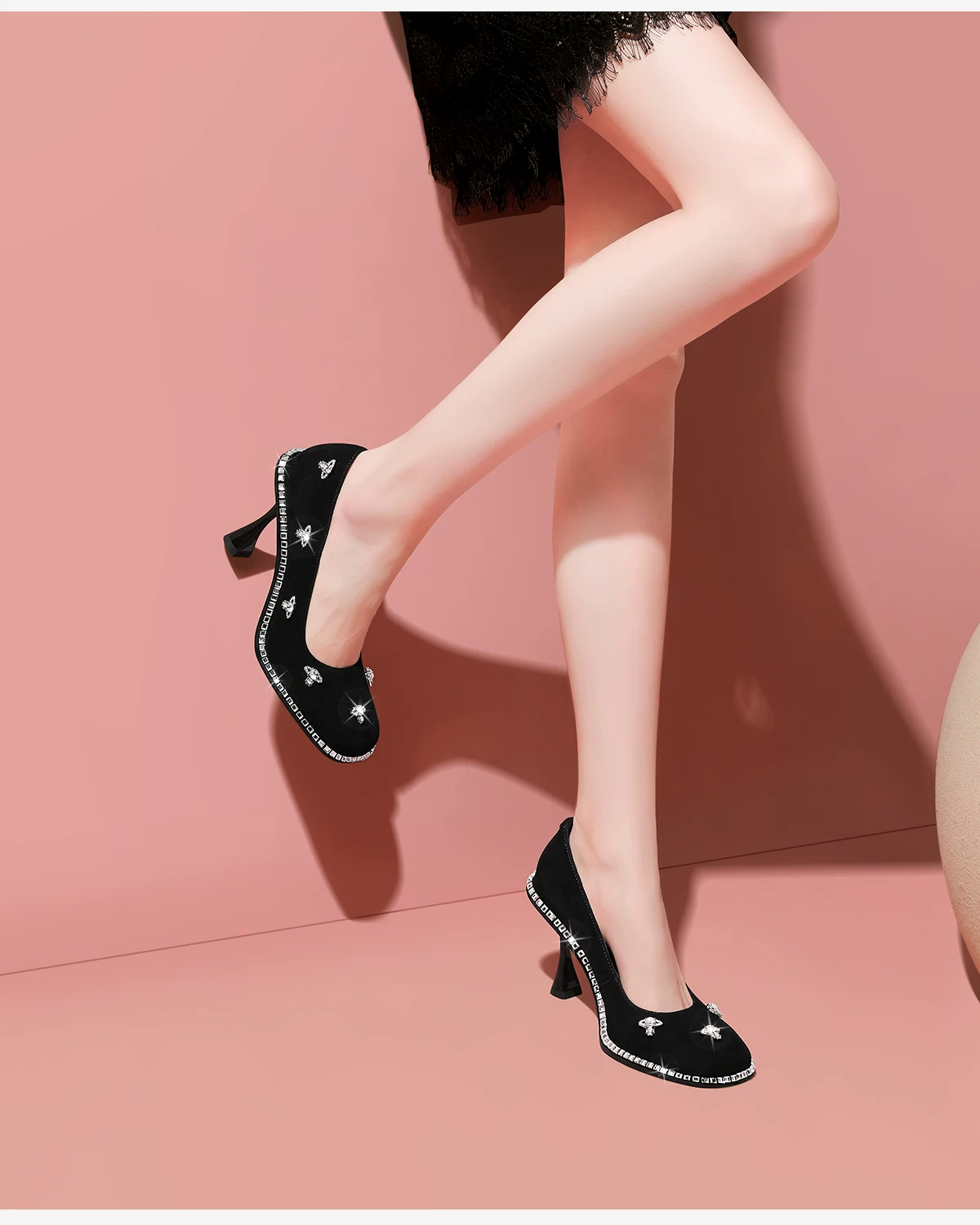
A square toe changes the mood of an outfit. Pointed reads sharp and formal. Square reads calmer and slightly retro, and that’s either exactly what you want or completely wrong, depending on the day.
- Straight-leg jeans, cropped at the ankle. The blunt toe lines up with the blunt hem. This is the outfit that made the shape popular again, and it still works better than any other combination.
- Wide-leg trousers. A pointed toe disappears under a wide hem. A square toe holds its own and gives the trouser a visible ending.
- Knit dresses and tights. Softer, less office, more Sunday lunch. A 50mm soft square in a dark suede is the version that gets the most wear.
- Tailoring for work. A square toe with a suit reads modern rather than corporate, which matters if you’re the youngest person in the room.
- Anything with volume on top. Puff sleeves, a big coat, an oversized blazer. The extra visual weight at the foot balances the extra weight above the waist.
Where it fails: really delicate dresses, slip skirts, anything with a lot of ruffle. The shoe looks like it belongs to a different outfit. Pointed wins there and there’s no point pretending otherwise.
The champagne and rhinestone end of the range is more forgiving than people expect. These rhinestone square toe heels with a slim heel work with a plain black dress precisely because the shoe is doing the decoration.
The honest downsides: the clunky trap and the bend test
Not everything about this shape is good news. Three complaints come up again and again, and they’re all fair.
It can look heavy. A square toe adds visual mass, and on a small frame or with a short skirt it can look like you borrowed someone else’s shoes. The fix is a lower vamp, a slimmer heel, or a lighter color. It’s not a fixable problem on a chunky black pair.
Cheap versions bend wrong. A square toe only works if the leather holds its shape. On budget pairs, the toe collapses after a month and the shoe develops a crease across the top that nothing removes. Press the toe box in the shop. It should flex and spring back. If it folds flat, walk away.
They age with the trend. The shape has been in and out four times in thirty years. That’s a shorter shelf life than an almond toe, and if you’re buying one pair to last a decade, that’s worth knowing before you spend on a statement version.
There’s also the fit trap that nobody warns about: a square toe that’s too short will press down on the tips of your toes with every step, because there’s no taper to let them slide off to the side. A pointed shoe that’s slightly short is uncomfortable. A square shoe that’s slightly short is unbearable. Length matters more here, not less.
How to tell a good pair from a bad one in 90 seconds
In a shop, with the shoe in your hand, these five checks do most of the work.
Flex point. Bend the shoe where your toes bend, not at the middle of the arch. If it only folds in half at the centre, the sole is too stiff and your foot will fight it all day.
Toe spring. Look at the shoe side-on. The tip should lift about 10 to 15mm off the table. None at all means the toe will drag. Too much means it’ll trip you on stairs.
Counter stiffness. Squeeze the heel counter, the stiff bit at the back. It should hold firm. A soft counter lets the heel roll inward and the shoe slips off within a month.
Interior seams. Run a finger inside the toe box. Any seam across the top of the toes will rub, and square toe shoes have more room for seams because the shape is boxier.
Lining. Leather lining breathes and lasts. Synthetic lining in a closed shoe turns into a sauna by 3pm, and the smell never fully leaves.
Fit a half size by feel, not by the label. And if you’re buying online, order two sizes and return one. The return postage is cheaper than a pair that sits unworn, and this shape has more size variance between makers than a standard pump.
One last buying note: if you only own one pair of heels and you’re choosing between pointed and square, choose based on your foot, not the trend. Wide forefoot or a tender joint, go square. Narrow foot with long toes, stay pointed and buy a half size up. The full heels collection covers both shapes, so at least you can compare them in the same place.
What to do with this
Buy a soft square, not a hard one. Keep the heel between 45mm and 70mm, in a block or a stacked shape. Go half a size down if you’re between sizes, then walk twenty steps on hard floor before you commit. And press the toe box with your thumb. If it folds flat, put it back.
Your toes have been telling you something for years. This is the shape that finally listens, as long as you buy the right version of it.
