

Your alarm goes off at 6:50. By 7:35 you’re in the hallway with one black shoe on and the other still in your hand, and the question in your head isn’t whether they look good. It’s whether you can stand in them from the 8:12 train until the six o’clock debrief without your toes going quiet.
That’s the entire job of a black kitten heel. A 50mm heel is short enough to walk in and tall enough to change how a pair of trousers falls. Choose well and you forget you’re wearing them by lunch. Choose badly and you’ll spend the afternoon shifting weight from foot to foot under the meeting table, hoping nobody notices.
Three measurements decide most of it: heel height, the gap between your two feet, and how deep the toe box sits over your toes. Everything else is upkeep. So before you add another pair to the basket, run these checks in order.
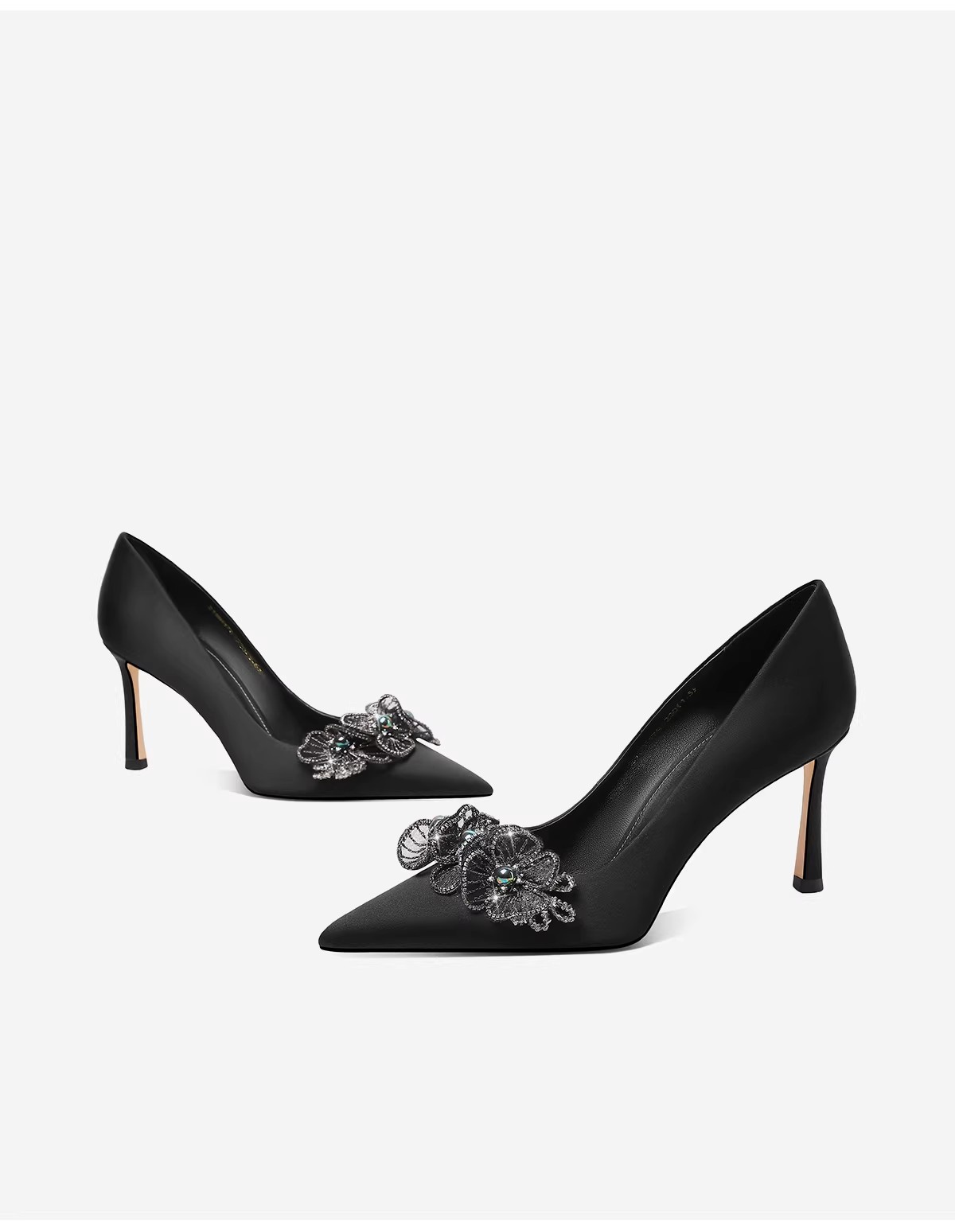
Heel height first: 45mm walks, 65mm sits down
Start with the number in the product title, because it sets the ceiling on what the shoe can do. Between 35mm and 50mm, your calf does most of the lifting and your arch stays close to neutral. That’s the walking band. You can do a kilometer in it, stand through a slow checkout queue, and climb three flights without commentary.
From 55mm to 65mm you’ve crossed into standing-and-sitting territory. Fine for a two-hour dinner, a ceremony where you’re mostly upright but not moving, a presentation where the walking part is twelve steps to a lectern. Past 70mm, these stop being kitten heels and become something else with a different set of rules.
Podiatrists generally draw the everyday line around two inches, roughly 50mm, which is why that range keeps showing up in clinical advice about what high heels do to the foot over time. It isn’t a moral rule. It’s just where the load shifts forward enough to matter.
Here’s the part most people skip: measure the heel on the shoe you already own and like. Not the number on the box. Worn heel tips shave height off fast, and a 55mm shoe that’s been to a cobbler twice can sit at 50mm in practice. If a pair you love measures 48mm, that’s your number. Buy to it.
One more thing. The height that works for a Tuesday is not always the height that works for a Saturday. If your week is six thousand steps and your weekend is two hundred, buy the 45mm and rent the drama elsewhere.
Weight matters as much as millimetres, and it never appears in the listing. A leather kitten heel with a leather sole lands somewhere around 180 to 220 grams per shoe. Add a heavy block heel or a thick platform and you’re at 300 grams, which doesn’t sound like much until you’ve lifted it 4,000 times on a Tuesday. Go lighter for the pair you’ll walk in, heavier for the pair you’ll stand in.
What actually changes between a 36 and a 37
European sizes step up by about 6.6mm in length, which is less than the width of your little fingernail. That tiny jump explains most of the “my usual size is too tight but the next one falls off” complaints. Length moves. Width barely does. The instep, the part that crosses the top of your foot, changes almost not at all between adjacent sizes.
So the sizing question splits in two. If your toes touch the front, go up a size. If the shoe slips at the heel but your toes have room, going up will make it worse, and you need a narrower fit or a heel grip instead.
- Toes brushing the end: size up half or full.
- Heel lifting more than 5mm when you walk: heel grip, not a bigger size.
- Pressure across the top of the foot: the instep is too low for you in this style, and no size will fix it.
- Both feet different: fit the larger one, pad the smaller.
Nearly everyone has one foot half a size bigger. If you’ve been buying to the smaller foot for years, that’s the source of the ache you blame on the heel height.
Break-in matters too. Leather kitten heels give about 2-3mm across the vamp in the first fortnight. Patent gives nothing. Suede gives a little, then stops. If a pair feels tight in the shop, assume you have maybe 2mm of forgiveness and plan accordingly. If it feels tight in a way that pinches a specific toe, no amount of wearing will fix it. That’s a shape problem.
Toe box depth decides whether your toes go numb
Turn the shoe over and look at the front from the side. The space between the sole and the top of the shoe at the widest part of your foot is the toe box, and it’s the number nobody lists. Pointed kitten heels usually run shallow. Almond toes run a few millimetres deeper. Round toes are deepest and read the most casual.
Shallow is where numbness comes from. When the top of the box presses on the knuckles of your toes, the nerves get squeezed and by hour three you’ll feel that pins-and-needles thing in your second and third toe. It isn’t the heel. It’s the ceiling of the shoe sitting too low.
You can test this in ten seconds in a shop. Slide your foot in, stand up, and press down on the leather above your toes. If you can push it down onto your toes without effort, it’s shallow. If there’s a little spring in it, you’re fine.
The other half of the problem is width at the ball. A pointed toe that’s 2mm too narrow at the widest point will hurt no matter how good the leather is, because the shoe has nowhere to give. Wide feet and pointed kitten heels are a genuinely bad match, and the honest advice is to look at women’s shoes cut with a rounder or almond toe rather than trying to stretch a point.
If you want the pointed look anyway, there’s a version that works. Look for a toe that’s pointed in profile but wide across the ball, sometimes sold as a soft point or a French almond. The shape reads sharp from the side and stops squeezing where your foot is actually widest. It’s the single most useful thing to know about the kitten heel silhouette before you shop, because the photos all look identical.
One caveat on the light test. Black doesn’t show the toe box problem the way lighter colours do, which is why so many people discover the pinch only after they’ve worn them outdoors. Bring a thin sock to the fitting room and try the shoe over it. If it fits over a sock, you’ll be fine barefoot for a full day.
The sole, the heel tip, and the 8mm test
Flip the shoe. The little plastic or rubber cap at the bottom of the heel is called the top piece, and it’s the cheapest part of the shoe to replace and the most expensive to ignore. A worn tip changes the angle you stand at, which throws weight onto the outside of your foot, which is how a shoe that felt fine in March feels wrong by June.
The 8mm test: new tips on most women’s kitten heels sit between 8mm and 12mm wide at the base. Below 8mm they sink into grass, grates and gravel, and they wear out in a season. If the tip is thin enough to look like a nail head, budget for a cobbler visit twice a year.
Look at the sole too. A stitched sole with a thin leather bottom will mould to your foot and last years if you resole it. A glued sole is lighter and cheaper and usually fine, but once it separates at the toe it’s done.
Check the shank by holding the shoe at the heel and pressing the arch with your thumb. There should be some resistance. If the whole shoe folds in half like a sock, there’s no support under your arch and a 50mm heel will feel like 80mm by four in the afternoon.
Cost per wear is the number that settles most of these arguments. A 90-dollar pair you wear twice a week for a year, at roughly a hundred wears, works out under a dollar a wear. A 40-dollar pair that hurts after one outing costs you the full 40. That math assumes the cheap pair survives, and thin tips and glued soles usually don’t. If you’re buying one pair to do everything, spend it once on the better sole and have the tips replaced every spring.
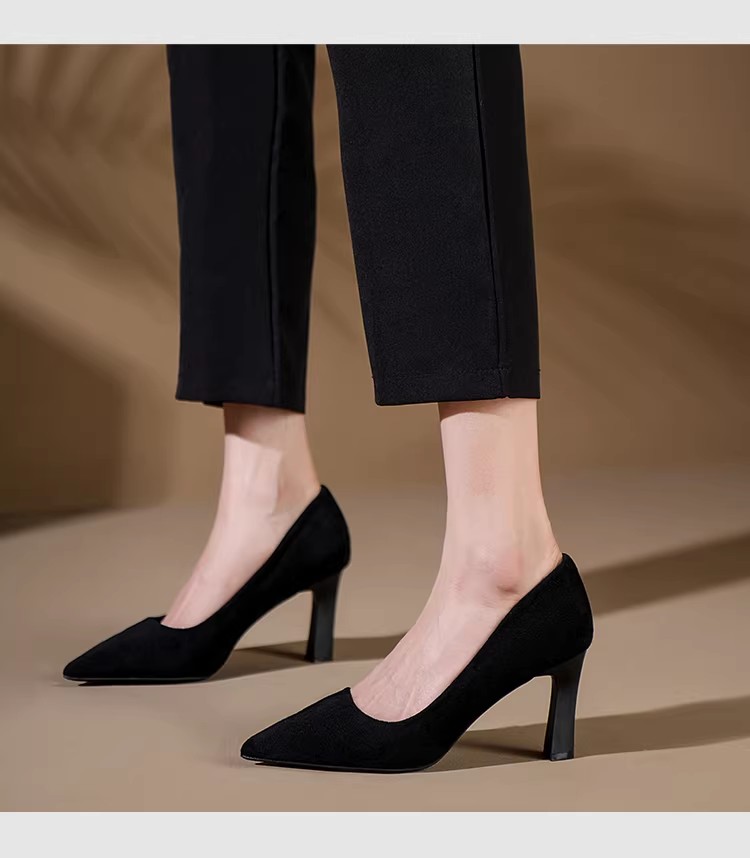
Black leather, black suede, black patent: three different shoes
All three photograph the same. They behave nothing alike.
Leather is the one that adapts. It softens at the flex point over your toes, and after three or four wears a good pair starts to feel shaped to you rather than to a last. It also scuffs, and black leather scuffs show as a grey-white line that needs polish, not a wipe.
Suede is quieter and slightly more forgiving across the instep because it has a bit of give. It also marks. One rainy commute and you’ve got water spots that don’t come out with brushing. If you walk through a city with weather, suede kitten heels are a calculated risk.
Patent is the least forgiving and the most photographed. It doesn’t stretch, it doesn’t breathe, and it shows every crease across the vamp within a month. It also looks sharper than either of the others with tailoring, which is why people keep buying it and then complain about it.
For daily wear, take leather. For a wedding where you’ll sit through a two-hour ceremony, patent is fine. For anything involving public transport in November, suede will disappoint you.
Then there’s the crease. Every leather vamp creases across the ball of the foot after a few weeks, and the only thing you can control is where it lands. If you size up too far, the crease happens further back and digs into your toes. Fitting correctly puts it right over the flex point, where the shoe already bends and nobody notices. A pair like black suede commuter heels with a soft sole creases gently because the upper has some give, which is also why it marks more easily.
Strappy or plain: the ankle strap question
A thin ankle strap looks like a small detail and changes the shoe completely. It holds your foot back against the heel, which fixes slipping, and it cuts the line of your leg at the narrowest point, which is either flattering or not depending on your ankle.
The practical trade is simple. If your heel lifts in a plain pump, a strap solves it without a grip that peels off in June. If your ankle is fine and the shoe already stays put, the strap is decoration, and decoration with a price.
There’s a fit issue people miss too. Straps sit over the bone on the outside of your ankle, and on a kitten heel they’re often cut for a 36 rather than a 41. On larger sizes the strap can land right on the bone and rub within twenty minutes. Try them on, walk the length of the shop twice, and check that spot before you commit.
For work, skip the strap. For evenings, take it. That’s the short version.
Three outfits, and the one that fails
A 50mm black kitten heel is a styling shortcut, and it works with more than people expect. The failures are almost always about hem length rather than the shoe.
- Wide-leg trousers. Let the hem fall to just above the floor in the shoe. The short heel keeps the trouser from dragging, and the pointed toe gives you the extra 2cm of line the wide leg eats.
- Midi skirt, below the knee. This is the pairing that made the style survive. Keep the hem within 10cm of your ankle bone or the proportion goes sideways.
- Straight-leg jeans, cropped. Roll them once, no more. Two rolls and you’ve created a gap that makes the shoe look like it belongs to someone else.
The one that fails: skinny jeans cropped exactly at the ankle with an ankle strap on the shoe. You get a horizontal line, a vertical gap, and a shoe that reads as an afterthought. If that’s your default outfit, buy a plain pump with no strap.
Colour is simpler than it looks. Black kitten heels with black tights elongate the leg. With bare legs and a light dress, they create a hard stop at the ankle, which is fine if you want that and wrong if you don’t.
Where kitten heels lose
They aren’t a universal shoe, and pretending otherwise wastes money.
If your day tops ten thousand steps, a 50mm heel with a thin sole will not carry you. Neither will any heel. That’s what flat boots and the three-hour test for work shoes is for. The same logic shows up in what survives a ten-hour work day on your feet, and the answer isn’t a taller shoe with a better insole.
Cobblestones are a genuine problem. Small heel tips catch in gaps, and the narrow base gives you less recovery when you stumble. If your commute crosses old paving, width at the heel base matters more than the height.
Plantar fasciitis and a kitten heel are a bad pairing too. The heel shortens the calf slightly and the raised position loads the fascia. Some people are fine. Some are in pain by noon. If you already know which camp you’re in, you know.
And if you have a bunion, pointed toes will press right where you don’t want pressure. Look for a shoe with a seam-free vamp and a wider toe, or accept that this style isn’t yours and stop buying it hopefully every autumn.
Breaking them in without wrecking the heel
Two evenings indoors, that’s the whole method. Wear them on carpet for an hour while you cook, then again the next night. Carpet gives you grip without scuffing the sole, and an hour is enough to find the one spot that’s going to be a problem while you’re still near the plasters.
If the heel slips, add a heel grip before you wear them outside. If the vamp pinches across the top, a cobbler can stretch leather by about 3mm, and it’s worth the small fee on a pair you’ll keep. Don’t try to stretch patent. It cracks.
Store them with the tips off the floor and out of direct sun. Black leather fades to a dull charcoal near a window, and it happens faster than anyone expects.
There’s also the small maintenance habit that separates a pair that lasts three years from a pair that lasts one: wipe the vamp with a dry cloth after a wet day, and keep a tin of black cream polish for the scuffs that show up along the inner heel. You’ll get those from driving, from crossing your legs under a desk, from the pedal of a car. Two minutes a week keeps them looking like a new shoe rather than a survivor.
Then the practical bit: put a spare pair of foldable flats in your bag for the first three wears. Not because the shoes will fail, but because knowing you have an exit makes you walk differently. You stand taller when you’re not calculating the distance back to the station.
Buy the 45mm. Wear it for a month. If you find yourself reaching for it on a Saturday, that’s the pair you actually needed, and the black pointed pump with a low heel for office days will earn its price in a way the higher pair never does.
