

Four minutes by the door, one box, no time to change your mind
Your dress is on, your hair is pinned, and the car is already at the curb. Somewhere near the front door sits the box holding the pink lace wedding heels you bought three weeks ago and wore exactly once, around the living room, for eleven minutes. You have four minutes to decide whether they come with you.
I did that math in September, at a cousin’s wedding in a converted barn with a gravel courtyard. I wore the pink lace pair, kept a bag of flats by my chair, and honestly never opened it.
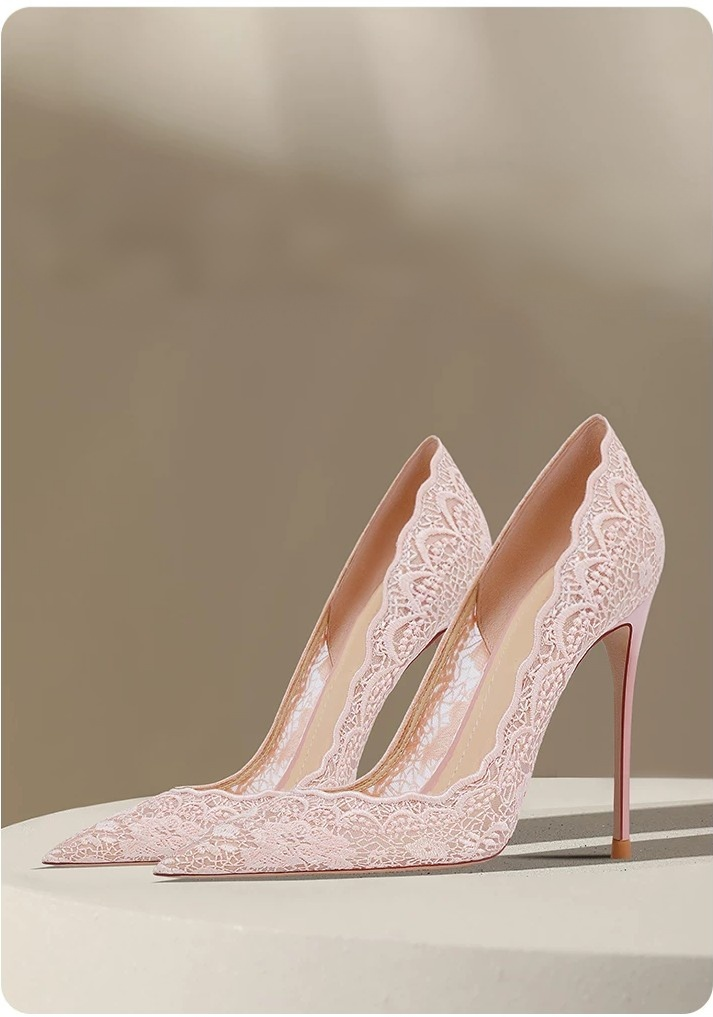
Ten centimetres is not the problem. The pitch is.
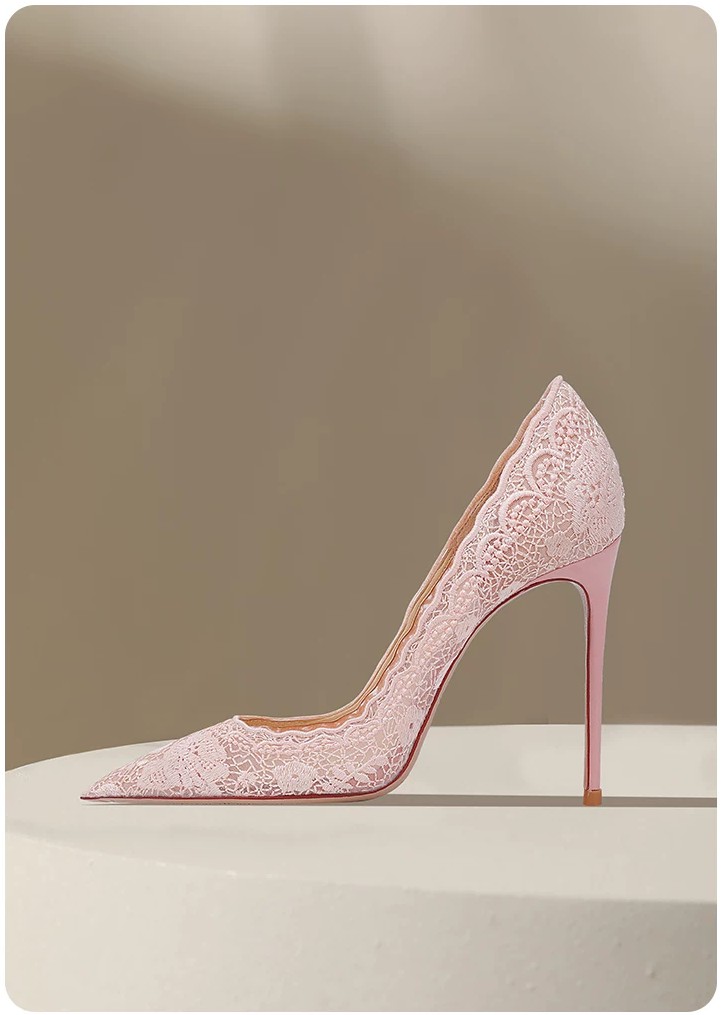
These sit at 10cm, just under four inches, on a slim heel rather than a block. Most people flinch at the number and forget to look at what the shoe does under the ball of your foot. The insole here is sheepskin over a latex pad, and that pad is what keeps your weight from hammering straight into the metatarsals after the second hour.
Heel height only tells you how far your calf shortens. Pitch tells you how much of the day you can stand. A 10cm shoe with a soft pad and a slightly forward-set heel feels shorter than a hard 8cm pump, and I’d argue that’s the whole game.
Walking took a day to relearn. You land heel first, roll through, and let the toe do the push-off. Do that and the shoe stays quiet. Climb stairs on your toes and it clacks like a tap dancer, which is fine in a church and less fine at 11pm in a hotel corridor.
Podiatrists have been saying the same thing for years: it isn’t one bad afternoon in heels that hurts, it’s the hours you spend in them without a break. The NHS guidance on heel pain suggests alternating footwear across the week, which is a polite way of saying don’t make these your only pair.
Sizing, EU 34 to 41, and what the pointed toe does to a wide foot
The pink lace wedding heels run 34 through 41, and my usual 38 fit with a thin sock and about 5mm of room at the toe. Size 36 measures 23.5cm long and 7cm across, per the listing, which is a standard-to-narrow last. If your forefoot is wide, sizing up half a size won’t fix a pointed toe. It just moves the pinch back.
High insteps are the other sticking point. The lace panel across the top of the foot has almost no give, so if the strap line cuts into the ridge of your foot when you stand, it will keep cutting at hour five. Try them standing, not sitting. Sitting hides everything.
- Narrow or average foot: true to size.
- Wide forefoot: size up and expect a small gap at the heel.
- Very high instep: check the lace panel before you commit.
Mine loosened by maybe 2mm over two weeks. Don’t count on more than that.
For conversions, a 38 sits around a UK 5 and a US 7.5, but don’t trust the chart alone. Lace has no stretch, and the pointed toe means the length you feel is the length of your longest toe, not your heel. Measure your foot in the afternoon, standing, against a wall. If you’re between sizes and have a narrow foot, take the smaller one. If you’re between sizes and wear wide shoes, take the larger one and add a heel grip.
Lace over sheepskin: cooler than patent, warmer than you think
The upper is lace, the lining and insole are sheepskin, and the sole is rubber. Lace breathes. That’s the part people get right and then overrate. What actually decides whether your feet cook at 3pm is the lining, and sheepskin holds warmth close to the skin even when air moves through the pattern.
In a 24°C afternoon I was fine. In a heated marquee at 28°C, my feet were damp by the toast and stayed damp. Thin cotton or a splash of foot powder fixes most of it. The hollow pattern also means you can see every seam through the shoe, so a dark pedicure shows more than you’d expect in photographs.
Worth knowing what you’re buying: sheepskin used in footwear is usually chrome-tanned or vegetable-tanned, and the tanning process is what the OEKO-TEX leather standard exists to police. Neither the listing nor the price tells you which process was used here, so if you have a nickel or chrome sensitivity, patch-test the lining before an all-day event.
Storage matters more than it should. Stuff the toes with tissue after each wear and the point keeps its shape. Leave them loose in a bag and the lace collapses at the tip, which looks tired by the second season and can’t be pressed back.
Rain is the obvious weak point. Water goes straight through lace in about ten seconds, and rubber soles grip wet stone better than wet gravel.
The sole deserves a mention too. It’s rubber with a shallow tread, so it grips paving and carpet but skates a little on polished hotel marble. That slim heel has a small contact patch, roughly the width of a thumbnail. On a waxed dance floor, walk with your weight slightly forward and you’ll stay upright.
Standing for six hours, and what changes around hour three.
Ceremony at four, dinner at seven, dancing at nine. Nobody warns you that the middle stretch is the hard part, because you’re mostly standing still with a drink in your hand, shifting weight from one leg to the other like a slow metronome.
By hour three my toes had gone slightly numb at the tips, which sounds alarming and isn’t. It’s pressure from a pointed box, and it resolves the moment you sit down and flex. The fix that worked was small: every time the room changed, I walked a slow lap. Twenty steps resets the blood, and nobody notices you doing it.
Walking helps more than standing still does. The WHO physical activity guidance counts brisk walking toward the weekly 150 to 300 minutes, which is a clinical way of saying a lap around the venue is doing you good.
Swelling is real. Feet widen by a few millimetres over a long day, which is exactly why you should never buy a pair that only just fits at 9am. Mine were snug at breakfast and correct by cake. If they’d been tight at 9am, hour four would have been miserable.
The other thing to plan: sitting cross-legged, or perching on a bar stool, puts your full weight on the outer edge of the shoe. Lace has no structure there. Stand up slowly for the first few seconds.
The five-minute rule: three decisions, then out the door
Wedding mornings collapse into a queue of small choices, and shoes are usually last. Here’s the version that worked for me. Decision one, heel or flat. Decision two, open or closed toe. Decision three, colour that matches the dress or colour that stands apart. Once those three are answered, stop looking in the box.
What you skip is the try-on fashion show. No walking to the mirror in three pairs, no asking the group chat. Pick, buckle, leave.
I timed it once, out of curiosity, standing in a hallway with a taxi waiting. From opening the box to closing the front door: 90 seconds, and 40 of those were spent finding a plaster. The decision itself took less time than the lift ride down. Most of the anxiety around wedding shoes is about the shopping, not the morning.
The fallback combination I’d hand to anyone running late: the pink lace pair with a midi dress and no jewellery below the neck. It reads finished in four seconds because the lace does all the decorating for you. What never works under time pressure is a shoe you have to break in, a strap you have to adjust, or a colour you have to talk yourself into.
What to wear them with, and what fights the lace
Lace is busy at close range and soft from across a room, which is why pink lace wedding heels behave best next to plain fabric. A satin midi that stops a hand’s width above the ankle, a plain crepe column, or wide-leg trousers in a matte wool all let the shoe be the only textured thing in the frame.
Skip anything with its own pattern. A floral print plus lace hollows becomes a mush at 20 paces, and heavy leather or a chunky knit drags the whole outfit toward winter. This shoe wants linen, crepe, satin, or a very plain cotton poplin shirt.
Colour is simpler than it looks. Pink reads neutral against cream, navy, charcoal, and black. It argues with coral, mustard, and most reds. If your dress is already in one of those three, take a look at the silver leather heels instead and keep the lace for another day.
A pointed toe also buys you length. If you’re 160cm and wearing a floor-skimming dress, that extra bit of toe is worth more than the heel.
Trousers need a small adjustment. A full break, where the hem folds over the shoe, hides the point entirely and makes the whole outfit look heavier. Ask a tailor to finish the hem so it just touches the top of the vamp, or roll them once. That single centimetre changes how tall you look more than the 10cm heel does.
Two weeks of break-in, two blisters, and a price that maths out
The pink lace wedding heels needed two weeks before they stopped being an event. The heel counter has foam strips stitched in to stop your foot sliding down, and on my left foot that strip still rubbed the tendon for the first week. Day two gave me a blister the size of a five-pence coin. A fabric plaster and thicker tights got me through, and by day ten there was nothing to feel.
Budget two weeks of short wears before a long event. Wear them for an hour, then two, then a supermarket trip. That’s it.
The second complaint is the colour. Pale lace picks up dust and gravel scuffs and doesn’t wipe clean the way leather does. A soft brush and a barely damp cloth handle most of it. Anything oil-based is permanent. If you want a wedding shoe you can wear to a muddy outdoor ceremony and forget about, this isn’t it.
Fair enough. It’s a shoe for indoors, terraces, and paved courtyards.
So what does $104 buy you per wear?
The pink lace wedding heels are listed at $104 against a regular $114, in pink only. Divide that by realistic wears and the number stops being scary. Eight outings in a season, which is roughly one wedding plus a few dinners, puts you at $13 a wear. Wear them to work twice a month for a year and it drops under $5.
Renting a comparable lace heel for a single wedding costs $50 to $80 in most cities and you still hand it back at midnight. Buying also means you can test the fit at home, on carpet, weeks ahead of the event, which is the only way to find the blister before the day.
My phone logged 4,100 steps between the ceremony and dessert. I took them off once, at 10:40pm, in the car. For a 10cm pointed shoe with a lace upper, that’s the number I’d tell a friend.
If you only remember one thing.
Try them standing, on a hard floor, at the end of the day when your feet are already a little swollen. If the lace panel doesn’t cut and your heel doesn’t lift, you can stop worrying about the four minutes by the door.
And if the answer is no, that’s useful information too. A shoe that fails the standing test at 8pm on a Tuesday will fail it at 3pm on a Saturday, only louder.
Still deciding between lace and something with more give? These wedding-guest sneakers solve a different problem, and this piece on glitter heels and sizing decisions covers the same three-decision method. Browse the rest of the women’s shoes range if you want to compare heel shapes side by side.
