

You order grey high heels because grey sounds safe. It goes with everything, right? Then the box arrives, you open it on a Tuesday evening under a warm bulb, and the shoes look like wet cement.
That’s not a bad pair. That’s grey doing what grey does.
Grey sits between black and white and borrows from both, which means it changes depending on what’s next to it and what light hits it. Get the shade and the finish right and you have the most useful neutral in your wardrobe. Get them wrong and they read as tired before you’ve worn them once.
Grey is three colours wearing one name
Open any listing and you’ll see one word. In the box there are at least three meanings.
Cool grey carries a blue or silver undertone and looks sharp next to navy, charcoal, and white. Warm grey carries a hint of beige and sits closer to taupe, which makes it friendlier to cream and camel and slightly muddy next to pure white. Mid grey is the one most shops mean, and it’s the one that photographs badly under warm light.
Then there’s the finish, which matters as much as the pigment. Matte leather swallows light and reads darker and more solid. Patent, metallic, or glitter finishes bounce light back and can look almost silver. Same dye, different shoe.
Here’s the test: put the shoe on a sheet of white paper near a window. Cool grey looks bluer against the paper. Warm grey looks slightly pink or yellow. If you can’t tell, the shade is probably mid grey and you should judge it by the finish instead.
One more variable that catches people: the lining colour. Some grey shoes are lined in dark brown or black, and that dark interior shows at the edge of the topline when you walk. It’s a small thing, and in a photo it makes the shoe look heavier than it is.
Worth knowing: grey as a colour has no hue of its own, which is exactly why it takes on the tone of whatever surrounds it. That’s not a marketing line, it’s the reason two people can describe the same shoe as silver and as stone.
There’s a fourth shade in practice: the grey that photographers call smoke, which is dark enough to behave like black in photos but still reads softer in person. If you want one pair that works for evening and daytime, smoke is the safer buy than a light grey.
Ask the seller which one they mean if the listing just says grey. Most will tell you whether it’s a cool or warm shade, and the ones who can’t are usually selling a pair that photographs differently from how it looks.
What grey does next to your skin and your tights
This is where most people get caught, and it’s easy to test before you buy.
Grey next to bare legs in summer reads elegant, especially in a light cool grey. The same shoe in November, over black opaque tights, reads like office furniture. Not wrong, just flat.
Over sheer black tights it works better, because the sheer layer lets some skin tone through and stops the grey from looking isolated. Over nude tights it can go strange, and the warmer your tights, the more the grey looks blue by comparison.
Against your skin, the rule is simple. If you’re cool-toned, cool grey flatters and warm grey dulls. If you’re warm-toned, the reverse. Most people can wear both in a shoe, because the shoe isn’t next to your face, but it does affect how the whole outfit photographs.
- Bare legs: any grey works, cool reads sharper.
- Sheer black: cool grey and mid grey, avoid warm.
- Opaque black: only deep grey, otherwise the contrast is odd.
- Nude tights: warm grey only, and check in daylight.
One practical detail: if you’re wearing grey high heels to a wedding, photograph the outfit in the room where the ceremony happens. Grey shifts more under venue lighting than any other neutral, and the photos will be the thing you keep.
Then there’s the dress question. Grey next to a white dress looks cool and modern. Grey next to ivory looks slightly grey-green, which is a real risk in photographs. If your dress is ivory or champagne, try the pair on with the fabric, not with your memory of it.
And if you’re wearing a grey dress, be deliberate. Grey shoes with a grey dress is a tonal look and it needs a difference in texture to work, suede with leather, or matte with a slight sheen. Two flat greys in the same finish read as a uniform, and not in a good way.
Summer is the easier season for grey, and that’s worth planning around. Grey high heels with bare legs and a linen dress look like a deliberate choice. The same pair in February needs the outfit to do more work, usually a black or grey base and one warm element like a camel coat.
The counterpoint, which I’d defend: a mid grey shoe next to a charcoal dress is one of the easiest evening outfits there is. The colours are close enough to look considered and far enough apart to avoid matching too hard.
The heel shape that stops grey looking washed out
Grey is quiet, so the shape has to carry the interest. That’s the whole principle.
A pointed toe with a slim 7-8cm heel gives grey an edge, because the shape is decisive and the colour isn’t. A round toe with a block heel turns the same grey into something sensible and slightly dated, unless the leather has a texture that adds life.
What works reliably: a pointed toe, a slim heel, and a finish with a little sheen. What works less reliably: a heavy platform in flat grey, which looks like a school shoe that went to a party.
Height is a practical decision, not a style one. At 6cm you can wear grey high heels for a working day. At 9cm they’re an evening shoe and you should treat them as one. There’s no grey-specific rule beyond that, but grey at 9cm looks more formal than black at 9cm, so plan the outfit around it.
If you want a shape that stays sharp without demanding attention, a slim pointed pair at 8cm shows how much work the silhouette does when the colour is understated. And if you’d rather have the metallic end of grey, this silver-leather pair at $169 is the version that reads as jewellery rather than as a neutral.
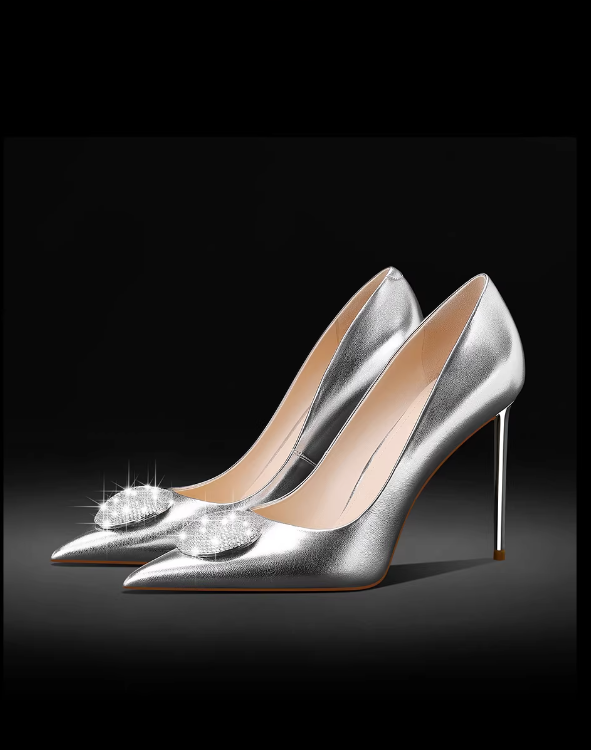
One shape to avoid: a pointed toe with a very thin 10cm heel in pale grey. It looks beautiful on a shelf and photographs like a mistake, because the thin heel and the light colour both disappear against a light background. If you want a high pale grey, go for a wider heel so the shoe has some weight in the frame.
Try the pair with the trousers you wear most. A slim heel under a wide leg disappears. A slim heel under a cigarette trouser looks sharp. Same shoe, and the hem decides whether you love it.
Sizing, lining, and the 40-minute test
Grey high heels are usually sold in whole European sizes, 34 to 42. No half sizes, which is the same problem as every other colour and more annoying here, because a grey that fits badly is a grey you’ll never wear.
Measure your foot at the end of the day. You want 8-10mm of clearance beyond your longest toe in a pointed shoe and 5-7mm in a round one. In a 23.5cm foot that’s usually an EU 37, and a wide foot moves up to 38.
Then look at the lining. A leather lining grips your foot and stops it sliding forward, which matters more in a pointed shoe because the taper pushes your toes into the tip. A synthetic lining slides, and sliding means your toes hit the end of the shoe with every step.
The 40-minute test is the only one I trust. Wear them indoors on carpet for forty minutes, in the sock or tight you’ll actually use, and stay on your feet for at least half of it. Then take them off and look at your foot. Red marks that fade in ten minutes are fine. Red marks that are still there after an hour mean the fit is wrong, no matter what the size label says.
If you’re between sizes, size up. Grey shows a stretched toe box more than black does, because the creases catch light. A pair that’s slightly too big can be fixed with a heel grip. A pair that’s too small can’t be fixed at all.
For the half-size problem specifically, I wrote about why size charts skip the half size that matters, and the same arithmetic applies here.
Try them at the end of the day, not the morning. Your feet can be half a centimetre longer by evening, and a grey pair that fits at 9am can pinch by the time you’re standing at a bar at 7pm. If you’re shopping in person, go late and go after a walk.
If you can only try one thing, try the toe. Press the top of the toe box, then stand up and see whether your longest toe touches the end. A gap of a few millimetres is right. Contact means the size is wrong, and no amount of stretching will add length to a pointed tip.
Also check the insole. A padded insole helps for an hour and flattens over a month. A leather-covered insole over a firm board is less instantly comfortable and holds up far better, which is what you want from a pair you’ll wear for years.
Care, scuffs, and why grey shows everything
Grey leather shows a scuff as a pale line, which is more obvious than the same scuff on black and less obvious than on white. That middle position is the whole maintenance story.
For matte grey, a cream polish in a neutral shade every six weeks keeps the colour even. Don’t use black polish, obviously, and don’t use a coloured cream that’s darker than the shoe, because it settles in the creases and leaves a shadow across the vamp.
If you care about what’s in the finish, the OEKO-TEX Leather Standard sets tested limits for harmful substances in finished leather, which is a reasonable thing to ask about on a shoe you’ll wear against bare feet.
For metallic or patent grey, you can’t polish out a scuff, because the finish is a coating. Keep them clean with a damp cloth and accept that a scratched patent shoe stays scratched. That’s a reason to buy metallic grey for occasions rather than for daily wear.
Water is the other issue. Light grey leather marks with water spots, and once they dry you get a faint ring. If you get caught in rain, blot rather than rub, and let them dry away from heat. Radiators are what turn a water mark into a permanent stain.
Storage: keep them in a dust bag, not a plastic box. Leather needs to breathe, and trapped moisture is what makes grey go patchy over a winter. A shoe tree in the vamp holds the shape and stops the toe from curling up.
And keep a pair of grey shoes away from denim that bleeds. Indigo transfers onto light leather at the heel and along the side, and it doesn’t come off with leather cleaner. I’ve seen a pale grey pair ruined by one rainy day in new jeans.
One last thing worth doing before you wear them out: check the heel tip. Grey high heels usually come with a plastic or rubber tip that wears faster than the leather, and replacing it early costs a few pounds. Replacing it late means the heel block itself wears down, and then you’re paying a cobbler to rebuild it.
If you want to compare finishes in person, the women’s shoe collection has both matte and metallic grey, and seeing them side by side is the fastest way to know which one you’ll actually wear. Buy the shade in daylight, in a shape you can walk in, and grey earns its place as the neutral you didn’t know you needed.
