

Your beige heels looked right in the shop mirror. Then you stepped onto the street and they went pink. By 8pm, under a restaurant’s warm bulbs, they read almost grey.
That’s not your eyes. Beige sits at the low-chroma end of the colour scale, so it borrows tone from whatever light is in the room. Shop LEDs push it yellow. Office fluorescents push it green. A phone flash flattens it into something you’d never pay for.
Before you spend 56 or 180 on a pair of beige heels for women, decide which beige you actually want to own. Three checks settle it faster than a dozen product photos.
Three lights, three different shoes
Retail lighting is built to sell. Most shops run 3000K to 4000K LEDs with a high colour-rendering index, which makes leather look richer and skin look warmer than it does outdoors. Daylight at 11am is closer to 5600K and much flatter. Evening interiors drop back to 2700K and add a strong amber cast.
A beige shoe that reads “warm sand” at 3500K will read “pale peach” at 5600K and “light taupe” after dark. The shoe hasn’t changed. The light has.
Here’s the test I’d give anyone standing in a shop with a box under one arm:
- Take one shoe to the doorway and hold it at arm’s length in daylight for ten seconds.
- Photograph it on the floor with your phone’s normal camera, no flash, no filter.
- Look at the photo next to the shoe itself. If the two don’t match, trust the photo less and the daylight more.
You’ll learn more in that minute than from any listing shot lit by a softbox. Almost every product image on a shoe site is shot under controlled light with a colour-corrected background, and beige is the colour that suffers most from that treatment.
One more thing worth knowing: screens lie in a specific direction. Most phones default to a slightly cool white point, so beige looks greyer on your phone than in real life. If a pair looks warm and slightly dull on screen, there’s a fair chance it’s warmer in person. If it looks bright and clean on screen, it may well be muddier in the hand.
That single habit, checking the shoe outside the shop’s lighting, kills most bad beige purchases before they happen.

The beige that goes grey by lunchtime
Not all beige is the same family. There are three you’ll meet in shops, and only one of them is likely to work for you.
Yellow-based beige runs from sand to camel. It’s warm, it photographs well, and it flatters most medium and olive skin tones. Downside: it can look yellow against very pale skin, especially in cold light.
Pink-based beige is the classic “nude” of bridal ranges. It’s soft and slightly rosy, and it works on cool and fair skin. On olive or deep skin it can look ashy, like the shoe is a shade of foundation that doesn’t match.
Grey-based beige, often sold as greige or taupe, is the one that turns dirty. It has almost no warmth to lean on, so any grey in the light shows up directly in the shoe. Under office fluorescents it can look like a pair of worn-out flats by 2pm.
Greige isn’t wrong, it’s just conditional. It works with grey, navy, charcoal and white. It fights cream, ivory and anything with a yellow base. If your wardrobe is mostly warm neutrals, a greige heel will spend most of its life in the box.
And beige darkens with wear in a way black never does. Dust, road grit and the grey film that builds up on leather all show on a light shoe within a few weeks. A beige heel four months old rarely matches the pair you tried on in the shop. Budget for a cleaning routine, or pick a slightly deeper shade from the start.
There’s also the dye question. Pale leather is often finished with a light surface coat rather than a deep-penetrating dye, because the depth of colour you’d need would make the leather stiff. That coat wears off first at the toe, where you scuff curbs, and at the heel counter, where your ankle rubs. What’s underneath is usually a slightly different tone, so a scuff on beige doesn’t just look like a mark. It looks like a patch of a different shoe.
Deeper shades hide this. A camel or tan sits close enough to the base tone that scuffs read as age instead of damage. If you plan to wear the same pair four days a week, buy the deeper version and save the pale one for occasions where the ground is clean and the walk is short.
Match the shoe to your skin, not the product photo
The single most useful rule with nude and beige heels is that they should sit within one or two shades of your own skin. Not lighter, not darker by much. That’s what makes the leg line read as continuous instead of chopped into three pieces.
You can check this without a mirror. Hold the shoe against the inside of your wrist, where the skin is closest to your face and least tanned. If the shoe disappears into the wrist, it’s your shade. If it looks like a bandage, it’s too light. If it looks like a bruise, it’s too grey.
Fair skin with cool undertones: go pink-beige or a very pale sand. Medium skin with warm undertones: camel, honey, tan. Olive skin: deeper beige, almost caramel, because pale beige goes chalky on you. Deep skin: chocolate-tinted nudes and rich tawny shades, not the pale ones sold as “universal”.
There is no universal nude. Any brand claiming one is selling you a colour that flatters their photography, not your leg.
Two more practical notes. First, beige shows the shape of your foot more than black does, because there’s no dark mass to hide behind. A pointed toe in pale beige will look longer and more exposed. If you’re self-conscious about toe length, a round or almond toe in a slightly deeper shade is the calmer choice. Second, pale beige on a narrow stiletto reads formal. The same colour on a block heel reads casual. Colour and heel shape are read together, not separately.
If you already own a pair you like and want a second in a different tone, compare the two against your bare leg in daylight. The one closer to your skin will get worn twice as often. That’s usually the whole decision.
Heel height changes the colour more than you’d expect
A 60mm beige heel and a 100mm beige heel in the same leather do not look the same colour. The higher shoe shows less surface to the eye and tilts the foot forward, so the light hits it at a different angle. The practical result: tall beige heels read paler and shinier, short ones read denser and warmer.
It’s also a posture change. A higher pitch shifts load onto the ball of the foot, which changes how the upper creases and how the toe box looks from the front. On a pale shoe, that extra creasing is visible in a way it never is on black. The history of the high heel is a long argument about proportion, and the colour question is a smaller version of the same thing.
That matters because it changes what the shoe pairs with.
- 50 to 60mm: reads as a solid neutral. Works with tailoring, denim, midi skirts. The safest height if you want one pair to do everything.
- 70 to 80mm: the sweet spot for most people. Still walkable for a commute, formal enough for a dinner, and the colour holds its depth.
- 90 to 100mm: reads lighter and dressier. Great with bare legs and short hemlines. Less forgiving with opaque tights, where the pale shoe cuts the leg line badly.
Heel shape matters just as much. A stiletto in beige is a formal shoe and looks underdressed with a canvas tote. A block or stacked heel in the same colour reads as everyday and works with a coat. Same colour, different job.
Then there’s the measurement nobody prints on the box: the pitch. Two 90mm heels can feel completely different depending on how far forward the sole is built. A shoe with a 20mm platform under the toe effectively walks like a 70mm. If you’re choosing between heights, judge the platform, not the heel number.
For a first beige pair, 70mm to 75mm in a slightly tapered heel is the version you’ll wear most. It looks intentional with a dress and doesn’t look odd with cropped trousers. Taller pairs are a second purchase, once you know your size in that last.
Weight is the other number that never appears in the listing. A pale leather heel at 100mm often weighs 260g to 300g per shoe, and that extra 60g over a 60mm pair is what your calf feels at hour three. If you’re standing through a reception, lighter wins over taller every time, and beige is a colour people buy for long events.
Leather, suede, patent: which beige holds
Material decides how beige behaves more than any other variable. A matte suede absorbs light and reads two shades deeper than the same colour in patent. Patent bounces light back and reads lighter, sometimes plastic.
Smooth leather is the middle ground and the easiest to keep clean. It creases across the toe box after a few weeks, and on beige those creases collect a grey line. Treat it with a neutral cream before the first wear and wipe it down weekly. A cream polish, not a coloured one, because tinted polish on beige leaves patches.
Suede looks the most expensive in beige and tolerates scuffs better, since the nap hides small marks. It also drinks rain. One wet commute can leave a water line across the toe that never fully lifts. If you live somewhere with real weather, suede beige is a summer-only shoe.
Patent wipes clean in seconds and handles rain without damage, which makes it the practical pick for a commuter. It also shows every scratch, and a scratched beige patent toe is visible from across a room. Patent beige also tends to look cheaper than leather beige in flat daylight, even when it costs more.
One detail worth checking on any pale pair: the lining. A dark lining in a beige shoe will bleed onto your foot on a hot day, and pale dye transfer is hard to remove. Pull the heel counter back in the shop and look. If the inside is black or deep red, expect marks after a long, warm afternoon.
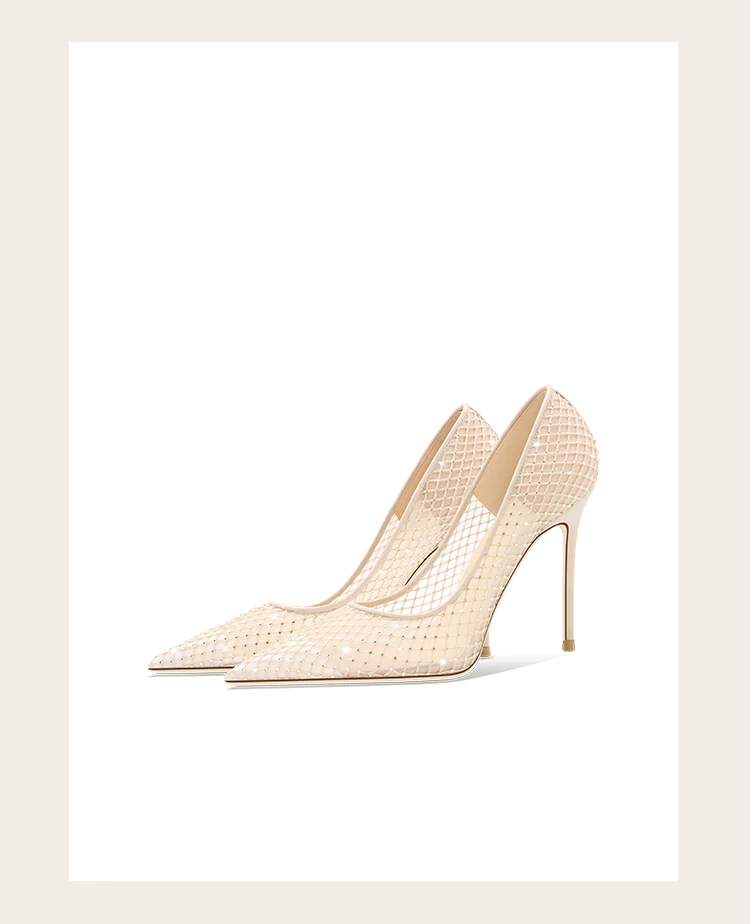
Mesh is the wildcard. A nude mesh pair with a diamond lattice reads lighter than solid leather in the same tone, because light passes through the open areas instead of bouncing off a surface. It’s cool in July and hopeless in November, and it photographs beautifully in flash light. If you want one pale pair for summer weddings, mesh does more for the leg line than a solid beige pump does.
What a beige heel does to the rest of your outfit
Beige is the quietest colour in the shoe rack, and that’s the point. It doesn’t add a statement. It removes a break in the line.
With dark denim, a beige heel lifts the whole look without competing. With black trousers, it’s a deliberate contrast that reads more modern than a matching black pump, though it can also look like you forgot to change shoes if the beige is too pale against a heavy fabric. With cream and ivory, the shoe has to be either clearly lighter or clearly deeper, otherwise the two tones merge into a muddy middle.
Where beige earns its keep is bare legs. A nude shoe within a shade of your skin extends the leg visually, which is why brides and wedding guests keep buying them. The effect only works at the right tone. Half a shade too light and the shoe becomes a visible cuff at the ankle.
Prints are the exception. A beige heel calms a busy floral or a striped skirt, but it also drains energy from a look that needed one strong element. If your outfit is already quiet, a beige shoe can push it into beige-on-beige nothing. In that case, go for texture instead of colour: suede against smooth wool, or a woven leather against linen.
For office wear, a closed pale pair is the flexible one. Open toes still raise eyebrows in plenty of workplaces, and a closed beige pump works with a suit, a knit dress, or tailored shorts in September. If you want the office angle in more depth, our notes on shoes that survive a nine-hour office day cover the fit side of that.
One combination to skip: pale beige with opaque black tights. The shoe becomes a bright block at the end of a dark leg, and the proportion reads off no matter how good the rest of the outfit is. Dark beige, chocolate or a deep tan handles tights far better, because the contrast drops to something the eye accepts.
Hosiery is where most people get caught out. Sheer 15 denier in a skin tone close to your own makes a nude shoe almost invisible, which is the aim. Sheer black does the opposite and cuts the leg at the ankle. If you’re building one pair around tights season, buy 20 denier sheer in your shade and test the whole thing at home before an event, not on the morning of one.
Keeping beige beige: a six-week routine
Pale shoes don’t need much, but they need it regularly. Six weeks of neglect is roughly when a beige pair stops looking deliberate and starts looking tired, and by then the dirt is in the grain rather than on it.
Once a week, wipe the whole shoe with a barely damp microfibre cloth and let it dry away from heat. Not a wet cloth, and never a radiator. Leather that dries too fast hardens at the flex point across the toe, and a hard crease on a pale shoe catches dirt permanently.
Once a month, clean the creases properly. A soft toothbrush with a drop of pH-neutral soap, worked in small circles, lifts the grey line that builds where your toes bend. Wipe it off straight away with a clean cloth. Leave soap to dry on beige and you’ll have a pale ring that’s harder to remove than the dirt was.
For suede, the order is different: brush dry first, always. A suede brush in one direction lifts the nap and takes most surface dust with it. Water on suede before brushing just pushes dirt deeper into the fibres, and beige suede shows every pushed-in mark.
Store them stuffed, in a dust bag, out of sunlight. Unstuffed beige leather folds at the vamp within a season, and sunlight fades pale leather unevenly, usually on whichever shoe sat nearer the window. If you keep shoes on an open rack, rotate the pair weekly so both fade the same amount.
Two products earn their place: a neutral cream conditioner for smooth leather, and a suede protector spray applied before the first wear and again every eight weeks. Skip coloured polishes. On beige, a tinted polish is a one-way trip to a patchy toe.
Two checks before you pay
Colour is the fun part. Fit is what decides whether the pair gets worn.
First, walk twenty steps on a hard floor, not carpet. Carpet hides a heel that slips and a sole that’s too stiff. Hard floor tells you within five steps if the heel counter grips your ankle or lets it lift. On a beige pump, ankle lift is worse than on a black one, because the gap is visible against bare skin.
Second, check the toe box width with your own foot, not the size chart. Press your thumb across the widest part of the shoe while wearing it. If you can feel the edge of the shoe pressing on your little toe, size up half a size or choose a wider last. Pale pointed shoes almost always run narrow, and beige makes a squeezed toe more obvious than black does.
Then confirm two numbers before you leave: the return window, and whether the heel tip is replaceable. A beige heel with a plastic tip that can’t be replaced is a six-month shoe in a city. A pair with screw-in or glued-but-serviceable tips will go two or three years with a 10 repair.
If you want to see how the same colour logic plays out in a different finish, the tan heels piece on nine outfits from three pairs is the deeper version of this argument. And if your wardrobe leans cool, compare beige against silver heeled sandals before committing to a warm neutral.
Start with the wrist test in daylight. If the shoe disappears against your skin, you’ve found the pair. If it doesn’t, no amount of styling will fix it later. Browse the rest of the heels collection with that one rule in hand, and you’ll skip about half the pairs you’d otherwise have ordered and returned.
One pair of genuine leather beige heels at 10cm taught me the last lesson the hard way: a tall beige shoe needs a platform or a very good sole, or the colour is the only thing you’ll remember about it. Check the pitch before the shade.
