

I bought a pair of embroidered heels in September for a wedding, wore them for two hours and 40 minutes, and spent the rest of the night in the flats I’d brought in a tote bag. Three people asked where they were from before I took them off. Nobody asked after.
That’s the honest shape of the unique heel problem. The pair that gets noticed is not always the pair that survives an evening, and the two qualities pull against each other more often than shops admit. So this is what I’ve learned from buying four pairs of genuinely odd shoes in two years, keeping two, and returning the others.
Three kinds of unique, and only one is worth the money
Most unusual shoes are unusual in one of three ways: the shape, the surface, or the closure. Sorting a pair into one of those boxes before you pay tells you what will fail first, which is more useful than any style advice.
Shape uniqueness means a sculpted heel, a square toe, an asymmetric opening, a wedge cut at an angle. The risk here is structural. A heel that isn’t a standard shape can’t be replaced from a stock part, and a toe that’s cut square has no stretch in the corners.
Surface uniqueness is embroidery, woven metallic, printed leather, beading, appliqué. The risk is durability. Every one of those is attached to something, and attached things come off, usually at the point where the shoe flexes.
Closure uniqueness is the safest bet and the least dramatic. A wrap tie, a crossover strap, a lace panel up the back. If it goes wrong, it goes wrong in a way you can fix with a ribbon, and the shoe underneath is a normal shoe.
I’ve had one of each now. The closure pair is the one still in rotation two winters later, and it cost the least.
The pair everyone noticed, and why it only lasted one evening
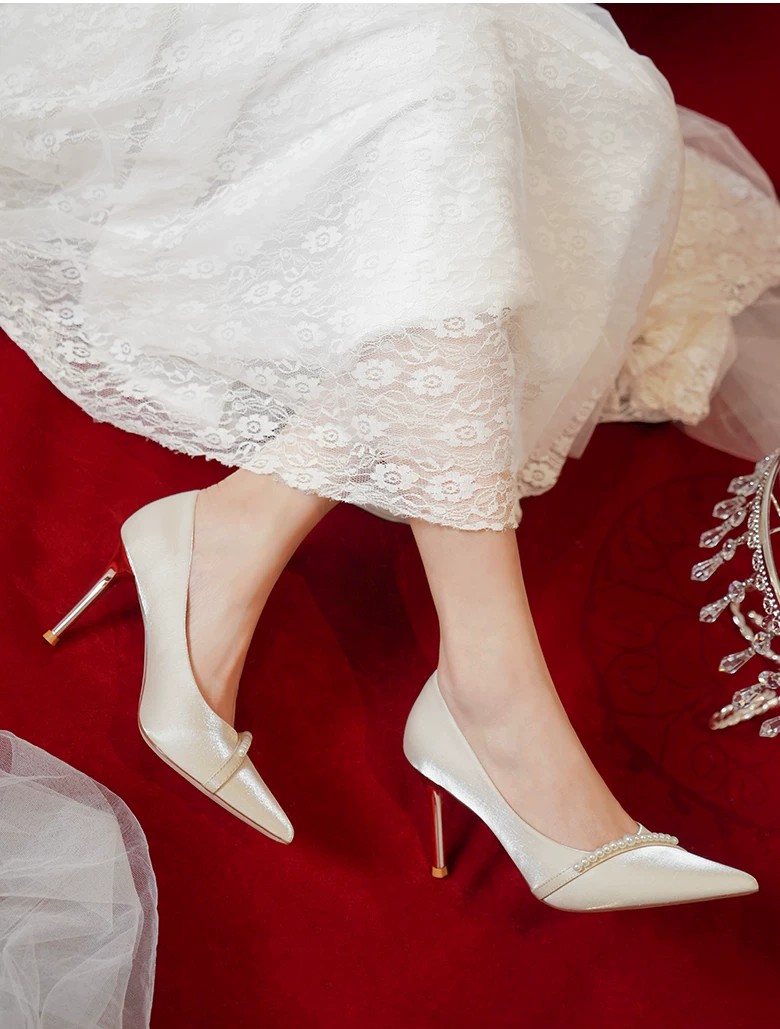
The embroidered pair had a 75 mm heel, a pointed toe, and dense floral stitching over the whole vamp. On the shelf it looked like something from a museum case. On my foot it looked like the same thing, which is rarer than it sounds.
Getting to the venue involved 39 steps down a stone staircase and about 200 m of gravel. By the time I sat down, the embroidery had already caught twice on the hem of my dress, and there was a loose thread near the toe that I pretended not to see.
Two hours in, the real problem wasn’t the embroidery. It was the toe. A pointed toe with stiff stitching over it doesn’t give, so the shoe pushed my toes together and by the second glass of wine I could feel the pressure as a line across my second toe.
I took them off during the dancing and never put them back on. The pair is in my cupboard now, worn twice, and I still like looking at them.
That’s not a regret exactly. It’s a classification: they’re an event shoe, not a shoe.
Event shoes are allowed to exist. They just shouldn’t be the only pair you own that fits.
The 20-minute rule for a loud pair
Here’s the test I use now, and it’s saved me from two bad purchases. Wear the pair at home for 20 minutes doing something ordinary: making tea, standing at a counter, walking to the bin and back. Not sitting. Not posing.
If something is wrong, it shows up in that window. A heel that’s too high for your ankle shows up as a dull ache at the outside of the ankle around minute 12. A toe that’s too narrow shows up as heat under the ball of the foot. A stiff counter shows up as a rub at the heel you can already feel starting.
I ignored that test once, on a pair of red suede mules with a 90 mm sculpted heel. I wore them to a birthday dinner, walked 600 m from the car, and by the time I arrived I had a blister the size of a five pence piece. The shoes were gorgeous. They were also the reason I left early.
Twenty minutes at home is the cheapest return window you’ll ever get.
The rule has one exception: shoes with a very stiff leather upper need longer, because they soften. Give those 40 minutes over two days, and put a plaster on the spots that rub before you decide. Stiff leather that softens is a different thing from a last that’s the wrong shape.
Unusual shapes don’t follow size charts
A standard pump is predictable: same last shape, same proportion, and a 38 fits like a 38 across most brands. A sculpted or square-toed shoe doesn’t behave that way, because the volume inside the shoe changes with the silhouette.
My square-toe pair runs a full half size larger than the pointed pair from the same shop. The square version has more internal length at the toe because the corner sits further forward, but it also has less height over the toes. Same size number, completely different fit inside.
The practical consequence is that you can’t buy unusual shapes online using your usual size and hope. Measure the insole if the listing gives it, and compare to a pair you already own. If the listing doesn’t give an insole measurement, that’s information too.
Width is the other variable. Odd silhouettes often come on narrow lasts, because narrow makes a shape read sharper in photographs. If your forefoot is on the wide side, expect to size up and accept a bit of slip at the heel, or look for the same shape in a square toe dress shoe with more room across the toes. Sizing up by half a size usually fixes the width and creates a heel gap, so budget for a heel grip at the same time.
For anyone wondering whether the shape genuinely suits them, the trick is a mirror at knee height rather than a photo from above. Almost every unusual toe looks fine from above. What matters is the line from the shin down to the toe, seen from the side.
The cost-per-wear maths nobody does
I keep a note in my phone of what I paid and how many times I’ve worn each pair. It’s a boring habit and it changed what I buy.
The embroidered pair cost 78 and has been worn twice. That’s 39 a wear, which is more than a taxi home. The plain black pair I bought the same month cost 55 and has been worn about 60 times, which works out at under a pound a wear.
Loud shoes almost always lose this calculation, and that’s fine as long as you go in knowing it. The question isn’t whether a unique pair will earn its price back in wears. It won’t. The question is whether you want to pay 39 for the two hours, and whether the photographs are worth it.
There’s a version of this maths that works in your favour. Buy one loud pair per season instead of three, and put the money into the pair you’ll wear weekly. Two loud pairs a year, worn twice each, is 156 spent on eight hours of wear. One good pair worn 60 times costs less per hour than the coffee you had while shopping.
Resale softens it a little. Unusual shoes hold a surprising amount of value if they’re a recognised shape and in good condition, mostly because the buyer who wants them can’t find them anywhere else. Embroidered and beaded pairs don’t resell well. Sculpted heels and unusual straps do.
Repairs are where odd shoes get expensive
A cobbler can re-tip a standard stiletto in ten minutes from a stock part. A sculpted heel with a curve, a wedge with a cutout, or a heel that tapers in two directions often needs a part made, and that’s a different conversation and a different price.
I learned this with a pair of wooden-heeled sandals. The tip wore through after a summer of city walking, and the repair took three weeks because the shape had to be cut by hand. It cost 32 on a pair that cost 90. Worth it, but only because I liked them.
The other repair problem is surface. Beading can be reattached. Embroidery can be stabilised. A sprayed metallic finish that has worn through at the toe cannot be matched, and any cobbler will tell you the same thing: it’s a new pair, not a repair.
Materials matter here more than most people consider at the till. Suede takes a patch and hides it. Smooth leather takes a patch and shows it. Woven or printed surfaces fall somewhere in between, depending on whether the pattern can be aligned. How suede is finished and why it marks so easily explains a lot of what happens to a light-coloured pair after one wet evening.
Buying an odd shape online without gambling
Most of my bad purchases happened because I bought a silhouette I’d never tried, from a listing with two photos. The fix is boring and it works: buy from a shop with a return window you can actually use, and treat the first delivery as a fitting rather than a purchase.
There are four things I look for in a listing now. An insole measurement in centimetres. A photo from the side rather than straight on. A note about the last width, even if it just says standard. And at least one picture of the shoe on a foot, because proportions change completely once there’s an ankle above them.
If a listing has none of those, I assume the worst and skip. There are enough unusual shoes in the world that I don’t need to gamble on a pair described as “fashion design, comfortable”.
Colour is the other online trap. Silver, champagne, and warm grey all look like each other on a screen and behave differently in daylight. Two of my returns were colour rather than fit, and both would have been obvious in a doorway with the shoe in my hand.
The pair that taught me this was an embroidered champagne heel I ordered in winter. On the site it was a soft gold. In my hallway it was beige with a green cast, which is not what I wanted next to a navy dress. Embroidered champagne heels with a dense floral vamp are lovely in the right light. Mine went back in the box on day two.
Care for a pair you wear twice a year
Shoes worn rarely fail differently from shoes worn often. Daily pairs wear out at the sole and the heel tip. Occasion pairs dry out, go dusty, and lose their shape in a box, which is why the pair from two seasons ago can look older than the pair you’ve worn 60 times.
Two things matter more than anything else: keeping the shape and keeping the moisture. Cedar shoe trees hold a toe box open while the leather dries, and they cost less than a single wear of the pair you’re protecting. Crumpled newspaper does the same job if you change it after the first day.
Dust is the quieter problem. Anything with a textured surface collects it, and a beaded or embroidered pair left uncovered for a year will look grey rather than silver. A cotton dust bag, not plastic. Plastic traps moisture and is how a pair ends up with a white bloom across the toe.
Leather wants conditioning twice a year even if you never wear it, because the oils migrate and the material stiffens. Suede wants a brush and nothing else. Any pair with glued decoration wants to stay below 25°C, which in practice means not the top shelf of a wardrobe next to a radiator.
For a wider look at how different heels behave over a season, this guide to boot heels that survive daily wear covers the same trade-offs with a shaft involved.
Test the look before you commit to the price
There’s a cheap version of this experiment that doesn’t involve buying anything. Take the outfit you’d wear with the pair, put it on, and stand in front of a full-length mirror in your usual shoes. Then look at where the eye lands. If your eye goes to your knee, a dramatic shoe will work. If it goes to your waist, the shoe is going to be the loudest thing in the frame and nothing above it will get a look.
That’s the whole trick, and it costs nothing. The pair I returned without ever wearing outside was a mirror-finish sandal that looked incredible in the shop and made every outfit above it look unfinished. The pair I kept is a dull suede with a strange toe, and it makes plain clothes look considered.
Photographs complicate it, because a phone camera flattens dramatic shapes and exaggerates shiny surfaces. Take the photo anyway, but look at it on a laptop screen rather than on the phone. Small screens flatter everything.
One more test that sounds odd and works: walk past a window at dusk and look at the reflection rather than at the shoe. Distance is honest. At three metres, most unique shoes either read as deliberate or as a mistake, and there’s rarely a middle.
What I’d buy again, and what I wouldn’t
Would buy again: the wrap-tie pair with the 60 mm heel. Two straps crossing the instep, nothing glued on, nothing sculpted at the back. It’s the least dramatic thing I own and it gets the most comments, because people notice a well-fitted shoe faster than a strange one.
Would also buy again: a suede pair in a colour I couldn’t wear every day, at a price that made the two-wears-a-year maths tolerable. Something like these retro suede heels with a sculpted silhouette, which look odd in the box and normal on a foot.
Wouldn’t buy again: anything with dense beading on the toe, anything with a heel shape that needs a custom tip, and anything in a mirror finish. All three fail in the same place, which is the part of a shoe that takes contact first.
If you’re shopping for something unusual right now, the order I’d go in is: shape first, closure second, surface last. Shape gives you the look people remember. Closure gives you the fit. Surface gives you the shortest life of the three.
And before you pay, put them on and stand still for a full minute. If your face changes, put them back. If you’d wear them to the shop counter and to the bin and back without thinking about your feet, that’s the pair. Mine’s a boring answer, and it’s the only one that has ever worked.
For the full range of shapes to compare against, the heel styles women actually keep wearing is a better starting page than a search box. And if you’re weighing up how a shape reads from the side, the history of the high heel and its changing silhouettes is a good reminder that every “weird” shape was normal once.
