

It’s 7:40 on a Wednesday. You’ve got a 9am presentation, drinks at six, and two pairs by the door that are wrong for both. The 90mm stilettos will have you shuffling by lunch. The ballet flats look a bit apologetic under a suit. What you actually want is the pair in between, and for most people that pair is black kitten heels.
They’re the shoes you can wear to the meeting and still be standing at the bar. But they’re also the category with the most quietly terrible options on the market, because a low heel is easy to make and most brands make it badly. Here’s how to tell the good ones from the ones that will rub your heel raw by 11am.
50mm is the number worth arguing about
Kitten heels run from about 35mm to 50mm, and the difference between those two numbers is bigger than it looks. At 35mm you’re basically in a flat with a lifted heel seat, and your calf does almost no work. At 50mm you get a real pitch under the arch, a longer-looking leg line, and enough lift that a hem sits properly.
Most people land at 45mm to 50mm. That’s the height where the shoe still reads as a heel from across a room but your foot isn’t sliding forward into the toe box with every step.
Heel height is only half the story. The other half is the heel shape, and this is where cheap black kitten heels fall apart. A slim 8mm kitten heel puts all your weight on a tiny footprint, so it sinks into grass, catches in pavement cracks, and wobbles on tile. A slightly thicker 15mm to 20mm heel spreads the load and stays upright.
The American Podiatric Medical Association’s general advice on heel height and forefoot pressure is that lower is better for daily wear, which is why this category exists at all. But lower isn’t automatically comfortable. A badly balanced 40mm heel hurts more than a well-made 60mm one, because balance comes from where the heel sits under your body weight, not from the millimetres.
Test it standing up, not sitting down. Put the shoe on, stand, and see whether your weight lands over the ball of your foot or behind it. If you feel like you’re tipping forward, the heel is set too far back and you’ll spend the day gripping with your toes. That grip is what makes your shins ache at 4pm.
The shape itself has been around since the 1950s, when the low curved heel was named for its resemblance to a kitten’s heel. The history of the high-heeled shoe is a long argument between height and stability, and kitten heels are the compromise that keeps winning whenever women get tired of both extremes.
Black hides scuffs and shows dust, and that trade is worth it
Everyone says black is the practical colour. It’s practical in one specific way: scuffs on the toe and heel counter blend in, so a pair you’ve worn 40 times still looks fine at a distance. It’s impractical in another: black leather and black suede show every speck of dust, every bit of pavement grit, and every white salt line from a winter street.
You’ll be wiping these shoes more than you wipe a nude pair. A microfibre cloth in your bag solves it in ten seconds.
The finish matters more than the colour. Patent black kitten heels photograph beautifully and then crack at the flex point across the vamp within a season, because patent is a coated surface and coatings don’t stretch. Smooth calf leather creases instead of cracking, which looks like wear rather than damage. Suede is the softest against the skin but hates rain, and if you’re caught in a shower the nap goes flat and stiff.
For a first pair, smooth leather in the 40mm to 50mm range is the safest money you can spend. For a second pair, suede in the same shape covers the evenings when leather feels too office.
If you want to know what’s actually in the leather, the OEKO-TEX testing standards for leather goods are the ones most European brands work to, and a pair that carries the label has at least been checked for the nastier finishing chemicals.
One more thing about black: it makes a cheap shoe look cheaper. If the leather has a plasticky sheen and the edge paint is uneven, black amplifies it. Hold the pair under the shop lights and look at the welt where the upper meets the sole. Clean, tight stitching reads as quality. Glue squeeze-out and wobbly edge paint don’t.
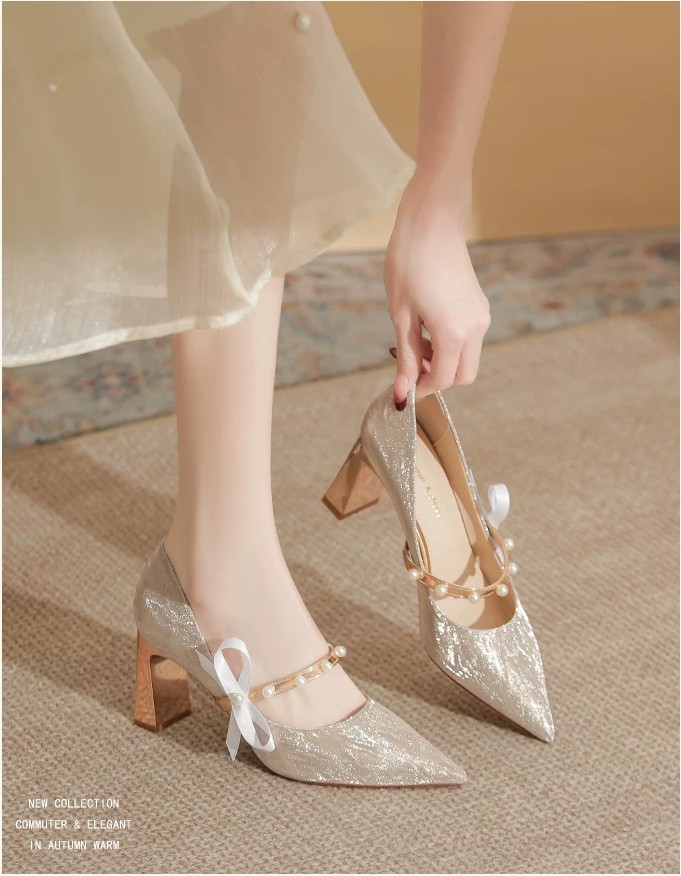
Slingback or closed pump: pick by your heel, not your taste
This is the decision that determines whether you can actually wear the shoes, and almost nobody makes it consciously. A slingback has a strap around the back of your heel. A closed pump has a full counter. Both look like black kitten heels from the front, and they behave completely differently on your foot.
If your heel is narrow and slips out of shoes, a slingback with an adjustable buckle is your friend. It holds the shoe on without squeezing the front of your foot, which is where most women get pain. If your heel is wider or you have a shallow heel cup, the strap will dig in above the bone and you’ll have a red line by noon.
- Narrow heel that slips: slingback with a buckle, not elastic
- Wide heel or prominent heel bone: closed pump with a padded counter
- High instep: slingback, because the topline sits lower
- Very low instep: closed pump, or the shoe will gap at the side
Elastic slingbacks deserve a warning. They’re comfortable for the first month and then the elastic relaxes, and a slingback that has lost its tension is a shoe that flaps off your foot on stairs. Buy the buckled version, or accept that the pair has a two-season life.
The topline is the other half of this. On a closed pump, the cut across the top of your foot decides whether the shoe stays on. A low cut shows more foot and grips less. A higher cut holds better but can press on the tendons if your instep is high. Try the shoe on at the end of the day when your feet are at their largest, because a pump that fits at 9am can be unbearable by 6pm.
Toe shape changes what your toes do all day
A pointed toe makes a kitten heel look sharper and more expensive. It also puts your toes in a triangle, and if the point is long and shallow your big toe gets pushed inward with every step. Over 8,000 steps that’s not a small thing.
Square toes give your toes a rectangular box to sit in, which is the most forgiving shape for wide feet and bunions. The catch is that a square toe in black leather can look slightly heavy, especially on a small foot. Almond toes split the difference and suit almost everyone.
Here’s the shop test that takes ten seconds. Stand up in the shoes and press a thumb down at the very end of the toe box. You want about 10mm of space beyond your longest toe. Less than that and your toes will hit the front on every step downhill. More than 15mm and the shoe will crease badly across the vamp because your foot slides forward to find the end.
Also check width at the widest part of your foot, not just length. Most women buy black kitten heels a half size up to get width, which then makes the shoe too long and causes heel slip. If the width is the problem, look for a brand that offers a wide fitting rather than sizing up. Our guide to how seven heel styles load your feet goes through this shape by shape.
The first week tells you whether to keep them
Every leather shoe needs a break-in period, and kitten heels are no exception. What matters is the difference between normal break-in and a shoe that will never work.
Normal: slight stiffness across the vamp for two or three wears, a bit of pressure at the top of the heel counter, and the leather softening where your foot flexes. That resolves in about 10 to 15 hours of wear.
Not normal: a sharp pain at the back of the heel that doesn’t fade after 20 minutes, numbness in your toes, or a red mark that’s still there the next morning. Take them back. Leather stretches about 3mm to 5mm at most, and it stretches where it’s already tight, so a shoe that pinches hard on day one will pinch on day thirty.
The cheap trick that actually works is a hairdryer and thick socks. Warm the tight spot for 20 seconds, put the shoe on over a thick sock, and walk around for two minutes while it cools. It buys you a couple of millimetres. It doesn’t fix a shoe that’s a full size wrong.
Wear them indoors for two hours before you take the tags off. Carpet doesn’t scuff the sole, so you can still return them if the fit is wrong. This one habit has saved me more money than any buying guide.
Where black kitten heels work, and where they don’t
They’re excellent with tailored trousers, because the low heel keeps the hem off the floor without shortening your stride. They’re good with midi skirts and dresses that hit below the knee. They’re the obvious choice for a long day that turns into an evening, and they’re the pair you can keep in a desk drawer without it looking strange.
Where they don’t work: with a very short hem. A mini skirt plus a kitten heel reads slightly off, because the whole point of the low heel is a longer line, and a short hem breaks that line in the wrong place. They’re also wrong for anything with a heavy lug sole aesthetic, and they look odd with wide-leg cropped jeans that stop right at the ankle.
Also be honest about the office. If your job involves 12,000 steps across a warehouse floor or a hospital corridor, no heel of any height is the right answer, and a 50mm kitten heel is still a heel. This is a shoe for sitting, standing, and moderate walking, not for a shift on your feet.
For the black-tie adjacent events where you want the look without the pain, a satin pair in the same shape works better than leather. Something like these black satin heels cut for evening wear handles a wedding or a dinner without the shine of patent.
A four-minute check before you pay
You don’t need to be an expert to spot a bad pair. You need four minutes and a hard floor.
- Walk 20 steps on tile. Listen for the heel tapping unevenly, which means a bent heel pin.
- Press the heel with your thumb from the side. It should feel solid, not spongy.
- Bend the shoe at the ball. It should flex there and nowhere else.
- Check the insole edge for glue lines and the lining for loose stitching.
- Stand on one foot for 10 seconds. If you wobble, the heel is too narrow for you.
The bend test catches most problems. A shoe that folds in the middle of the arch has no shank, and a shoe with no shank will collapse under you within a month of daily wear. You’ll feel it as a dull ache under the arch around 3pm.
Also look at the heel tip, the little plastic or rubber cap at the bottom. It’s the first thing to wear through and the cheapest thing to replace. If the pair comes with spare tips in the box, that’s a brand that expects you to keep the shoes. If the tip is already worn on a floor model, note how fast that happened.
Keeping the toe box from creasing into a mess
Black leather kitten heels crease across the vamp. It’s unavoidable, because the leather has to bend where your foot bends. What you can control is how deep the crease gets and whether it cracks.
Use shoe trees. Cedar ones cost about the price of a coffee and they hold the vamp flat overnight, which stops the crease from setting into a hard line. If you don’t have trees, stuff the toes with rolled-up newspaper while the shoes cool down after wear.
Condition the leather every 6 to 8 wears with a neutral cream, not a coloured polish. Black polish builds up in the creases and eventually flakes, leaving pale lines in exactly the place you were trying to hide. Neutral cream keeps the leather supple so it bends instead of cracking.
Rotate them. Wearing the same pair three days running doesn’t give the leather time to dry out from foot moisture, and damp leather creases deeper. Two pairs worn alternately last roughly three times as long as one pair worn daily. That maths is the whole argument for buying a second pair in a different finish rather than a more expensive first pair.
If the heel tip wears down to the metal pin, stop wearing them until it’s replaced. A metal pin on tile is slippery, and it will chew through the heel block underneath, which turns a cheap repair into a resole. Our notes on keeping suede and leather uppers out of trouble cover the same logic for the other finishes.
One last thing. If you’re buying online and the brand only shows the shoe from one angle, look for a photo of the inside. The lining tells you the price bracket faster than anything on the outside. Leather lining means the shoe will mould to your foot. Synthetic lining means it will stay exactly the shape it was made, which is fine if that shape happens to match your foot, and useless if it doesn’t.
Try the pointed pair with a mid-height heel if you want the sharper line, or stay with a rounded toe if your feet are wide. Either way, buy the one that fits at 6pm, not the one that fits at 9am. Browse the full heel range and check the heel height in millimetres before you commit, because the photo almost never tells you.
