

It’s 2:10 in the afternoon, you’ve been on your feet since noon, and the pointed heels you bought for this wedding have started to feel like a decision you made for somebody else. Your little toe is pressed against the side. Your heel lifts a little with every step. And the schedule still has photos on gravel, a sit-down dinner and a first dance you promised to join.
I wore this glitter pair in champagne through a full wedding day in October, then to the office twice, because a wedding only proves a shoe can survive one night. Five hours in, I knew which parts I’d warn a friend about.
Short version: the fit is honest, the insole is better than the price suggests, and the break-in is real.
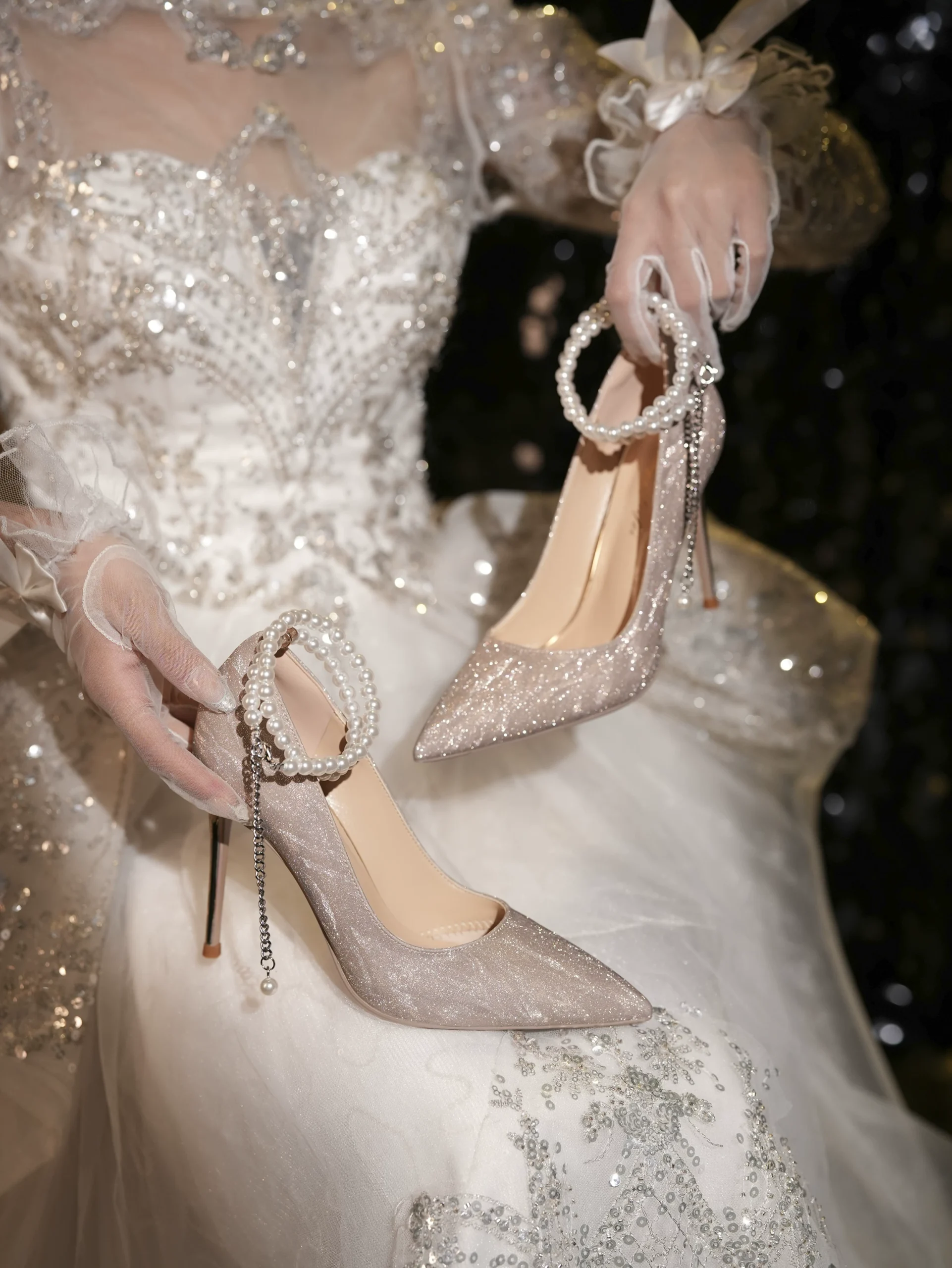
The first hour tells you more than the mirror does
Most people buy heels standing in front of a mirror for 90 seconds. That tells you almost nothing. A pointed shoe either works with your foot shape in the first ten minutes of walking, or it never will, and no amount of padding rescues a toe box that’s the wrong shape.
Three checks, in this order. Walk 30 steps and watch your heel: if it lifts more than a centimetre, the shoe is too long, not too small. Then press the widest part of your forefoot against the side: it should touch, not dent. Then stand still for a minute and see whether your arch is supported or hanging.
Timing matters more than people admit. Feet swell through the day, roughly half a size by late afternoon, and they swell again in heat. A pair that fits at 9 a.m. can pinch at 4 p.m. Try shoes after work, and bring the tights you’ll actually wear, because 40 denier changes the fit more than you’d think.
I tried these at 5 p.m. on a warm day, which is the honest way to do it.
Sizing from 37 to 41, and what the wide last actually does
The pair is built on a standard 36 last, with each size stepping up by 0.5cm, which is normal for this kind of factory. So the sizing is predictable: order your usual EU size. There’s no vanity sizing and no mysterious gap in the middle of the run.
Sizes start at 37 and stop at 41, so if you’re a 35 or a 42, this specific style won’t help you. Worth knowing before you fall in love with the photo. The rest of the pointed and block heel range runs a wider span, if you need another size.
The useful part is the wide option. The wide last adds 6 to 7mm across the forefoot, which is about one full size of extra width without extra length. If your forefoot is broad or fleshy, or you’ve spent years sizing up to survive pointed toes, choose the wide last instead of going up a size. Sizing up gives you length you don’t need and a heel that slips.
One detail that decides comfort for a lot of women: the second toe. If yours is longer than your big toe, a pointed shoe will press on it first, and no insole fixes that. Go up half a size at most, never a full size, and check the fit late in the day.
High arches are the other group that struggles. If the top of your foot sits high, the vamp of a pointed shoe can cut across it. These have a relatively low cut at the throat, so I had room. If yours is higher than average, wear them for twenty minutes indoors before committing.
Worth adding: the first pair I ordered felt tight across the top of the toes, and my mistake was assuming I needed a bigger size. It was the glitter fabric, which has almost no stretch, sitting over a stiff toe puff. Twenty minutes of walking softened it enough. Fabric uppers like this break in at the creases, not across the whole shoe, so if the pressure is on the bone rather than the fabric, sizing up won’t fix it. That distinction is the single most useful thing I learned from this pair.
How a pointed toe changes the way you walk
A pointed toe doesn’t hurt because it’s pointed. It hurts because your foot slides forward into the point, and the toes curl to keep balance. That’s a walking problem, not a width problem, and you can feel it starting within a block.
What helped me: shorter steps, and letting the heel land first instead of the whole foot. Sounds obvious. Almost nobody does it in new shoes, because new shoes make you cautious in the wrong way, which is to walk flat and grip with your toes.
The grip is the thing to unlearn. If your toes are curling to hold the shoe on, either the length is wrong or the heel counter is too loose. Padding won’t fix either. It just moves the pressure somewhere less noticeable until hour five.
There’s also a calf story. Any heel above four centimetres shortens the Achilles slightly, and if you go from flat boots straight to heels for a ten-hour day, your calves will file a complaint by evening. NHS guidance on foot pain and forefoot pressure is blunt about this: repetitive narrow toe boxes and long standing hours are the usual suspects, and stretching helps more than painkillers.
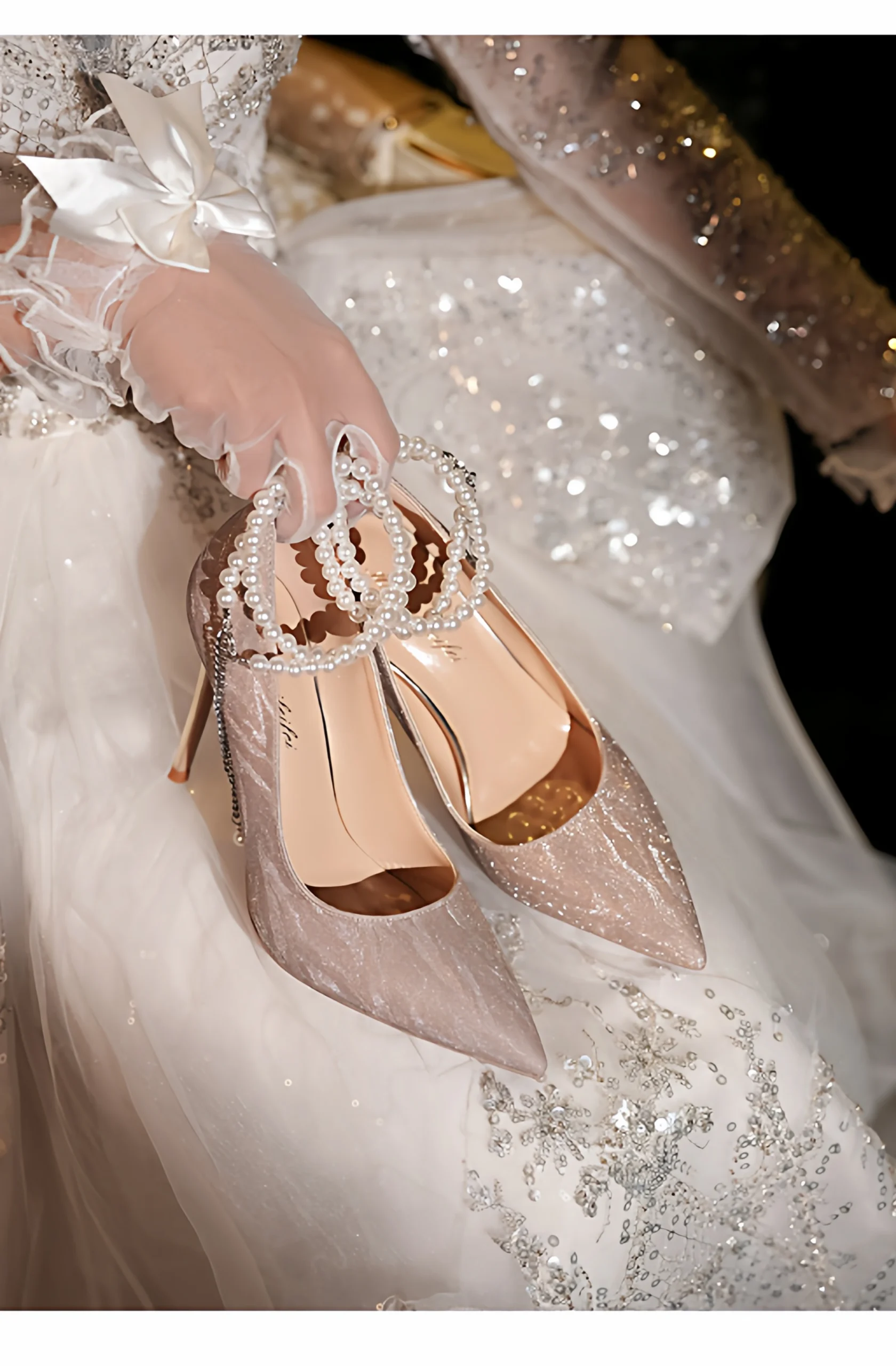
Glitter, sheepskin, and what happens at hour four
The upper is a glitter fabric rather than loose glitter glued to satin, which matters. Cheap glitter shoes shed a trail across a dance floor and look patchy by the second wear. This one is woven, so the shine is in the cloth, and mine still looks even after five outings.
Inside is sheepskin over a thick latex layer. That’s the reason the first hour feels softer than the price suggests. Sheepskin absorbs sweat instead of letting your foot slide, and the latex gives about the amount of cushioning you’d get from a decent insole.
On materials, one honest note. Linings and leathers get tested for harmful substances under standards like OEKO-TEX Standard 100, and that’s the benchmark worth asking about. The product page here doesn’t name a certificate, so treat the sheepskin as a comfort feature rather than a safety claim.
Hour four is where any heel tells the truth. For me it was the ball of the foot, not the toe. Standing on marble in the reception hall, the forefoot got warm and the sole felt thin. I switched to flats for the dancing, which I’d recommend to anyone, and put them back on for the drive home.
One warning about tights. The glitter weave has a slight texture, and fine 15 denier tights will catch on it around the heel counter if you’re careless pulling them on. Thicker tights, or bare legs, are easier. The manufacturer’s care note says dry clean only for the fabric, and they mean it: no damp cloth, no shoe polish, just a soft brush.
The office test was less romantic and more useful. Two days at a desk, roughly 4,000 steps each, a lunchtime walk to a sandwich shop and back. The insole handled it. The toe box didn’t complain. What I noticed was the noise on a hard floor, which is a quiet click that carries further than you’d expect in an open-plan office. If you’re in a shared space and self-conscious about sound, that’s a real consideration, and no insole changes it.
Cost per wear at $137
The pair is $137, down from $157. That’s mid-range for a heel with a leather insole, and the number only means something once you divide it by wears.
Thirty wears puts it at about $4.50 each time. A $55 pair that rubs and gets left in the cupboard three times out costs $18 a wear, which is why the cheap option is often the expensive one. I’ve done that math the hard way with a pair of silver sandals I wore exactly twice.
My honest guess for this pair: eight to twelve wears a year if you have a wedding-heavy autumn, closer to twenty if your office leans smart. Two years of that is comfortable. The glitter is the weak point in the long run, not the construction.
If you’re building a wedding-season rotation rather than buying one pair, it’s worth reading this piece on how three small decisions pick a wedding heel before you add a second colour.
If you want a single pair that covers weddings, dinners and the office, this is a reasonable candidate. It’s not a commuting shoe for a two-kilometre walk, and I wouldn’t pretend otherwise.
Two practical notes on the price. The $157 tag is the regular one, so the $137 isn’t a permanent number and the discount could disappear. And returns matter more than the saving: this shop accepts returns on all sizes, which means the risk of ordering a size and being wrong is low. Order two sizes if you’re between them, keep the one that fits, send the other back. That’s cheaper than a pair that sits unworn.
How to wear champagne and silver without the costume look
Metallic shoes go wrong when they’re treated as jewellery. The rule that works: let the shoe be the only shiny thing, and keep the hem close to the ankle.
A midi skirt or dress should end two to three centimetres above the ankle bone. Longer and the point disappears; shorter and the shoe starts shouting. With a slip skirt in ivory or oatmeal, champagne reads almost neutral. With black, it turns into evening wear, which is fine if that’s the plan.
Silver behaves differently. It’s cooler, so it suits grey, navy and washed denim better than cream. Try it with straight-leg jeans cropped at the ankle and a plain knit, and the whole thing looks deliberate rather than festive. Runway seasons swing between matte and metallic, and the runway coverage in Vogue is the fastest way to see which way the swing is going before you spend money.
Three combinations that worked for me:
Champagne pair, cream midi slip skirt, fine knit in the same tone. Silver pair, dark grey wide-leg trousers with a soft break. Either colour, black tailored shorts and an oversized blazer, which is the version I’d wear to a December dinner.
One thing I got wrong at first: I tried them with a long, full skirt and the shoe vanished under the hem. A pointed toe only earns its keep if people can see the point. Anything that covers the instep turns the whole thing into a plain pump with a sparkly texture nobody notices. If your favourite dress is floor-length, this isn’t the shoe for it, and a strappy sandal will do more work.
Skip the matching metallic bag. Two shiny objects in one outfit is what makes it look like a costume.
If glitter is too much for a Tuesday, the suede retro high heels in the same shop do the same job with a matte finish, and they’re easier to keep clean.
Break-in, upkeep, and the two things I don’t love
The heel counter is stiff for the first week. Mine rubbed the right heel enough to need a plaster on wear three, then settled by wear eight. That’s a normal break-in for a structured shoe, and a heel grip shortens it considerably. If a pair needs two weeks before it stops biting, that’s not a defect, it’s the leather softening.
Flaw one: champagne shows scuffs. A grey mark on the side of the toe is visible from a metre away, and glitter fabric can’t be polished back. Keep them for indoors, cars and paved ground, and they’ll stay presentable.
Flaw two: the sole is smooth. On wet tile or a polished hotel floor, grip is average at best. I’d add a thin rubber sole pad before wearing them to an event with stone floors, which is a five-minute job at any cobbler.
Care is simple once you accept it. Brush off dust with a soft brush, store them in the dust bag, and never reach for a damp cloth. Sheepskin inside benefits from airing after each wear, and a cedar insert keeps the shape.
The last thing I’d say to a friend: try them on at the end of a working day, with the tights you’ll wear, and walk for ten minutes on a hard floor rather than carpet. Carpet flatters every shoe. Concrete tells you the truth about the sole, the point and the heel, and it’s a much cheaper place to find out than a wedding at 2:10 in the afternoon.
If your calendar has three weddings next year and one pair of heels in it, this is the pair I’d point you toward, in the wide last if your forefoot complains. Order it late in the day, walk thirty steps before you decide, and give it two weeks before you judge it. More of the women’s shoes on the same site follow the same sizing logic, so the habit carries over.
