

You’re in a shop holding a black sandal whose heel is shorter than your thumb, and the assistant tells you it’s a kitten heel, as if that settles everything. It doesn’t. In this trade the heel height is the least interesting number on the box. What decides whether you wear the pair twice or all summer is where the strap crosses your foot, and that has almost nothing to do with the 45mm printed on the sole.
Fitters watch the same scene every week. A woman tries on a pair of black kitten heels sandals for women, walks four steps to the mirror and stops. She doesn’t say the heel is too high. She says something like “it’s cutting me here”, pointing at the outside of her foot, or “my heel keeps coming up”. Both complaints come from the same place: the sandal was built on a last that doesn’t match her foot’s width.
So here’s the framework that actually works. Judge a kitten sandal by three measurements you can take in thirty seconds, none of which appear in the product listing: strap position across the instep, the gap at the back of the heel, and how much sole sits in front of your longest toe. Get those right and the heel height stops mattering. Get them wrong and even a 30mm pair will sit in the cupboard.
45mm is the number that keeps you walking
Between 30mm and 50mm is where most people stop noticing they’re in heels at all. Below 30mm the shoe starts to read as a flat with a lump under the heel, and the arch gets no support worth mentioning. Above 50mm the angle at the ankle changes enough that your calf stays switched on all day, which is the thing you feel at 6pm rather than at 10am.
A kitten heel at 40 to 45mm sits in the gap. The foot stays close to level, so the load stays spread across the whole sole instead of jamming into the ball. That’s why a 45mm sandal can be worn for a nine-hour day while a 90mm stiletto of the same quality cannot, and it isn’t toughness or practice. It’s geometry.
Worth knowing: the height on the box is measured at the back of the heel, but what your body feels is the difference between the heel and the front platform. A 45mm heel with a 10mm front platform behaves like a 35mm shoe. That’s why two pairs of black kitten heels sandals for women can carry the same number on the label and feel nothing alike underfoot. Check the platform before you trust the number.
Heel shape matters too, and it’s the part manufacturers change most often to save weight. A cone-shaped kitten heel puts the contact patch roughly under the centre of your heel bone. A thin blade puts it in a line about 8mm wide, which turns every uneven paving slab into a wobble you have to correct. If you walk on brick or cobbles, a slightly wider heel is the difference between a shoe you forget and a shoe you’re managing.
Then there’s the trend layer. Kitten heels have been pushed in and out of fashion so many times that the shape now carries a reputation as a safe, slightly old-fashioned choice, which is unfair and also useful. Nobody is watching your feet when the heel is 45mm. They’re looking at whether you can walk normally, and that’s a much easier bar to clear.
Where the strap sits on a wide foot
A wide foot doesn’t fail at the toe box in a sandal, because there is no toe box. It fails at the instep strap. On a wider foot the highest point of the instep sits further forward and further out, so a strap placed for an average last cuts across the bony ridge on the outside of the foot instead of lying behind it.
You’ll know within ten steps. The sensation is a dull pressure on the outer edge, just behind the little toe. It’s not sharp enough to make you take the shoe off in the shop, which is the trap. Two hours in, that pressure has a red line under it.
What to look for instead:
- A strap that meets the sole further back, closer to the ankle joint than the middle of the foot.
- Some give in the strap itself. Elastic gussets or a buckle with two holes of slack beat a fixed band every time.
- Width at the sole, not just the strap. Measure the sole at its widest point and compare it with your foot’s widest point while standing.
- A sole that follows your arch. Flat beds with no shaping will let the foot slide outward and load that same outer edge.
It’s the same reason so many women say a pair felt fine in the shop and unbearable by lunch: the sandal wasn’t judged against the foot’s widest point, and most black kitten heels sandals for women are built on a single average last with only the length graded. Width is quietly assumed.
Narrow feet run into the mirror problem. The strap sits loose, the foot slides forward, and the toes end up over the front edge. In a sandal you can’t fix that with an insole, because the insole pushes the foot up and out of the straps. The honest answer for a very narrow foot is a slingback or a closed pump rather than a strappy sandal.
One more thing fitters notice: feet spread through the day. The pair that fits at 9am can be tight at 5pm, and the difference on a hot day is real. If a strap is already touching firmly when you try it on in a cold shop, size up or walk away.
The ankle strap is the one that decides whether you keep them
Most black kitten sandals for women come with a thin ankle strap, and that strap is doing two jobs badly at once. It’s meant to stop the heel lifting, and it’s meant to look delicate. Delicate wins, which is why so many of them slip.
The fix isn’t a tighter buckle. The strap needs to sit in the dip just under the ankle bone, not across it. If it crosses the bone, tightening it just presses the bone harder and the heel still lifts, because the strap has nothing to hook under. A strap that sits 5mm lower does more for retention than any amount of tension.
Test it this way in the shop. Put the sandal on, buckle it at the loosest hole that still holds, then walk on your toes for five steps. If your heel rises more than about a centimetre out of the bed, the sandal will rub. It’s that simple, and no shop assistant will offer to do it for you.
There’s a trade-off nobody mentions: ankle straps shorten the visible leg. On a 5’4″ frame with a midi skirt, a strap at the ankle cuts the line at the narrowest point and you lose maybe 3cm of apparent height. A slingback or a mule keeps the line open and reads longer. If leg line matters more to you than security, skip the strap and accept a slightly less locked-in feel.
What it does to your leg line at 5’4″
Heel height isn’t the only lever. Colour is a bigger one. A black sandal on bare skin draws a hard line at the ankle and again at the toe, and those two lines break the vertical run of your leg. The same shoe in nude, or in a shade within a step of your skin, keeps the line unbroken and reads taller.
Which is not an argument against black. Black kitten sandals work with black tights, dark denim and anything with a lot of volume, because the shoe anchors the hem instead of floating under it. The mistake is wearing black sandals with a pale midi skirt and expecting length. You’ll get contrast, not height.
Length of hem is the other half of the equation. A kitten sandal looks best with a hem that stops above the ankle bone or well below it. Right at the ankle is the dead zone, because the hem and the strap compete for the same 3cm of space. Try the same black kitten heels sandals for women with a cropped jean and then with a full midi and you’ll see the difference in a mirror before you’ve walked a step.
The other variable is toe shape. A pointed toe extends the line of the foot by roughly 2cm of visual length and reads sharper with trousers. A round toe looks softer but stops the line dead at the front, so it works better with skirts than with wide-leg trousers. Neither is better. They just finish the outfit differently.
For reference on how much this matters, the proportion rules behind heel height and hem length are well documented and haven’t changed in decades: the history of the kitten heel is a good place to see how the shape was originally sold as a walking shoe for women who needed to move, not as an evening accessory.
What to test in the shop, in order
Four checks, about two minutes, and you’ll know more than any listing will tell you. Do them in this order because each one can end the trial early.
Stand on the sole. Take the sandal off, stand on it barefoot with your heel at the very back. If more than 8mm of sole sticks out in front of your longest toe, the sandal is too long and your foot will slide forward when you walk. If your toes hang over, it’s too short and the front edge will dig in.
Check the back gap. With your heel pushed back, there should be room for a fingertip at the sides of the heel but not a finger’s width behind it. A sandal with a big gap behind the heel cannot be saved by the strap.
Walk on the outside edge. Ten steps on the outer edge of your foot. This loads the strap the way a full day will. Any sharp pressure now becomes a blister by lunch.
Look at the finish where it bends. Bend the sandal where your toes flex. Cheap PU cracks at that line within a season. Leather creases and keeps going. The material matters more in a sandal than in a closed shoe because so much more of it is exposed to sun and sweat, and the finish standards behind leather are documented by bodies like OEKO-TEX if you want to check what a label actually certifies.
If you’re shopping online for black kitten heels sandals for women, ask for one number most listings hide: the internal length in millimetres. Sizes drift by up to 5mm between factories, and 5mm is exactly the margin between a sandal that works barefoot and one that only works with a thin sock.
One caveat about buying online: the three measurements that decide fit are the ones listings never include. If a site gives you sole width and strap position, that’s a good sign. If it only gives heel height and a size chart, expect to return one pair.
Two pairs that show the difference
The clearest way to see how much strap placement changes everything is to compare two sandals with the same heel height and different architecture. A pointed kitten sandal with a single strap set well back will hold a wider foot comfortably. A round-toe version with the strap forward of centre will cut the same foot in the same place every time.
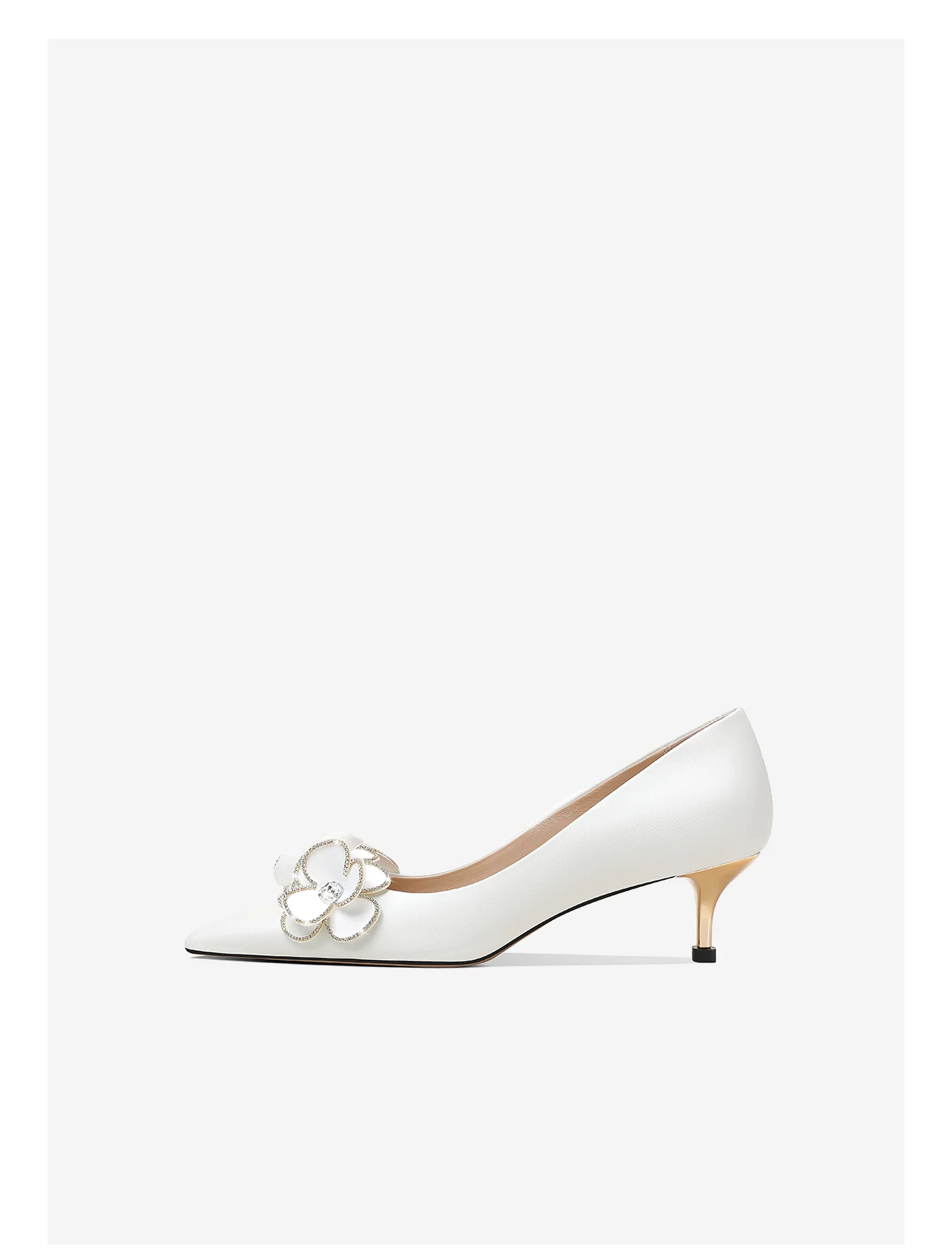
For a black pair built on a narrower last, the elegant white kitten heels with a socialite cut show the strap position that works, just in a lighter colour. The black commuting heels with a shallow mouth are the closed-shoe answer if you’ve given up on straps entirely, and the soft leather pointed small heels sit closest to a true kitten height with a toe that doesn’t pinch.
If you’re still deciding between a strap and no strap, the pairs that go back in the box almost always fail on the same two points. And the full range sits under women’s shoes if you’d rather browse by shape than by height.
What the good pairs have in common is boring: a strap placed for a foot rather than for a photograph, a sole wide enough to hold the whole foot, and a leather upper that softens instead of cracking. That’s the entire trick behind black kitten heels sandals for women that get worn out rather than stored.
The short version: a kitten sandal isn’t comfortable because the heel is low. It’s comfortable because the strap sits in the right place for your foot, the sole carries your full length and the material doesn’t fight back. Check those three things before you check the price, and the pair you buy will still be in rotation in September.
Next time you try a pair on, do the toe walk before the mirror. It takes five seconds and it tells you more than the reflection does.
