

You’re standing in front of the mirror at 8:05 on a Tuesday, one black and white heel on, one plain black pump in your hand, and you genuinely can’t tell which one looks more expensive. The two-tone pair is more interesting. It’s also the pair you’ve worn twice in fourteen months, both times to events where you sat down for most of the evening.
That gap between “looks great in the mirror” and “gets worn” is the whole problem with this colourway. Black and white heels for women aren’t hard to find. They’re hard to keep in rotation, because a shoe with two strong colours argues with more of your wardrobe than a single-colour pump ever will.
So here’s the short version before the detail. Two-tone works when the split follows the shape of your foot, when the heel sits at 70mm or under, and when you treat white as a colour that needs maintenance rather than a neutral that looks after itself. Get those three right and the pair earns its shelf space. Get them wrong and you own a very photogenic shoe that never leaves the house.
Four versions of “black and white” and only one of them is easy
The phrase covers at least four different shoes, and shops don’t always separate them. Knowing which one you’re looking at saves a return.
- Panel split (spectator style): white body, black toe cap and heel counter, or the reverse. The line runs across the vamp, which visually cuts the foot into thirds.
- Printed or patterned: houndstooth, polka dot, checkerboard, marble. Busy at close range, calm from three metres away.
- Trim only: a black shoe with white piping, stitching, or a contrast heel. Reads almost as a solid black shoe, which is why it gets worn most.
- Block colour blocking: white upper on a black platform sole. The most modern of the four, the least forgiving on a narrow foot.
Trim-only is the one I’d buy first if you’re unsure. From a distance it behaves like a black heel, so it slots into the outfits you already wear, but the white line gives it a bit of edge up close. It also hides scuffs, because the parts that take the abuse are black.
A full spectator split is the opposite. It’s the most striking option and it needs the most discipline from your outfit. That horizontal line across the vamp draws attention to the widest part of your foot, which is fine if you’re wearing a straight-leg trouser or a midi skirt and less fine with a skinny jean cropped right at the ankle. Where the line falls matters more than how wide the white panel is.
Printed versions are a different animal again. Houndstooth on a 70mm pump is a genuine statement and needs one plain thing next to it. If you’re wearing a patterned dress and patterned shoes, the two patterns will fight unless they share a scale. Small check with big floral works. Small check with medium check looks like an accident.
70mm is where most people stop walking properly
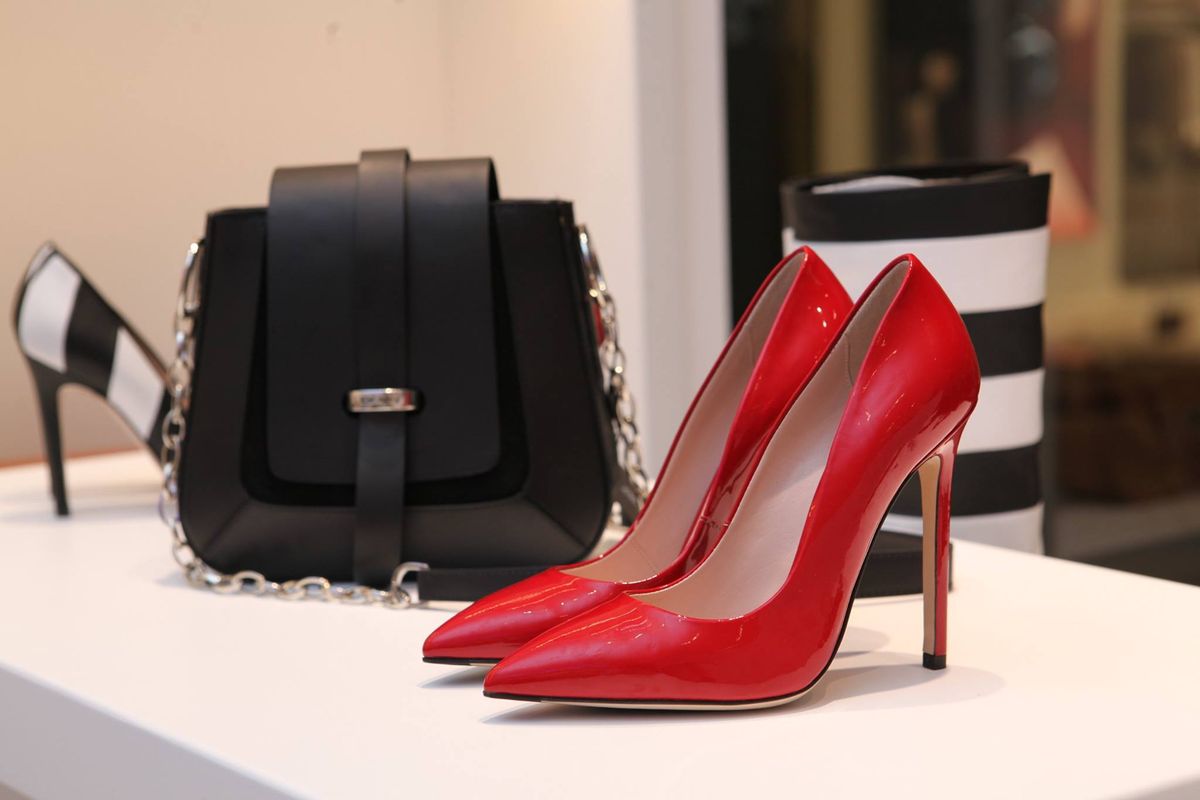
Colour gets the attention, height does the damage. On a two-tone shoe the pitch of the heel is more visible than on a plain pump, because the white panel reflects light and exaggerates the angle of the arch. A 90mm spectator looks like a 100mm shoe. That’s a styling bonus and a comfort problem at the same time.
Sixty to seventy millimetres is the practical ceiling for a shoe you’ll wear standing up. At 70mm the ball of your foot carries roughly three quarters of your body weight, which is already a lot, and every extra 10mm shifts more load forward. The mechanics of that shift are set out in this overview of high-heeled footwear, and they explain why the same colour split feels so different at 60mm and at 90mm. If you want the two-tone look for a working day rather than a dinner, stay at 60 to 70 and put the height into the toe shape instead.
A pointed toe at 65mm reads longer and sharper than a round toe at 85mm. That’s the trade most people miss. You get the elongation from the last, not from the heel, and your feet don’t pay for it at 6pm.
If you do want the high version, look at how the heel is built rather than how tall it is. A stacked or covered heel with a wider footprint spreads the landing. A slim stiletto at the same height concentrates the same weight into a smaller contact patch, so every step wobbles a little more, and by hour four your ankles are doing work they shouldn’t be doing.
There’s also the question of where the heel sits under your own heel bone. Set-back heels feel steadier than heels set forward, even at identical height, because your weight lands over the post instead of in front of it. You can check this in ten seconds in a shop: put the shoe on a flat surface, look from the side, and see whether the back of the heel post lines up with the back of the shoe. If the post sits forward of the upper, you’ll feel it on stairs.
What to wear them with, and the four outfits that survive a long day
Here are combinations that work, tested against the usual problem of an outfit that looks fine at 9am and ridiculous by 3pm.
- Straight-leg dark denim and a white shirt. The obvious pairing, and still the best one. Cuff the jean to just above the ankle bone so the strap and the split are visible.
- Navy tailoring. Black and white against navy is softer than black and white against black. A navy suit with a two-tone pump looks intentional rather than costumey.
- A floral midi with a white base. The white in the shoe repeats the white in the print, which ties the two together without matching them.
- All black with one white element. A black dress, black bag, and a white cuff or collar. The shoes then read as the second white note instead of a stray.
What tends to fail is a busy print plus a busy shoe, and anything with a competing horizontal line at the ankle, like a cropped wide-leg trouser that ends exactly where the shoe begins. Monochrome dressing is the reason the all-black-plus-one-white outfit works so reliably: there’s only one thing for the eye to land on. If you’re wearing wide legs, let them break over the shoe or stop three fingers above it. Nothing in between.
Ankle straps complicate this further. A strap in a contrasting colour creates a second horizontal boundary right where your leg is widest, and that’s the one visual trick that makes legs look shorter. If you want the two-tone effect and an ankle strap, keep the strap black and the leg bare, or wear a sheer 15-denier tight in a shade close to your skin tone.
The one thing I’d avoid: black and white shoes with a black opaque tight in winter. The tight and the shoe merge into one dark block and the white panel floats on top of it like a sticker. Skin-tone sheer or bare legs, even in November, looks cleaner. If it’s too cold for that, this is a summer shoe and pretending otherwise costs you the look.
The two places these shoes go wrong: toe box and ankle strap
Most of the complaints about two-tone heels come down to fit at the front and pressure at the back, and both are measurable before you pay.
The toe box is where a decorative shoe quietly becomes a painful one. Pointed lasts with a narrow taper squeeze the fourth and fifth toes together, and a white toe cap makes that squeeze more visible because the cap ends right where the toes bunch. Look for a toe box that’s at least 70mm wide across the ball at your usual size, or size up half and add a thin insole at the heel. On a wide foot, a square or softly rounded toe in the same colour split does everything the pointed version does and none of the pinching.
The ankle strap is the second failure point. A strap that sits directly on the ankle bone will rub within twenty minutes, no matter how soft the leather is. You want it either above the bone, over the narrowest part of the ankle, or below it, across the instep. Test it standing, because your ankle changes shape when you put weight on it. Sitting-down fittings lie to you about straps more than about any other part of a shoe.
Heel slip is the third thing people mention, and it’s usually a sizing issue rather than a design flaw. A shoe that lifts at the heel by more than about 5mm when you walk will give you a blister on the first long day. Half a size down often fixes it, unless the toe box was already tight, in which case you need a different last rather than a different size.
One more check that takes no time: press your thumb into the insole under the ball of the foot. If it feels like a sheet of cardboard over a hard surface, you’re buying a shoe for photographs. If there’s a few millimetres of give, you can stand in it.
Keeping the white part white, and the one thing I’d skip
White leather is maintenance. There’s no way around it, and any product claiming otherwise is selling optimism.
Clean the white panels after every second or third wear with a damp microfibre cloth and a drop of pH-neutral soap. Not detergent, not wipes with alcohol in them, because both dull the finish and leave a grey haze that shows up in daylight. For scuffs on smooth leather, a melamine sponge used dry with almost no pressure lifts most of the mark. Skip it on patent, where it leaves a matt patch that never blends.
Suede and nubuck are a different job. Brush dry, in one direction, then protect before the first wear and re-protect every three weeks in winter. White suede with a black cap is a beautiful shoe that will look tired by February unless you’re disciplined.
What I’d skip is patent white with black trim in a high-heeled pump. It’s the version that photographs best and ages worst. Patent creases at the toe break and the crease holds dirt, and once a white patent shoe creases, no amount of cleaning gets the line out. Smooth leather creases too, but it creases in a way that reads as worn-in rather than damaged.
Store them with the black and white parts not touching. Sounds fussy; it isn’t. Patent against patent in a warm cupboard can transfer colour, and you’ll only notice in spring.
Sizing: they run small more often than you’d expect
Two-tone shoes are often made on fashion lasts, and fashion lasts run narrow and short compared with the lasts used for everyday shoes. If you’re a true 38 in a walking shoe, there’s a fair chance you’re a 38.5 in a pointed spectator from a dress brand.
- Try them at the end of the day, when your feet are at their largest, ideally after 6pm.
- Bring the socks or tights you’ll actually wear, not the thin ones from the shop’s sample drawer.
- Allow about 8mm between your longest toe and the end of the shoe, standing.
- Walk on a hard floor, not carpet. Carpet hides a stiff midsole.
- Check both shoes. Left and right are cut from different panels and a half-size mismatch happens more than brands admit.
If you’re between sizes and the toe is pointed, size up and add a heel grip. If the toe is round or square, size down. That single rule handles most of the guessing.
Break them in at home for two short sessions before you take them outside. Twenty minutes on carpet, then forty on a hard floor, is enough to show you where they’ll rub. Better to find out in your hallway than at a wedding two hours from home.
When to leave them on the shelf
There are feet these shoes don’t suit, and saying so is more useful than pretending otherwise.
If you have a bunion, a pointed spectator with a decorative cap is close to the worst possible choice, because the cap edge lands right on the joint. A rounded toe in the same colours is fine. If you’re on your feet for more than 8,000 steps a day at work, a 90mm two-tone pump will cost you more than it gives you, and a 60mm block version will do the same styling job.
If you’re going to an outdoor event on grass, skip the stiletto entirely. Heels sink, and a white toe cap in wet grass is finished.
And if your wardrobe is mostly prints, this is a shoe that will sit unworn. Two-tone heels need plain ground around them. Count how many solid-colour outfits you actually wear in a month before you buy. Fewer than five, and the money is better spent on a plain pair you’ll wear twice a week.
Where they do earn their place: a work wardrobe built on navy, black, and denim, a social calendar with two or three dressy events a month, and a tolerance for ten minutes of cleaning every couple of weeks. That’s the honest profile. For a closer look at how height changes the way the whole shoe reads, the platform version of the black heel is worth reading next, and the open-toe cut changes the proportion again.
If you’re shopping now, the black satin pair with a clean vamp gives you the shape these outfits need, and the woven white leather heels work as the light half of the same idea. Browse the full women’s heels collection if you want to compare heel heights side by side, or the wider women’s shoes range for the flats that will end up doing the heavy lifting on the days these don’t.
The colour split isn’t the risky part. The height is, and so is the width at the ball of your foot. Get the last right and a two-tone shoe becomes the pair you reach for when a plain black pump feels like giving up. What’s the last pair you bought that actually got worn more than ten times?
