

It’s the first properly warm Saturday of the year, you’ve got a lunch booked across town, and you’re standing in the doorway deciding between trainers and the sandals that gave you a blister last July. That’s the exact moment low heel sandals are supposed to solve.
They usually don’t, because most of them are built badly. A 90mm block on four thin straps is not a walking sandal. A flat sole with a single toe post is not a sandal you can wear for six hours either. The useful version sits somewhere in between, and it’s rarer than it should be.
Here’s the range that works for most women: a 40mm to 50mm heel, a strap that crosses the instep just behind the ball of the foot, and a sole you can bend with one hand. Get those three right and you can walk 6,000 steps in them without thinking about your feet.
Everything below is how to check those three things before you pay, plus the places where low heel sandals will still let you down.
45mm is the height that still reads as a sandal
There’s a visual threshold around 60mm. Below it, people read the shoe as a sandal. Above it, they read it as a heel with straps. That matters if you’re trying to dress down, because a 70mm strappy sandal with a linen dress looks like you’re going somewhere nicer than you are.
A 45mm heel also changes where your weight sits. At that height the load is split roughly evenly between heel and forefoot, so you can stand in line for 20 minutes without the burn starting under your toes. At 70mm the forefoot takes most of it, and at 90mm you’re on the ball of your foot full time.
Width of the heel base is the other half of the story. A 45mm heel on a 30mm block is stable enough for cobblestones. The same height on a 10mm tapered tip will find every gap between paving slabs and twist your ankle on the third one. If you live somewhere with bad sidewalks, the block wins.
Wedges behave differently again. A wedge gives you height with a continuous sole, so there’s no narrow point to catch. The trade-off is weight and a stiffer stride. A 50mm wedge is fine for a garden party and clumsy for a city walk.
One number worth knowing before you shop: your foot lengthens by about 5mm when you stand, and by up to 8mm by late afternoon in warm weather. Sandals with a closed heel cup can’t accommodate that. That’s why open-back sandals feel better in August than any enclosed shoe.
The strap that decides whether they stay on
Look at where the front strap crosses your foot. The useful position is just behind the ball of the foot, over the metatarsal heads. That’s the widest, most stable part of your forefoot. A strap there holds the shoe without pressing on anything bony.
A strap that sits forward of that point will cut across your toes when you walk. A strap that sits back over the instep will slide toward your ankle with every step, and by mid-afternoon the shoe is hanging off your heel.
Ankle straps are optional at this height, and I’d argue against them for daytime. At 45mm your foot doesn’t need ankle support, and an ankle strap in hot weather means a tan line plus a pressure point. If you do want one, make sure it sits 10mm above the ankle bone rather than on it.
Slingbacks are the best compromise for low sandals. Our notes on how suede holds up in wet weather apply here too if you like suede straps. The elastic sling holds the heel without a full strap, and it lets the back of your foot breathe. Check the elastic tension by pulling it: if it stretches more than about 15mm with light pressure, it’s already tired and the shoe will flap within a month.
Buckles are worth the extra 20 seconds. Velcro on sandals fails quietly, then loudly. A metal buckle with a leather keeper will outlast the sole.
If you have a very high instep, look for a design with an adjustable strap over the instep rather than a fixed band. Fixed bands on high insteps create a red line across the top of the foot within an hour, and no break-in period fixes it.
The sole test takes ten seconds
Hold the sandal and bend the front third upward with both hands. A leather sole with a proper shank will flex at the ball and stay stiff through the arch. If the whole sole folds in half like a paperback, there’s no shank and your arch will do all the work.
Then twist it along its length. Some give is good. A sole that twists like a wet towel has no structure at all, and those are the sandals people describe as “comfortable for ten minutes”.
Material matters here. Leather soles breathe and mold to your foot, but they’re slippery when new and they hate rain. Rubber soles grip better and last longer in wet weather, but they don’t breathe, which matters more in a sandal than in a closed shoe. A leather footbed with a rubber outsole is the practical combination, and it’s what most decent sandals use.
Look at the footbed edge, too. If you can see a foam core wrapped in synthetic lining, expect it to compress within a season. A cork or latex footbed holds its shape for years, and it can be repaired. The history of the sandal is basically a history of sole construction, and the good versions haven’t changed much.
Finally, check the heel tip. On a low sandal it’s usually a small plastic cap that wears through in months. Ask whether it’s replaceable. If the answer is no, budget for a new pair each summer.
Wide feet, bunions, and the sizing trap
Sandals are more forgiving than closed shoes, but they have their own sizing problem. Because there’s no toe box, people size up to get width at the front, and then the heel is too long. You end up with a sandal that fits at the toes and slides at the back.
The better move is to find a style with an adjustable buckle at the widest strap and buy your true length. You get width from the adjustment, not from extra length. This is the single most useful thing I know about buying sandals for wide feet.
If you have a bunion, avoid straps that cross directly over the joint. A strap that sits behind the joint, or a design with a diagonal strap that runs from the big toe toward the outside of the foot, spreads the pressure. Bunion pressure comes from a hard edge sitting on a bony prominence, so the fix is placement, not padding.
Narrow feet have the opposite issue. Most sandals are built on a medium last, and a narrow foot slides sideways until the arch of the shoe is under your heel. Look for a strap that wraps the instep rather than a single band across the toes, and check that the footbed edge supports your arch rather than sitting inside it.
One more: if one foot is bigger than the other, which is normal for most people, buy for the larger foot. A sandal that’s slightly loose on the smaller foot can be adjusted with a strap. A sandal that’s too short on the larger foot cannot be fixed at all.
What low heel sandals are genuinely bad at
Grass. Any heel, even 40mm, sinks into soft ground. If the event is in a garden, a wedge or a flat is the only thing that works, and no amount of balancing will save a narrow heel.
Long distances. Sandals expose your skin to sun, dust, and the occasional stone. At 8,000 steps on city pavement, the lack of a toe box means your toes take small knocks all day. That’s not dangerous, just tiring.
Cold evenings. A low sandal in September is a gamble, and your feet get cold before the rest of you does. If you’re going out after 8pm, carry a pair of thin socks or accept that you’ll be the one who leaves early.
And formal events. Low heel sandals read casual no matter how good the leather is. For a wedding, a dinner with a dress code, or anything with a printed invitation, a closed toe or a higher, slimmer sandal will look more appropriate.
None of that is a reason to skip them. It’s a reason to own one good pair and not ask it to do everything.
What to wear them with, and what looks off
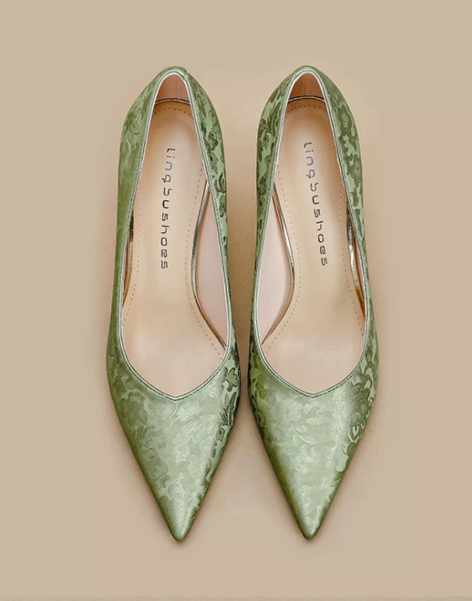
Low heel sandals work best with volume on the bottom half. Wide-leg linen trousers, a midi skirt with some movement, straight-leg jeans cropped above the ankle. The 45mm height gives you a bit of lift without demanding a short hem.
They look off with very tight, very short hemlines. A mini skirt plus a low strappy sandal reads like two different outfits, and the shoe looks like an afterthought. If you want a short hem, go up in heel height or go flat.
Color is simpler than people think. Tan and cognac go with everything warm. Black is the safest for evening. Metallic works better than expected with denim and with white, and it hides dust. White leather sandals look fantastic for about three wears and then show every scuff on the toe, so I’d only buy white if you’re genuinely careful.
Bare legs versus tights is the usual question in shoulder seasons. At 45mm, sandals with a sheer black tight can work if the straps are dark. Nude tights with sandals almost never look right, because the footbed edge and the tight create a visible line at the heel.
For a quick test before you leave: stand in front of a mirror and look at the gap between the front strap and your hem. If there’s less than a hand’s width of visible leg, the proportions will look cramped.
Break-in, care, and the rain problem
Leather sandals need about three short wears before the straps soften. Wear them indoors for an hour first, then for a short walk, then for a full day. Skip the indoor hour and you’ll get a blister on the top of your foot where the strap edge meets skin.
New leather soles are slippery on smooth tile. Rough them up with fine sandpaper on the ball area, or walk on pavement for ten minutes before you take them indoors. It sounds silly until you’ve gone down on a marble floor.
Rain is the enemy of leather soles. If they get soaked, let them dry away from heat, stuffed with newspaper, for 24 hours. Never put them near a radiator, because the leather will harden and crack at the flex point. If you live somewhere wet, buy rubber-soled sandals and stop worrying.
Clean straps with a damp cloth and a little saddle soap, then condition once a month in summer. Salt from sweat dries leather out faster than rain does, and it’s the reason so many sandals crack by August.
Store them flat, not hanging, and don’t stack them under other shoes. A crushed strap keeps the crease permanently, and a creased strap will rub in exactly the spot where it bends.
The two-minute fit check
Do this before the tags come off.
- Stand up. Your heel should sit 2mm to 4mm from the back edge of the footbed.
- Press the front strap. You want it snug, not tight enough to leave a mark on bare skin.
- Walk ten steps. The sole should flex at the ball of your foot, not in the middle of the arch.
- Twist the shoe gently. Some give, no wet-towel flop.
- Check the strap edges. Raw, unsealed edges will rub; rolled or stitched edges won’t.
Two fails and I’d walk away. There are enough good sandals that you don’t need to negotiate with a bad pair.
If you want a starting point, the pointed strappy sandal covers the dressed-up end of the range, and the silver summer sandal handles evenings without going full formal. The rest of the heel range is worth a look if you want to compare heights in one place.
Then take them for a real walk before the event you bought them for. Ten minutes around the block tells you more than any fitting room mirror ever will.
