

It’s 7:40 on a Tuesday. You’ve got a meeting at nine, drinks at six, and one pair of shoes that has to survive both without a change in between. All black feels heavy next to the dress you picked. All white will be grey by lunch. So you stop at the window with the black shoe and the white toe and think: this might solve it.
Sometimes it does. Sometimes you get home at seven with a scuffed toe and a blister on your little toe and wonder why you bothered.
The difference between those two outcomes isn’t the colour scheme. It’s the shape, the leather, and where the straps sit. Black and white heels for women are a small category with a wide quality range, and most of the bad ones are bad for reasons you can spot in the shop in about ninety seconds.
Two colours on one shoe is a harder sell than it looks
A single-colour shoe has one job: match the outfit or deliberately not match it. A two-tone shoe has to balance both colours against whatever you’re wearing, and it has to do it without looking like a costume piece from a 1980s office drama.
That’s why the good versions are almost always a dominant base colour with a small accent. Black pump, white toe cap. Ivory shoe, black slingback strap. Black satin, thin white piping at the edge. The accent is 10% of the surface or less. Most black and white heels for women fail this test on the product photo alone, which is why so many end up in the returns bin.
The ones that go wrong split the shoe roughly in half. White front, black back, meeting in a hard line across the middle of your foot. That’s the version that photographs well on a shelf and looks like a referee’s kit on an actual person.
There’s a practical reason too. The toe is the part of a shoe that takes the most damage: kerbs, car doors, the underside of a desk. White on the toe shows every one of those marks. White anywhere else, like a heel counter or a strap, survives far longer because nothing hits it.
If you want a pair that still looks intentional in eighteen months, put the pale colour where nothing touches it. That single decision matters more than brand, price, or how the product page is styled.
One more thing worth knowing before you shop. Two-tone shoes are a genuinely old idea rather than a recent trend. The court shoe has been built with contrasting toe caps and heel counters since the 1920s, partly because the contrast hides scuffs in the places that collect them. The design logic hasn’t changed. Only the marketing has.
The cap-toe pump is the safe buy, and that’s not an insult
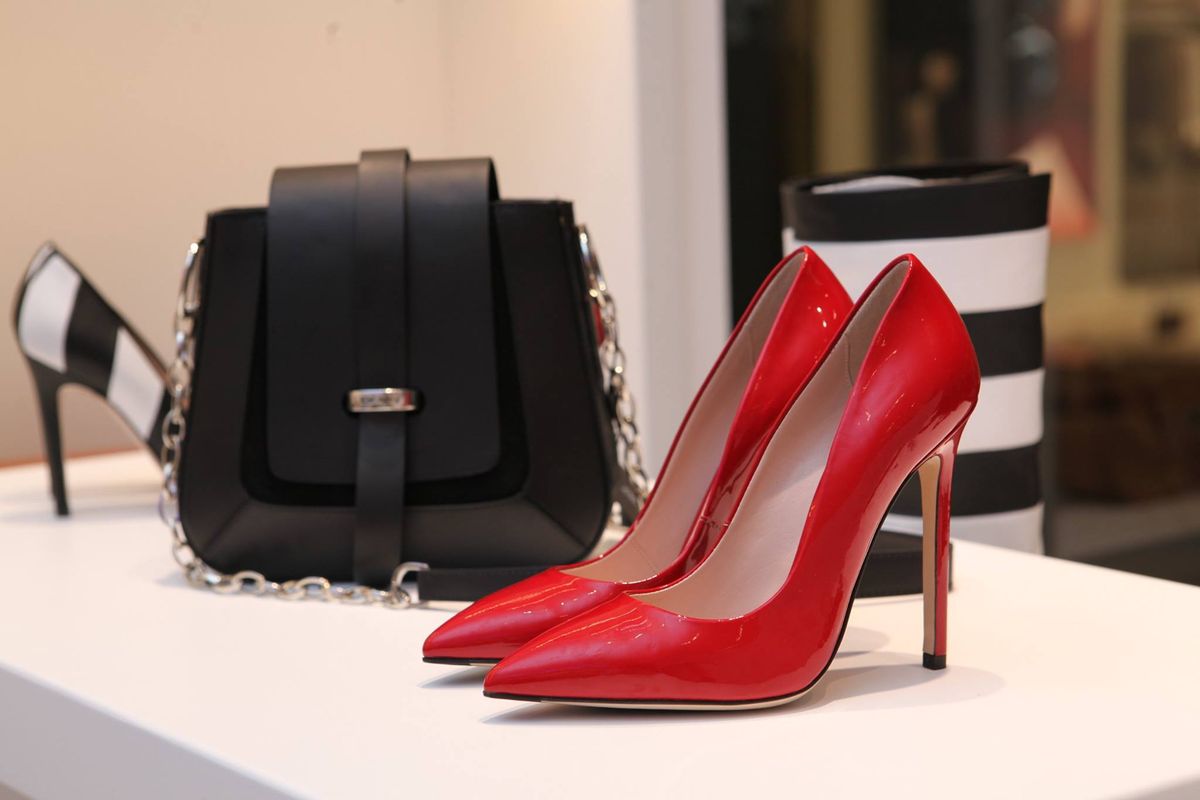
If you’re buying your first pair, buy a cap toe. Court shoe shape, 70mm heel, leather or a good synthetic, white toe, black body. It handles interviews, weddings, and a normal Thursday without anybody commenting on your shoes, which is usually what you want.
Heel height is where most people overshoot. A 70mm heel puts roughly 70 to 75% of your body weight through the ball of your foot when you stand still. At 100mm that figure climbs closer to 85%, and the difference between those two numbers is the difference between walking to the station and standing on the platform barefoot. The mechanics behind it are well documented in the history and biomechanics of the high heel, and none of it has changed since the shoe was invented.
Seventy is the height that stays on your feet past 8pm. It’s also the height that reads as deliberate rather than as an event.
Look at the heel itself, not just the number. A 6mm steel stiletto on tile is a different object from a 25mm block wrapped in the same leather. The thin one will find every gap in the paving between your office and the tube. The thicker heel that doesn’t punish you is less photogenic and more useful, and it’s the one I’d hand to someone who has to walk 800 metres in the rain.
Then check the toe box depth. Press your thumb down on the top of the shoe above your toes. If the leather gives less than about 4mm, your toes will be doing the work your shoes should be doing. This is the single test that separates a pair you’ll wear forty times from a pair you’ll wear twice.
Cap toes also hide a fitting problem that pointed toes expose. The seam sits behind the toes rather than at the tip, so there’s a little more room up front, and the shape forgives a slightly wider forefoot. If you’ve spent years being told heels don’t suit your feet, this is the shape to try before you agree with them.
Three outfits they actually work with
Forget the styling shots where the model is standing still against a white wall. Here’s what the shoe has to cope with in real life.
Straight-leg jeans and a white shirt. The hardest combination to get wrong and the one that sells this shoe to people who claim they don’t wear heels. A black cap-toe pump with dark denim reads as a choice rather than an effort. Keep the jean hem at the ankle bone or just above it. Anything longer and the shoe disappears.
A black midi dress for a wedding. This is where the white toe earns its keep. All-black shoes with a black dress can look like you forgot to finish getting dressed. A small pale accent at the front lifts the whole column without dragging attention to your feet. Add a bag in the same leather as the toe, not a matching white shoe, and you’re done.
Wide-leg trousers, cropped at the ankle. The version that reads most modern. The pale toe catches light at the bottom of a dark outfit, which is exactly where a wide trouser needs something to stop it looking like a curtain.
What doesn’t work: pale blue denim, anything with a print, and maxi skirts that cover the shoe entirely. In each case you’ve paid for a detail nobody can see.
If two-tone still feels like too much on a Tuesday morning, the quieter route is a grey heel as the neutral under a plain outfit. Same idea, less contrast, and it works with navy and brown, which black-and-white never will.
Strap placement decides whether you can walk
Most people blame heel height for a shoe that won’t stay on. The real culprit is usually the strap or the lack of one.
A slingback that sits too low on the heel will slide off every fourth step, and no amount of tightening fixes it because the geometry is wrong. The strap should cross the back of your heel at roughly the height of your ankle bone, angled slightly upward. If it sits below that, walk ten steps in the shop. You’ll feel it move.
Wider straps are more forgiving than thin ones. A 12mm strap spreads pressure across more skin than a 5mm strap, which matters most on the days you’re on your feet for six hours. If you’re shopping for a summer pair, the block heel sandals that survive grass use the same strap logic with far more surface area.
An ankle strap is the opposite problem. It holds the shoe on beautifully and cuts your ankle in half visually, which shortens the leg. If you’re wearing cropped trousers, that’s fine. If you’re wearing a midi skirt, it’s a choice you should make on purpose.
Toe straps on sandals need about 3mm of clearance on each side of your foot. Less than that and the edges will press into your skin by the end of the first hour. More than that and the shoe will slide sideways as you walk, which is how people end up rolling an ankle on a flat pavement.
The one adjustment worth paying for is a buckle with more than three holes. Two-hole buckles are a manufacturing shortcut. Four or five holes give you about 8mm of range, which is often what separates a wearable pair from a return.
And if the strap is elastic, check how much it stretches. Elastic that gives more than 10mm within a week of wear stops holding the shoe altogether. You want a strap that feels slightly too firm in the shop, because leather and elastic both loosen with body heat.
Where black and white heels look wrong, and why that’s fine
There are places this colour scheme just doesn’t belong, and pretending otherwise wastes your money.
Black tie is one. Two-tone shoes read as daytime. If the invitation says gown, you want a single colour, ideally in satin, and nobody will look at your feet twice, which is the point. In my experience black and white heels for women get bought for a wedding, worn once, and then sit in a box for two years because the next invitation says the same thing.
Heavy winter outerwear is another. A pale toe next to a wool coat and dark tights looks like a mistake in the mirror, and it looks like one to everyone else too. The shoes don’t have a seasonal problem so much as a weight problem: they’re visually light, and they need an outfit of similar weight.
Then there’s the office with a strict dress code. Some corporate environments still read two-tone as fashion-forward in a way that draws comment. You know your building better than I do. Wear them on the days you’re not presenting.
Here’s the counterintuitive part, and it’s the reason I keep recommending these over a plain black pump: the contrast makes a cheap outfit look considered. A £40 black dress and a good two-tone shoe beats a £200 dress and a boring flat every time. The eye lands on the small deliberate detail and reads it as intent.
That’s also the risk. If the shoe is cheap, the contrast advertises it. Glue lines, a plastic-looking toe cap, stitching that wanders. In a single-colour shoe those flaws hide. In a two-tone shoe they sit under a spotlight.
Sizing, break-in, and the scuff you’ll get in week two
Almost every pair of heels I’ve owned ran half a size small, and the two-tone ones are worse because the toe cap is usually a stiffer leather than the rest of the upper.
Try them at the end of the day, when your feet are at their largest. There should be about 5mm between your longest toe and the end of the shoe. If your toes touch the front when you stand, size up. Heels don’t stretch lengthways, no matter what the shop assistant tells you.
Width is the other half of the story. Leather gives about 2 to 3mm across the ball of the foot over the first two weeks. Patent gives almost nothing. If a patent pair is tight in the shop, it will be tight in June.
Break-in takes three sessions, not three weeks. Wear them for twenty minutes at home on carpet, then an hour out, then a full day. Skip a session and you’ll get the blister anyway.
Now the part nobody puts on the product page. White toe caps pick up grey marks from car pedals, escalator edges, and the bottom of your own desk. A melamine sponge takes most of it off, but it also takes the finish, so use it sparingly and only on the scuff itself. A cream leather balm worked in with a finger does less damage and hides more.
And keep them out of the rain. Water marks white leather in a way that black leather forgives, and once the toe cap goes slightly grey at the edges, no polish brings it back to the original shade. Mine lasted two winters before the white started reading as off-white. That’s normal, not a defect.
If you want white leather done properly, the woven white leather heels are a better starting point than a painted synthetic cap, because the colour goes all the way through the material instead of sitting on top of it.
What to spend before you know the shape suits you
Spend less than you think on the first pair. The expensive version isn’t automatically the durable one, and I’ve had a £180 pair split at the heel within four months while a £55 pair lasted three years. Black and white heels for women sit in a strange price bracket where the £200 version often has the same sole as the £60 one.
What you’re paying for in the £40 to £80 range is the last shape, and that’s the part that decides whether you can walk. A well-shaped cheap shoe beats a badly shaped expensive one every time, because no amount of leather quality fixes a toe box that’s 6mm too shallow.
Above £100 you should be able to see where the money went: a leather lining rather than a synthetic one, a stitched sole rather than a glued one, a heel that can be replaced by a cobbler for £12 instead of thrown away with the shoe. Check the inside of the heel counter with your thumb. If it feels like cardboard through a thin layer of fabric, that’s a shoe with a two-year life.
Once you know the shape works on your foot, then go up. That’s when a second pair in a better leather makes sense, and it’s usually the pair you’ll still be wearing in 2030.
One last thing. Before you buy, put the shoe on and walk to the far end of the shop and back on the hard floor, not the carpet. Two-thirds of the pairs I’ve rejected were rejected in that walk, and every single one of them looked fine standing still.
You’ll know within thirty seconds. If you’re counting steps to the door, put them back.
If you want to see the shapes side by side before you commit, start with the wider women’s shoe range and filter by the toe shape you already know works. It’s faster than guessing from photos.
