

It’s 4:40 on a Tuesday, your shoes are under the desk instead of on your feet, and the arch is doing that hot, bruised thing again. You’ve still got the 6:15 train and a supermarket run before you’re home. Total steps for the day: maybe 4,000. Nothing heroic. Just a normal Tuesday in dress shoes that were never built to hold a foot up for eight hours.
Buying dress shoes with arch support for women is less mysterious than the marketing makes it sound. Four measurements decide almost everything: your arch height, the heel-to-toe drop, the width of the toe box, and how deep the footbed sits under your heel. Get those right and a 60mm court shoe can carry you through a ten-hour day. Miss one and even a flat ballet pump will have you limping by lunch.
It also helps to know which parts of the shoe are doing the work. If you’ve read how the plantar fascia behaves under load, the reasoning behind everything below will make more sense: the shoe is a platform, and platforms either share the load or hand it straight to your tissue.
Check them in that order. It’s the fastest route from “my feet hurt” to “I forgot I was wearing them”.
Your arch type decides the shoe, so measure it before you shop
Stand on a piece of paper with wet feet and look at the print. A wide band down the outside edge with a thin or broken line through the middle means a high arch. A print that’s nearly solid from heel to ball means a low or flat arch. Most adults sit somewhere in between, and that middle group is who off-the-shelf shoes are shaped for.
Why it matters: the higher your arch, the more the shoe itself has to cushion the midfoot, because your foot won’t flatten and absorb load on its own. The lower your arch, the more you need a firm shank and a stiff heel cup, since the foot rolls inward and drags the whole shoe with it.
Three quick tests you can run in the shop, no equipment needed:
- High arch: press a thumb into the insole under the midfoot. Rock hard means walk away.
- Low arch: hold the heel and the toe and twist. If it folds like a sock, there’s no shank in there.
- Neutral arch: construction matters less, so pick on width and heel height instead.
Ignore the word “orthotic” on a product page. A moulded footbed isn’t an orthotic, and a 4mm foam bump under the arch won’t correct anything. It just feels like something is happening for the first twenty minutes. If a shop assistant tells you a shoe is “orthotic-friendly”, the useful question is whether the insole lifts out and whether there’s depth left underneath for a real insert.
That last part separates a shoe you can work with from one you can’t, and it’s covered below.
Heel height: the 25mm to 45mm window is where support survives
Arch support isn’t only what’s under your foot. It’s also how much load the shoe lets your forefoot take. Above about 60mm, most of your body weight shifts onto the ball of the foot, and no insole design fixes that. Below 25mm, the heel sits almost level with the toe, the Achilles works harder, and a stiff low shoe can start rubbing the back of your ankle by the end of the week.
For a full working day, 25mm to 45mm is the practical range. That’s the band where dress shoes with arch support for women can still hold your weight close to how you stand barefoot, while leaving room inside for a proper heel counter and a shank.
Compare the two ends of that range side by side:
- 25-30mm block heel: best for standing, public transport, and days with 8,000+ steps. Looks slightly dated in a very formal office.
- 40-45mm tapered heel: fine for desk-heavy days and meetings. Less forgiving on cobblestones and slippery station floors.
Heel shape matters as much as height. A 45mm block spreads load across a wider base than a 45mm stiletto, and the difference shows up around hour six, not hour one. If you want the look of a slim heel without the wobble, look for a heel that tapers only in the last third, or a “kitten” at 35mm.
One honest warning: if you have plantar fasciitis that’s still active, none of this replaces a physio. The clinical overview of plantar fasciitis is blunt about rest and stretching mattering more than footwear. A better shoe helps you keep working. It doesn’t treat the problem.
Depth under the heel is the spec nobody prints on the box
Here’s the number that ruins most good intentions: how much room is left inside the shoe once your foot is in it. A dress shoe with a glued-in insole, a thin sockliner, and a snug heel leaves maybe 2mm of clearance. Your own insert needs 4mm to 6mm. Force it in and your heel rides up, your toes get pinched, and you’ve made the shoe worse than it was.
So before you buy anything, do this: take the insole out. If it comes out easily and the base underneath is flat and clean, you can fit an insert. If it’s glued down, you’re stuck with whatever cushioning the factory gave you.
What the layers are actually doing:
- EVA foam: light and soft, flattens in about three months of daily wear.
- PU or latex: heavier, holds shape for a year or more, less bouncy.
- Cork: moulds to your foot over a few weeks, doesn’t bounce back if it gets soaked.
None of these are arch support on their own. Real support comes from the combination of a firm shank under the midfoot, a heel cup that holds your heel vertical, and a footbed that doesn’t collapse sideways. A soft insole with a high-looking arch bump has the geometry without the structure, and it will pancake by September.
This is also why two pairs of dress shoes with arch support for women can feel completely different at the same price. One has a shank running from heel to ball; the other has a cardboard board. You can’t see either from the outside, but you’ll feel it at hour four, and you’ll feel it again at hour nine.
If you’re replacing the insole anyway, buy the shoe a half size up and keep the original insole, so you can swap back when the insert wears out. That trick alone has saved me two pairs.
Toe box width: measure at 4pm, not at 10am
Feet swell during the day, sometimes by half a size. Shopping at 10am means you’re buying for a foot that no longer exists by the time you’re on the train home. Try shoes on late afternoon if you can, and always standing up, because everything changes when your full weight is on it.
The measurement to look for is internal width at the widest point, roughly 92mm to 98mm across the ball for most women’s dress shoes. Almost no brand publishes it, so use your thumb: press the upper at the widest part of the ball. If you can feel your toe bones right against the leather with no give, the shoe is too narrow, no matter what size is printed inside.
Shape matters more than the number. A pointed toe that’s 20mm longer than your foot has room to taper. A pointed toe that ends exactly where your longest toe ends will crush it within an hour.
What to look for instead:
- Almond or soft square toe: most forgiving, works with wide forefeet.
- Pointed with 15-20mm of clearance: still elegant, still wearable for a full day.
- Sharp point, zero clearance: a two-hour shoe at best. Fine for a ceremony, not for the reception.
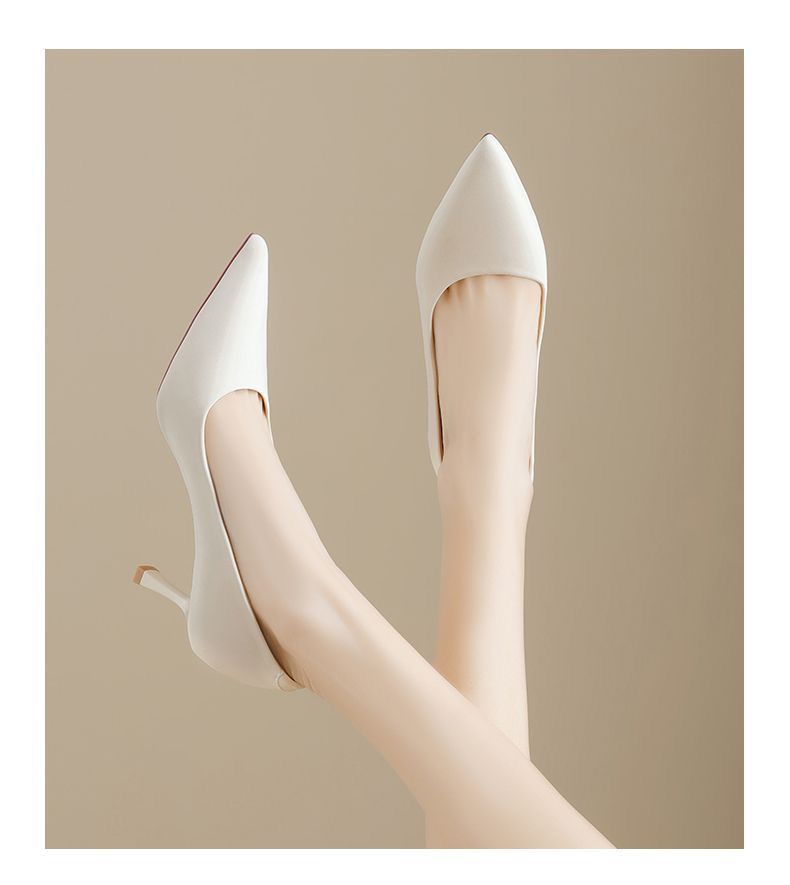
Wide forefoot, narrow heel is common, and it’s the hardest combination to fit in dress shoes. If that’s you, look for lace-up oxfords or a mary jane with an adjustable strap, since a strap can hold a wider shoe onto a narrow heel. The low block heel range leans toward softer leathers and rounded toes, which helps here. Two shapes that tend to suit this foot: a soft leather pair with a shallow cut and a 35mm heel, and a suede commuter shoe with a soft sole. Both give your toes room without loosening the heel.
The heel counter is why your ankle rolls, and why it hurts by 3pm
Squeeze the back of the shoe where your heel sits. It should resist you, then spring back. If it collapses with two fingers, the shoe will let your heel tilt outward with every step, and your ankle does the correcting. That’s the dull ache you feel on the outside of the ankle after a long day, and it isn’t a muscle problem. It’s a shoe problem.
Two things to check at the same time. First, padding: 2mm to 3mm around the collar is enough, more than that and the shoe grips your heel so hard it rubs. Second, the height of the counter. A counter that stops below your ankle bone gives less control than one that rises just past it, which is why low-cut ballet flats feel less stable than they look.
The break-in question ties in here. A stiff heel counter is good for support and bad for your first week. Two or three short wears at home with thick socks will soften the top edge without wrecking the structure. If the counter is still biting after ten days, the shoe is the wrong shape for your heel, and no amount of wearing will fix it.
There’s a second test that takes one minute and predicts most of your future complaints. Put the shoe on, stand up, and try to slide your heel up and down with your hand on the back of the calf. If your heel lifts more than about 5mm, the shoe is too long or the counter is too soft. Every step will then involve your heel slapping back down, which is where blisters come from, and it also means the arch of the shoe never lines up with the arch of your foot. A shoe that slips is a shoe that can’t support anything.
What good looks like on the foot:
- Heel stays put with no lifting, even when you walk on tiptoe.
- No gap you can fit a finger into behind the heel.
- The widest part of the shoe sits at the widest part of your foot, not ahead of it.
If a shop only has one width, ask them to check the pair in a half size down and a half size up. Two minutes of trying usually beats twenty minutes of reading reviews, because heel fit is the one thing no product page can tell you.
Construction and price: where the extra 100 euro actually goes
Two pairs can look identical on a shelf and behave nothing alike. The difference is usually the sole attachment. Cemented shoes are glued, which is fast and cheap, and once the sole separates you’re buying new shoes. Stitched constructions, blake or goodyear, cost more up front and can be resoled for a fraction of the price.
Do the cost-per-wear arithmetic before you decide the cheap pair is the sensible one. A 70 euro pair worn twice a week for eight months works out at about 2.20 euro a wear, and then it’s landfill. A 190 euro pair resoled once over three years comes in closer to 1.10 euro a wear, with better support the whole time. The cheap shoe isn’t cheap. It just bills you in smaller amounts more often.
What I’d spend on, in order:
- A firm shank and a proper heel counter. Non-negotiable, and invisible from the outside.
- Leather that’s soft at the toe and firm at the heel. Same hide, different finishing.
- Rubber top piece on the heel. Cheap to replace, saves the whole heel stack.
What I’d skip: a designer sole unit that can’t be repaired, and any shoe described as “flexible” in a formal context. Flexible in a dress shoe usually means no shank.
For a sense of how much support the cheaper end leaves out, this breakdown of what a budget work shoe skips is worth ten minutes before you order.
A ten-day break-in plan that doesn’t wreck your feet
New dress shoes with structure need a ramp, not a baptism. Wear them for 20 minutes on day one, indoors, on carpet. Day two, 40 minutes including a walk to the kitchen and back. Day three, an hour outside on pavement. Days four to ten, add 30 minutes a day and stop the moment you feel a hot spot, not when it becomes a blister.
Keep a plaster in your bag for the first fortnight. Not because the shoe is bad, but because the top edge of a new heel counter always finds the same spot on the Achilles, and one plaster on day four saves you a week of limping.
Two things that genuinely help: shoe trees overnight, which pull moisture out and hold the shape, and rotating between two pairs if you can. Leather needs about 24 hours to dry out fully. Wearing the same pair five days straight is how uppers crack at the flex point above the toe.
And if the shoe has a leather sole, scuff it on concrete before you wear it anywhere with a polished floor. New leather soles on a station concourse in the rain are genuinely dangerous.
Watch for numbness rather than pain during those first ten days. If your toes go cold or tingle after an hour, the toe box is too shallow and the fix isn’t patience, it’s a different last. Nerve pressure doesn’t toughen up the way skin does. Give it three wears and if the tingle comes back, return the pair while you still can.
One more routine worth building: take the insoles out once a month and let both shoe and insole air separately overnight. Moisture is what kills the foam under your arch, and a shoe that dries out properly keeps its shape for years instead of months. It costs nothing and it’s the difference between a pair that lasts two winters and one that lasts five.
What to skip, even though it looks like the answer
Memory foam everything. It feels like relief in the shop and turns into a flat pancake by the third month, and once it’s compressed there’s no support left to give. The same goes for shoes with a built-in 10mm arch bump and no shank underneath, which is a shape pretending to be structure.
Also skip the idea that one pair can do everything. If you’re on your feet for a wedding, a full office day, and a 20-minute walk to the station, that’s three different loads. Two pairs of dress shoes with arch support for women, one at 30mm and one at 45mm, covers more ground than one perfect pair ever will.
Sizing up to make room is another fix that backfires. A half size up does give your toes space, but it also moves the arch of the shoe forward, away from your arch, and loosens the heel. If the shoe is right everywhere except the toes, look for a wider last or a softer upper at the toe. If it’s tight through the middle, no size will help, because the last is the wrong shape for your foot.
The same logic applies to buying online. Order two sizes if the shop allows returns, walk around indoors for twenty minutes on carpet, keep the box, and decide before you take them outside. Once the soles are scuffed you own them, and a wrong last is not something you can break in.
Start with the measurement you can do tonight: the wet footprint on the bathroom floor. Whatever it shows, you’ll know which of the four specs to fight for when you’re standing in the shop with a box in your hand and a queue behind you. And if you only remember one sentence from all of this, make it this one: the right pair of dress shoes with arch support for women is the pair where your heel stays still, your toes stay flat, and you forget about your feet by 2pm.
