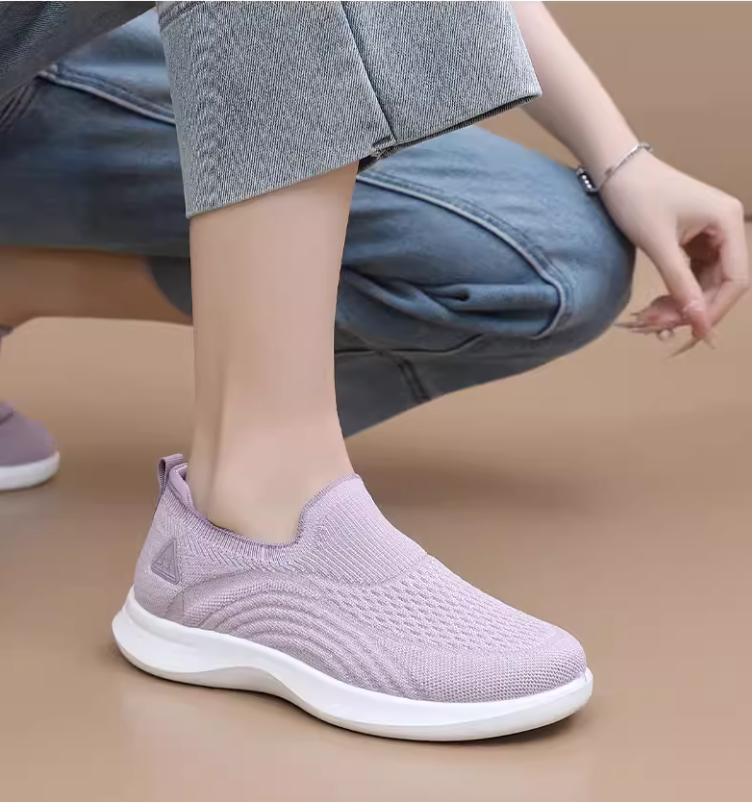
You see them in the shop at 11am and they look like a clean mid-grey. You get them home, put them on by the window at 4pm, and they’ve turned lilac. Under the warm bulb in the hallway they go brown. Nothing is wrong with the shoes. Grey suede is simply the most light-sensitive neutral you can put on your feet, and most people buy it without knowing that.
That matters because grey suede sneakers for women are sold on a single studio photo, usually shot against white with a softbox. The photo is not a lie, exactly. It’s one version of the truth, taken under conditions you’ll never meet again.
Below is how to judge the colour before you pay, how suede behaves once it’s wet, and where this style quietly fails. Three checks first, in order of how much they cost you if you get them wrong.
None of this is a reason to avoid grey. It’s a reason to buy it deliberately, in the light you’ll actually live in.
Why one pair reads as three different colours
Grey sits in the middle of the value scale, which means it has the least colour of its own and reflects the most of what’s around it. A warm light pushes it towards taupe. A cool north-facing window pushes it towards blue. Evening tungsten pushes it back towards brown.
This isn’t a defect in the dye. It’s how a low-saturation surface behaves, and suede makes it worse because the nap scatters light in every direction instead of reflecting it cleanly. You’re seeing the light source, filtered through fibre, more than you’re seeing the pigment.
Practical consequence: judge the pair in the light where you’ll wear them most. If you commute at 7:30am, look at them in morning daylight by a door. If you’re buying for evening, look at them under a warm bulb. If those two views disagree, believe the one that matches your actual week.
The napped surface that makes suede soft is also what makes the colour unstable. Sanded fibres stand up at slightly different angles, so two panels cut from the same hide can read as two shades. On a grey pair this is obvious. On black it’s invisible. That’s the trade you’re making.
Phones make it worse. Automatic white balance will neutralise a warm room and turn your warm grey into a cool one in the photo, then you’ll wonder why the pair looks different when it arrives. If you’re buying online, look for a shot with a hand or a wooden floor in frame. Skin and wood give you a reference the camera can’t fake.
There’s a name for the effect: metamerism. Two surfaces can match under one light and separate under another, because they reflect different wavelengths even though they look identical in a given source. It’s the same reason colour temperature changes what you see in a mirror at night. Grey suede, with almost no saturation of its own, is the most metameric thing in your wardrobe.
The three greys you’ll actually find in shops
Most stock falls into three groups, and they behave differently enough to treat as separate purchases.
- Cool grey, with a blue or slate undertone. Reads sharp and modern, photographs beautifully, and looks slightly cold against warm skin tones.
- Warm grey, closer to greige. Softer on the eye and easier to wear with cream and camel, but it can look muddy next to true black.
- Charcoal, dark enough to pass as a soft black in low light. The most forgiving for daily wear and the least interesting under a camera flash.
If you own mostly black and white, cool grey slots in with no effort. If your wardrobe leans oatmeal, camel, ecru, warm grey is the one that won’t fight. Charcoal is the safe middle for anyone who wants one pair and no decisions.
What you want to avoid is the flat, slightly greenish grey that appears when a factory dyes a cheap suede to hit a price point. It looks fine on a shelf and slightly ill in daylight, and no amount of styling fixes it. Hold the shoe next to a sheet of white paper. If the grey goes green, walk away.
Undertone is easier to read against metal than against fabric. Hold the shoe near a silver ring or a steel watch and then near gold. Cool grey sits comfortably with silver and looks slightly dull next to gold. Warm grey does the opposite. If neither looks wrong, you’ve probably found a true neutral, which is the most flexible and the hardest to find.
Suede in rain: what actually happens
Suede is leather with the surface sanded, and it has no protective finish unless someone put one there. Water darkens it immediately and, if it dries unevenly, leaves a tide line that’s genuinely hard to remove. That’s the honest version.
The good news is that rain doesn’t destroy suede the way people fear. It darkens, it dries, and most of the time it recovers. What kills a pair is heat. A radiator or a hairdryer sets the damage in, because the fibres shrink and the oils go.
So the protocol is dull but effective. Blot, don’t rub. Stuff with newspaper. Leave at room temperature, away from any heat source, for 24 hours. Brush the nap back up once it’s dry with a suede brush, in one direction. If a tide line remains, a suede eraser works on light marks and a dedicated suede shampoo on the rest.
For prevention, a fluorocarbon-free protector spray applied in two thin coats, 24 hours apart, before the first wear, will buy you about 20 minutes in a shower. It won’t make the shoe waterproof and any product claiming that is selling you a coating that will crack. Reapply every six to eight weeks if you wear them often.
One trap: don’t spray them the morning you plan to wear them. The carrier needs to dry or it transfers to your trousers.
Winter adds a second problem: salt. Road salt dries into a white bloom along the welt and the lower upper, and it’s alkaline enough to eat the nap if you leave it. Mix a tablespoon of white vinegar into a cup of water, dab it on with a cloth, and rinse with clean water. Do it the same day. A salt line left for a week becomes a permanent pale stripe on a grey shoe, which is exactly the shade you’ll notice most.
Fit rules, and why suede changes them
Suede stretches less than smooth leather and it doesn’t bounce back. That’s the single most important fit fact here, because it means the pair has to be right on day one. A smooth leather sneaker that’s slightly tight will mould to your foot over two weeks. A suede one will stretch a little across the vamp and then stay there, often with a permanent crease where your toe pushed.
Fit to the longer foot, standing, late in the day. Leave 8 to 10mm at the toe. Check the width across the ball of your foot with the shoe on and your weight forward; if the upper bulges over the sole edge, the last is too narrow for you and no break-in will fix it.
Heel slip is the thing to test hardest. A suede lining grips a sock better than a synthetic one, which helps, but a suede upper also has less give at the counter. Walk ten steps on a hard floor. More than a centimetre of lift and you’ll be fighting it for the life of the shoe.
If your instep is high, look for a pair with a padded tongue and a slightly lower cut at the throat. A soft-vamp mesh-and-suede sports shoe gives you the look without the pressure point. If your instep is low, the reverse: a higher throat and firmer lacing keeps the foot from sliding forward.
Socks change suede fit more than most people expect. A suede lining plus a wool sock can add half a size of volume, and because suede doesn’t give, that half size turns into a pressure point across the toes. Try the pair with the thickest sock you’d realistically wear, not the thinnest. If it only fits with a liner sock, it doesn’t fit.
Width is where suede pairs differ most between brands, more than length. Take the insole out and stand on it. If any part of your foot hangs over the edge, that last is too narrow, and no amount of wearing will spread a suede upper far enough to fix it. If there’s more than 5mm of insole visible on both sides, the shoe is too wide and your foot will slide, which on suede means a rub at the heel within a week.
The five-second silhouette test
Grey suede shows shape more than any other colour, because the nap catches light on curves and goes flat on flat panels. That makes it unforgiving of a bulky toe or a thick sole that doesn’t taper. Two shoes with identical measurements can look completely different in this finish.
Stand the pair on a table and look at them from the side, at eye level, not from above. A good line runs from the heel counter, dips slightly at the arch, and rises to a toe that’s lower than the collar by at least 15mm. If the toe is as tall as the heel, the shoe will look like a boot from the side and short from the front.
Then look at the sole thickness at the forefoot. Anything over about 25mm starts to read as a platform, which changes the whole outfit. That’s fine if you want it. It’s a problem if you bought grey suede expecting something quiet.
One more check: the collar padding. Press it. If it’s thin and hard, the shoe will cut into your ankle on the first long walk and stay that way. Suede doesn’t soften at the collar the way it does at the vamp.
Collar height is the other half of the silhouette. A collar that sits 5mm lower than the ankle bone looks lighter and works with cropped trousers and bare ankles. One that rises above the bone looks sportier and eats the ankle line, which matters if you’re wearing wide-leg trousers that stop at the shoe. Try both heights with the trousers you’ll actually wear, not with the jeans you happened to have on.
What grey goes with, and the one pairing to avoid
Grey suede is the easiest neutral to style and the easiest to ruin. It works with navy, cream, olive, denim, and almost any black that isn’t jet black. It fights with beige that’s too close in value, because the two read as a mistake rather than a contrast.
The pairing to avoid is raw indigo denim, especially new. Indigo crocks off onto suede and it doesn’t come out. If you’re wearing grey suede with jeans, wear a pair that’s been washed a dozen times, or cuff them so the hem doesn’t touch the shoe. This is not theoretical. It’s the most common reason a grey pair ends up looking dirty rather than worn.
For work, a cool grey pair with charcoal trousers and a white shirt is about as low-effort as dressing gets. For weekends, warm grey with ecru or stone denim reads softer and less deliberate. Charcoal works with everything, which is why it’s the pair people actually wear out.
One styling note that saves a lot of grief: match your sock to the trouser, not the shoe. A grey shoe with a black sock and a navy trouser creates a stripe at the ankle that pulls the eye straight down. Same trouser with a navy sock and the line continues.
Hem length decides more than the shoe does. A grey suede sneaker with a full-length wide trouser looks intentional and slightly dressed up. The same shoe with a cropped hem and a bare ankle looks casual and a bit younger. Neither is wrong, but you can’t get both from one hem. If your wardrobe is mostly full-length, buy the lower collar. If it’s mostly cropped, buy the higher one and let the ankle show.
One more pairing note for the office. Grey suede sits in a strange place in most dress codes: smarter than a trainer, more casual than a loafer. It works with tailored trousers and knitwear, and it looks underdressed with a suit skirt. If your week is mostly the second, buy charcoal and treat it as a soft black. If your week is the first, any grey goes. A low-profile sports-leisure pair in a warm neutral is the version that survives both, as long as the sole stays thin.
What to pay, and when to walk away
Grey suede is one of the few materials where the price tells you something real, because good suede is expensive to produce and cheap suede is very cheap. Under about £45 you’re usually looking at a split suede with a thin nap that will pill within a month. Above £120 you should be getting a full suede with an even nap and a proper lining.
Walk away from three things. A nap that feels stiff or papery under your thumb, because it will crack at the flex point. A colour that’s uneven between the left and right shoe in daylight, because it means the panels came from different dye lots. And a sole that’s glued with visible excess around the edge, because that’s the same factory cutting corners on the upper.
What you don’t need to pay for is a brand name on the heel tab. The construction details that matter are the same at £70 and £200: even nap, tight stitching at the toe, a lining that isn’t glued in, and a sole that bends at the ball.
Run the cost per wear before you decide, because it flips the answer surprisingly often. A £150 pair you wear three times a week for two years costs about £1 a wear. A £50 pair that looks tired after four months and gets replaced costs £1.60. The cheap pair isn’t cheap, it just spreads the payment differently. The one case where the £50 pair wins is if you genuinely only need it for one season, and you know that going in.
If you want a second opinion on how a lighter neutral behaves over a week of real wear, the four-day travel notes on grey slip-on sneakers cover the packing side, and the stain log for beige pairs is the cautionary version. The full women’s shoe range is where to compare lasts before you commit.
One last practical point on returns. Wear them indoors for two evenings before you commit, on carpet, with the tags on. Suede shows outdoor wear instantly, so a pair you’ve taken to the street is yours. Two evenings tells you about the heel, the instep and the toe box without costing you the option to send them back.
Buy the grey that matches your morning light, not the one that matches the shop. That’s the pair you’ll still be wearing in November.