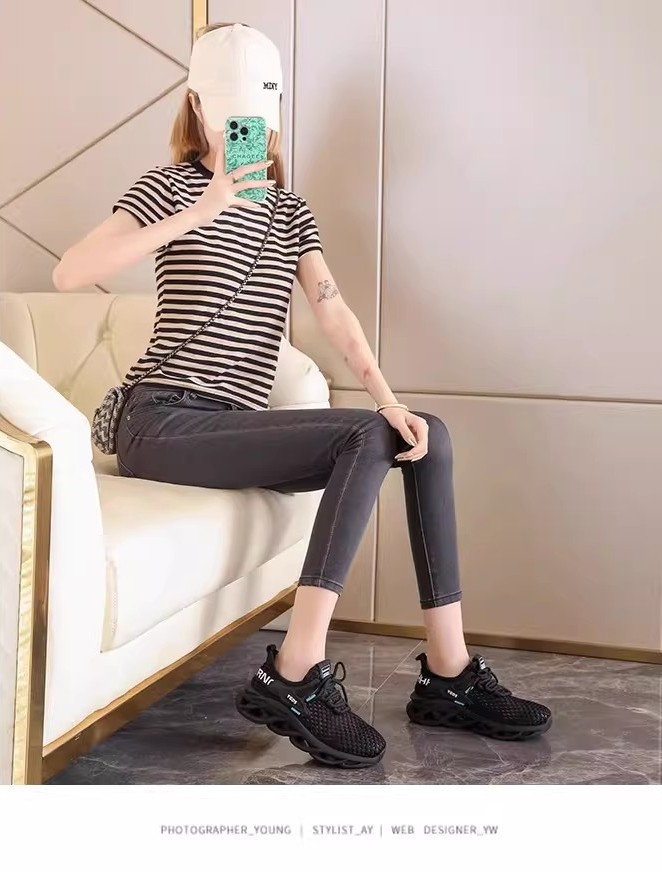
Sixty wears is about four months if you rotate one pair four times a week. That’s the point where an all-black sneaker either still reads as a black sneaker or has quietly become a grey shoe with black patches. The product photo won’t tell you which one you’re buying. Ten minutes in a shop will, if you know where to press.
I’ve been through six pairs of black sneakers in three years, mostly because I kept buying the wrong finish. Two of them looked great for three weeks. By week eight the toe boxes had the texture of a scuffed school desk. The pair I still wear, a plain leather low-top with a matte upper, is somewhere past its 200th wear and gets more compliments now than it did new.
So this isn’t a list of the best black sneakers. It’s the test I run before I pay, and the reasons each part of it matters.
What sixty wears actually does to a black sneaker
Wear shows up in a fixed order. First the toe box, where your foot flexes on every step. Then the inner heel, where the lining rubs against your sock. Then the outer edge of the sole, at the point where your foot rolls inward or outward. The upper itself is usually the last thing to go.
On a cheap coated upper, the toe crease turns pale grey within two weeks. The colour sits in a thin film on top of the material and the film cracks along the crease. On a dyed-through leather, the crease stays dark and just softens. Same shape, completely different outcome.
You can see this before you buy. Bend the shoe at the ball of the foot with both hands, hard, and look at the crease line. If the surface goes lighter, or you can see a fine web of cracks, that finish will do the same thing on your foot, only slower and in public. If the crease stays uniformly dark, you’re looking at a material that has colour in it rather than on it.
That single test has saved me more money than any review. It also explains something that confused me for years: two pairs at the same price, same brand, wildly different lifespan. The difference wasn’t the price. It was whether the black was dyed or painted on.
There’s a second-order effect too. Once the coating cracks, water gets under it on the first wet day, and the crack spreads. A pair that looked fine in October can be unwearable by February, and it’ll happen on the one morning you’re already late.
The same logic applies to the sole. Look along the edge where the upper meets the rubber. If you can see glue squeeze-out or a gap of a millimetre anywhere, that’s where water will get in first. A clean, tight join isn’t proof of quality, but a messy one tells you the factory wasn’t paying attention, and the coating probably got the same treatment.
Leather grades, without the sales patter
Three words get used loosely in shoe shops: full grain, top grain, corrected grain. The differences matter for how a black pair ages, and none of them are about prestige.
Full-grain leather keeps the outer surface of the hide intact, including its natural markings. It takes dye deeply, creases into soft folds, and darkens slightly where it flexes. It also costs more and needs a little care, because an unsealed surface will drink a glass of water.
Corrected grain has the surface sanded flat and then stamped or coated to look even. It’s more uniform and more water-resistant, and it’s cheaper. It also creases in sharper lines, and on black pairs those lines can go chalky over a year. Not a disaster. Just know what you’re looking at.
Bonded leather is the one to walk away from in a sneaker you plan to wear daily. It’s leather fibre glued together with a binder, and the coating on top does most of the work. When that coating fails, the shoe fails with it. A cheap pair made this way can be a reasonable buy for one season. It’s not the pair you keep for three years.
None of this is visible on a label in most cases. It’s visible at the crease, and at the cut edge of the leather near the collar, where you can see whether the material has a fibrous core or a plastic one. Look there. If it looks like fabric, it isn’t leather.
One more thing worth knowing: “genuine leather” is a legal term with a very low floor. It means some leather is present, not that it’s good leather. The words that tell you more are the ones about the grain, and the shop assistant may have to go and check.
Suede and nubuck are worth a separate word, because black suede behaves like a different animal. It’s soft from the first wear and needs almost no break-in, which is why so many people love it. It also marks with water, holds dust, and can’t be polished back to even colour. If you want the easy first week, take suede. If you want the easy second year, take smooth leather.
Black is at least four different colours
Matte black, satin black, patent black and washed black all photograph the same online and behave nothing alike on a foot. This is where most buying mistakes happen, and it has nothing to do with quality.
- Matte hides scuffs and creases. It also picks up dust and looks flat with formal trousers.
- Satin sits in the middle, with a low sheen that reads expensive in daylight and slightly dull indoors.
- Patent shows every fingerprint, every crease, and every grain of road grit. It looks sharp for a month.
- Washed or vintage black starts grey-ish and fades towards charcoal. Great with denim, wrong with a suit.
If you want one pair to do office, weekend and travel, matte is the safe answer. If you want a pair for evenings, satin does more work than patent and forgives more. Patent is a costume piece. Buy it knowing that.
I learned that one the expensive way, twice.
There’s also the question of what black does under different light. In a shop with warm downlights, a washed black pair looks almost brown, which is flattering and misleading. Take it to the door and look at it under daylight before you decide. The colour you see at the door is the colour you’ll live with.
Here’s a quick way to tell the finishes apart when the label doesn’t say. Tilt the shoe under a light and watch the highlight. Matte gives you a broad, soft band. Satin gives a narrow, bright line. Patent gives a hard, mirror-like spot that moves as you turn it. Your thumbprint will stay on patent for about a minute, which tells you everything about how it’ll look after a commute.
The toe box fails first: a 10-second check
Press your thumb into the top of the toe box, about two centimetres back from the tip. What you’re feeling for is structure. A reinforced toe holds its shape and resists the crease. A soft, unstructured toe will fold on the first long walk and stay folded.
Then look at the seam where the toe cap meets the vamp. On a well-made pair that seam is stitched and sits flat. On a cheap pair it’s often glued with a visible ridge, and the ridge is exactly where the coating splits.
Finally, flex the sole. A sneaker sole should bend at the ball of the foot and stay stiff through the arch. If the whole shoe rolls up like a carpet, there’s no shank and no support, and your arch will pay for it after about two hours on a hard floor. The rubber itself is usually vulcanised or injection-moulded, and on a black pair you want a dense, slightly matte compound rather than a shiny one that shows every scuff.
Two of those three checks take seconds. They’re also the three things that decide whether a black pair looks intentional at 60 wears or tired at 20.
There’s a reason the toe box goes first, and it’s simple mechanics. Every step flexes the shoe at roughly the same line, sixty or seventy times a minute when you’re walking at pace. No material enjoys that. The only question is whether it creases softly or breaks. You’re choosing between those two futures in the shop, whether you know it or not.
Eyelets deserve a glance while you’re there. Metal eyelets that sit flush will outlast pressed ones, which start cutting into the laces after a few months and then rust at the first wash. If the eyelets are plastic and moulded into the upper, expect them to crack around the edges. It’s a small detail that tells you how the rest of the shoe was assembled.
Fit comes down to three measurements
Length gets all the attention and causes maybe half the problems. The other half live in width and instep height, and black sneakers are less forgiving of both than people expect. There’s no pattern or contrast to distract the eye from a bulging vamp.
Measure your foot at the end of the day, standing, with the socks you’ll actually wear. Add 8 to 10mm to the longest toe for a walking shoe. Anything less and your toes will hit the front on downhills. Anything more and the shoe creases in the wrong place, which on black leather is very visible.
For width, trace your foot on paper and measure across the widest part. Most women’s sneakers are built on a standard width last. If you measure wider than about 95mm across the ball of the foot, look for a wide fit, or size up half and use an insole to take up the length.
Instep height is the one nobody checks. If the top of your foot is high, a low-cut sneaker will press across the laces and you’ll feel it within twenty minutes. A soft leather sports pair with a roomier vamp solves this better than any amount of sizing up. If your instep is low, the opposite applies and a padded tongue does the work.
Heel width is the fourth thing, and it’s why some people can never wear slip-on styles. If your heel slides side to side in a laced shoe with the laces done up properly, the last is too wide at the back for you. Try a different brand before you try a different size.
Try both shoes, not just the right one. Most people have one foot about 3 to 5mm longer than the other, and if the difference is bigger than that you’ve probably been buying one shoe too small for years. Fit the larger foot and use an insole in the smaller one. It sounds fussy. It’s the difference between a pair you wear daily and a pair you keep meaning to return.
Nine hours on your feet, honestly
I tested my current pair on a nine-hour shift that included two hours standing on a concrete floor and roughly 11,000 steps. By hour six the ball of my foot was warm but not sore. By hour nine I wanted them off, which is normal for any shoe without a custom insole.
The heel was the surprise. All-black pairs often use a stiffer heel counter to hold the shape, and a stiff counter against a thin sock rubs. I had a small hot spot on the left heel after the first long day. It disappeared after a week, once the counter softened, but I wore a blister plaster for three days.
Break-in on leather is real and it isn’t a marketing story. Give a new pair three short wears of two hours before you take them on a full day. Keep the laces looser than feels right for the first week. Leather stretches where it’s warm, and it’ll stretch in the direction your foot pushes, which is usually the right one.
If a pair still rubs after two weeks of that, it’s the wrong shape for your foot. No amount of breaking in fixes a last that doesn’t match your heel width.
What you wear inside matters more than most people admit. A cotton sock adds about 2mm of bulk and changes the fit noticeably. Thin synthetic socks feel cooler and let the shoe move more. Pick one and stay consistent through the break-in, otherwise you’re breaking in the shoe against two different feet.
If the ball of your foot aches after a long day rather than the heel, the insole is usually the culprit. The flat foam pad that comes in most sneakers compresses to nothing within a month. A 3mm gel or cork insole costs very little and adds more comfort than upgrading the shoe itself. Take the original insole out and compare thickness before you buy one, so you don’t end up with a shoe that’s suddenly too tight.
The 20-minute routine that keeps them black
Black sneakers don’t need much, but they do need something, and the something is boring. Once a week: brush off dust with a dry horsehair brush, wipe the upper with a damp cloth, let them dry away from heat. Once a month: a thin layer of black cream polish on leather, buffed after ten minutes.
Skip the silicone sprays on smooth leather. They sit on the surface, attract dust, and make future polishing patchy. They’re useful on suede and mesh, not on a matte leather upper.
For the sole edges, a magic eraser works better than anything sold as a sneaker cleaner, and it costs about a pound. White midsoles are the giveaway on a black pair, so keep them clean and the whole shoe reads newer.
Store them with the shape held. Cedar trees are lovely but a rolled pair of socks in the toe does most of the job for nothing. Never dry leather on a radiator. It’ll shrink, crack and go dull in one afternoon, and there’s no fixing that.
If you get caught in real rain, stuff the shoes with newspaper and leave them at room temperature overnight. Don’t rush it with a hairdryer. The leather will dry from the outside in, and the outside is the part you can see.
Deep scuffs need a different approach. A scuff that’s gone through the colour needs a touch of black cream worked in with a fingertip, left for five minutes, then buffed hard with a cloth. Don’t use a marker pen, however tempting, because it goes purple in sunlight and you’ll only notice a week later. If the scuff is on the sole edge rather than the upper, fine sandpaper followed by a dab of edge dressing gets it back to new.
What I would skip next time, and what I would buy again
I’d skip any black sneaker with a glossy coated upper, however good it looks under shop lighting. I’d skip a fully unstructured toe on anything expensive, because the crease will beat the shape within a month. And I’d skip the temptation to buy a black pair one size up for comfort. Black leather shows a bad fit more than any other colour, since there’s no pattern to hide the fold.
What I’d buy again: matte full-grain or good corrected-grain leather, a stitched toe cap, a sole that bends only at the ball, and a heel counter that I’ve pressed with my thumb in the shop and found firm but not rigid. That combination, in a plain low profile, is the pair that survives a year of real wear without looking tired.
If you want a second, cheaper pair for wet days and errands, a flat-soled canvas-style pair with a thick rubber base does that job without competing with your good pair. Rotate them. The leather pair will last nearly twice as long.
And if you’re weighing black against another neutral, the five-day office week notes on black sneakers cover the workwear side in more detail. If you’re tempted by something lighter instead, the notes on beige sneakers and their stains are the honest counterweight. For the wider range, the women’s shoe collection is the place to compare shapes before you commit.
One last thing. Try them on at 4pm, not 10am. Your feet are bigger by then, and it’s the version of your foot that’ll be inside the shoe at the end of a workday. That’s the foot you’re really buying for.