

The first pair of black closed-toe heels I bought for work lasted four days. By Thursday I was carrying them in a tote and walking home in flats, which is a bad sign in a shoe you bought to look serious.
The problem wasn’t the colour or the heel height. It was the toe box: a narrow pointed shape in stiff leather, half a size too small, chosen in a shop at 11am when my feet were at their smallest. I’d done the thing most people do with black pumps. I assumed black would be forgiving and bought on looks.
Six pairs later, I know what I actually need from a black closed-toe pair. Here’s the version of that list I wish someone had handed me before the first order.
The pair that finally survived a full week
It was a 75mm almond-toe pump in soft leather, bought in the evening after a day of walking, tried on with the socks I’d been wearing since 8am. That last detail mattered more than anything else in the purchase.
Feet swell through the day. Mine go up roughly half a size between morning and 6pm, which is normal and well documented. If you try shoes at 10am, you’re fitting the smallest version of your foot and buying for a shape that won’t exist by the afternoon.
The result of that one change was a pair I wore Monday to Friday for three months without a blister. Same price band as the pair that failed. Same colour. Different size, different last, different time of day.
That’s the whole lesson in one line: with closed black heels, the fit window is narrow, and the time of day you shop decides whether you land inside it.
Closed toe changes the fit more than the look
An open-toe heel forgives length. Your toes can sit at the edge because there’s no edge. A closed toe removes that slack: your longest toe now has a wall in front of it, and on a 75mm heel your foot slides forward into that wall with every step.
Three numbers decide whether it works.
- 10mm of space between your longest toe and the inside front. Not 5mm. A thumb’s width, measured standing.
- Toe box height of at least 20mm above your toes. Press down on the top of the shoe while wearing it. If you can feel your toes through the leather, it’s too shallow.
- Width at the ball matching your foot, not the size chart’s idea of it.
Pointed toes look sharper and are less forgiving. In a pointed pump, the usable width narrows over the last 40mm of the shoe, so a standard-width foot gets squeezed exactly where the big toe joint sits. That pressure point is what turns a good pair into a 4pm problem. The clinical description of bunions is blunt about the cause: narrow toe boxes and high heels, over years. One wedding won’t do it. Five days a week will.
Almond toes give up a little sharpness and buy back roughly 6mm of width. Round toes give up more and feel roomier than they look. For a work shoe, almond is the compromise most people can live with.
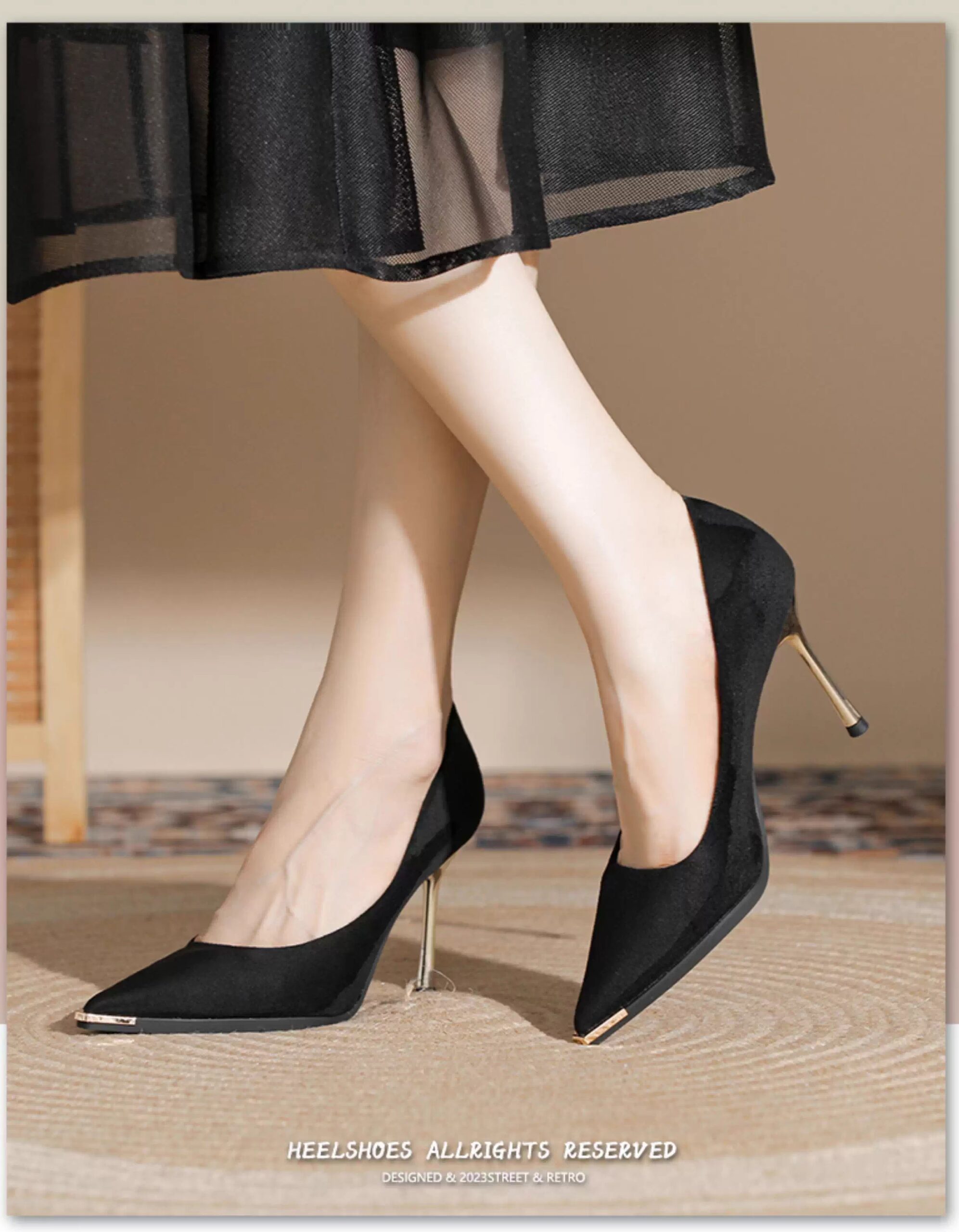
The 5pm problem nobody warns you about
Black leather shows less than beige, but it hides nothing about fit. A closed pump that felt fine at 9am will feel like a different shoe by late afternoon, and the difference isn’t in your head.
By 5pm my feet were about 4mm wider and noticeably longer than at breakfast. In a laced shoe that’s nothing. In a closed pump with a stiff toe, it’s the difference between comfortable and counting the minutes until you can leave.
What helped, in order of how much:
Buying in the evening. Trying on with thin socks, not bare feet, because that’s closer to how a foot sits after eight hours of standing. Choosing leather over patent, since leather gives about 2mm across the vamp over a month and patent gives none. And choosing a slightly deeper vamp so the top edge sat on the instep rather than cutting across the toes.
What didn’t help: insoles. Every gel insert I tried lifted my heel out of the cup and made the shoe slip, which traded a pressure problem for a grip problem. If a pair needs an insole to be wearable, it’s the wrong pair.
Stiletto, block, or kitten: what each one costs you
Heel shape changes the day more than heel height does, and this is where most buying decisions go wrong. A 90mm stiletto and a 90mm block are the same height on paper and completely different shoes by hour three.
Stiletto, 80 to 100mm. Reads formal and works with tailoring. The narrow base means your ankle does the balancing, so standing still is harder than walking. Fine for a meeting-heavy day with a car. Bad for a commute with two train changes.
Block, 60 to 80mm. The most stable option and the one I reach for on days with stairs. It reads slightly less formal with a suit, which matters in conservative offices and doesn’t matter anywhere else. Weight is the trade: a block heel usually adds 60 to 100g per shoe.
Kitten, 40 to 50mm. The kindest height and the one people underrate. At 45mm the pitch is shallow enough that your toes barely slide forward, so a closed toe stops being a problem. It reads a bit dated in a pointed shape and quite current in an almond or square toe.
My rule after six pairs: 75mm almond in leather for the default work shoe, 50mm kitten for long travel days, and one 90mm stiletto pair for the two or three evenings a year that need it. Buying the stiletto first was the expensive mistake.
Three returns, and what each one taught me
The first return was the four-day pair. Narrow point, stiff leather, half a size small. Lesson: try on at the end of the day, and never assume a brand’s sizing carries across shapes.
Return number two was a 90mm stiletto that fit perfectly standing and crippled me sitting. The heel height pushed my weight onto the ball of my foot, and after 40 minutes at a desk my toes went numb. Sitting in high heels is worse than walking in them, because you can’t shift the load. Lesson: if your job is desk-based, a lower heel does more for comfort than any cushioning.
Fewer than half of the pairs I’ve bought online survived the first week, and both failures came from the same assumption: that size is a number. It isn’t. A 38 in one last is a 37 in another, and a pointed 38 is narrower than an almond 38 from the same brand. The third return happened too late, after four wears, when the leather had already creased across the toe and I’d talked myself into believing they’d give.
That’s roughly 240 spent on learning. The pair I kept cost 87.
Tights, socks, and the quarter inch that ruins the fit
What you wear inside a closed pump changes its fit by about 3mm, which is more than most people realise and enough to turn a good pair into a tight one. Denier is the number that matters.
Bare feet are the baseline. A 15 denier sheer tight adds almost nothing, maybe 0.5mm. A 40 denier opaque adds around 1.5mm. A thin cotton sock adds 2mm to 3mm. A wool sock adds more, and a closed heel over a wool sock is a different shoe entirely.
So test the pair with whatever you’ll actually wear. If your winter week is 60 denier opaques, try the shoes on with a pair. If you’re buying for summer, bare feet. Buying in July for a January shoe and fitting it barefoot is how people end up with a pair that only works three months a year.
Tights also change the grip. A closed leather heel over a sheer tight is noticeably more slippery than the same shoe on bare skin, which matters on polished office floors and on the metal edge of a train platform. Suede-lined counters solve this. Smooth synthetic linings don’t.
One practical trick: keep a pair of 15 denier tights in your desk drawer. On the days when a closed pump starts rubbing at the heel, a thin tight layer is often enough to stop it, and it’s cheaper than a trip to the cobbler.
Buying online when you can’t try them at 6pm
Most black pumps get bought online now, which removes the one advantage a shop has: trying them on with swollen feet at the end of the day. You can rebuild most of that advantage with a plan.
Order two sizes. Not three. Two sizes in the same shoe tells you which direction the last runs, and it costs you one return instead of two. If you’re between sizes in a closed toe, take the larger one and add a heel grip. Toes don’t shrink.
Try them at 7pm, on carpet first, then on hard floor for ten minutes. Keep the box and the tissue until you’ve done both. Most return policies require the shoe to be unworn outdoors, and a ten-minute indoor test doesn’t break that. A twenty-minute walk to the shop does.
Read the reviews for numbers, not adjectives. “True to size” is useless without the reviewer’s normal size. “Runs narrow, I’m usually a 38 and took a 39” is the sentence you’re looking for. Skip the reviews that only mention how the shoe looked at a wedding, since nobody writes a review after hour six.
Check the returns window and who pays postage before you order, not after. A 14-day window with a paid return label is workable. A 14-day window where you cover 12 of postage means one bad guess costs you a fifth of the shoe price, and it makes you keep pairs you should return.
Finally, look at the product photos for the sole, not the upper. A side-on shot tells you the heel pitch and whether there’s a platform. A top-down shot tells you the toe shape. If the listing has neither, that’s a sign the brand is selling the look rather than the fit.
The uniform trick: one pair, five days
Black closed-toe heels are the closest thing to a uniform shoe, and that’s their real value. Not elegance. Consistency.
My week, when it works: the same 75mm pair with tailored trousers on Monday and Wednesday, a knit dress on Tuesday, dark denim on Thursday, and a skirt on Friday. Nobody notices the repetition because the shoe is quiet. That’s the point of buying black in the first place.
What makes the repetition work is keeping the shoe in good condition. Black leather scuffs at the toe and heel, and a scuffed pair worn five days a week starts to look careless by week three. A five-minute routine on Sunday: wipe, cream, buff. The court shoe has been the default office shape for a century for the same reason. It disappears into the outfit.
Two small things that extend the life. Rotate with a second pair if you can, because leather needs 24 hours to dry out between wears and a damp shoe creases faster. And replace the heel tip before it wears to the nail. A 10 repair prevents a 40 reheel and stops the shoe clicking on tile, which is the sound that gives cheap heels away.
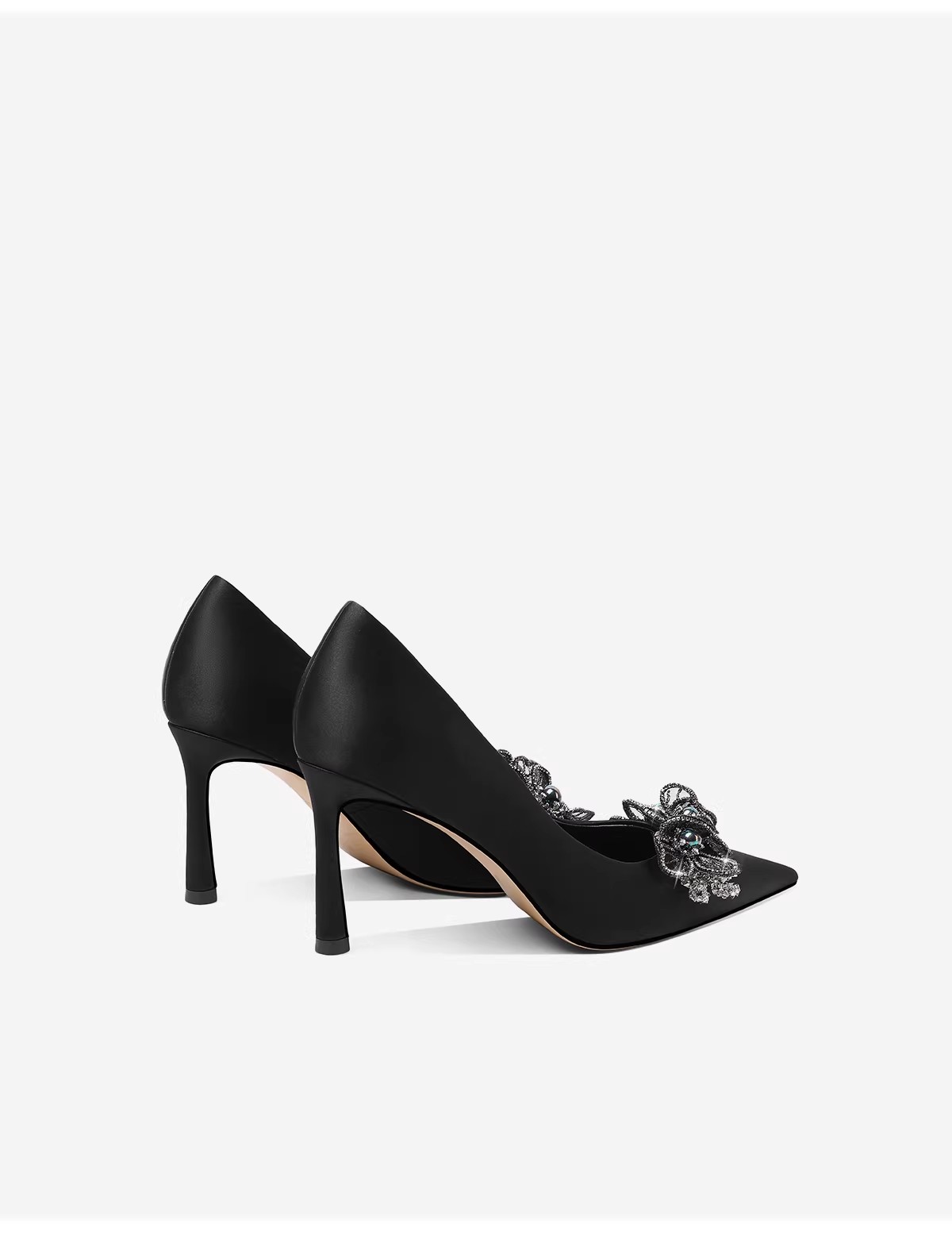
The 40 repair that doubles the life of a black pump
Black closed-toe heels die at the bottom, not the top. The upper stays presentable for years while the heel tip wears to the nail in eight or nine months of daily wear. That’s the point where most people replace the shoe and most of them don’t need to.
A new heel tip costs about 10 to 20 at a repair shop, or 5 if you buy the tips and do it yourself with a hammer and a block of wood. A full reheel, when the tip has been ignored and the heel block itself has worn unevenly, runs 30 to 50. The difference between those two numbers is a monthly glance at the back of the shoe.
Check for wear every six weeks. Set the shoe on a flat surface and look from the side: a worn tip makes the heel sit at a slight angle, and once the heel is angled your weight shifts onto the outer edge, which then starts to lean. That leaning is what makes a pair look cheap, and it’s structural, not cosmetic.
Two other repairs worth knowing. A stretched-out counter can be tightened with a small pad sewn inside, which brings a floppy pair back to wearable for around 15. And a scuffed toe can be recoloured with black cream polish in about four minutes, which is faster than ordering a replacement and works on smooth leather as long as the scuff hasn’t cut through the finish.
What can’t be fixed: a collapsed insole, a cracked sole at the flex point, and a toe box that was always too narrow. Those are buying mistakes, not repair jobs. If you’re comparing a worn pair against a new one, the notes on the half size that size charts miss explain why the second problem is so common.
What I’d buy now, and what I’d skip
If I were starting over with 200 and one pair to buy, I’d get a 70 to 75mm almond or soft-point pump in smooth leather, in the size that fits at 7pm, with a rubber-tipped sole and a replaceable heel. I’d try three pairs in one session and buy the one that let me stand for five minutes without shifting my weight.
I’d skip patent in a pointed shape. It looks the most formal in the box and the least comfortable by lunchtime, and it doesn’t give at all. I’d skip anything described as “non-tiring” without a platform to back it up, since the phrase is marketing rather than a measurement. And I’d skip buying two pairs at once, which is how people end up with two pairs that both pinch.
For the office-day side of this, including how sole construction affects a nine-hour shift, the nine-hour office shoe notes cover the parts that don’t show up in photos. If your week involves more standing than sitting, a shallower commuting pump with a soft counter is the version I’d try first.
And if you’re set on the sharpest silhouette, the pointed black pair at 79 is a fair way to test whether a pointed toe suits your foot at all, before spending three figures on the same shape in better leather. Try it at 6pm. If it pinches then, it will pinch at 6pm every day you own it.
One last check before you buy: walk 20 steps, then stand still for two minutes. Standing is the test that catches a bad pair. Walking distributes weight, standing concentrates it, and a closed black heel that fails the standing test will spend its life under your desk. See the rest of the closed and open heel styles with that two-minute test in mind.
